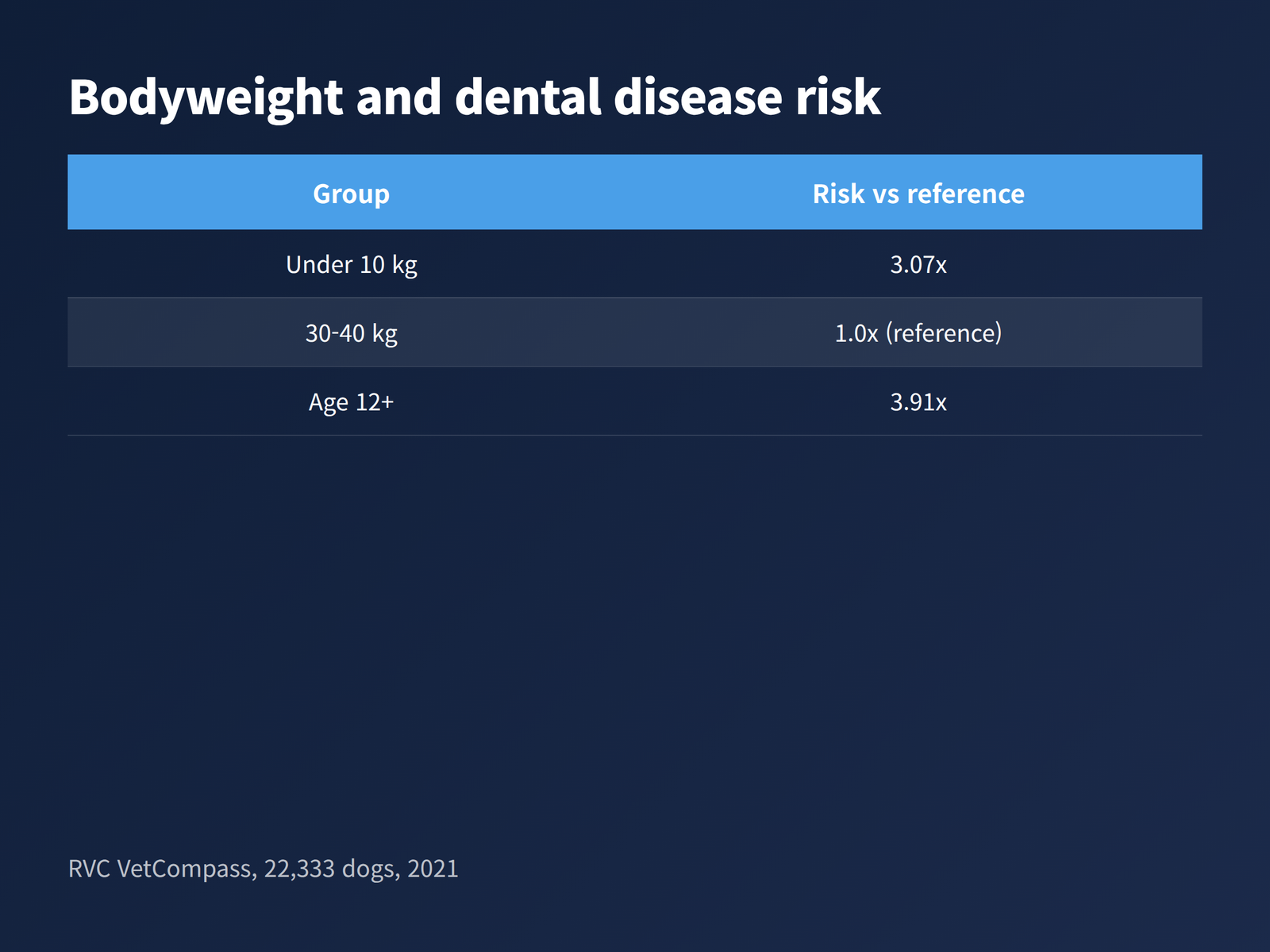
A VOHC seal proves one thing: the product met the Veterinary Oral Health Council’s pre-set standard for reducing plaque or calculus in two controlled trials. It does not prove the chew suits a 4 kg dog in size, hardness or calories. That gap matters, because dogs under 10 kg carry roughly three times the periodontal risk of dogs weighing 30-40 kg. Consult your veterinarian before changing a small dog’s dental routine.

Why do small dogs get periodontal disease more often than large dogs?
Small dogs face more periodontal disease because 42 adult teeth have to fit into a much smaller jaw. Royal Veterinary College VetCompass researchers studied 22,333 dogs in UK primary care and found that one in every eight dogs, 12.5%, has dental disease in any given year. Dogs under 10 kg carried 3.07 times the risk of dogs weighing 30-40 kg, and dogs aged 12 and over carried 3.91 times the risk of dogs aged 2-4 years.
Crowding is the mechanical part. Dr Jan Bellows, quoted by the American Kennel Club in an article updated 2024-04-03, describes small-dog mouths this way: “Their mouths are crowded, and teeth grow close together and at odd angles.” A long-backed, small-framed dog such as a longhaired dachshund sits inside that under-10 kg band, so the RVC figure applies by bodyweight rather than by breed name.
What does the VOHC Seal of Acceptance actually prove?
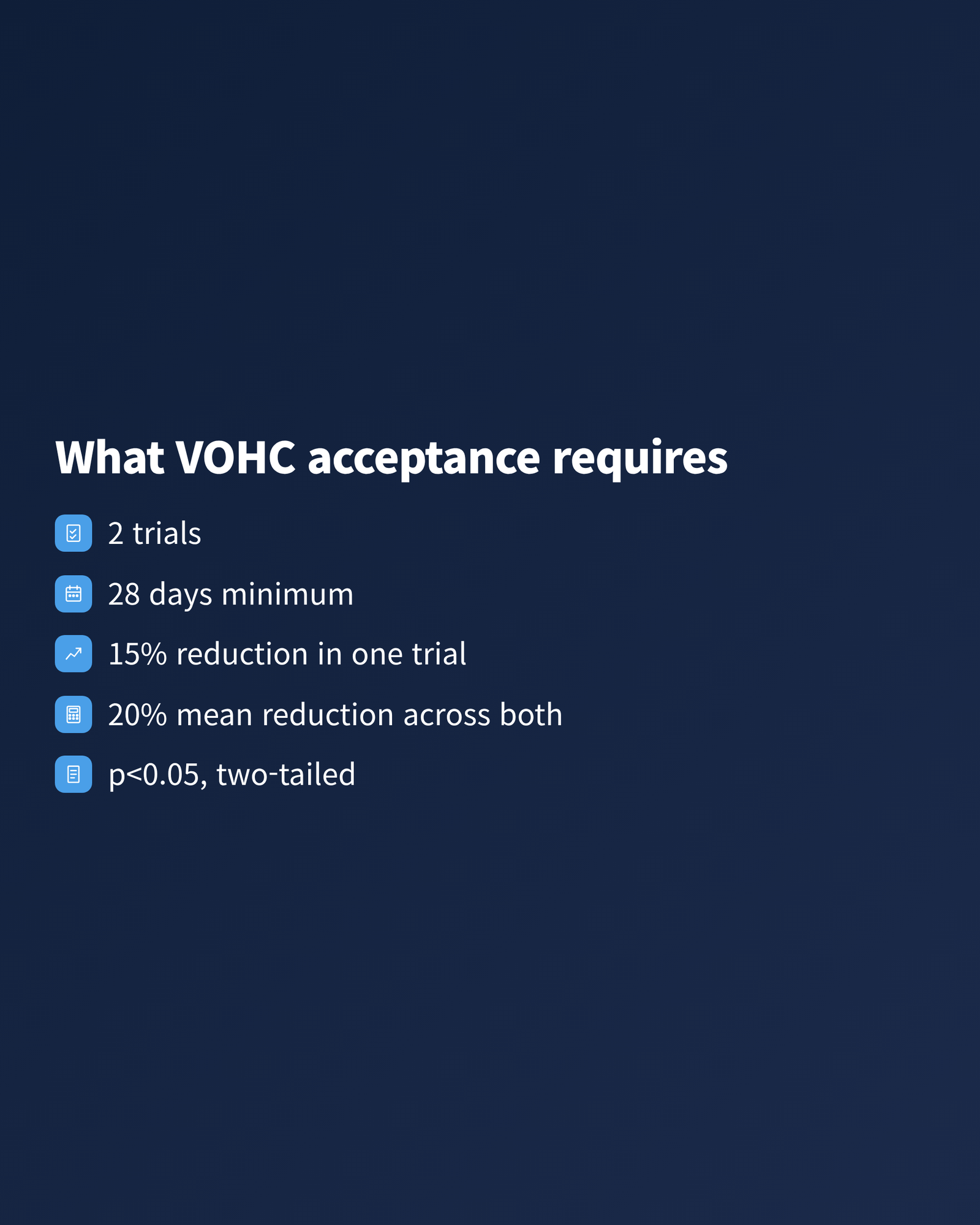
The VOHC Seal of Acceptance proves that a product met a fixed measurement threshold in two controlled trials, and nothing more. The Veterinary Oral Health Council protocol requires two trials of at least 28 days each, a statistically significant difference at p<0.05 on a two-tailed test in each trial, at least 15% reduction in the test group in either trial, and a 20% mean reduction across both, in plaque or calculus. The 2019 AAHA Dental Care Guidelines summarise that bar in one line: “Only those that have been accepted by the VOHC have met preset standards of doing so.”
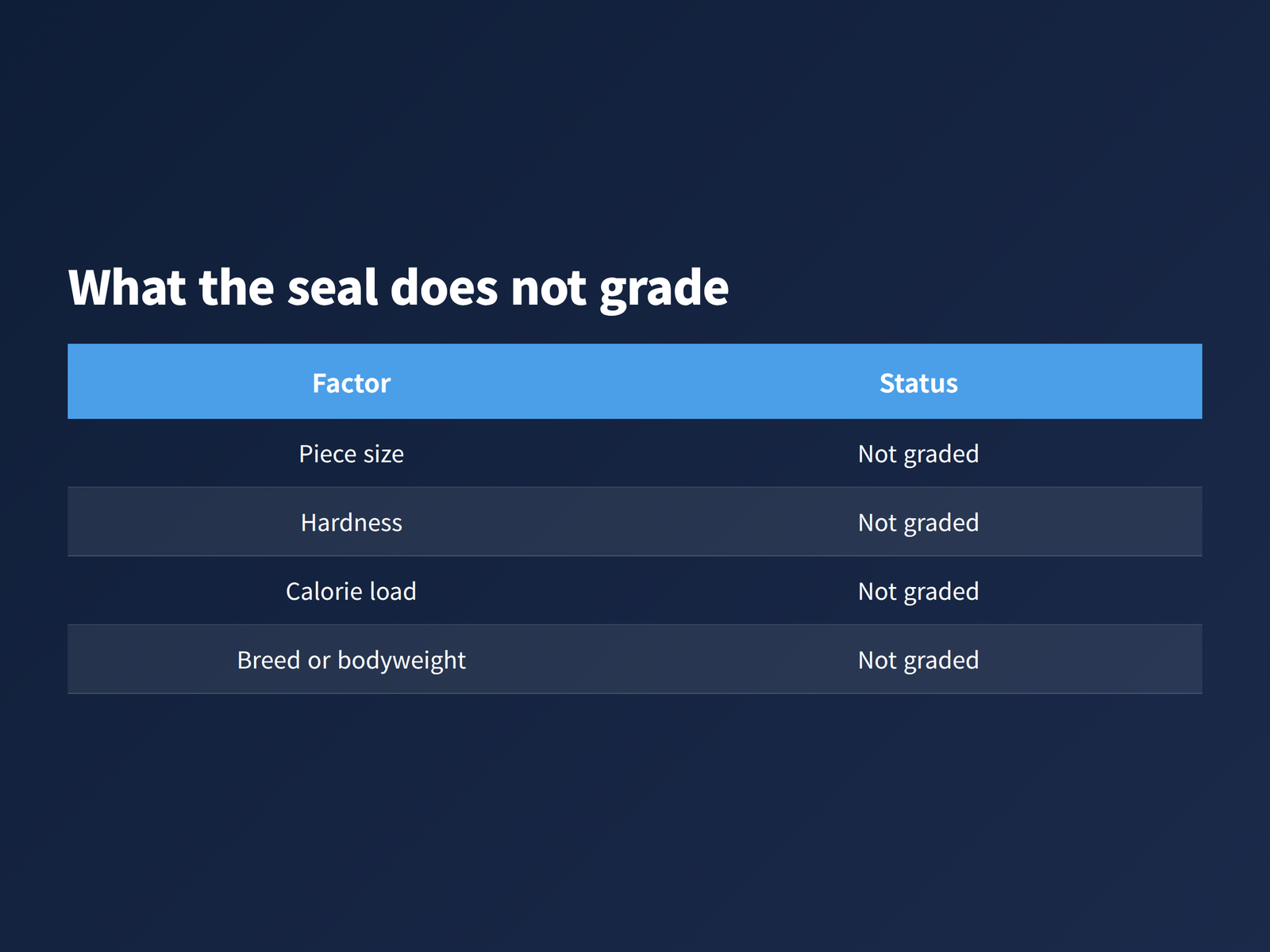
Acceptance is granted to a product, not to a dog size. The Veterinary Oral Health Council runs no small-dog tier, and its accepted-products table carries no size column, because it is organised by product category alone. Whether a piece suits a 4 kg dog stays with the owner and the veterinarian.
Two further limits sit inside the protocol itself. The Veterinary Oral Health Council states that “There is no VOHC minimum required number of animals in each group – this is up to the sponsor to determine”, so two significant trials can both be small. A 20% mean reduction is a floor, not elimination.
How many dog dental products actually carry the VOHC seal?
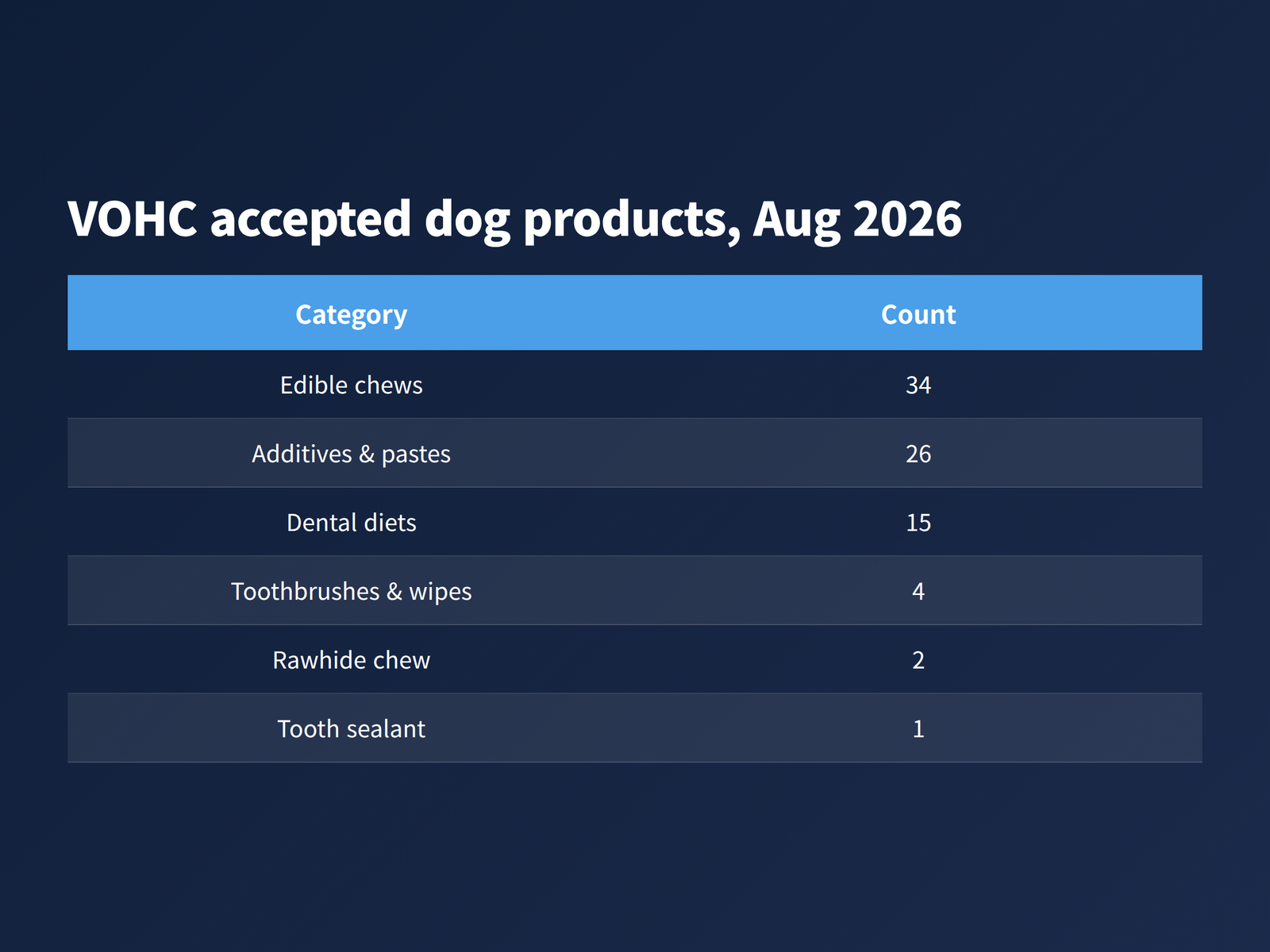
The August 2026 VOHC accepted-products table for dogs lists 82 products. Edible chew treats account for 34. Water additives, gels, sprays and toothpastes account for 26, dental diets for 15, toothbrushes and wipes for 4, with two rawhide chews and one professional tooth sealant.
That distribution rewards a second look. Brushing, the method the American Veterinary Medical Association ranks highest, is the least represented category on the list at 4 products, while edible chews carry 34. Acceptance counts show which manufacturers funded trials, not which method removes the most plaque.
Why don’t dental chews replace brushing for a small dog?
Dental chews do not replace brushing because no veterinary body positions them as a substitute. The American Veterinary Medical Association states that “Regularly brushing your pet’s teeth is the single most effective thing you can do to keep their teeth healthy between dental cleanings.” The 2019 AAHA Dental Care Guidelines are blunter: “Brushing needs to be done daily to be of benefit.” AAHA adds that brushing removes plaque only, not calculus, and should not be done on inflamed gingiva.
Blue Cross sets out a six-step introduction that runs over roughly a couple of weeks: stroke the closed mouth, let the dog lick dog toothpaste off a finger, run the finger along the gum line, let the dog lick the brush, brush the front teeth in small circles, then reach the back teeth.
One substitution is never available. Blue Cross warns: “Do not use human toothpaste, as it contains chemicals that can be toxic to dogs.” The US Food and Drug Administration, on a page updated 2025-02-14, lists toothpastes and mouthwashes among xylitol-containing products and states that poisoning “can start within 20 minutes”.
Which chews are too hard for a small dog’s teeth?
A chew is too hard if it will not flex or wear down under the dog’s own bite. The 2019 AAHA Dental Care Guidelines state that “The Guidelines Task Force believes that there is not a strong rationale for offering hard treats (antlers, synthetic, or natural bones) that could damage the structural integrity of the tooth.” The World Small Animal Veterinary Association takes the same line on antlers, hooves and sharp-edged items.
The cost of getting this wrong is measurable. The 2019 AAHA guidelines report fractured teeth in up to 49.6% of companion animals, and Blue Cross notes that “Hard chews can also risk fracturing your dog’s teeth, or wearing the teeth down.” None of those hard items appears on the Veterinary Oral Health Council dog list. Consult your veterinarian before giving a small dog any hard chew.
How much of a small dog’s daily calories can a dental chew take up?
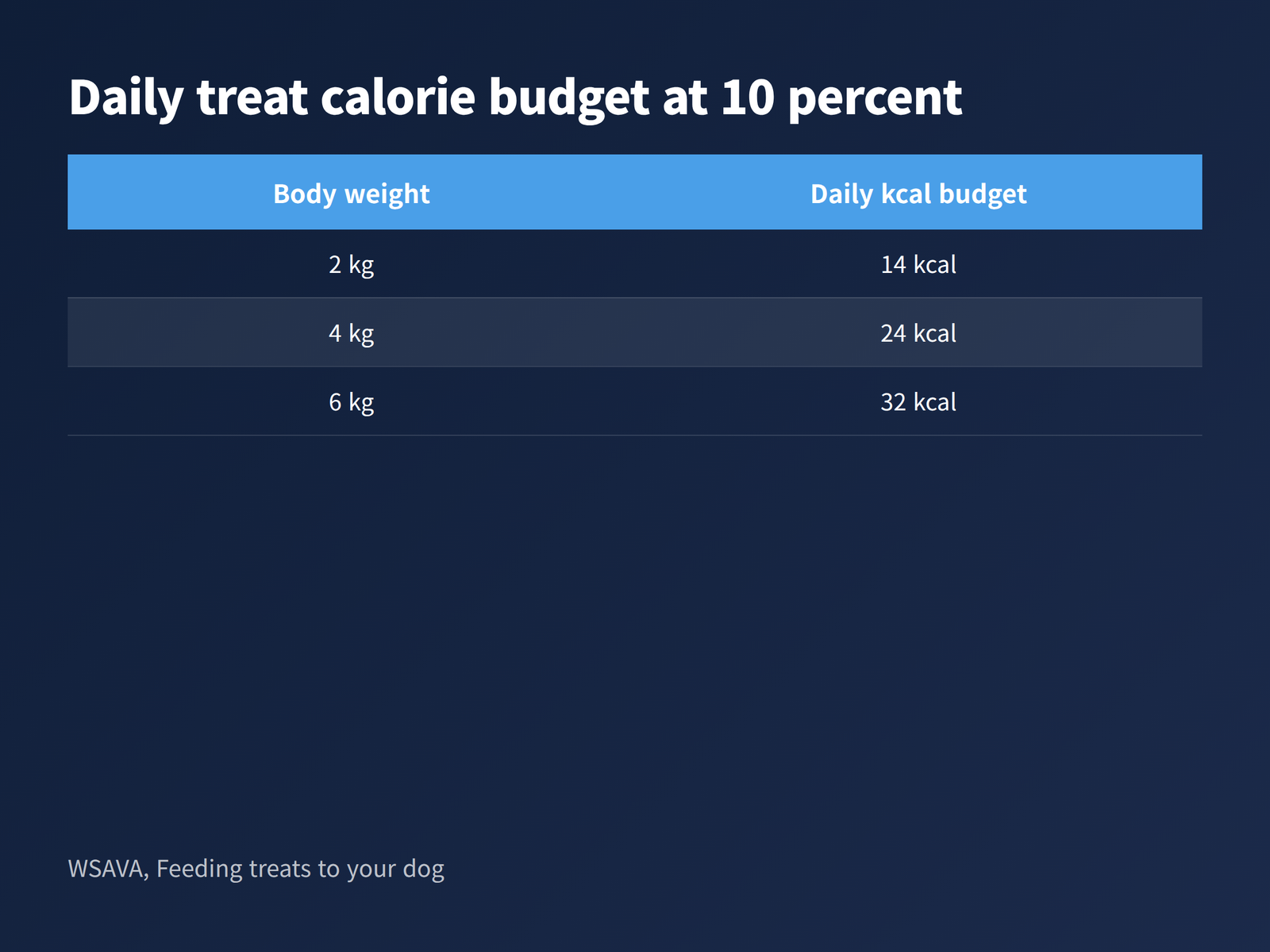
A daily chew for a small dog has to fit inside a treat allowance of roughly 14 to 32 kcal. The World Small Animal Veterinary Association caps treats at no more than 10% of a dog’s daily calorie intake: 14 kcal for a 2 kg dog, 24 kcal for a 4 kg dog and 32 kcal for a 6 kg dog. Blue Cross adds that “many dental chews are high in calories”.
Scale is why this pinches hardest at the bottom of the range. WSAVA gives one rawhide bone of 6.7 oz (190 g) as 700 kcal and warns that such an item “could exceed their maximum recommended daily calorie intake from treats”. For a longhaired dachshund or any dog inside the under-10 kg band, read the kcal-per-piece figure on the packet and subtract it from the daily budget first.
When should a small-breed dog have its first professional dental cleaning?
The 2019 AAHA Dental Care Guidelines place the first professional dental “by 1 yr of age for cats and small- to medium-breed dogs”, and by 2 years of age for larger-breed dogs. Small breeds reach that milestone a full year earlier, which matches the Royal Veterinary College figure of 3.07 times the risk under 10 kg. Timing for one dog is a clinical judgement, so consult your veterinarian rather than a calendar.
The American Veterinary Dental College explains why the anesthesia question sits with a clinic. Its position statement, adopted 10 April 2004 and still cited by the AVMA, reads: “Access to the subgingival area of every tooth is impossible in an unanesthetized canine or feline patient.” The AVDC pairs that limit with a home-care position: daily home care from an early age, periodic veterinary examination, and scaling under anesthesia when indicated.
How do the main home-care options compare for a small dog?
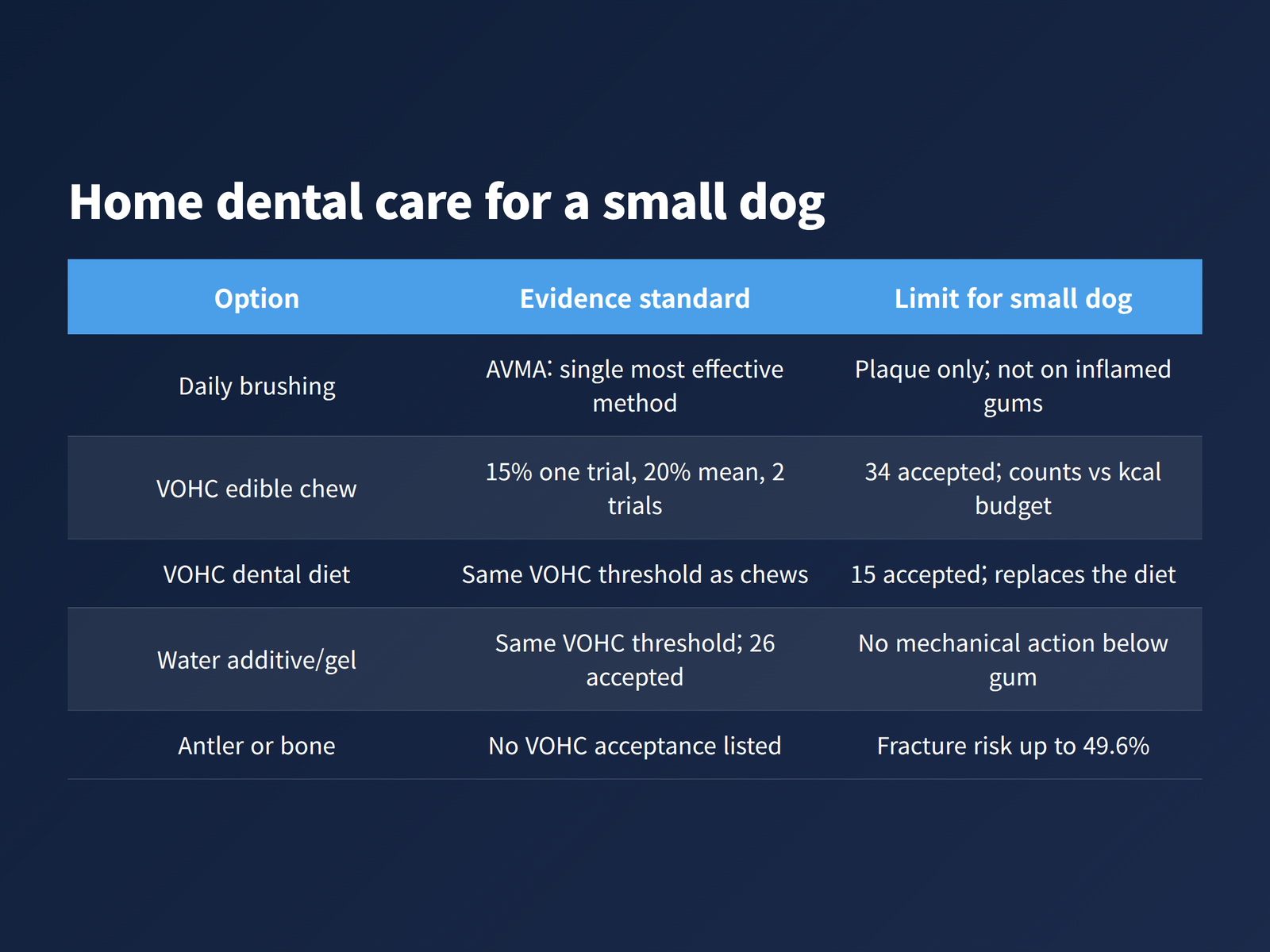
Each home-care option carries a different evidence standard and a different limitation once a dog weighs under 10 kg. The table below sets the five main routes side by side, using the Veterinary Oral Health Council thresholds and the August 2026 acceptance counts as reference points.
| Home-care option | What the evidence standard says | Limitation for a small dog |
|---|---|---|
| Daily brushing | AVMA: “the single most effective thing you can do”; AAHA: “needs to be done daily to be of benefit” | Removes plaque only, not calculus; not for inflamed gums; needs a two-week introduction |
| VOHC-accepted edible chew | 15% reduction in either trial and 20% mean over two 28-day trials, p<0.05 | 34 dog chews accepted, August 2026; calories count against a 14-32 kcal budget in a 2-6 kg dog |
| VOHC-accepted dental diet | Same threshold; 15 dog diets accepted, August 2026 | Replaces the main diet, so it is a whole-feeding decision |
| Water additive, gel or spray | Same threshold; 26 accepted, August 2026 | Does not reach below the gum line; adds nothing mechanical |
| Antler, hoof or natural bone | No VOHC acceptance; AAHA finds “not a strong rationale” | Fracture and wear risk; fractured teeth reported in up to 49.6% of companion animals |
Frequently asked questions
Does a VOHC seal mean a chew is suitable for a small dog?
No. Veterinary Oral Health Council acceptance measures plaque or calculus reduction against a set threshold, and the accepted-products table is organised by product category with no size column. Piece size, hardness and calories remain the owner’s checks.
How long does a VOHC trial run?
Each of the two required trials runs a minimum of 28 days, and crossover legs need a rest period of at least 7 days between them. Each trial must show a statistically significant difference at p<0.05 on a two-tailed test.
Is there a minimum number of dogs in a VOHC trial?
No. The Veterinary Oral Health Council states that “There is no VOHC minimum required number of animals in each group – this is up to the sponsor to determine”. The council assumes a normal distribution at 20 or more dogs per group.
Sources
- Veterinary Oral Health Council, “Trial Protocol Requirements”, retrieved 2026-09-08 — https://vohc.org/trial-protocol-requirements/
- Veterinary Oral Health Council, “VOHC Accepted Products for Dogs” table, edition dated 2026-08-25, retrieved 2026-09-08 — https://vohc.org/accepted-products/
- American Animal Hospital Association, “2019 AAHA Dental Care Guidelines for Dogs and Cats”, 2019 — https://www.aaha.org/wp-content/uploads/globalassets/02-guidelines/dental/aaha_dental_guidelines.pdf
- American Veterinary Medical Association, “Pet Dental Care”, retrieved 2026-09-08 — https://www.avma.org/resources-tools/pet-owners/petcare/pet-dental-care
- American Veterinary Dental College, “Companion Animal Dental Scaling Without Anesthesia”, adopted 2004-04-10 — https://avdc.org/PDF/Dental_Scaling_Without_Anesthesia.pdf
- Royal Veterinary College VetCompass, “New RVC research gets to the root of dental disease in dogs”, reporting O’Neill D.G. et al., Journal of Small Animal Practice, 2021 — https://www.rvc.ac.uk/vetcompass/news/new-rvc-research-gets-to-the-root-of-dental-disease-in-dogs
- World Small Animal Veterinary Association, “Feeding treats to your dog” — https://wsava.org/wp-content/uploads/2025/11/WSAVA_GuidetoTreats_Dogs_251107.pdf
- U.S. Food and Drug Administration, “Paws Off! Xylitol is Toxic to Dogs”, updated 2025-02-14 — https://www.fda.gov/animal-veterinary/animal-health-literacy/paws-xylitol-toxic-dogs
- American Kennel Club, “Do Small Dogs Have More Dental Problems Than Large Dogs?”, updated 2024-04-03 — https://www.akc.org/expert-advice/health/dental-problems-differ-for-large-and-small-dogs/
- Blue Cross, “Dog dental care”, retrieved 2026-09-08 — https://www.bluecross.org.uk/advice/dog/dog-dental-care