Retroreflective material only sends light back toward whatever lit it. On a night walk that light has to come from a driver’s headlights, land on a strip a few inches wide, and return along the same path. The short answer to why a reflective collar is not enough for a small dog at night is placement: a collar is the smallest reflective surface a small dog carries, and it rides at the top of a body that already sits low to the ground. Road-safety measurements show where that gap opens up.

Why is a small dog harder for drivers to see at night than a large dog?
A small dog sits inside the lowest band of a headlight beam and on the ground that modern vehicles hide best. The Insurance Institute for Highway Safety measures how far a vehicle’s usable light reaches at an intensity of at least 5 lux, taken 10 inches above the ground. The American Kennel Club standard for the Papillon puts height at the withers at 8 to 11 inches, with over 11 inches a fault and over 12 inches a disqualification. A dog of that build fills roughly the band the test measures, while a collar rides at its upper edge.
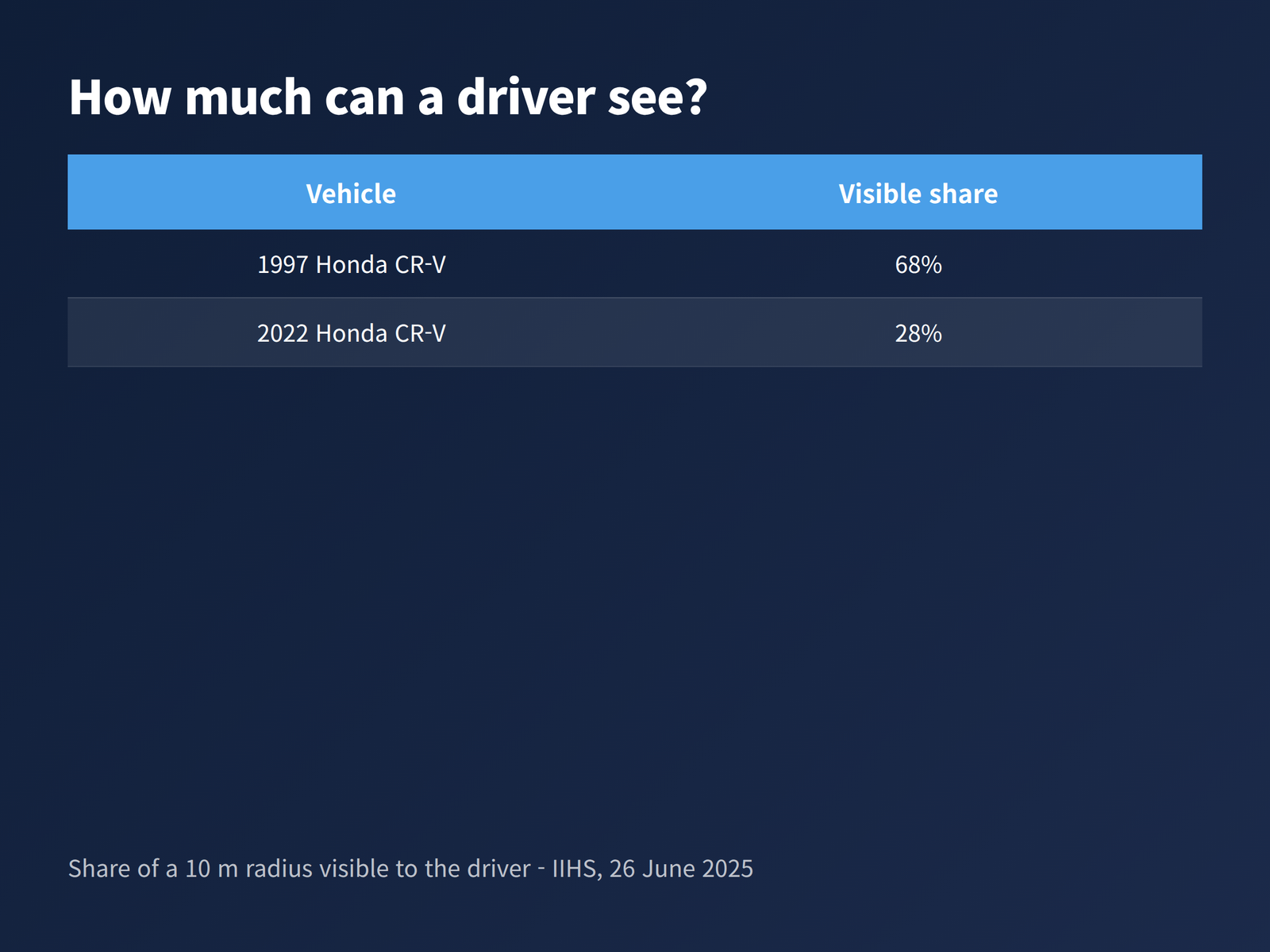
Vehicle shape has moved against small dogs too. Using a blind-zone measurement technique published on 26 June 2025, the Insurance Institute for Highway Safety found the share of a 10 metre radius around the vehicle visible to the driver fell from 68% in the 1997 Honda CR-V to 28% in the 2022 model, and from 56% to 28% between the 2000 and 2023 Chevrolet Suburban. David Harkey, president of the Insurance Institute for Highway Safety, called the across-the-board decrease in visibility for that group of models concerning.
Does a reflective collar work before a driver switches the headlights on?
No. Retroreflective material carries no light source of its own, so it returns nothing until a headlight beam reaches it. The Insurance Institute for Highway Safety describes its own method this way: “Engineers measure how far from the vehicle light extends with an intensity of at least 5 lux at 10 inches above the ground.” The same dependency runs in reverse for a reflective collar, and a dusk walk in late October falls inside the window where drivers have not switched on yet but the light has already gone flat.
Where should reflective gear sit on a small dog?
Low on the dog and spread across the moving outline, rather than concentrated at the neck. Blue Cross advises owners to “consider reflective harnesses, leads and collars to help your dog be seen when it is dark”, naming three carriers instead of one. Because usable headlight reach is measured 10 inches above the ground, material mounted low on the chest and flanks sits inside the band of light a driver actually has.
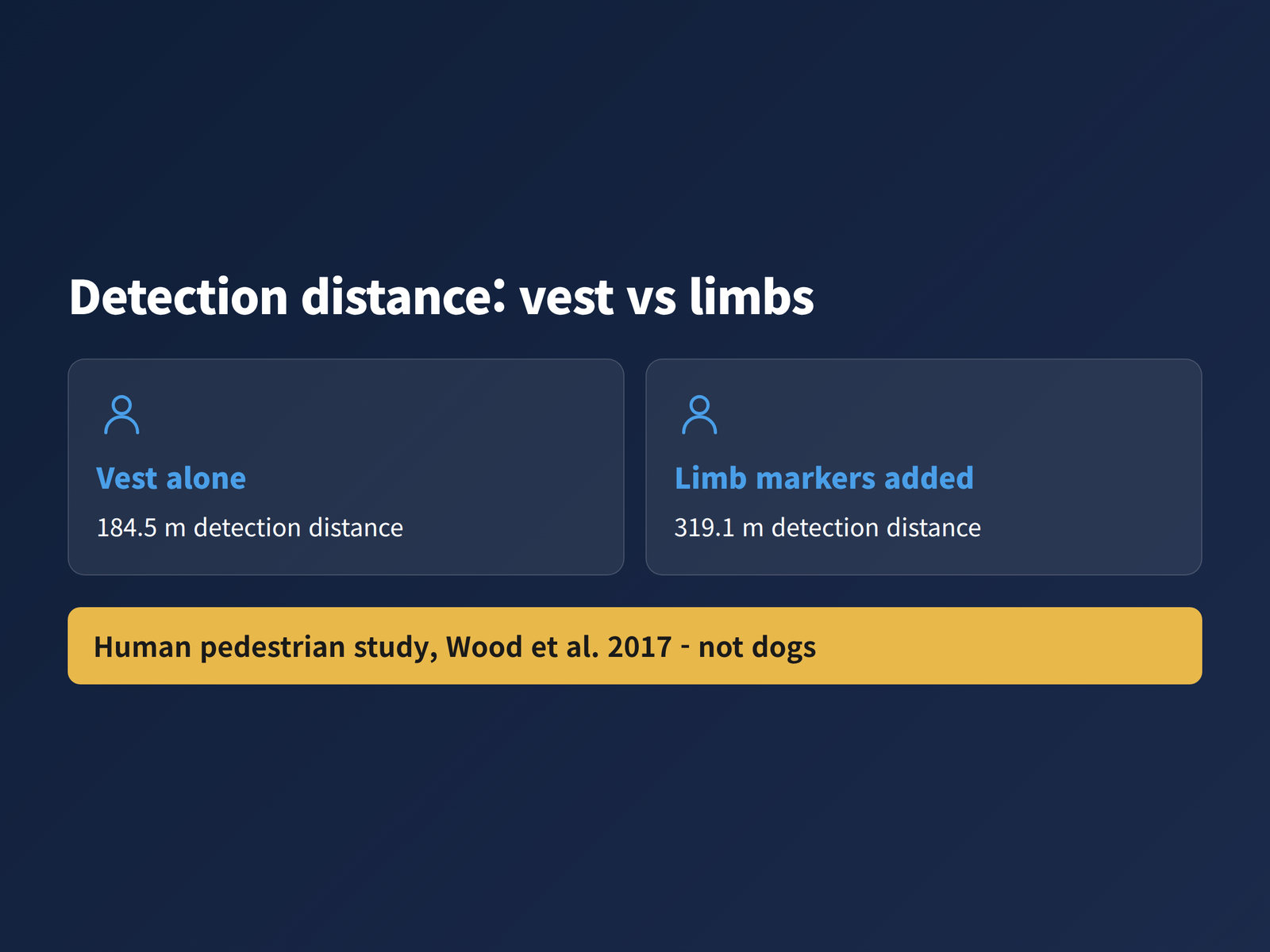
Spreading that material matters more than adding to it. Research on human pedestrians by Wood and colleagues, published in Ophthalmic & Physiological Optics in March 2017, found drivers detected a pedestrian wearing a retroreflective vest alone at 184.5 metres, but at 319.1 metres when markers were arranged on the limbs to show biological motion. Direction of travel was identified at 95.6 metres with the vest against 215.4 metres with limb markers, and first fixation came at 1.1 seconds rather than 3.5 seconds. That study used 14 drivers on a closed circuit and tested human pedestrians, not dogs, so it reads as an analogy for a small dog rather than a measurement of one.
Is a light-up collar better than a reflective one for a small dog?
A light-up collar removes the dependency on headlights, but it does not solve the outline problem. An active light emits its own light, so it still works at dusk before drivers switch on, which is the exact window a retroreflective collar misses. The Insurance Institute for Highway Safety test method, which measures light reaching a fixed point from the vehicle, describes the dependency an active light sidesteps.
Two limits are worth naming before swapping one for the other. Battery state stays invisible to the handler until the light fails mid-walk, and a single point of light gives a driver a dot rather than a shape. On the human-pedestrian evidence above, reading direction of travel is what improved most when material was spread across a moving body. No grade-A comparative test of reflective against active gear on dogs was found for this article.
How do the main visibility options compare on a small dog?
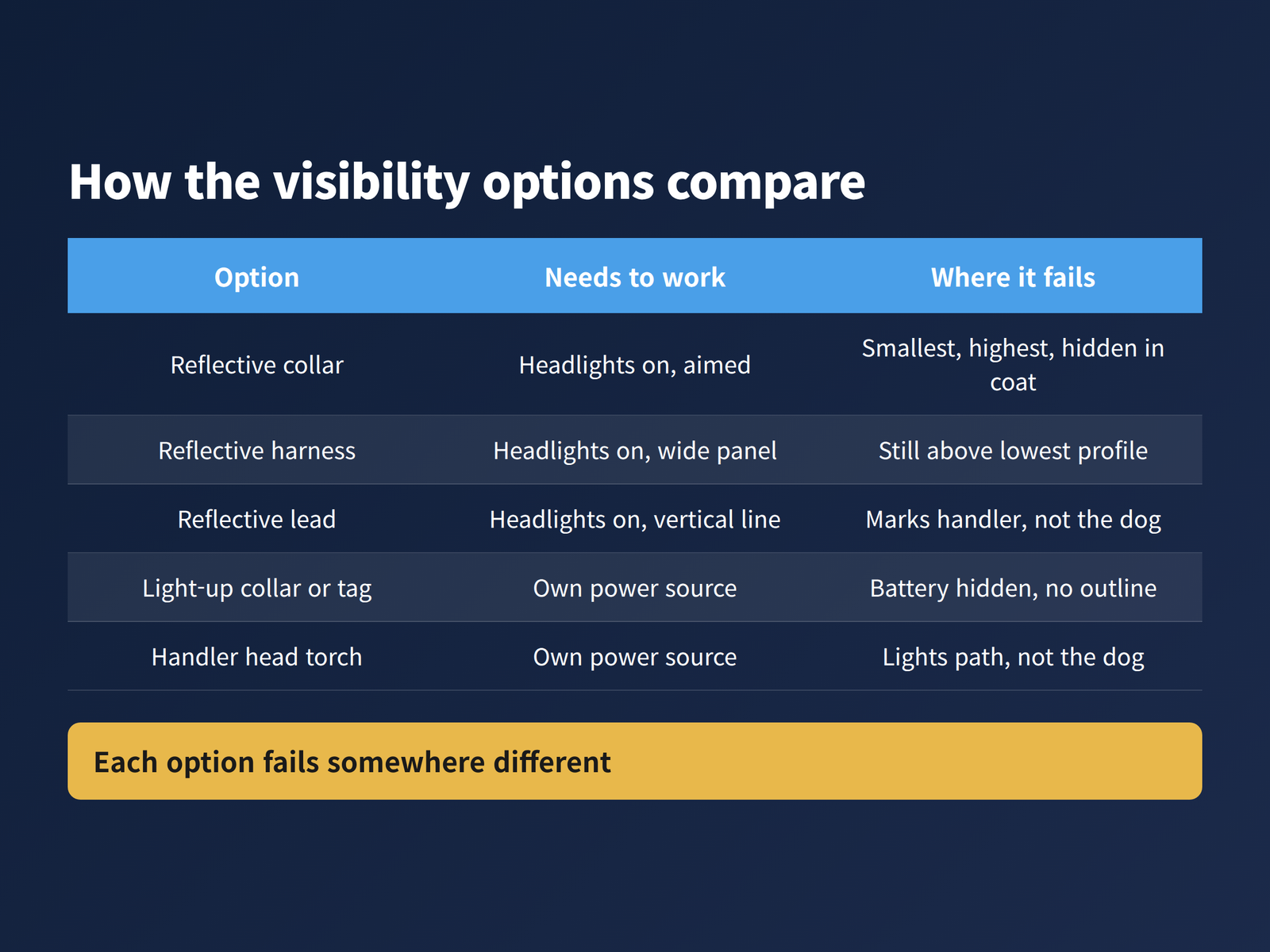
Each option depends on something different, and each one fails in a different place.
| Visibility option | What it needs to work | Where it fails on a small dog |
|---|---|---|
| Reflective collar | Headlights on and aimed | Smallest surface, sits highest, buried in coat |
| Reflective harness | Headlights on, wider chest panel | Still above lowest profile, covered by a coat |
| Reflective lead | Headlights on, vertical line | Marks the handler, not the dog |
| Light-up collar or tag | Own power source only | Battery invisible until it fails, no outline |
| Handler head torch | Own power source only | Lights the path, not the dog |
Does a long coat cancel out a reflective collar?
A long coat can bury a collar strip, and no grade-A study has measured how much. RSPCA advice states that “a reflective collar or coat can help drivers, wildlife or other dog walkers see you when out walking in the dark”, which describes the material being visible rather than hair covering it. Treat coat coverage as something to check by eye.
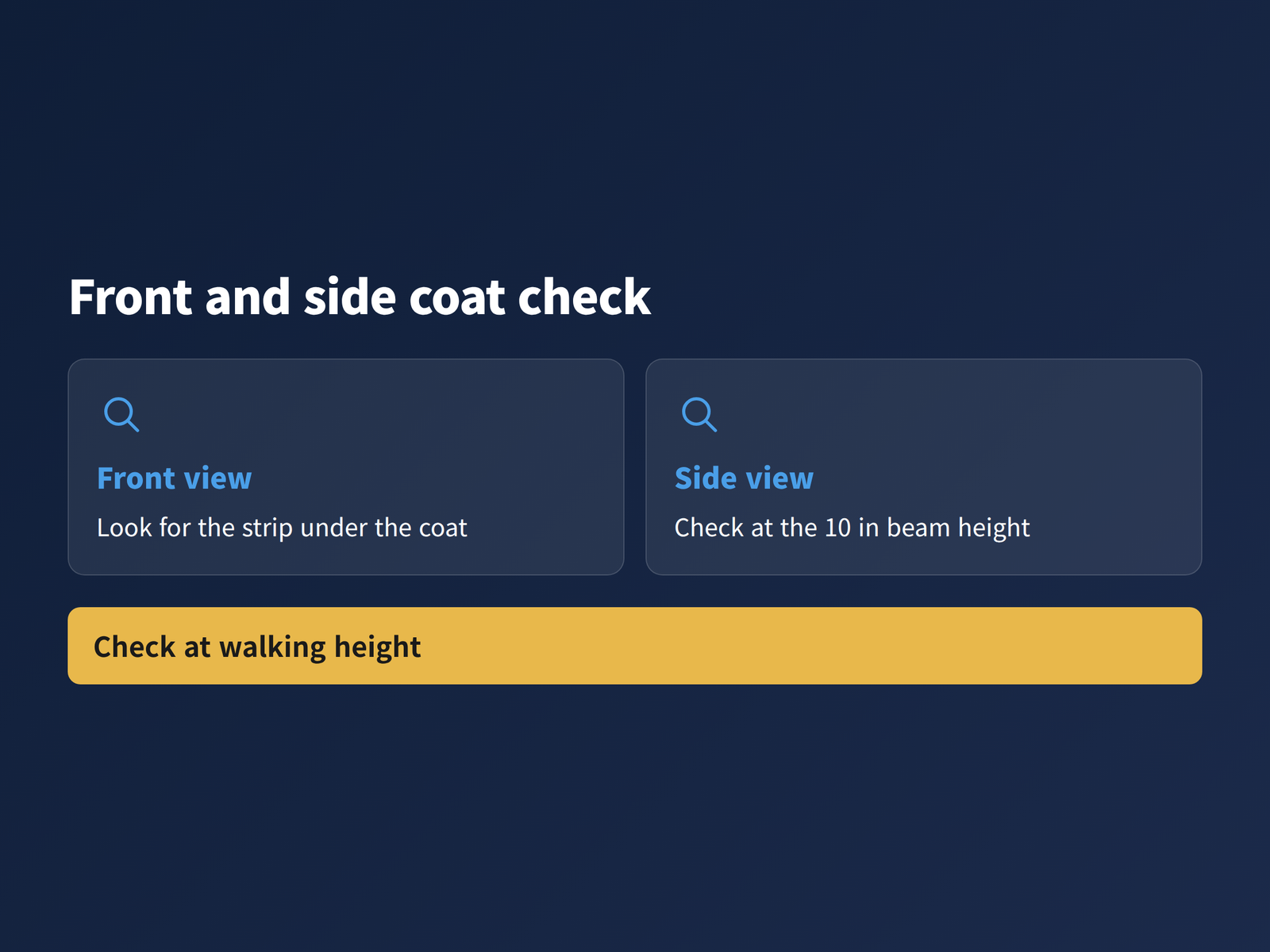
The practical check uses a light source held near the height a driver’s beam works from, which the Insurance Institute for Highway Safety puts at 10 inches above the ground. Look at the dog from the front and the side at that height, with the coat lying as it does on a walk rather than freshly parted. Gear that disappears under a ruff or a skirt of hair is gear that is not doing its job.
When do the clocks go back in 2026, and how much of the walk moves into the dark?
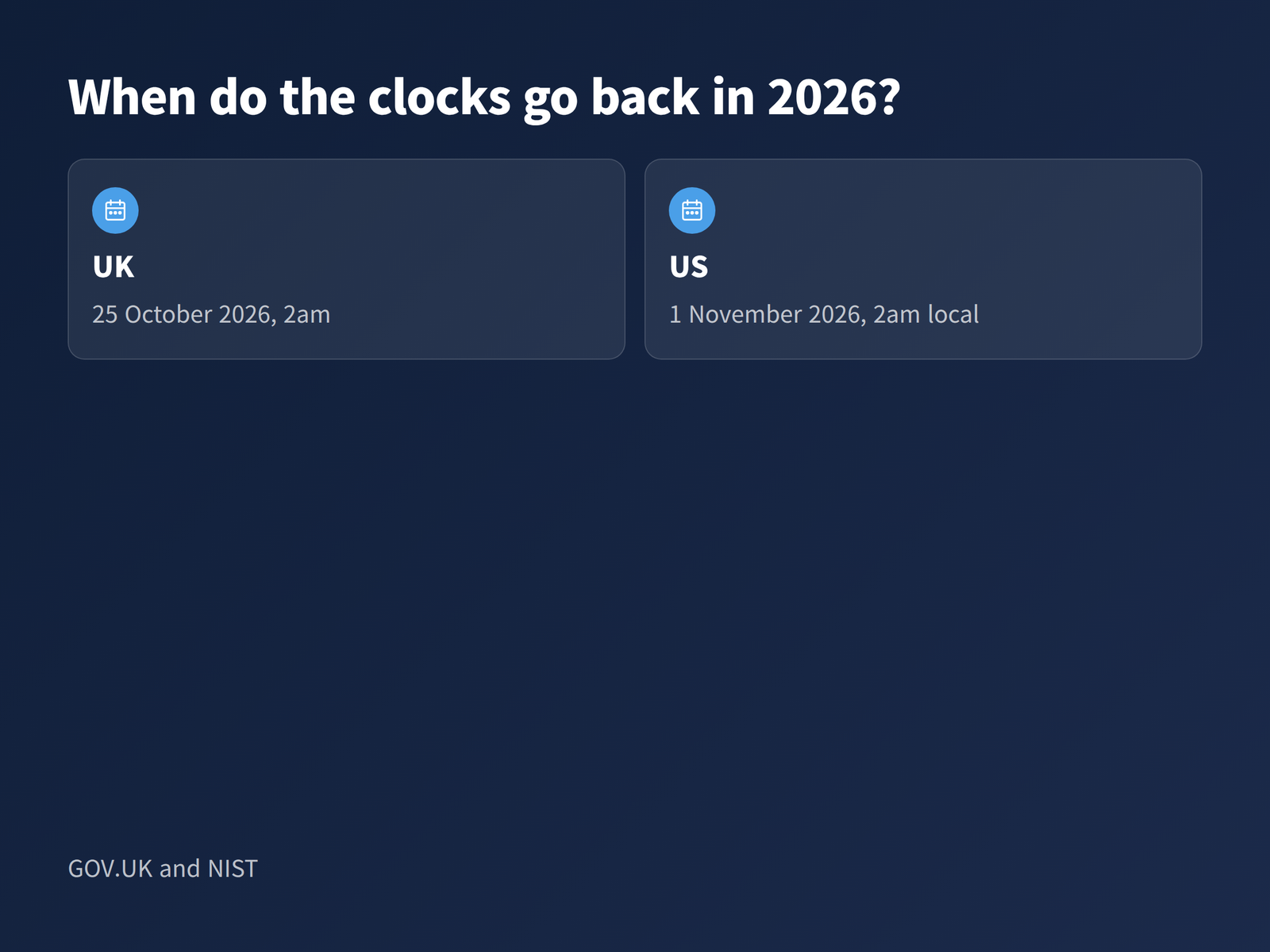
UK clocks go back at 2am on 25 October 2026, and United States daylight saving time ends at 2am local time on 1 November 2026. GOV.UK sets the UK change as the last Sunday in October, and NIST sets the US end date as the first Sunday in November under the Energy Policy Act of 2005.
PDSA advises owners to remember that evenings will now be darker, too, so they may need to start walking their dog a bit earlier. For a household in either market, the same evening slot loses an hour of usable light overnight. Shifting the walk forward costs nothing, and it removes the dusk window where retroreflective gear has no light to work with.
What do animal charities and the Highway Code actually say about dogs and roads?
The Highway Code covers leads but says nothing about dog visibility gear. Rule 56 states: “Do not let a dog out on the road on its own. Keep it on a short lead when walking on the pavement, road or path shared with cyclists or horse riders.” Rule 51 recommends reflective bands on the horse and reflective clothing on the rider in poor conditions. Across rules 47 to 58 there is no equivalent recommendation for dogs, so reflective equipment for a dog is charity advice rather than code.
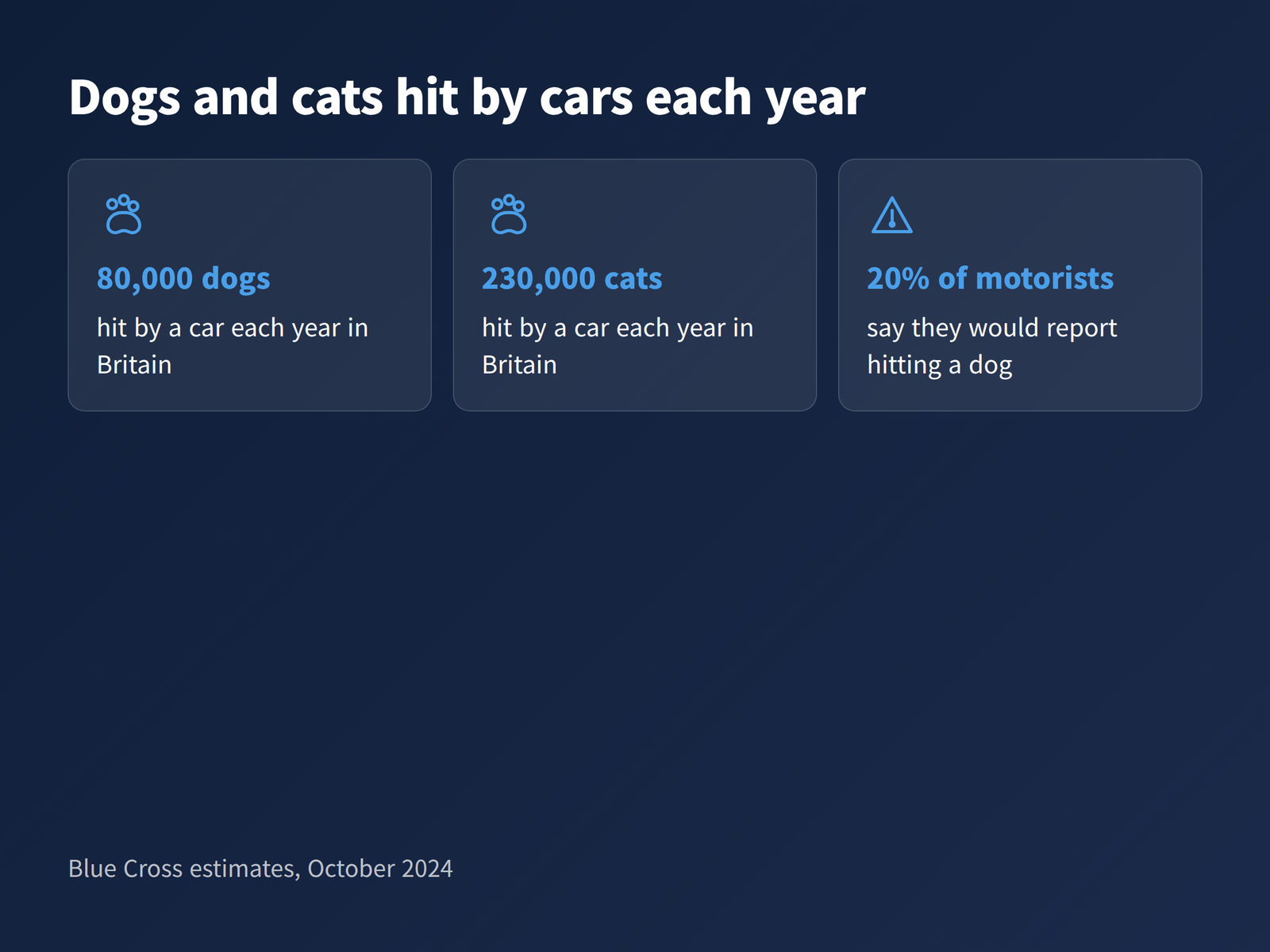
Blue Cross fills part of that gap. Its road-safety guidance tells owners that “when walking by roads keep your dog on the inside of the pavement”, and limits extendable leads to open spaces away from traffic. In campaign material reported in October 2024, Blue Cross estimated that 80,000 dogs and 230,000 cats are hit by a car each year in Britain, and reported that only 20% of motorists said they would report hitting a dog to police, which is legally required.
Frequently asked questions
Does a reflective lead make the dog visible?
A reflective lead marks the handler end of the walk. The dog is at the far end of it, lower to the ground and often inside the handler’s own shadow, so the lead adds a vertical line at human height rather than an outline at dog height.
Is there a legal standard for dog visibility gear in the UK?
No such standard appears in the Highway Code. Rule 56 covers keeping a dog on a short lead, and Rule 51 covers reflective equipment for horses and riders. Nothing between rules 47 and 58 sets a visibility requirement for dogs.
Do better headlights change the outcome?
The Insurance Institute for Highway Safety reported on 14 October 2021 that vehicles with good-rated headlights had 19% lower night-time single-vehicle crash rates than those rated poor. Matthew Brumbelow, senior research engineer at the Insurance Institute for Highway Safety, said the real-world results show that better scores in the headlight tests translate into safer night-time driving on the road.
Sources
- Blue Cross, “Blue Cross Code – Pet Safety on UK Roads”, campaign reported October 2024 – https://www.bluecross.org.uk/blue-cross-code
- RSPCA, “Walking your dog safely and responsibly in the UK”, page current 2026 – https://www.rspca.org.uk/adviceandwelfare/pets/dogs/walking
- GOV.UK, The Highway Code, “Rules about animals (47 to 58)” – https://www.gov.uk/guidance/the-highway-code/rules-about-animals-47-to-58
- GOV.UK, “When do the clocks change” – https://www.gov.uk/when-do-the-clocks-change
- NIST, “Daylight Saving Time Rules” – https://www.nist.gov/pml/time-and-frequency-division/popular-links/daylight-saving-time-dst
- Insurance Institute for Highway Safety, “Headlights – about our tests” – https://www.iihs.org/ratings/about-our-tests/headlights
- Insurance Institute for Highway Safety, “New IIHS measurement technique points to growth in vehicle blind zones”, 26 June 2025 – https://www.iihs.org/news/detail/new-iihs-measurement-technique-points-to-growth-in-vehicle-blind-zones
- Insurance Institute for Highway Safety, “Good IIHS headlight ratings linked to lower crash rates”, 14 October 2021 – https://www.iihs.org/news/detail/good-iihs-headlight-ratings-linked-to-lower-crash-rates
- American Kennel Club, “Official Standard of the Papillon”, approved 10 June 1991 – https://images.akc.org/pdf/breeds/standards/Papillon.pdf
- Wood JM, Tyrrell RA, Lacherez P, Black AA, “Night-time pedestrian conspicuity: effects of clothing on drivers’ eye movements”, Ophthalmic & Physiological Optics, March 2017 – https://pubmed.ncbi.nlm.nih.gov/28211184/
- PDSA, “Getting pets ready for when the clocks change” – https://www.pdsa.org.uk/pet-help-and-advice/looking-after-your-pet/all-pets/pets-and-daylight-savings