A small dog can mat on a daily brushing routine for two reasons that have little to do with effort. The brush may be a finishing brush, which smooths the outer hair without lifting a mat out, and the breed may carry an undercoat the stroke never reaches. Breed standards from the American Kennel Club and The Royal Kennel Club settle the coat question in writing, and a USDA APHIS handout settles where mats start. Both answers are public, and neither one appears in most brushing advice.
Why does a small dog still mat when you brush it every day?
Why a small dog still mats despite daily brushing comes down to the tool and the coat, not the schedule. A finishing brush smooths the surface, and a second coat layer never gets reached. USDA APHIS states the rule plainly in AC-18-001, issued October 2018 and reviewed February 2024: “The frequency of brushing, whether daily or weekly, is going to vary by breed, type, and length of hair.” A daily session with the wrong tool is still a daily session that leaves the mat in place.
Matting is also not a cosmetic problem that can wait for the next appointment. USDA APHIS attributes nine distinct functional harms to matted hair in that same handout, including pain, skin irritation, hidden foreign bodies such as ingrown collars, hidden tumors or injuries, and interference with vision, hearing, chewing, urination, defecation, movement and temperature regulation. Watson and Niestat, writing in Veterinary Radiology & Ultrasound in 2021, describe strangulating hair mats as “soft tissue injury secondary to chronically matted hair, which can encircle the extremities and constrict lymphatic tissue and local vasculature.”
Is a Shih Tzu single-coated or double-coated?
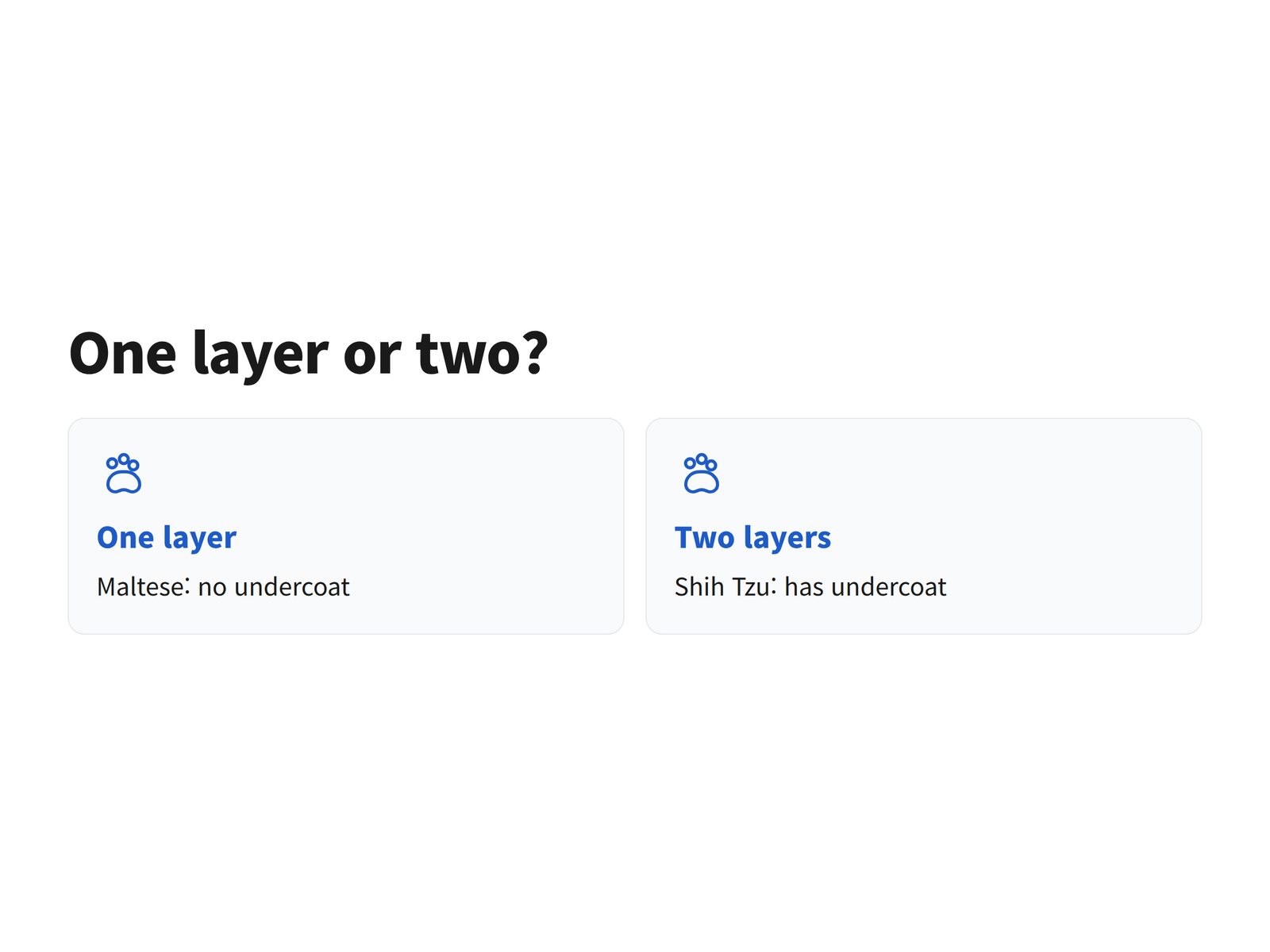
The Shih Tzu is double-coated, and that is stated in the breed standard rather than inferred from how the coat looks. The American Kennel Club standard, approved 1989-05-09 and effective 1989-06-29, describes the coat as “Luxurious, double-coated, dense, long, and flowing. Slight wave permissible.” The Royal Kennel Club standard, last updated April 2025, reads “Outer coat long, dense, not curly, with moderate undercoat, not woolly.” A Shih Tzu owner brushing only the outer hair is leaving an undercoat untouched.
The Maltese sits at the opposite end despite a similar silhouette. The American Kennel Club standard approved 1964-03-10 states: “The coat is single, that is, without undercoat. It hangs long, flat, and silky over the sides of the body almost, if not quite, to the ground.” The Yorkshire Terrier is the honest unknown of the three. Neither the American Kennel Club standard, approved 2007-07-10, nor the Royal Kennel Club version mentions an undercoat at all, so the correct statement is that the standard does not specify one.
Which small breeds carry an undercoat, and which do not?
Five small breeds split three ways: explicitly single, explicitly double, and unstated. The table below quotes each breed standard rather than summarising it, because the wording is what decides which tool reaches the skin.
| Small breed | Coat in the breed standard | What that changes |
|---|---|---|
| Maltese | AKC: single, no undercoat | No underlayer to reach |
| Yorkshire Terrier | AKC: fine and silky, undercoat unstated | Treat as long silky coat |
| Shih Tzu | AKC: double-coated; RKC: moderate undercoat | Surface stroke misses a layer |
| Pomeranian | AKC: dense undercoat, harsh guard hair | AKC assigns undercoat rakes |
| Bichon Frise | AKC: soft dense undercoat, curly outercoat | AKC assigns slicker brushes |
Which brush removes mats, and which one only finishes the coat?
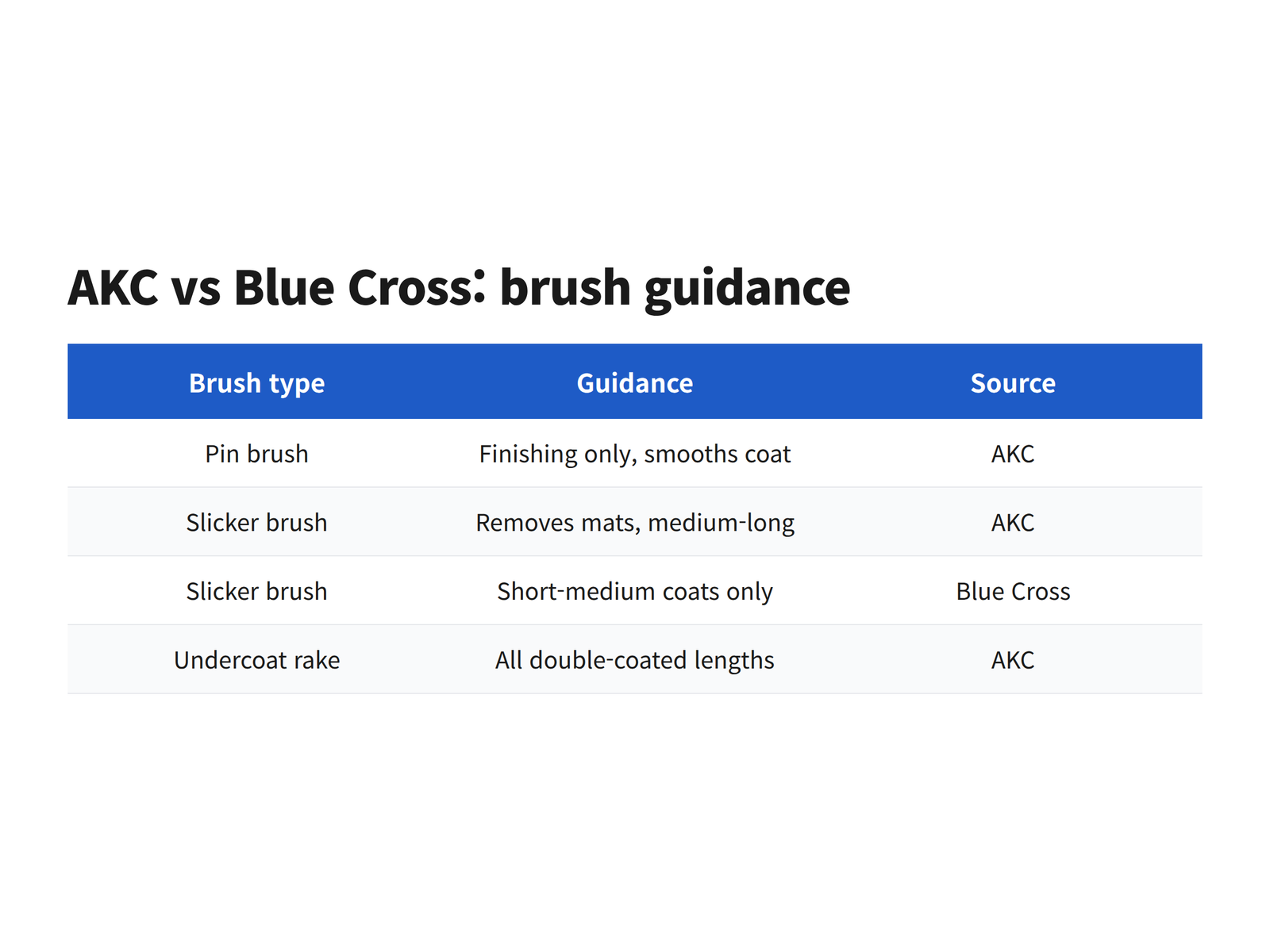
A pin brush is a finishing tool, not a dematting tool, and that single distinction explains a large share of daily-brushing failures. The American Kennel Club describes pinhead brushes as “best used as finishing brushes for long-coated breeds to smooth the hair and remove dirt.” A coat can look finished while the mat survives underneath, which is exactly what an owner reports as brushing every day and still finding mats.
Two A-grade organisations disagree about the next step, and that disagreement is worth knowing before buying anything. The American Kennel Club places slicker brushes on “medium-coated, long-coated, wire-coated, and curly-coated dogs to remove mats,” while Blue Cross limits slicker brushes to “removing knots from short to medium coat breeds.” Neither body is a marketing source, and neither has retracted its wording. The practical reading is that a tool choice should follow coat construction and whether the tool actually reaches the skin, not a category label on a package. The American Kennel Club also assigns undercoat rakes to “double-coated breeds of all fur lengths,” which is the line that matters for a Shih Tzu or a Pomeranian rather than for a Maltese.
Should you bathe a matted small dog before the mats come out?
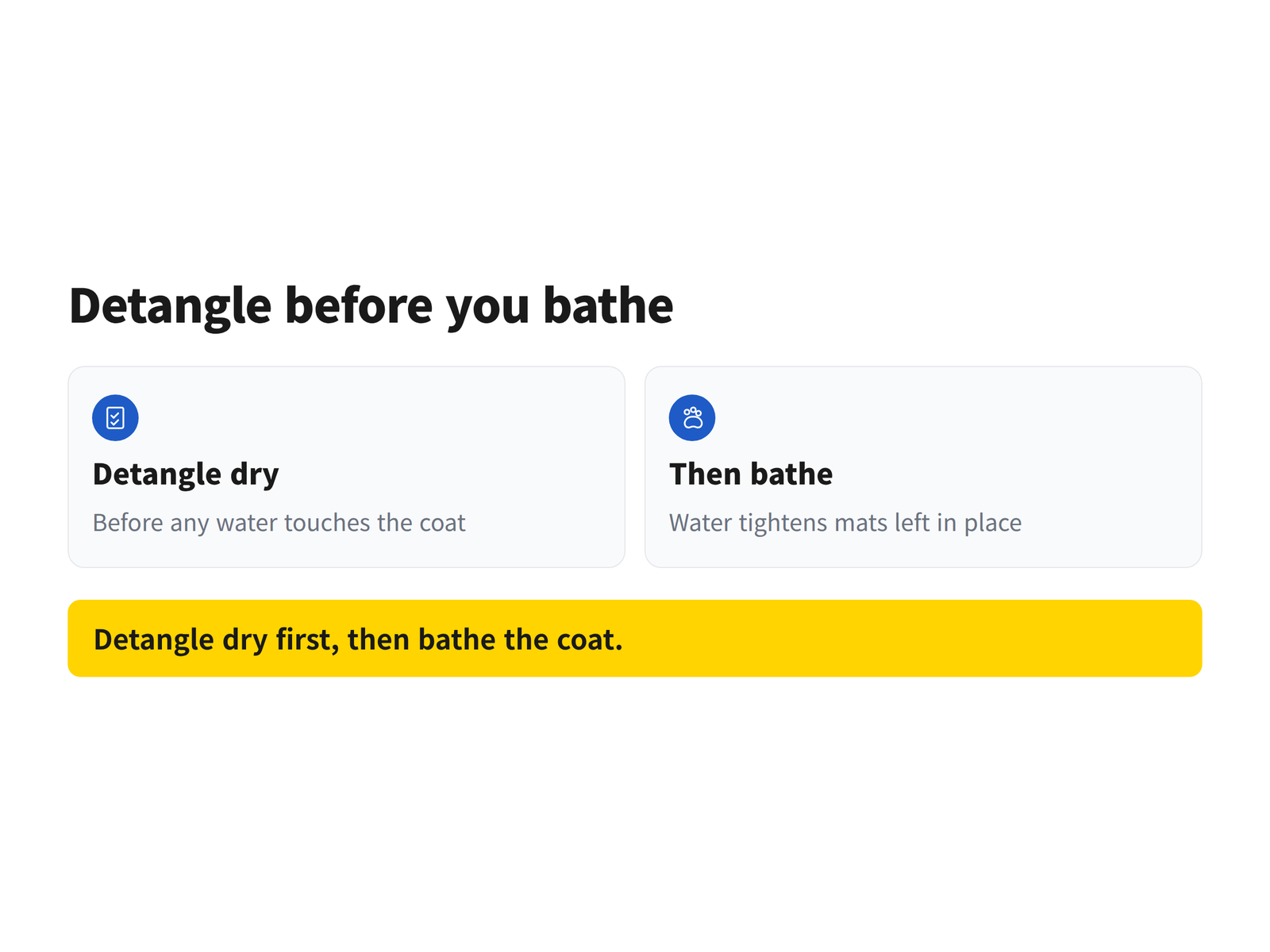
No. Detangling comes before water, and two independent A-grade bodies say so in almost identical terms. Blue Cross states: “Detangle any matts before washing as they will only get worse during shampooing.” The American Kennel Club public education handout Grooming Your Dog states: “Be sure to brush your dog before giving him a bath, removing all mats and tangles.” Shampoo and water tighten a mat that was still workable dry, which turns a brushing problem into a clipping problem.
Where do mats form first on a small longhaired dog?
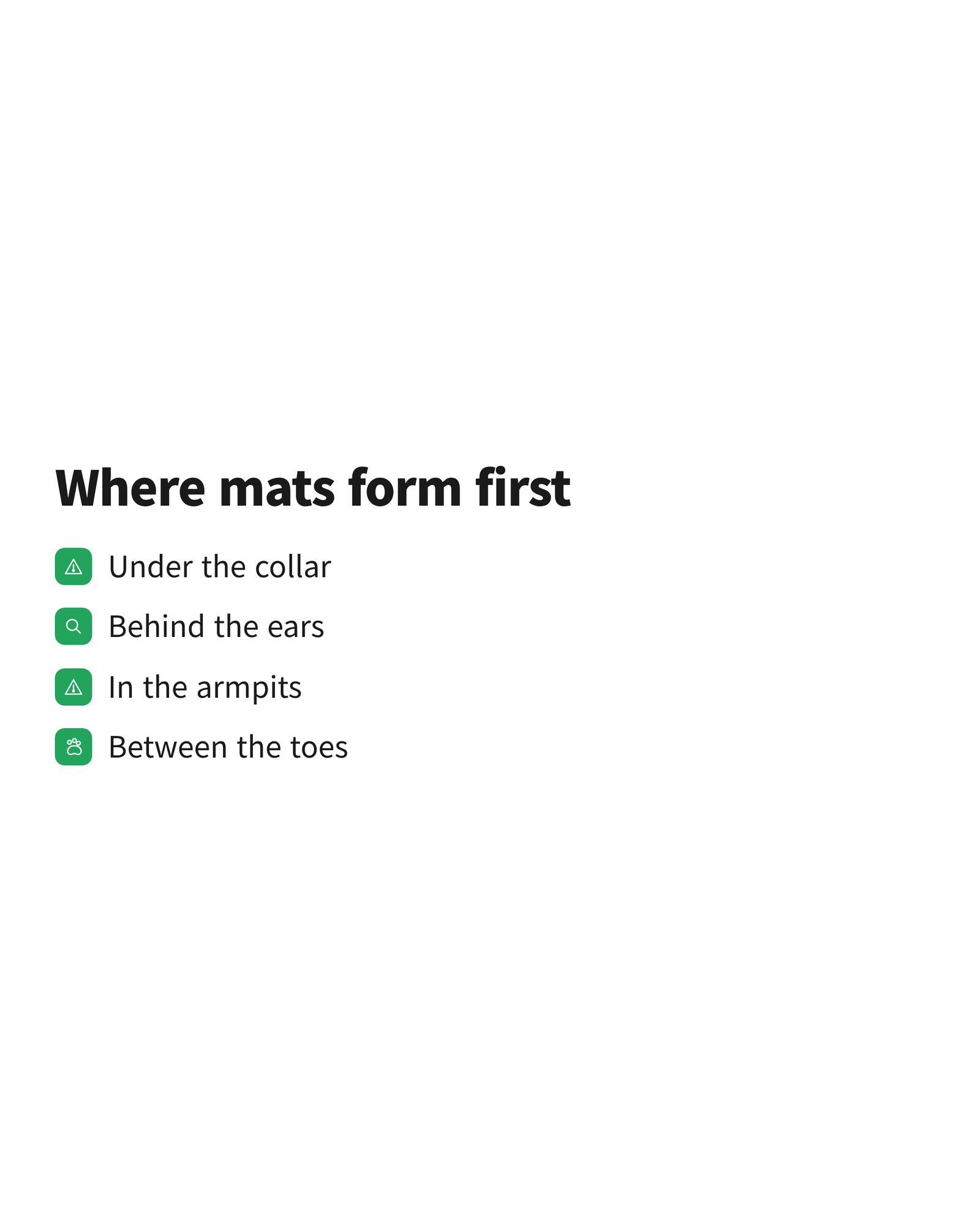
Mats form first where hair rubs against something. USDA APHIS names the sites directly in AC-18-001: “Mats are commonly found under the collar, behind the ears, and in the armpits – areas where there is rubbing.” The American Kennel Club names the same head and limb pattern, noting that “Mats commonly develop behind the ears and under the legs.”
Feet are a separate case with a separate answer. The American Kennel Club notes that “Hair growing between the toes can mat easily and may need a careful trim from a professional.” The collar line is a documented friction site, so any equipment that sits against the coat on a small dog earns its own pass with the brush.
When should you stop brushing and call a groomer or a veterinarian?
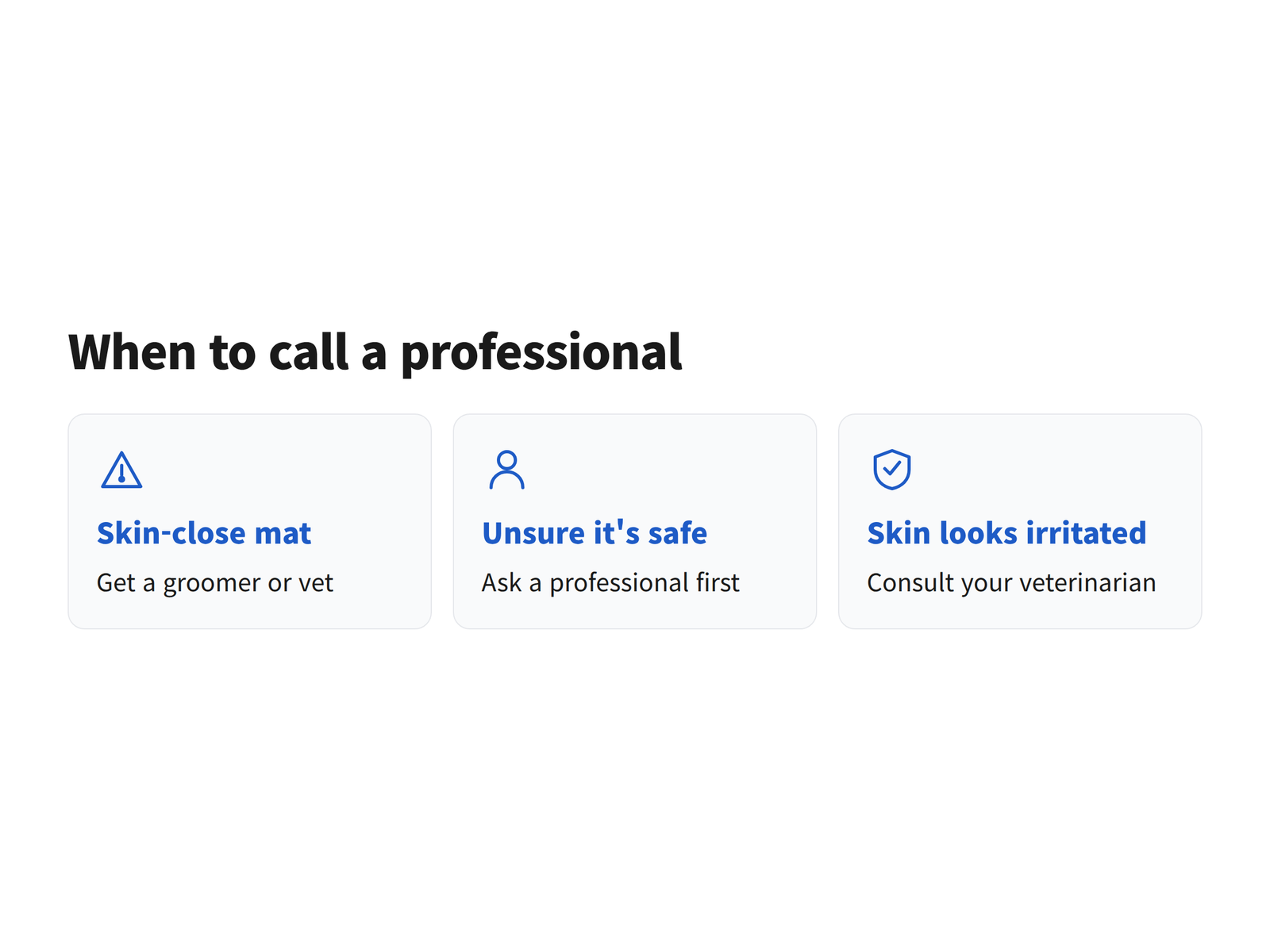
Stop when a mat sits close to the skin or when you are unsure you can work it out safely. RSPCA Australia puts it this way: “If you are uncertain about trimming out a tangle/matt safely or it is close to the skin, it might be safest to have a professional groomer or veterinarian help you.” Skin-close mats are a stop sign rather than a challenge, and consulting your veterinarian is the right move whenever the skin underneath looks irritated, smells, or hurts when touched.
The reason to escalate early is documented in the veterinary literature. ASPCApro’s summary of Watson and Niestat 2021 reports a case series of 27 dogs with 43 lesions, with two self-amputations and 11 clinical amputations, and lists Shih Tzu, Poodle, Yorkshire Terrier, Pekingese and Maltese among the breeds involved. McDonald and colleagues, publishing in Frontiers in Veterinary Science in 2022, found that 13% of ASPCA-NYPD cruelty cases involved hair matting or strangulating hair mat wounds, that 93% of those cases were long-haired breed types, and that 77% of medically necessary grooming appointments involved long-haired breed types.
Frequently asked questions
Does brushing more often fix matting on its own?
Not reliably. USDA APHIS ties brushing frequency to breed, type and hair length, so an unsuitable tool repeated daily still leaves the same mat behind.
Is a silky coat proof that a small dog is single-coated?
No. The Shih Tzu looks silky and is described as double-coated by the American Kennel Club and as carrying a moderate undercoat by The Royal Kennel Club, while the Maltese standard is explicitly single.
Do Yorkshire Terriers have an undercoat?
The breed standards do not say. Both the American Kennel Club and The Royal Kennel Club coat clauses describe a fine, silky, non-woolly coat without addressing an undercoat, so no undercoat claim can be made from the standard.
Can a mat be cut out at home?
RSPCA Australia routes uncertain or skin-close mats to a professional groomer or a veterinarian, and that is the safer default for a small dog with thin skin under a tight mat.
Sources
- American Kennel Club, “Maltese – Official Standard of the Maltese”, approved 1964-03-10 – https://images.akc.org/pdf/breeds/standards/Maltese.pdf
- American Kennel Club, “Shih Tzu – Official Standard”, approved 1989-05-09, effective 1989-06-29 – https://images.akc.org/pdf/breeds/standards/ShihTzu.pdf
- American Kennel Club, “Yorkshire Terrier – Official Standard”, approved 2007-07-10, effective 2007-10-01 – https://images.akc.org/pdf/breeds/standards/YorkshireTerrier.pdf
- American Kennel Club, “Pomeranian – Official Standard”, approved 2011-07-12, effective 2011-08-31 – https://images.akc.org/pdf/breeds/standards/Pomeranian.pdf
- American Kennel Club, “Bichon Frise – Official Standard”, approved 1988-10-11, effective 1988-11-30 – https://images.akc.org/pdf/breeds/standards/BichonFrise.pdf
- American Kennel Club, “Dog Brushes: How to Choose the Right Dog Brush for Your Pet” – https://www.akc.org/expert-advice/health/types-dog-brushes-shedding/
- American Kennel Club, “Dog Grooming at Home: Brushing, Bathing, and Nail Care” – https://www.akc.org/expert-advice/health/how-to-groom-a-dog/
- American Kennel Club Public Education, “Grooming Your Dog” – https://images.akc.org/pdf/public_education/grooming_your_dog.pdf
- The Royal Kennel Club, “Breed Standard: Shih Tzu”, last updated April 2025 – https://www.royalkennelclub.com/breed-standards/utility/shih-tzu
- The Royal Kennel Club, “Breed Standard: Yorkshire Terrier”, last updated April 2025 – https://www.royalkennelclub.com/breed-standards/toy/yorkshire-terrier
- USDA APHIS Animal Care, “AC Aids for Dogs – Coat Care: Preventing Matted Hair”, AC-18-001, issued October 2018, reviewed February 2024 – https://aphis.prod.usda.gov/sites/default/files/AC-Aids-for-Dogs_Coat-Care-Preventing-Matted-Hair_0.pdf
- Blue Cross, “How to groom your dog” – https://www.bluecross.org.uk/pet-advice/how-groom-dog
- RSPCA Australia Knowledgebase, “Why and how should I groom my dog?” – https://kb.rspca.org.au/categories/companion-animals/dogs/caring-for-my-dog/why-and-how-should-i-groom-my-dog
- Watson E, Niestat L, “Osseous lesions in the distal extremities of dogs with strangulating hair mats”, Veterinary Radiology & Ultrasound 62(1):37-43, 2021 – https://pubmed.ncbi.nlm.nih.gov/33184951/
- ASPCApro, “Clinical Features and Outcomes of Strangulating Hair Mats in Dogs”, summary of Watson and Niestat 2021 – https://www.aspcapro.org/resource/clinical-features-and-outcomes-strangulating-hair-mats-dogs
- McDonald SE, Sweeney J, Niestat L, Doherty C, “Grooming-Related Concerns Among Companion Animals”, Frontiers in Veterinary Science, 2022 – https://www.frontiersin.org/journals/veterinary-science/articles/10.3389/fvets.2022.827348/full