
A carrier sold as airline approved can still be turned away at the gate, and the label is the reason travelers are caught out. Airline approved is a manufacturer’s marketing description, not a certification. The Federal Aviation Administration leaves the cabin-pet decision to each airline, and Delta Air Lines states that the maximum kennel size is set by the aircraft flying the route. Whether an airline approved pet carrier under the seat is accepted depends on the aircraft, the seat and the airline.

Does “airline approved” mean an airline actually approved the carrier?
No airline approves or certifies pet carriers, so the phrase carries no guarantee from the airline you fly. The Federal Aviation Administration states that it “allows each airline to decide if they will allow you to travel with your pet in the passenger cabin.” The FAA sets only a functional baseline: the pet container “must be small enough to fit underneath the seat without blocking any person’s path to the main aisle of the airplane.” That rule sits in 14 CFR part 121, section 121.589, which governs carry-on baggage rather than pet products.
Why does under-seat space change from one aircraft to another?
Under-seat stowage is built into the seat structure, so it differs with every cabin layout. Delta Air Lines publishes the reason in plain language: the maximum in-cabin kennel dimensions “are determined by the aircraft dimensions of your flight, as the under-seat space varies by aircraft.” Delta recommends a soft-sided kennel of 18 x 11 x 11 in but sets no fixed maximum. American Airlines splits its allowance by fleet: 19 x 13 x 9 in (48 x 33 x 22 cm) hard-sided on mainline aircraft, but only 16 x 12 x 8 in (40 x 30 x 20 cm) on American Eagle.
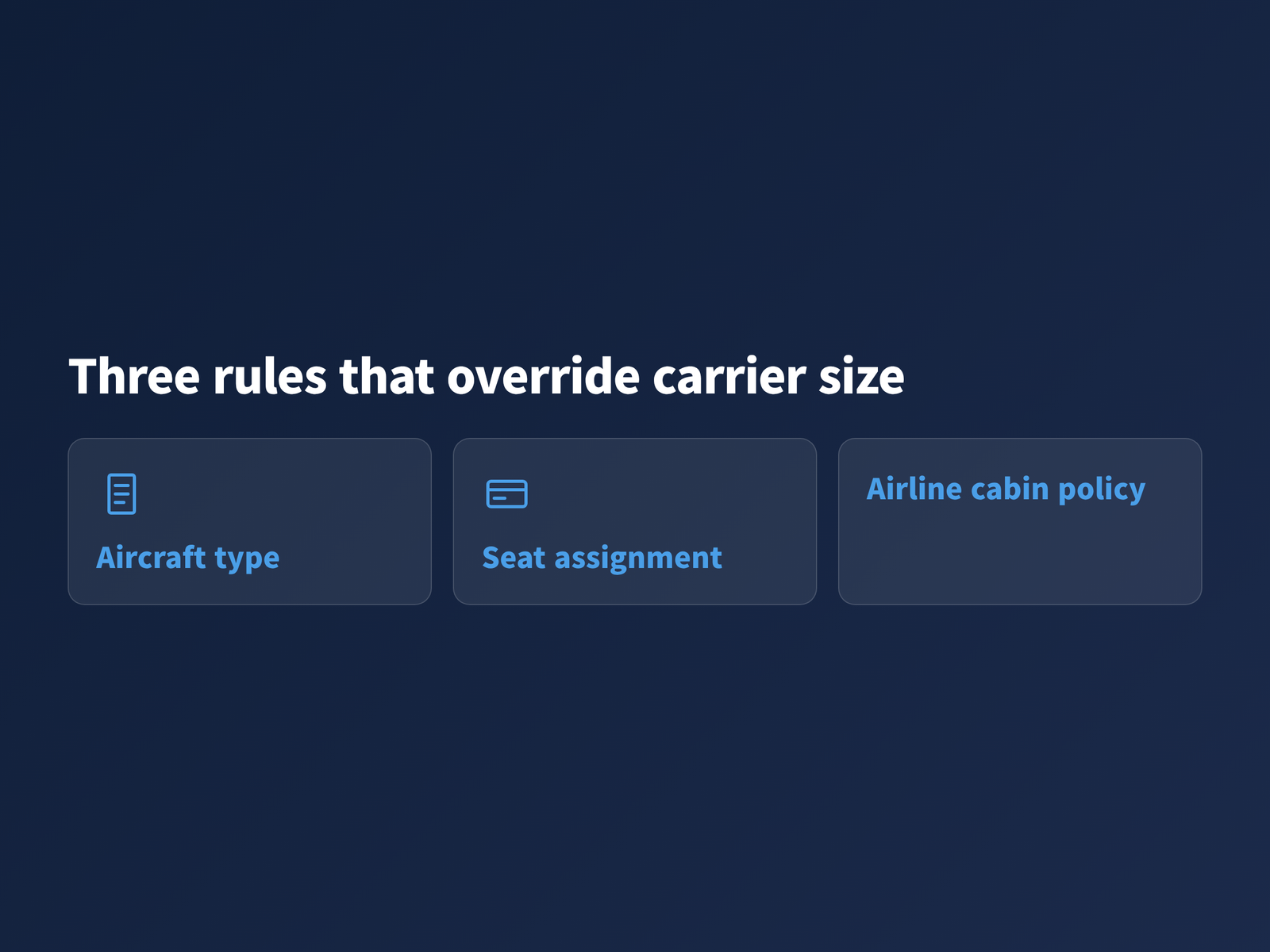
No airline publishes a per-aircraft table of under-seat measurements. The practical consequence is that one carrier can pass on a widebody and fail on a regional jet, and that an itinerary mixing a mainline leg with a regional leg is governed by the smaller figure.
Which seats will not take a small dog carrier at all?
Bulkhead rows and emergency exit rows are barred on every airline reviewed here, however small the carrier is. A bulkhead row has no seat in front of it and therefore no under-seat stowage, and exit rows must stay clear. Delta Air Lines also excludes seats marked as having no stowage, flat-bed Delta One seats, and specific rows on certain aircraft. American Airlines excludes bulkhead and exit rows, restricts pets in First and Business on certain aircraft, and names seat 13D on the A321NEO. Air Canada bars exit and bulkhead rows and the whole of Premium Economy, because “the layout of Premium Economy seats does not allow for the safe stowage of a pet carrier.”
The overhead bin is not an alternative. The FAA requires the pet container to be stowed before the last passenger door closes, and to remain stowed the entire time the airplane is moving on the airport surface, and for takeoff and landing.
Does a pet carrier count as a carry-on bag or a personal item?
The FAA classifies the pet container as carry-on baggage, so it counts against the carry-on allowance and follows all carry-on baggage rules. American Airlines applies this directly: a passenger travelling with a pet may bring only one additional item, either a personal item or a carry-on bag, not both. Fees sit on top. Delta charges USD or CAD 150 for US and Canada domestic travel on tickets issued on or after 2025-04-08, and USD or CAD 95 on tickets issued before that date, so the fee follows the ticket-issue date rather than the travel date. American Airlines charges USD 150 per kennel, retrieved 2026-09-18.
What are the in-cabin carrier size limits at major airlines?
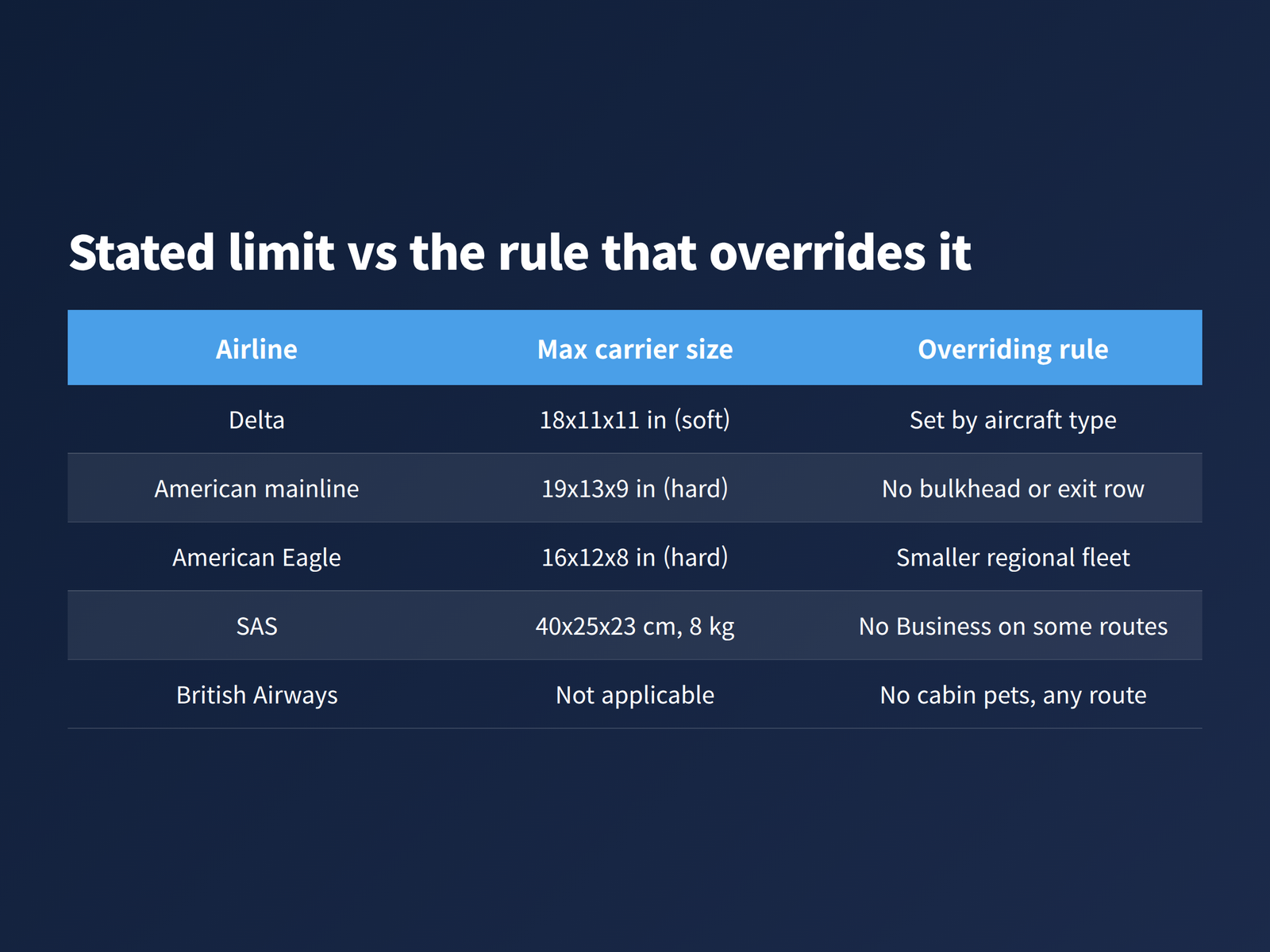
Published limits exist, but each one is qualified by a rule that can override it. The table pairs the stated maximum with the rule that decides the outcome at the gate.
| Airline | Stated maximum in-cabin carrier size | The rule that overrides the size |
|---|---|---|
| Delta | 18 x 11 x 11 in soft-sided, recommended | Maximum set by the aircraft; under-seat space varies |
| American Airlines mainline | 19 x 13 x 9 in hard-sided; 18 x 11 x 11 in soft-sided | Not permitted in bulkhead or exit rows |
| American Eagle | 16 x 12 x 8 in hard-sided | Smaller regional aircraft, smaller allowance |
| SAS | 40 x 25 x 23 cm, 8 kg including the pet | No pets in Business to North America or Asia, or on charters |
| British Airways | Not applicable | Pets are not carried in the cabin on any route |
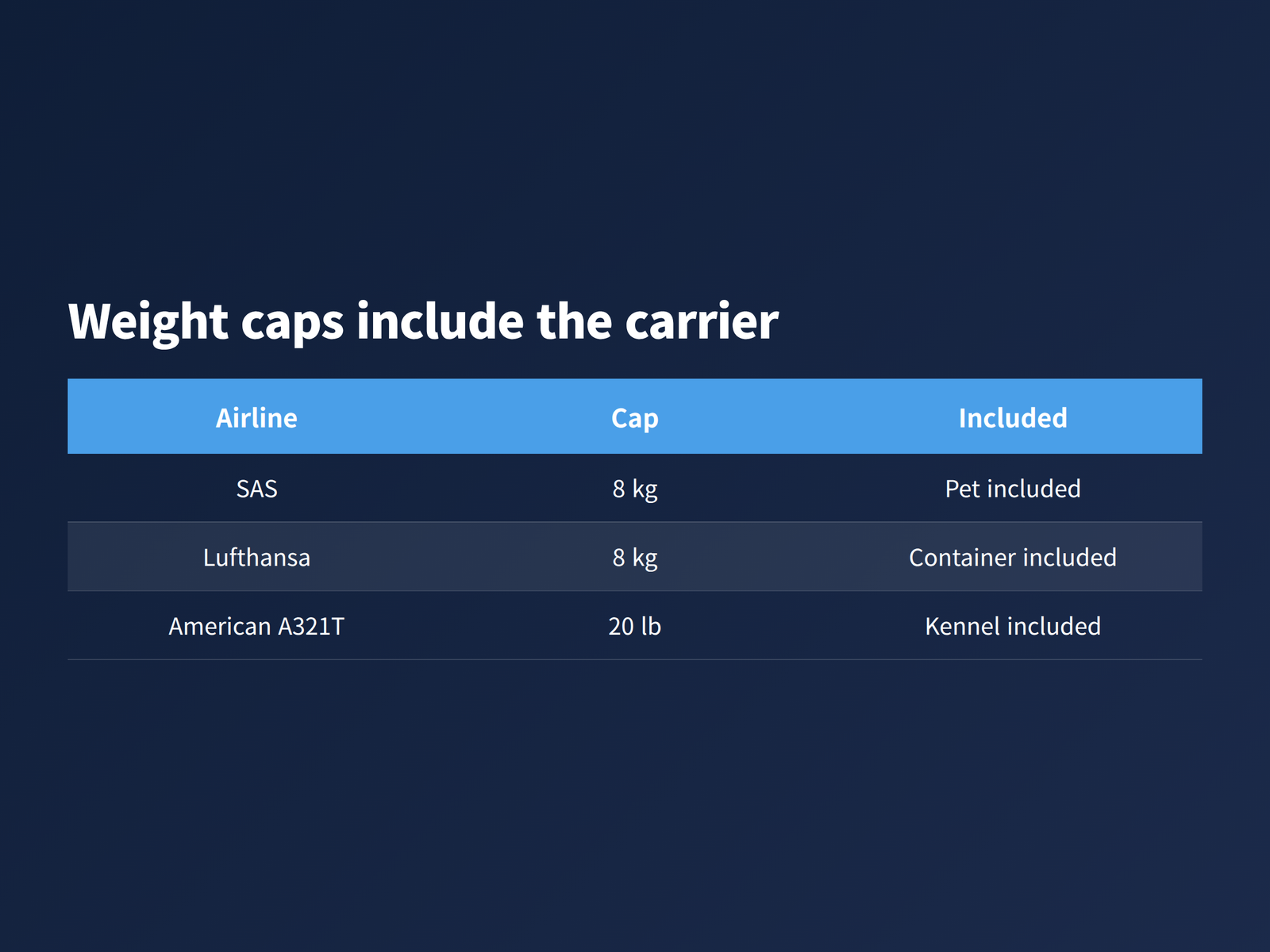
Weight is measured with the carrier included, and the allowance is low. SAS caps the total at 8 kg including the pet and requires the animal to be older than 8 weeks. Lufthansa caps the total at 8 kg including the transport container, with registration 72 hours before departure for flights to and from the USA. Southwest Airlines permits up to two small cats or dogs of the same species per carrier, one carrier per ticketed customer.
Can a soft-sided carrier be squashed down to fit under the seat?
A soft-sided carrier compresses, but the interior space the airline requires does not. Every policy reviewed here defines the minimum by what the dog can do inside. The American Veterinary Medical Association describes a container “large enough to allow the pet to stand (without touching the top of the cage), sit up, turn around, and lie down comfortably.” SAS requires that “the pet must be able to stand, turn and lie down comfortably inside the carrier.” Delta requires the pet to move around “without touching or sticking out from the sides.” Pressing a soft-sided carrier into a gate sizer does not change that interior test.
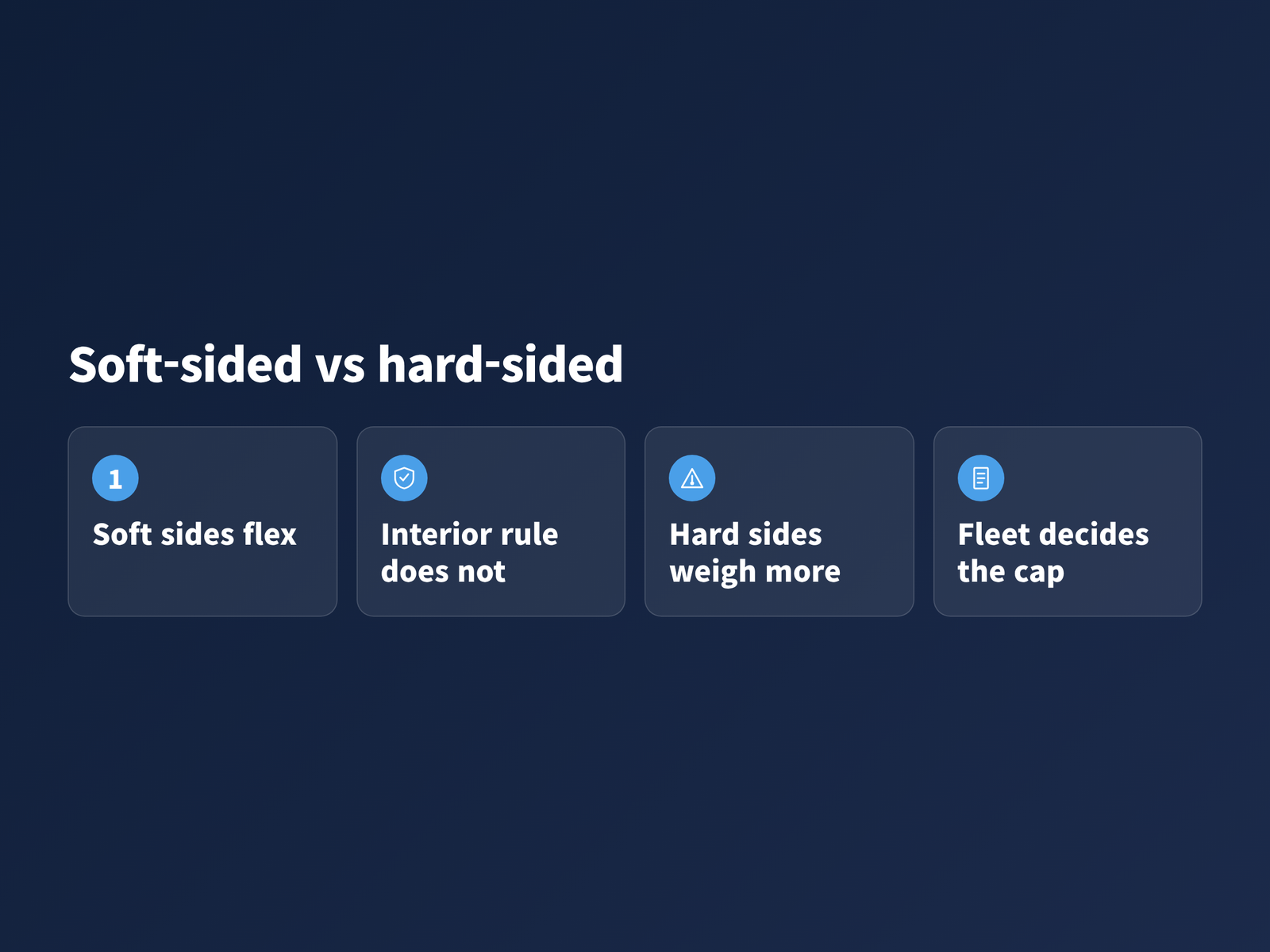
The two carrier types fail in different ways. A hard-sided carrier holds its interior volume, which suits the stand-turn-lie-down test, but the shell adds weight against an 8 kg combined cap. A soft-sided carrier is lighter, yet the flex is worth nothing if the dog can no longer stand inside. American Airlines allows a larger hard-sided footprint on mainline aircraft than the soft-sided size it recommends, so the better choice is fleet-dependent.
Which airlines refuse to carry a small dog in the cabin at all?
British Airways states plainly: “We don’t carry pets in the cabin on any route.” On those flights no carrier size is correct, because the cabin is closed to pets entirely. SAS applies a narrower version, barring pets from the Business cabin on flights to and from North America and Asia, and from all SAS charter flights. Air Canada closes its entire Premium Economy cabin. Checking whether a cabin accepts pets at all, before comparing dimensions, avoids buying a carrier for a route that will never take one.
Does a short-nosed small breed need extra planning before a flight?
Yes, and that planning belongs with a veterinarian rather than a retailer. The American Veterinary Medical Association names pugs, Boston Terriers, Pekingese, Lhasa Apsos, Shih Tzus and bulldogs among short-nosed breeds, and notes that these dogs have “smaller-than-normal nostrils, a longer-than-normal soft palate, and a narrowed trachea.” The AVMA also tells owners to “consult your veterinarian before giving your pet any tranquilizers or sedatives,” which “can increase the risk of heart or respiratory problems and generally are not allowed by airlines.”
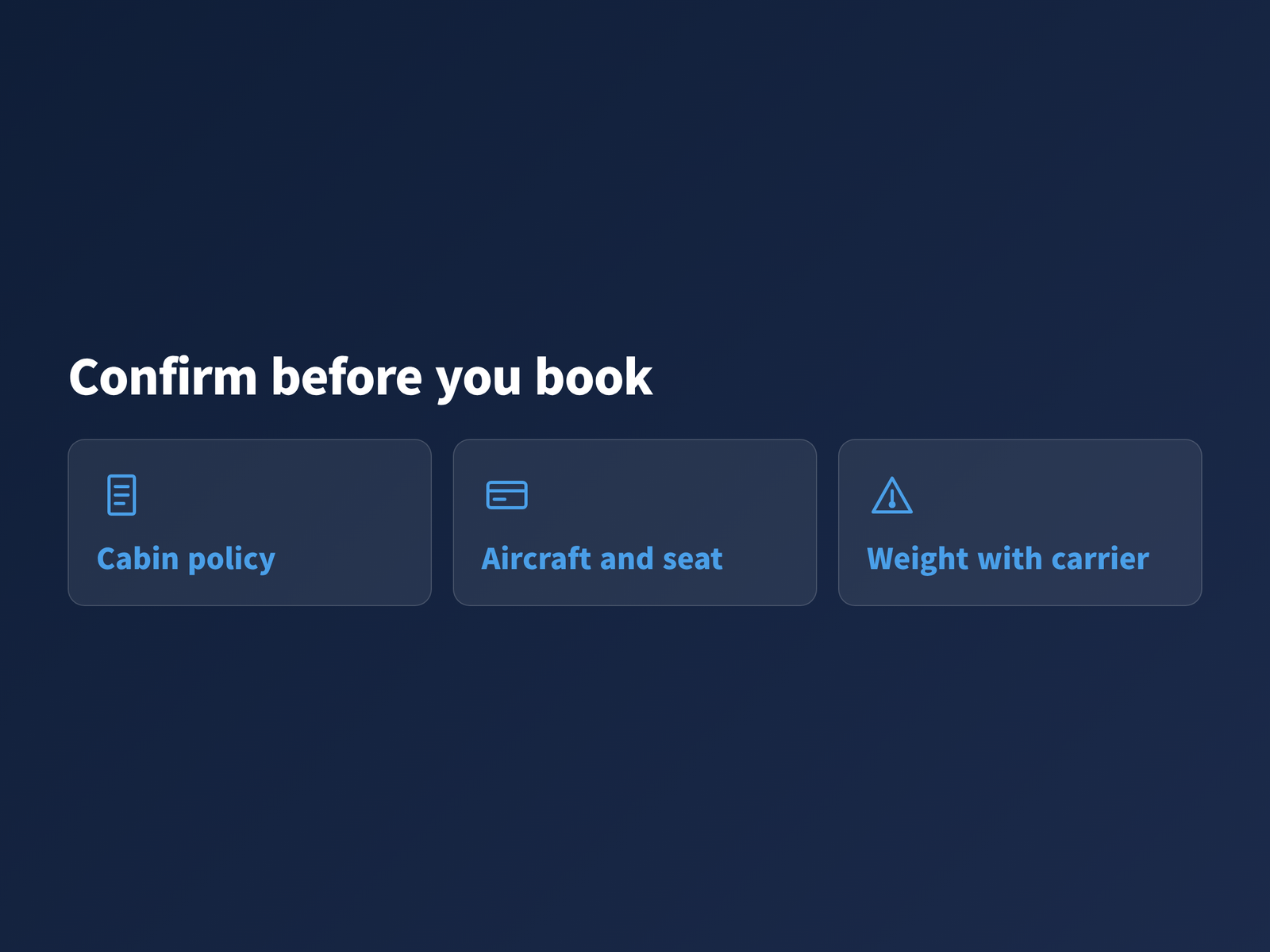
What should you confirm before booking a flight with a small dog?
Confirm the cabin policy first, the aircraft second and the carrier last. The American Veterinary Medical Association puts it the same way: “Check with your airline when booking your flight to make sure you understand and comply with its requirements for pet travel.”
- Whether the airline accepts pets in that cabin on that route
- Which aircraft operates each leg, including any regional leg
- Whether the assigned seat is a bulkhead, exit or no-stowage seat
- The combined weight of dog plus carrier against the airline cap
- The in-cabin fee and which ticket-issue date it depends on
- Whether the dog can stand, turn and lie down with the carrier closed
Frequently asked questions
Can the carrier go in the overhead bin for takeoff?
No. The FAA requires the pet container to be stowed under the seat before the last passenger door closes, and to remain stowed while the airplane is moving on the airport surface and for takeoff and landing.
Does a connecting flight change the maximum carrier size?
It can. American Airlines allows 19 x 13 x 9 in hard-sided on mainline aircraft but only 16 x 12 x 8 in on American Eagle, so an itinerary with a regional leg is governed by the smaller figure.
Is the in-cabin fee charged per pet or per carrier?
American Airlines charges USD 150 per kennel rather than per animal, retrieved 2026-09-18. Southwest Airlines permits up to two small cats or dogs of the same species in one carrier, one carrier per ticketed customer.
Sources
- Federal Aviation Administration, “Cabin Safety – Pets FAQ”, retrieved 2026-09-18 – https://www.faa.gov/about/initiatives/cabin_safety/pets_faq
- Federal Aviation Administration, “Flying with Pets”, retrieved 2026-09-18 – https://www.faa.gov/travelers/fly_pets
- American Veterinary Medical Association, “Traveling with your pet FAQ”, retrieved 2026-09-18 – https://www.avma.org/resources/pet-owners/petcare/traveling-your-pet-faq
- American Veterinary Medical Association, “Air travel and short-nosed dogs FAQ”, retrieved 2026-09-18 – https://www.avma.org/resources-tools/pet-owners/petcare/air-travel-and-short-nosed-dogs-faq
- Delta Air Lines, “Pet Travel Overview”, retrieved 2026-09-18 – https://www.delta.com/us/en/pet-travel/overview
- American Airlines, “Traveling with pets”, retrieved 2026-09-18 – https://www.aa.com/i18n/travel-info/special-assistance/pets.jsp
- Air Canada, “Travelling with pets”, retrieved 2026-09-18 – https://www.aircanada.com/us/en/aco/home/plan/special-assistance/pets.html
- SAS, “Pet in cabin”, retrieved 2026-09-18 – https://www.flysas.com/en/travel-info/travel-with-pets/cabin
- British Airways, “Travelling with pets”, retrieved 2026-09-18 – https://www.britishairways.com/en-gb/information/travel-assistance/travelling-with-pets
- Lufthansa, “Travelling with animals”, retrieved 2026-09-18 – https://www.lufthansa.com/us/en/travelling-with-animals
- Southwest Airlines, “Pet Policy”, retrieved 2026-09-18 – https://support.southwest.com/helpcenter/article/pet-policy