A calming wrap on a double-coated sheltie only has a chance of helping if it is snug against the body, not just the fluffy coat, and if the dog already knows the wrap before fireworks night. The research on pressure vests shows small benefits at best, and the clearest result came from a snug fit, not a loose one. This guide covers calming wrap fit for a double-coated sheltie, what the studies found, and what else to set up before the season starts.
Why does a calming wrap fail on some dogs during fireworks?
A calming wrap most often fails because it is fitted too loosely, put on for the first time during the noise, or expected to work like a cure. A 2018 critical appraisal in Veterinary Evidence by Louise Anne Buckley reviewed four pressure vest studies and concluded that pressure vests “may have small but beneficial effects on canine anxiety.” The same appraisal warned that owners “should not expect their dog’s anxiety to be fully alleviated or prevented, and it may have no beneficial effect at all.”
Two further limits apply to the evidence itself. Buckley noted that the Cottam 2013 and Pekkin 2016 studies were funded by manufacturers, and that owners in the Cottam trial were not blinded. Cottam, Dodman and Ha wrote that their high effectiveness rating may reflect “a powerful placebo effect.” Pekkin 2016 also found no effect on salivary cortisol or urinary oxytocin. A calming wrap, in other words, is one modest tool, and a sheltie owner who treats it as the whole plan is likely to be disappointed.
Does a snug fit matter more than the brand of wrap?
The available evidence points to fit as a variable that changed results; no study compared brands. In King et al. 2014, 90 dogs were split into three groups of 30: no wrap, a snug-fit wrap and a loose-fit wrap. Buckley’s appraisal reports that 90% of control dogs oriented toward the door, compared with 53% of snug-fit dogs, and that snug-fit dogs differed from both control and loose-fit dogs on heart rate.
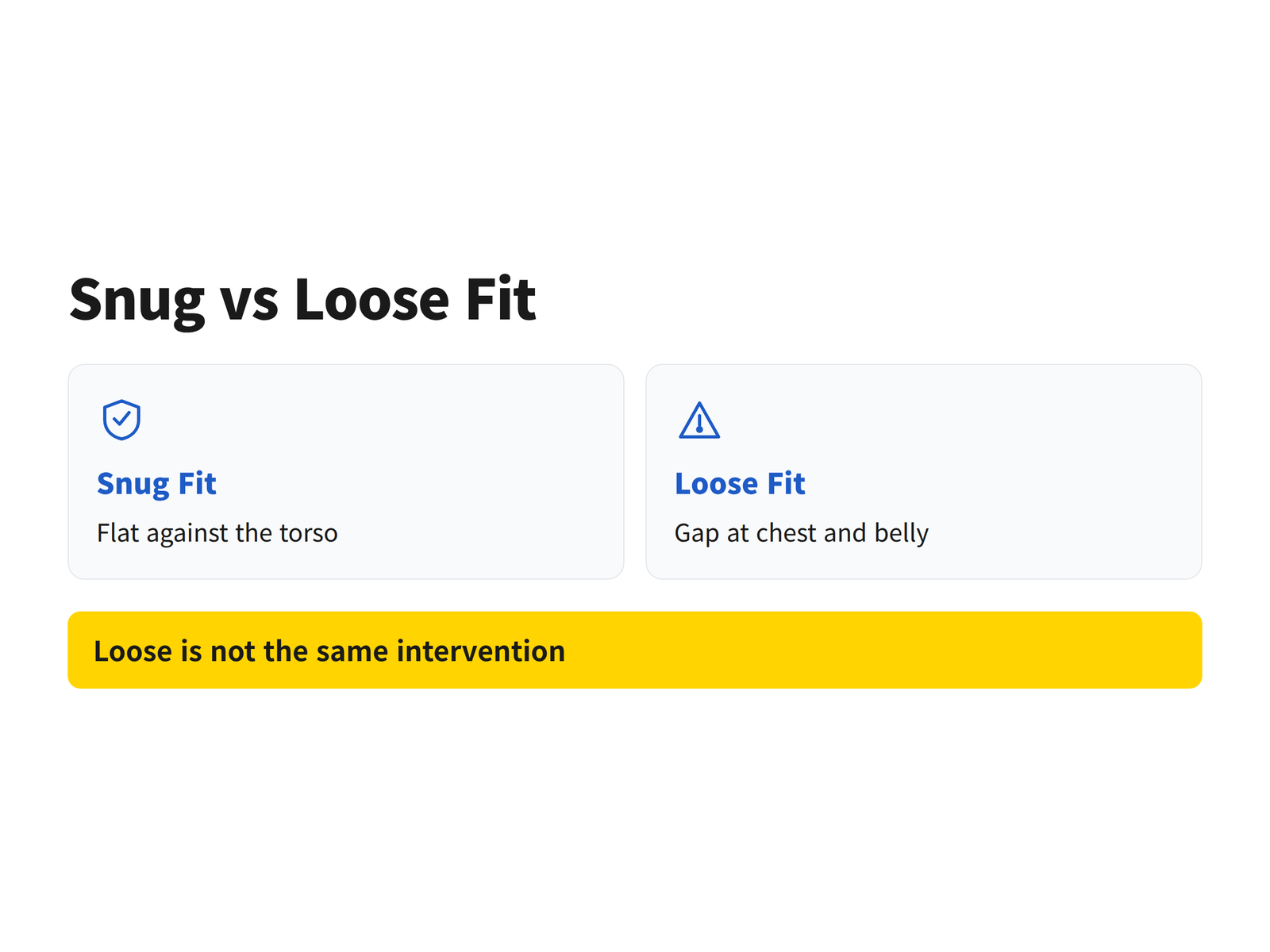
The practical reading is that a loose calming wrap is not the same intervention as a snug one. Fish et al. 2017 defined snug as tight enough to allow only two fingers under the vest, and dogs wearing the vest in that study averaged 95.5 bpm against 103.9 bpm without it, with an anxiety score 40% lower during thunderstorm audio. Neither study compared brands, so brand choice has no evidence behind it either way. Whether a snug wrap helps your sheltie will still depend on the individual dog.
How should a calming wrap fit over a sheltie’s double coat?
A calming wrap on a sheltie should be checked against the body under the coat, not against the coat surface. The American Kennel Club breed standard describes the Shetland Sheepdog coat as double, with an undercoat “so dense as to give the entire coat its ‘standoff’ quality.” That standoff undercoat adds loft that short-coated breeds do not have.
This next point is an editorial inference, not a study finding: because the undercoat stands away from the skin, a calming wrap that feels snug on the outer coat may still sit loose against the sheltie’s body. No study has tested pressure wraps on Shetland Sheepdogs specifically. The safest approach is to apply the Fish 2017 two-finger standard at the skin level. Part the outer coat, slide two fingers under the wrap at the chest and at the belly, and confirm there is no room for a third.
For scale, the AKC standard places the Shetland Sheepdog at 13 to 16 inches at the shoulder. As a further editorial inference, a small wrap on a sheltie can shift easily if the coat is compressing unevenly. As a further editorial inference, a dense coat can settle and loosen the wrap, so check the fit again after the dog lies down and stands up.
When should you start getting a sheltie used to wearing a wrap?
Start three to six months before fireworks season, on calm days, and never wait for the first bang. Blue Cross states that “any training will have to start three to six months in advance of the firework season.” For a sheltie in the UK, that means starting well before Bonfire Night on November 5; in the US, the same logic applies to July 4 and New Year’s Eve.
Habituation matters because an unfamiliar calming wrap can add stress rather than remove it. Buckley’s appraisal notes that dogs in King 2014 were not habituated to the vest, and their baseline heart rate rose when the vest was first fitted. By contrast, owners in Cottam 2013 practised fitting the wrap three times on non-stormy days, and anxiety scores were 47% lower by the fifth use. Buckley concluded that habituating the dog, assessing for comfort and using the wrap repeatedly may improve the likelihood of any benefit.
What did the pressure wrap studies actually find?
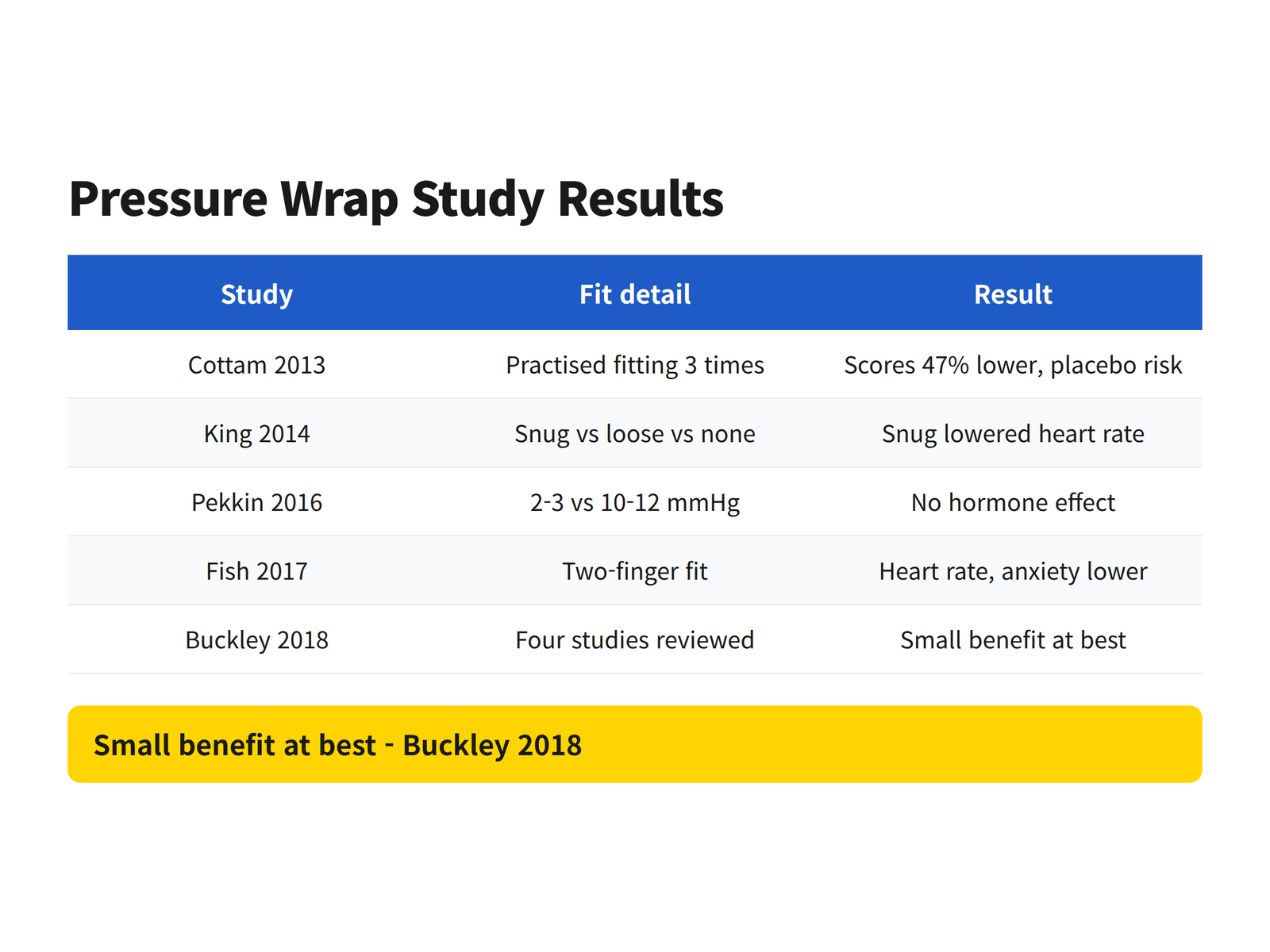
The pressure wrap studies found modest, mixed effects, with the strongest signals tied to snug fit and prior practice. The table below summarises the five sources Buckley’s appraisal draws on or represents.
| Study | Fit detail | Result |
|---|---|---|
| Cottam 2013 | Practised fitting 3 times | Scores 47% lower, placebo risk |
| King 2014 | Snug vs loose vs none | Snug lowered heart rate |
| Pekkin 2016 | 2-3 vs 10-12 mmHg | No hormone effect |
| Fish 2017 | Two-finger fit | Heart rate, anxiety lower |
| Buckley 2018 | Four studies reviewed | Small benefit at best |
Every study in the table had limits. Fish 2017 used 8 Labradors per group, and the result lost significance under a two-tailed test (P = 0.0942). Pekkin 2016 compared light pressure of roughly 2 to 3 mmHg with deep pressure of roughly 10 to 12 mmHg and found no hormonal effect. In Cottam 2013, 89% of owners rated the wrap at least partially effective and 80% said they would continue, but those were unblinded owner ratings.
What should you not do when a sheltie is scared of fireworks?
Do not punish a frightened sheltie, and do not start new training during the fireworks season itself. Cornell University College of Veterinary Medicine states plainly: “Punishment must never be used because it will only increase your dog’s distress.” Blue Cross likewise advises against starting training once the season has begun, which is why the three-to-six-month lead time matters.
Ignoring the dog is also not required. Certified behavior consultant Jenn Stanley, quoted by the American Kennel Club, says: “You absolutely can and should comfort your dog if he’s afraid.” Fear of fireworks is common across dogs; a 2020 study of 13,700 Finnish dogs by Salonen et al. found noise sensitivity in 32% and fear of fireworks in 26%. The same study listed Shetland Sheepdogs among the breeds where general fearfulness was most common, which is a reason for sheltie owners to plan ahead rather than react on the night.
What else should a sheltie owner set up before fireworks night?
A calming wrap works best as one part of a wider fireworks plan. RSPCA, Blue Cross and The Royal Kennel Club recommend the first four steps below; the fifth comes from the Buckley appraisal:
- Walk the dog in daylight, before dusk, on fireworks evenings
- Keep the dog indoors with curtains closed
- Set up a quiet den the dog can retreat to
- Keep microchip details and the collar tag current, even indoors
- Fit and check the wrap well before the noise starts
The microchip step is easy to overlook. The Royal Kennel Club reports that 53 per cent of microchips in the UK carry wrong owner details, and a startled sheltie can bolt through an open door.
Please consult your veterinarian if your sheltie’s fear seems unmanageable, or before trying pheromone products; Blue Cross, RSPCA and Cornell all direct owners to a vet for that step. A calming wrap is not a treatment, and a veterinarian can assess what else may help an individual dog.
Frequently asked questions
How tight should a calming wrap be on a sheltie? A calming wrap on a sheltie should allow only two fingers under the wrap, the standard used in Fish et al. 2017. On a double-coated sheltie, check that gap against the body, not the fluffy outer coat.
Can a calming wrap stop a sheltie’s fear of fireworks? A calming wrap is unlikely to stop fear on its own. Buckley’s 2018 appraisal found small benefits at best and warned that a wrap may have no effect at all for some dogs.
How early should a sheltie start wearing a wrap before fireworks season? Blue Cross advises starting preparation three to six months ahead. Short, calm-day fittings help the sheltie accept the wrap before it is needed.
Is it okay to comfort a sheltie during fireworks? Yes. Behavior consultant Jenn Stanley, quoted by the American Kennel Club, says owners can and should comfort a frightened dog. Punishment, by contrast, increases distress, according to Cornell.
Sources
- Buckley L.A., “Are Pressure Vests Beneficial at Reducing Stress in Anxious and Fearful Dogs?”, Veterinary Evidence 3(1), 2018 – https://veterinaryevidence.org/index.php/ve/article/view/152
- Salonen M. et al., “Prevalence, comorbidity, and breed differences in canine anxiety in 13,700 Finnish pet dogs”, Scientific Reports, 2020 – https://www.nature.com/articles/s41598-020-59837-z
- Cottam N., Dodman N.H., Ha J.C., “The effectiveness of the Anxiety Wrap in the treatment of canine thunderstorm phobia: An open-label trial”, Journal of Veterinary Behavior 8:154-161, 2013 – https://www.academia.edu/17429502/
- King C. et al., “The effect of a pressure wrap (ThunderShirt) on heart rate and behavior in canines diagnosed with anxiety disorder”, Journal of Veterinary Behavior 9:215-221, 2014 – https://www.sciencedirect.com/science/article/abs/pii/S1558787814000902
- American Kennel Club, “Official Standard of the Shetland Sheepdog”, approved 1959-05-12 – https://images.akc.org/pdf/breeds/standards/ShetlandSheepdog.pdf
- American Kennel Club, “How to Keep Your Dog Calm During Fireworks”, updated 2026-06-10 – https://www.akc.org/expert-advice/training/how-to-keep-your-dog-calm-during-fireworks/
- Blue Cross, “Dogs and fireworks”, reviewed 2025-11-26 – https://www.bluecross.org.uk/advice/dog/behaviour-and-training/dogs-and-fireworks
- RSPCA, “Keeping dogs, cats and other small pets safe during fireworks” – https://www.rspca.org.uk/adviceandwelfare/fireworks/pets
- The Royal Kennel Club, “Fireworks” – https://www.royalkennelclub.com/health-and-dog-care/health-dog-care/health/health-and-care/a-z-of-health-and-care-issues/fireworks/
- Cornell University College of Veterinary Medicine, Riney Canine Health Center, “Fear of fireworks and thunderstorms” – https://www.vet.cornell.edu/departments-centers-and-institutes/riney-canine-health-center/canine-health-topics/fear-fireworks-and-thunderstorms