The health tests to ask a Cairn Terrier breeder for are the seven screenings on the Cairn Terrier Club of America (CTCA) minimum list: two DNA tests, a liver blood test, a kidney ultrasound, heart and kneecap exams, and an eye exam by a veterinary ophthalmologist. A Cairn Terrier breeder who follows that list can show you paperwork for each item. This guide turns the breed club’s list into buyer questions and explains what “vet checked”, “health tested” and a CHIC number do and do not prove.

Which health tests should a Cairn Terrier breeder be able to show you?
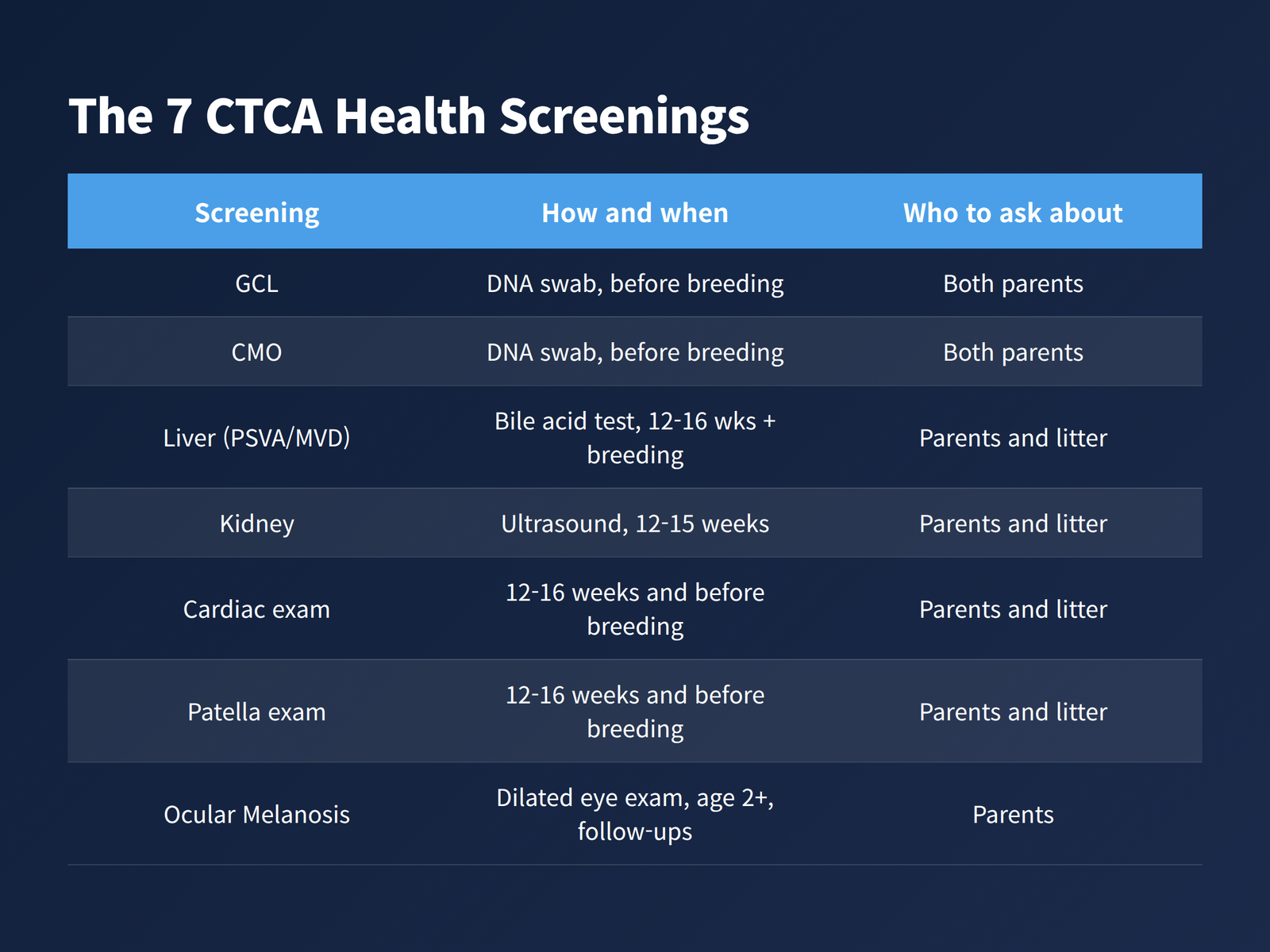
A Cairn Terrier breeder should be able to show results for all seven screenings that the CTCA Board of Governors approved as minimum health-testing guidelines for breeding Cairns. Two items are DNA tests taken from a cheek swab, and five are exams, imaging or blood work. The CTCA Foundation adds that the kidney ultrasound is done by a board-certified specialist.
| Screening | How and when | Who to ask about |
|---|---|---|
| Globoid Cell Leukodystrophy (GCL) | DNA swab, adult before breeding | Both parents |
| Craniomandibular Osteopathy (CMO) | DNA swab, adult before breeding | Both parents |
| Liver (PSVA/MVD) | Bile acid test, 12-16 weeks and before breeding | Parents and litter |
| Kidney (renal aplasia/dysplasia) | Ultrasound, 12-15 weeks | Parents and litter |
| Cardiac exam | 12-16 weeks and before breeding | Parents and litter |
| Patella exam | 12-16 weeks and before breeding | Parents and litter |
| Ocular Melanosis | Dilated eye exam, age 2+, with follow-ups | Parents |
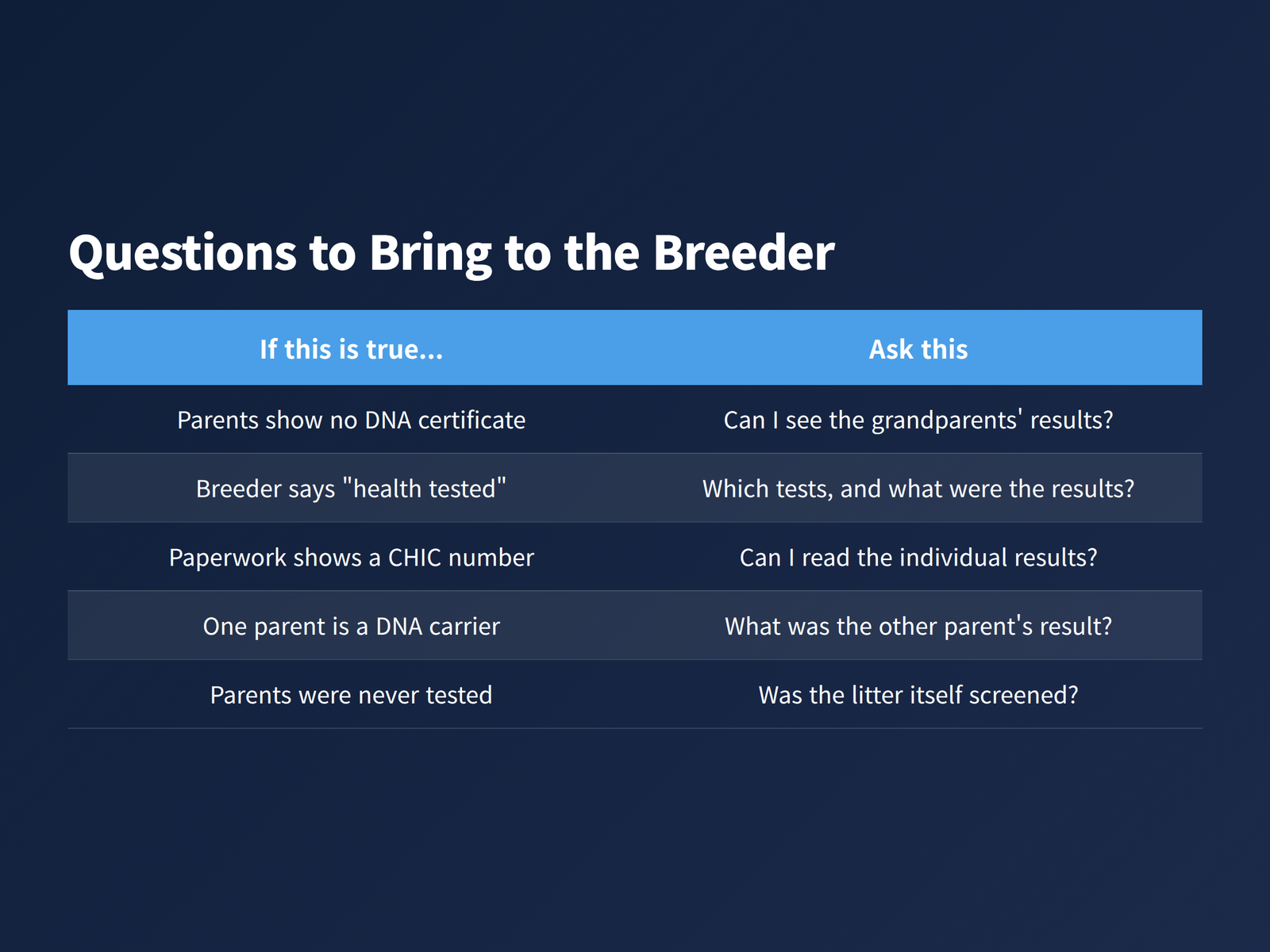
For the DNA items, the CTCA wording covers “any adult Cairn (dog or bitch) prior to breeding who has not been previously cleared by test or parentage.” That phrase matters for buyers. A parent with no GCL or CMO certificate of its own may still be cleared through its own parents’ results, so the right follow-up question is to see those grandparent results rather than to walk away.
Why is “vet checked” not the same as “health tested” for a Cairn Terrier puppy?
“Vet checked” means a veterinarian examined the Cairn Terrier puppy, while “health tested” should mean the parents were screened for the breed’s listed conditions. A puppy exam looks at one animal on one day. The CTCA list describes screening of breeding stock, including DNA tests and an eye exam that the list sets at age two or older.
“Health tested” on its own is also incomplete. A Cairn Terrier breeder can truthfully say “health tested” after running one test out of seven. Ask which tests were done, on which dogs, and ask to see the results. The AKC describes its Breeder of Merit commitment this way: “Breeders that participate certify that applicable health screens are performed on their breeding stock as recommended by their AKC Breed Parent Club.” For a Cairn Terrier, that parent club is the CTCA.
What does a CHIC number actually prove, and what doesn’t it prove?
A CHIC number proves that a Cairn Terrier has completed every screening its parent club requires and that the results are public; it does not prove the results were normal. The AKC states it plainly: “The CHIC number does not imply normal test results, only that all required breed specific tests were performed, and that the results are made publicly available.”
The AKC now prints CHIC numbers on certified pedigrees, registration applications and certificates, so a buyer may see one on the paperwork. Treat a CHIC number on a Cairn Terrier parent as a sign that the results exist and can be read. Then read them. The individual results are the part that answers your question.
What do clear, carrier and affected DNA results mean for a puppy buyer?
For recessive conditions, a DNA result of clear, carrier or affected describes how many copies of the abnormal gene a dog has. The Royal Kennel Club (RKC) defines them this way. Clear dogs “do not have any copies of the abnormal gene associated with the condition that has been tested for.” Carrier dogs “have one copy of the normal gene and one copy of the abnormal gene associated with the condition that has been tested for.” Affected dogs have two copies.
The RKC breeding guidance explains why a carrier parent is not automatically a problem. A clear x clear, clear x carrier or clear x affected pairing produces no affected puppies, although a clear x affected litter will be all carriers. For a Cairn Terrier buyer, the useful question is what the other parent’s result was for the same test. A “clear” result covers one gene only, not the other CTCA screenings.
How do breeder claims compare with what they actually prove?
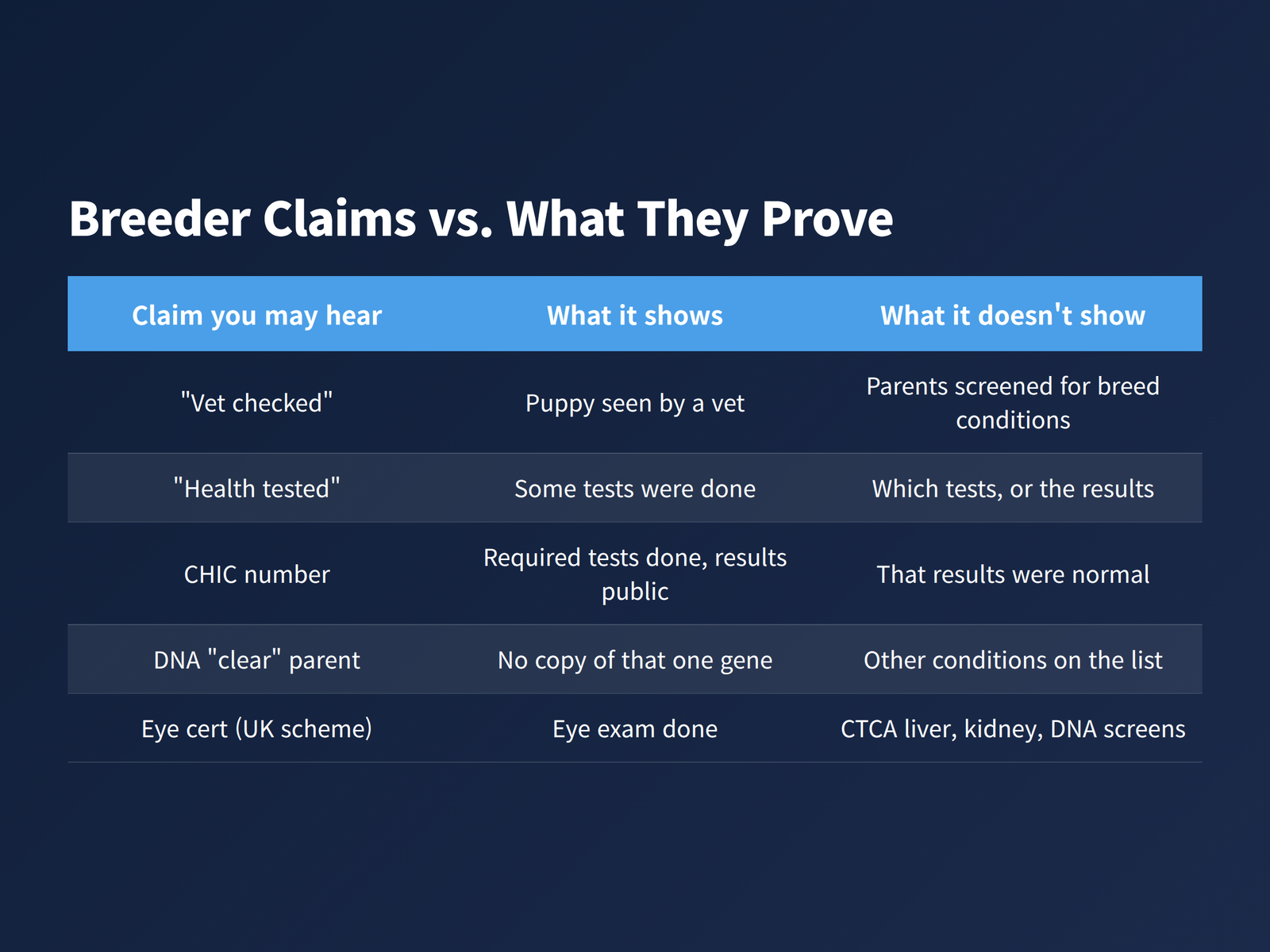
Each common breeder claim proves something narrower than it sounds. The table below lines up five claims a Cairn Terrier buyer may hear against what each shows and what it leaves out.
| Claim you may hear | What it shows | What it doesn’t show |
|---|---|---|
| “Vet checked” | Puppy seen by a vet | Parents screened for breed conditions |
| “Health tested” | Some tests were done | Which tests, or the results |
| CHIC number | Required tests done, results public | That results were normal |
| DNA “clear” parent | No copy of that one gene | Other conditions on the list |
| Eye cert (UK scheme) | Eye exam done | CTCA liver, kidney, DNA screens |
Why does the UK Kennel Club list fewer Cairn Terrier tests than the US breed club?
The Royal Kennel Club recommends only one test for the Cairn Terrier: “Eye testing using the BVA/KC/ISDS Eye Scheme.” The RKC breed page also says, “We don’t currently offer a breed-specific DNA testing package for this breed.” The CTCA list, by contrast, has seven items, including the liver, kidney, heart, kneecap and two DNA screens.
That gap changes what a UK buyer should ask. A UK Cairn Terrier breeder who follows the RKC recommendation to the letter may have an eye certificate and nothing else, and still be within the national club’s guidance. If the liver, kidney and DNA screens matter to you, ask for them by name. The RKC Health Test Results Finder lets you “look up an RKC registered dog and find available health & test information,” which is a way to check a named parent rather than rely on a verbal answer.
What should you do if the parents of a Cairn Terrier puppy were not health tested?
If the parents of a Cairn Terrier puppy were not health tested, ask whether any screening was done on the litter itself before deciding. Four CTCA screens, the bile acid test, kidney ultrasound, cardiac exam and patella exam, are listed for puppies at 12 to 15 or 12 to 16 weeks. A breeder may have litter results even when the parents’ paperwork is thin.
Missing DNA certificates need a closer look before they count against a Cairn Terrier breeder, because a dog can be “cleared by parentage.” Ask for the grandparents’ results in that case. Screening reduces the risk of passing on a tested condition; the Royal Kennel Club frames testing as risk reduction, and no test list guarantees a healthy puppy. Consult your veterinarian and ask them to go through the parents’ certificates with you before you commit, so the paperwork is checked while you can still ask questions.
Frequently asked questions
Does a CHIC number mean a Cairn Terrier passed its health tests? No. The AKC says a CHIC number “does not imply normal test results,” only that the required tests were done and the results are public. Read the individual results.
How old must a Cairn Terrier be for the eye exam? The CTCA list sets the dilated eye exam by a veterinary ophthalmologist at age two or older, before breeding, with periodic follow-ups.
Is a carrier parent a red flag? Not by itself. Under RKC guidance for recessive conditions, a clear x carrier pairing produces no affected puppies. Ask for the other parent’s result for the same test.
How can a UK buyer check a breeder’s results? The RKC Health Test Results Finder lets you look up an RKC-registered dog and see available health and test information.
Sources
- Cairn Terrier Club of America, “Care & Health”, 2026-06-17 — https://cairnterrier.org/care-health/
- Foundation of the Cairn Terrier Club of America, “Health Information”, undated — https://www.cairnterrierhealth.org/health-info
- American Kennel Club, “CHIC Number Now Displayed on AKC Documents”, 2022-03-16 — https://www.akc.org/expert-advice/dog-breeding/chic-number-now-displayed-akc-documents/
- American Kennel Club, “Breed Health Testing Requirements”, undated — https://www.akc.org/breeder-programs/breed-health-testing-requirements/
- The Royal Kennel Club, “Cairn Terrier – Breeds A to Z”, accessed 2026-09-27 — https://www.royalkennelclub.com/search/breeds-a-to-z/breeds/terrier/cairn-terrier/
- The Royal Kennel Club, “Breeding advice for DNA test results”, accessed 2026-09-27 — https://www.royalkennelclub.com/health-and-dog-care/health-dog-care/health/getting-started-with-health-testing-and-screening/dna-testing/breeding-advice-for-dna-test-results
- The Royal Kennel Club, “DNA testing”, accessed 2026-09-27 — https://www.royalkennelclub.com/health-and-dog-care/health-dog-care/health/getting-started-with-health-testing-and-screening/dna-testing/