Retractable leashes fail small dogs for three reasons that have little to do with brand. The weight label on a retractable leash is only a maximum, most models extend far past the six-foot limit used by U.S. national parks and New York City, and every sudden stop at the end of the line sends force into the collar. A standard 6-foot leash sidesteps most of these problems. A retractable leash still has a narrow role in open, empty spaces, and this guide shows where that line sits.

Why does a retractable leash work against a small dog?
A retractable leash works against a small dog because it puts distance between dog and handler, rewards pulling, and ends each run with an abrupt stop. The American Kennel Club (AKC) notes that the most common retractable length is 16 feet and that some models reach up to 30 feet, while a standard leash runs 4 to 6 feet. AKC trainer Stephanie Gibeault puts the upper end plainly: “26 feet is likely too long for most dogs.” On a small dog, that extra length means less control and less time to react.
The AKC also points out that a retractable leash teaches a dog that pulling earns more line. For that reason, AKC guidance says a dog should master walking on a standard six-foot leash before a retractable leash enters the picture. A small dog that has never learned loose-leash walking will simply learn to lean into the reel, and that habit follows the dog onto every other leash.
What does the weight rating on a retractable leash actually tell you?
The weight rating on a retractable leash tells you the heaviest dog the leash is built to hold, and nothing about whether the leash suits a very light dog. The manufacturer flexi states it directly in its instructions: “Only use this leash with a dog that does not exceed the weight limit listed on the leash.” That sentence sets a ceiling. It is not a minimum, and it is not a fit guide.
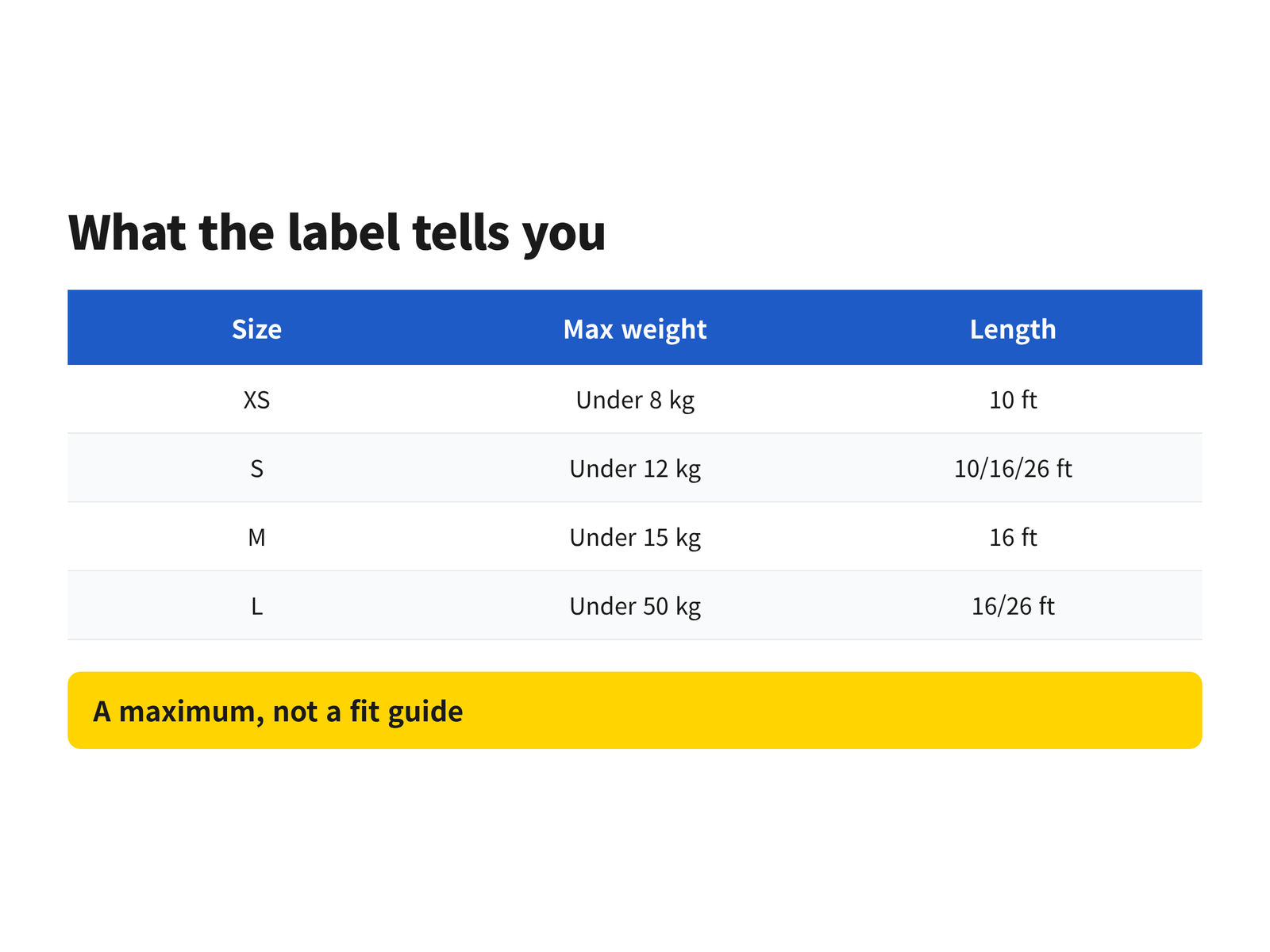
The flexi North America product range shows how broad those bands are:
- XS: under 8 kg, 10 ft (3 m) length
- S: under 12 kg, 10, 16 or 26 ft lengths
- M: under 15 kg, 16 ft length
- L: under 50 kg, 16 or 26 ft lengths
The smallest band covers every dog under 8 kg, so a tiny toy breed and a much heavier small terrier share one label. Nothing printed on a flexi retractable leash addresses how the reel behaves with a very light dog. The label confirms the leash will not be overloaded, and little else.
Is a retractable leash legal where the leash limit is six feet?
A retractable leash complies in a six-foot zone only while it is locked at six feet or shorter. Retractable leashes are not banned as products; the restriction is on the length in use.
In U.S. national parks, federal regulation 36 CFR 2.15 requires pets to be restrained “on a leash which shall not exceed six feet in length.” The National Park Service makes the point explicit on its Whiskeytown National Recreation Area page: “Federal, state, and county laws require that dogs be kept on a leash no longer than six feet, including retractable leashes.”
New York City sets a similar limit. NYC Health Code §161.05 requires a dog in a public place to be “effectively restrained by a leash or other restraint not more than six feet long,” with an off-leash exception in designated Parks areas from 9 p.m. to 9 a.m. In the UK, Highway Code Rule 56 tells walkers to keep a dog “on a short lead when walking on the pavement, road or path shared with cyclists or horse riders.” Rules elsewhere vary, so check the local ordinance.
What happens when a retractable leash snaps back?
When a retractable leash snaps back, the cord and metal clasp can fly toward the handler fast enough to injure an eye. flexi North America warns: “If the leash or your dog’s collar breaks, or if the leash disconnects from your dog’s collar, the cord/tape/belt and hook can snap back with enough force to cause serious eye damage.”
That warning is not hypothetical. In 2008 the U.S. Consumer Product Safety Commission announced a recall of about 223,000 SlyDog retractable leashes because the metal clasp could break. The recall notice listed five injury reports, including facial cuts, a broken tooth, a displaced eye lens and a bruised collarbone.
The handler’s hands are at risk too. flexi instructions warn that a cord wrapped around fingers “can amputate fingers or break bones,” and that cord running across skin can cause rope-burn-like abrasions or severe cuts. Hold the handle, never the cord or tape.
Should a small dog wear a collar or a harness with a retractable leash?
A collar concentrates the force of a sudden stop on the neck, so the choice of collar or harness matters more on a retractable leash than on a short one. In a 2020 study in Veterinary Record, Carter, McNally and Roshier attached collars to a simulated neck model and applied a firm pull of 40 N, a strong pull of 70 N and a jerk averaging 141 N. Pressure on the model neck ranged from 83 kPa to 832 kPa.
The authors concluded: “No single collar tested provided a pressure considered low enough to mitigate the risk of injury when pulling on the lead.” The study used a model neck, not live dogs, so the figures show relative pressure, not injury rates. The AKC separately warns that when a dog hits the end of a retractable leash, “your dog can suffer injuries like a damaged trachea or spine.”
The right setup depends on the individual dog. If your small dog has any neck or back history, consult your veterinarian before choosing between a collar and a harness for any leash, retractable or not.
When is a retractable leash a reasonable choice for a small dog?
A retractable leash is a reasonable choice for a small dog only in open, uncrowded spaces where six-foot rules do not apply. The AKC names an unfenced backyard and large open parks or fields with no other dogs or people nearby. The AKC lists places to avoid: pet stores, veterinary offices, crowded sidewalks and any multi-dog situation.
Where a retractable leash is allowed, a few habits lower the risk:
- Choose tape over cord for visibility, with a non-slip handle and bright or reflective markings (AKC).
- Hold the handle and never touch or wrap the tape or cord (flexi).
- Lock the leash short near roads, in line with Highway Code Rule 56.
- Check the leash for wear and replace it when worn.
The AKC also admits a real reason owners of tiny dogs reach for longer leads: “If you have a toy breed, you’ll find it difficult to use a very short leash.” A 6-foot standard leash answers that problem, giving a toy breed more room than a 4-foot one while staying inside every six-foot rule.
Retractable leash vs standard leash: which suits a toy breed better?
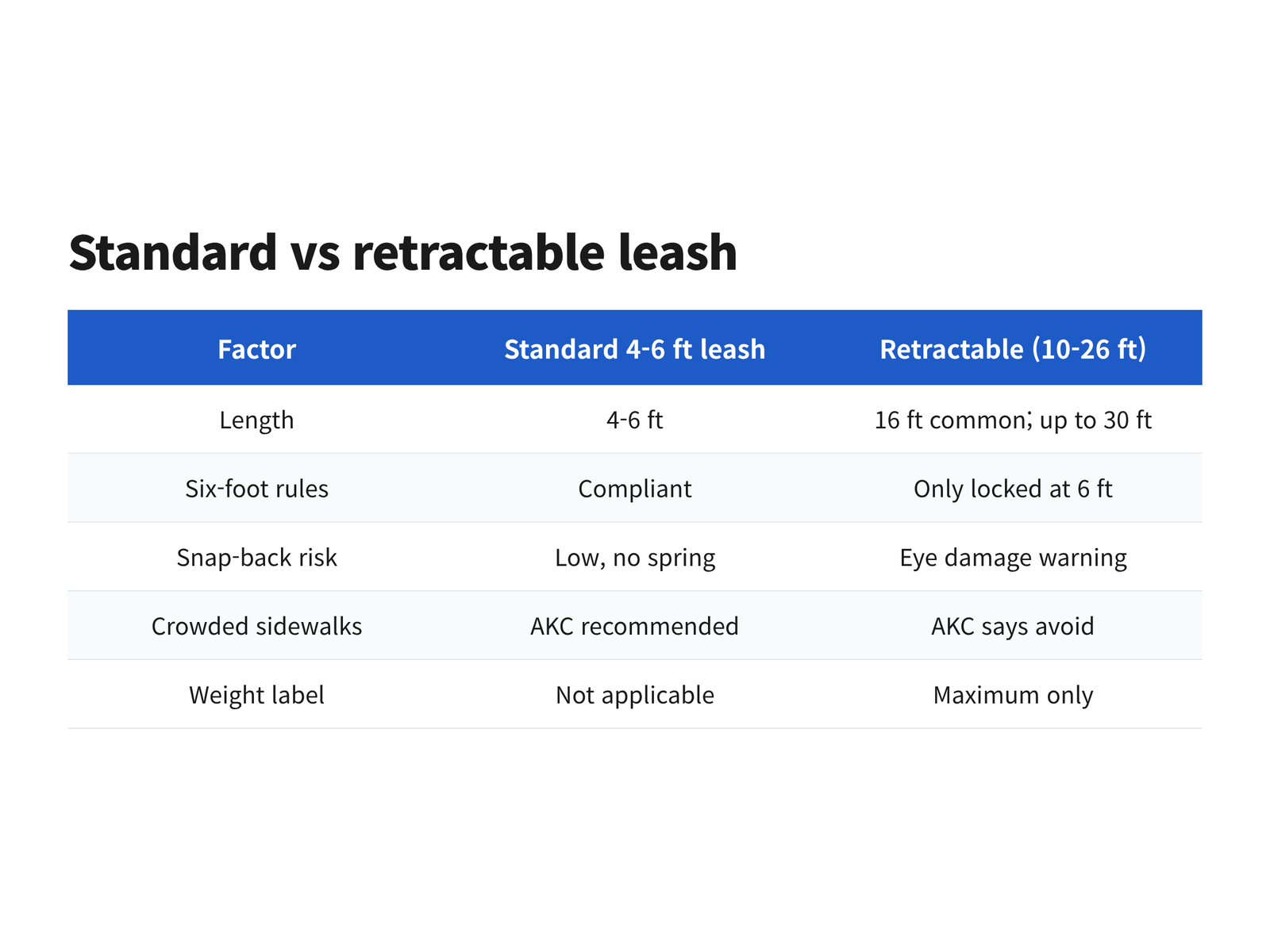
A standard 4 to 6 foot leash suits a toy breed better for everyday walks, and a retractable leash fits only open, empty ground. The table draws on AKC guidance, six-foot leash rules and manufacturer warnings.
| Factor | Standard 4-6 ft leash | Retractable (10-26 ft) |
|---|---|---|
| Length | 4-6 ft | 16 ft common; up to 30 ft |
| Six-foot rules | Compliant | Only locked at 6 ft |
| Snap-back risk | Low, no spring | Eye damage warning |
| Crowded sidewalks | AKC recommended | AKC says avoid |
| Weight label | Not applicable | Maximum only |
A standard leash stays legal, predictable and short enough to keep a small dog close, while a retractable leash trades control for distance. For a toy breed in towns, regulated parks or busy paths, the standard leash covers far more situations.
Frequently asked questions
Are retractable leashes illegal?
Retractable leashes are not banned as products. Under six-foot limits such as 36 CFR 2.15 in U.S. national parks, a retractable leash complies only when locked at six feet or shorter.
Is the smallest flexi size made for tiny dogs?
The flexi XS band covers dogs under 8 kg. That number is a maximum load, so the label confirms the leash will not be overloaded but says nothing about how well the reel suits a very light dog.
What is the main injury risk to the handler?
flexi warns that snap-back can cause serious eye damage and that a cord wrapped around fingers can amputate fingers or break bones. Holding only the handle reduces the hand risk.
Sources
- American Kennel Club, Stephanie Gibeault, “Retractable Dog Leashes: When and How to Use Them Safely,” updated 2026-03-10 — https://www.akc.org/expert-advice/training/retractable-dog-leashes-use-safely/
- American Kennel Club, Harriet Meyers, “Dog Leashes 101: Choosing the Right Dog Leash for Your Dog,” updated 2026-03-04 — https://www.akc.org/expert-advice/lifestyle/choosing-right-dog-leash/
- U.S. Code of Federal Regulations, 36 CFR 2.15 “Pets,” via Cornell Legal Information Institute, accessed 2026-10-02 — https://www.law.cornell.edu/cfr/text/36/2.15
- U.S. National Park Service, Whiskeytown National Recreation Area, “Pets,” accessed 2026-10-02 — https://www.nps.gov/whis/planyourvisit/pets.htm
- NYC Department of Health and Mental Hygiene, Health Code Article 161, §161.05, accessed 2026-10-02 — https://www.nyc.gov/assets/doh/downloads/pdf/about/healthcode/health-code-article161.pdf
- GOV.UK, The Highway Code, “Rules about animals (47 to 58),” Rule 56, accessed 2026-10-02 — https://www.gov.uk/guidance/the-highway-code/rules-about-animals-47-to-58
- U.S. Consumer Product Safety Commission, “Worldwise Inc. Recalls Retractable Dog Leashes; Metal Clasp Can Break and Cause Facial Injuries,” 2008-09-03 — https://www.cpsc.gov/Recalls/2008/worldwise-inc-recalls-retractable-dog-leashes-metal-clasp-can-break-and-cause-facial
- Carter A., McNally D., Roshier A., “Canine collars: an investigation of collar type and the forces applied to a simulated neck model,” Veterinary Record, 2020, doi:10.1136/vr.105681 — https://irep.ntu.ac.uk/id/eprint/39713/
- flexi North America, safety instructions and product size bands, accessed 2026-10-02 — https://www.flexi-northamerica.com/us/instructions/ and https://www.flexi-northamerica.com/us/products/