The Norfolk vs Norwich terrier difference comes down to the ears: the Norfolk Terrier has drop ears that fold forward, and the Norwich Terrier has prick ears that stand upright. Both breeds were shown as one breed until 1964, which is why the two still look so alike. Height, weight and coat overlap in the American Kennel Club standards, so none of those traits can separate a Norfolk from a Norwich. This guide sets the AKC and Kennel Club standards side by side and explains which traits work and which do not.

What is the main difference between a Norfolk and a Norwich terrier?
The main difference between a Norfolk and a Norwich terrier is ear carriage, and no other trait is reliable. The AKC Norfolk Terrier standard describes the ears as “Neatly dropped, small, with a break at the skull line, carried close to the cheek and not falling lower than the outer corner of the eye.” The AKC Norwich Terrier standard describes ears of “Medium size and erect. Set well apart with pointed tips. Upright when alert.” In short, a Norfolk ear folds over and a Norwich ear points up.
The AKC put the rule plainly in “Characteristics of the Norwich Terrier”: “The Norfolk has drop ears, and the Norwich has prick ears, a distinguishing feature of the breed.” The Kennel Club in London describes the Norfolk ear as “Medium-sized, V-shaped, slightly rounded at tip, dropping forward close to cheek.” The AKC article “5 Facts About Norfolk Terriers” also offers a simple memory aid for owners: “The ‘folk’ in ‘Norfolk’ sounds like ‘fold’ (the ear is folded over).” Folded means Norfolk; upright means Norwich.
When did the Norfolk and Norwich terriers become separate breeds?
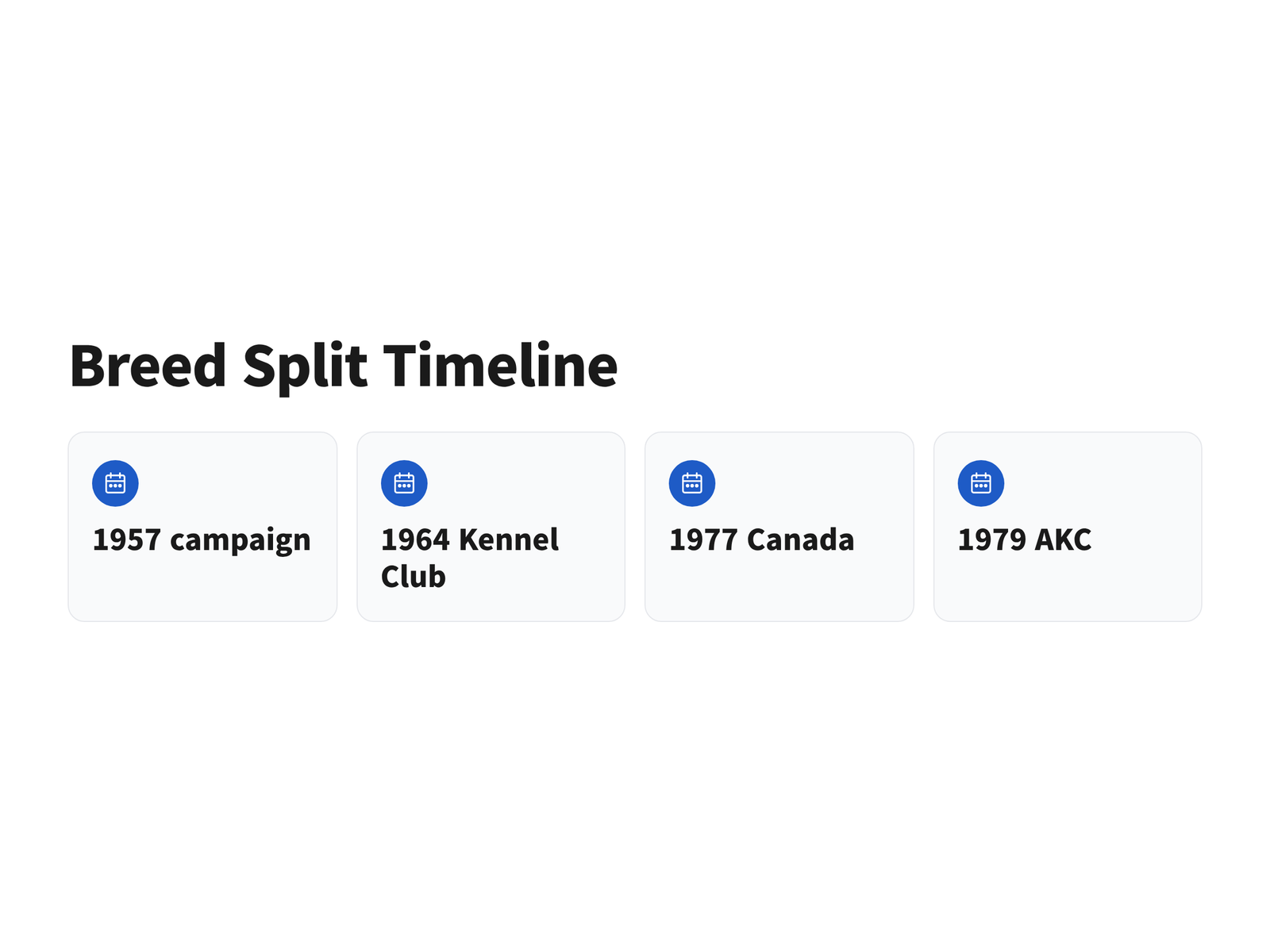
The Norfolk and Norwich terriers became separate breeds in 1964, when the Kennel Club in England split them. According to the Royal Kennel Club, breeders began campaigning for the separation in 1957. Other registries followed later: the Canadian Kennel Club recognized the split in 1977, and the American Kennel Club recognized the split in 1979.
The naming followed the ears. The AKC records it this way: “The prick-eared (ears up) variety continued to be called the Norwich, and the drop-eared (ears down) was renamed the Norfolk Terrier.” That history explains why an older photo or pedigree labelled “Norwich” may show a drop-eared dog. Before 1964 in England, and before 1979 in the United States, both ear types were registered under the Norwich name.
Why can’t size tell a Norfolk terrier from a Norwich terrier?
Size cannot tell a Norfolk terrier from a Norwich terrier because the official ranges overlap. The AKC Norfolk Terrier standard gives a height of 9 to 10 inches at the withers and a weight of 11 to 12 pounds. The AKC Norwich Terrier standard gives an ideal height of not over 10 inches at the withers and a weight of about 12 pounds. A 10-inch, 12-pound terrier fits both descriptions.
The Kennel Club Norfolk standard gives an ideal height of 25 cm, which is about 10 inches, so the British figure lands in the same overlap zone. A matching Kennel Club height for the Norwich could not be confirmed for this article, so only the AKC Norwich figures are used here. The practical point is simple: a tape measure or a bathroom scale will not settle a Norfolk vs Norwich question. Look at the ears instead.
Does coat type help tell the two breeds apart?
Coat type does not help, because both AKC standards describe the same coat. The Norfolk and Norwich standards both call for a coat that is “hard, wiry and straight” with a definite undercoat. The AKC Norfolk standard adds a coat length of about 1.5 to 2 inches, but the Norwich standard describes the same texture, so length and feel do not divide the breeds either.
Coat color is also not a dependable tool for this question, because the breed standards cited in this guide do not use color to separate a Norfolk from a Norwich. A shared ancestry before 1964 means the two breeds still share most of their outward traits. The Royal Kennel Club even lists matching care needs for both: exercise of up to 1 hour per day and grooming more than once a week.
Why shouldn’t a Norfolk or Norwich terrier coat be clipped into a shape?
A Norfolk or Norwich terrier coat should not be clipped into a shape because both breed standards penalize shaping. The AKC Norwich Terrier standard states: “This breed should be shown with as natural a coat as possible. A minimum of tidying is permissible but shaping should be heavily penalized.” The AKC Norfolk Terrier standard says: “Some tidying is necessary to keep the dog neat, but shaping should be heavily penalized.”
The Kennel Club Norfolk standard takes the same line: “Excessive trimming undesirable.” These rules describe how the breeds should look in the show ring. Whether clipping changes coat texture or color over time could not be confirmed from an authoritative source, so this guide makes no claim about coat damage. A pet owner who wants a natural breed look can ask a groomer for light tidying rather than a shaped cut.
Which of the two is rarer in the UK?
The Norwich Terrier is the rarer of the two in the UK. The Royal Kennel Club lists the Norwich Terrier as a Vulnerable Native Breed, and the Norfolk Terrier is not on that list. The Royal Kennel Club describes the Norwich as “the smallest of the terrier breeds but with great substance for their size and characters to match.”
Rarity can affect how easy a puppy is to find, but no confirmed figures on waiting times, prices or annual registrations were found for either breed. Anyone looking for a Norwich puppy in Britain can ask the breed club or the Royal Kennel Club for current breeder contacts rather than relying on a general estimate.
How do the AKC standards compare side by side?
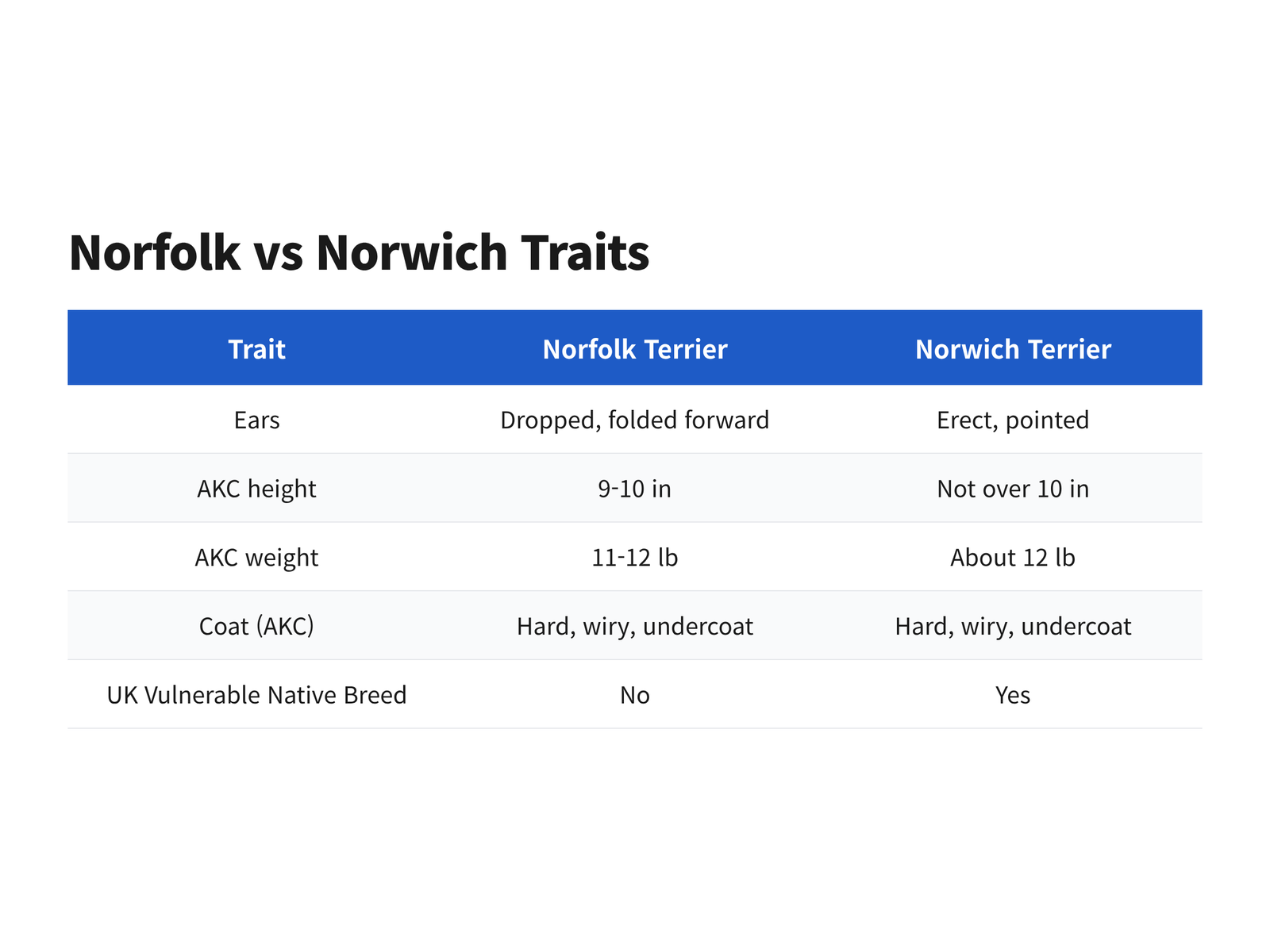
The AKC standards show one clear split, the ears, and near-identical numbers everywhere else. The table below sets five traits next to each other. Only the first row and the last row differ in a meaningful way. The height, weight and coat rows show why owners and even some sellers mix up the Norfolk Terrier and the Norwich Terrier.
| Trait | Norfolk Terrier | Norwich Terrier |
|---|---|---|
| Ears | Dropped, folded forward | Erect, pointed |
| AKC height | 9-10 in | Not over 10 in |
| AKC weight | 11-12 lb | About 12 lb |
| Coat (AKC) | Hard, wiry, undercoat | Hard, wiry, undercoat |
| UK Vulnerable Native Breed | No | Yes |
Are Norfolk and Norwich terriers small lap dogs?
Norfolk and Norwich terriers are small, but neither breed is a lap dog by temperament. The AKC Norfolk breed page says: “Norfolks, despite their toyish qualities, are genuine terriers—feisty, confident, sturdy, and game for adventure.” The Royal Kennel Club gives both breeds an exercise need of up to 1 hour per day and a lifespan of over 10 years.
Which breed suits a household depends on the owner, not on a ranking, since the care needs listed by the Royal Kennel Club are the same for both. Anyone with questions about weight, activity level or long-term care for a specific Norfolk or Norwich should consult your veterinarian, who can assess the individual dog.
Frequently asked questions
Is a Norfolk terrier just a Norwich terrier with folded ears?
A Norfolk terrier was once registered as a drop-eared Norwich, but the Norfolk has been a separate breed since 1964 in England and 1979 in the United States. Today the two breeds have separate standards and separate registrations.
How can papers confirm a Norfolk vs Norwich terrier?
Registration papers from the American Kennel Club or the Kennel Club name the breed directly. Because the registries have kept the breeds apart since 1979 and 1964, recent papers settle the question when ear carriage is unclear.
Is a Norwich terrier smaller than a Norfolk terrier?
A Norwich terrier is not reliably smaller. The AKC standards give the Norfolk 9 to 10 inches and 11 to 12 pounds, and the Norwich up to 10 inches and about 12 pounds, so the ranges overlap.
Should a Norfolk terrier be clipped short in summer? The breed standards penalize shaping and call for a natural coat with only light tidying. For any coat or skin concern on an individual dog, consult your veterinarian.
Sources
- American Kennel Club, “Norfolk Terrier Breed Standard”, approved 1981-10-13, reformatted 1990-03-23 — https://images.akc.org/pdf/breeds/standards/NorfolkTerrier.pdf
- American Kennel Club, “Norwich Terrier Breed Standard”, approved 1981-10-13, reformatted 1990-03-23 — https://images.akc.org/pdf/breeds/standards/NorwichTerrier.pdf
- American Kennel Club, “5 Facts About Norfolk Terriers”, Bud Boccone, updated 2026-08-13 — https://www.akc.org/expert-advice/lifestyle/5-facts-norfolk-terriers/
- American Kennel Club, “Characteristics of the Norwich Terrier”, Jan Reisen, updated 2017-10-24 — https://www.akc.org/expert-advice/lifestyle/characteristics-of-the-norwich-terrier/
- American Kennel Club, “Norfolk Terrier” breed page — https://www.akc.org/dog-breeds/norfolk-terrier/
- Royal Kennel Club, “Norfolk Terrier” breed page — https://www.royalkennelclub.com/search/breeds-a-to-z/breeds/terrier/norfolk-terrier
- Royal Kennel Club, “Norwich Terrier” breed page — https://www.royalkennelclub.com/search/breeds-a-to-z/breeds/terrier/norwich-terrier
- The Kennel Club, “Norfolk Terrier Breed Standard” (KUSA reprint), changes effective 2026-01-01 — https://www.kusa.co.za/images/breed%20stds%20djaki/Norfolk%20Terrier%20-%20KC%20[01-2026].pdf