The Lancashire Heeler vs corgi question has a short answer: the two breeds stand at almost the same height, but the Lancashire Heeler is lighter, far less long in the body and limited to two coat colors. The Lancashire Heeler is also not a corgi mix. The Lancashire Heeler is a purebred herding dog recognized by The Kennel Club in 1981 and by the American Kennel Club in 2024. The sections below set the official breed standards side by side so the differences are measurable rather than a matter of looks.

How big is a Lancashire Heeler compared to a Pembroke Welsh Corgi?
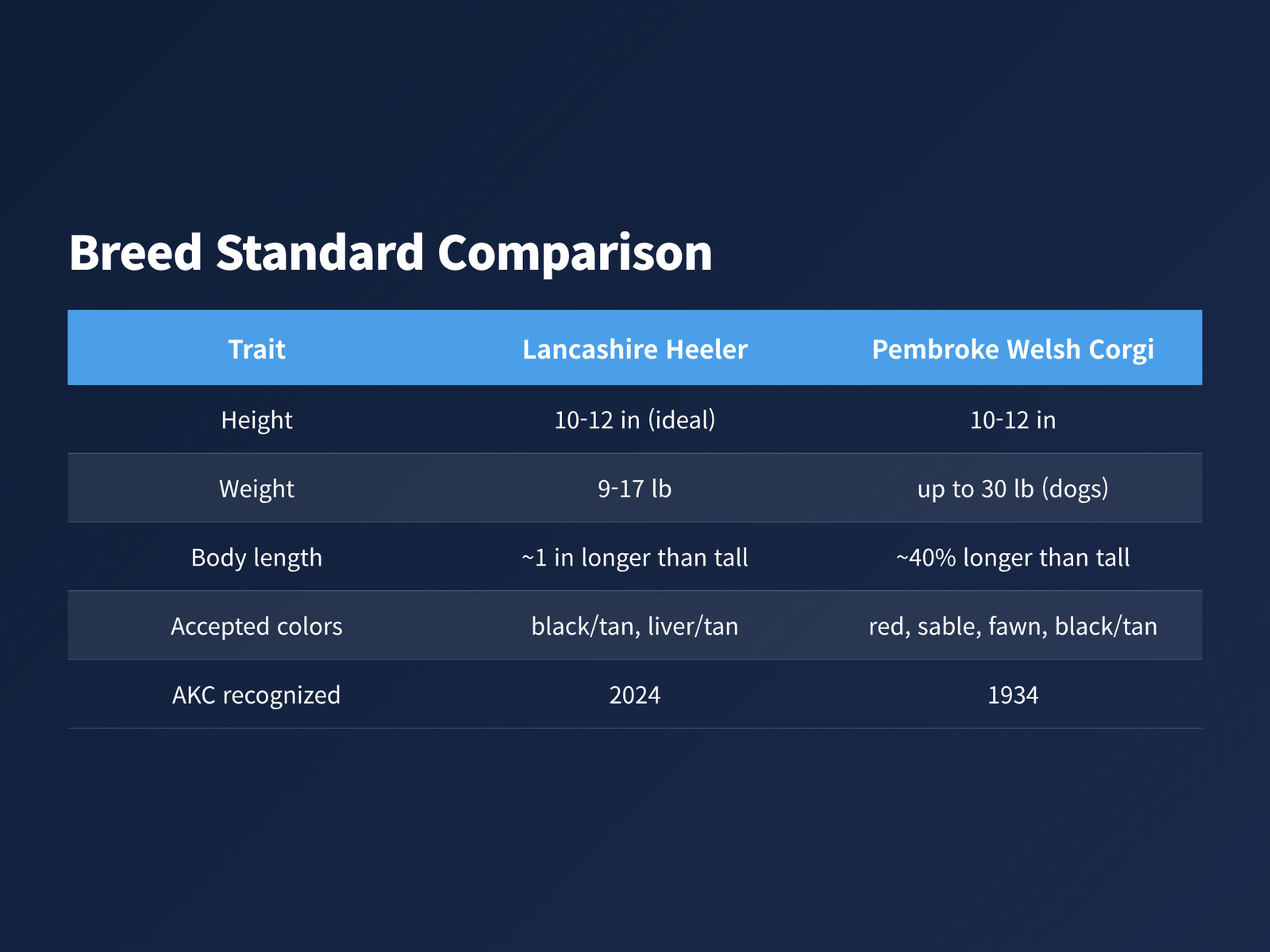
A Lancashire Heeler matches a Pembroke Welsh Corgi in height but weighs roughly half as much at the top of the range. The AKC standard gives an ideal height of 12 in for Lancashire Heeler males and 10 in for females, while the Pembroke Welsh Corgi standard sets 10 to 12 in. The Kennel Club in the UK lists 30 cm for males and 25 cm for females, and describes those figures as guides rather than strict limits.
Weight is where the two breeds separate. The AKC puts the Lancashire Heeler at 9 to 17 lb. The Pembroke Welsh Corgi standard caps males at 30 lb and females at 28 lb, and the AKC Breed Weight Chart lists the Pembroke at 28 to 30 lb. A Pembroke Welsh Corgi at standard weight can therefore be close to double a heavy Lancashire Heeler, even though both dogs reach about the same point on a measuring stick.
| Trait | Lancashire Heeler | Pembroke Welsh Corgi |
|---|---|---|
| Height | 10-12 in (ideal) | 10-12 in |
| Weight | 9-17 lb | up to 30 lb (dogs) |
| Body length | ~1 in longer than tall | ~40% longer than tall |
| Accepted colors | black/tan, liver/tan | red, sable, fawn, black/tan |
| AKC recognized | 2024 | 1934 |
Is a Lancashire Heeler a corgi mix or a “mini corgi”?
No. The Lancashire Heeler is a purebred, not a crossbreed and not a “mini corgi.” The Kennel Club recognized the Lancashire Heeler in 1981, and the American Kennel Club made the Lancashire Heeler its 201st recognized breed in 2024, placing the breed in the Herding Group. “We are excited to welcome the Lancashire Heeler to the AKC registry as our 201st breed,” said Gina DiNardo, AKC Executive Secretary, at the time of recognition.
The corgi link comes from origin stories, not from current breeding. The AKC breed history describes the Lancashire Heeler’s origin as unclear and treats ancestry from the Manchester Terrier and the Cardigan Welsh Corgi as only “some theories.” The same AKC article notes that, genetically, the coats and colors of the Lancashire Heeler and the Swedish Vallhund are closely related. The Lancashire Heeler developed around Ormskirk in West Lancashire, England, as a dog that drove cattle and caught rats. A shared resemblance to a corgi reflects a similar working job, not a recent cross.
Is a Lancashire Heeler as long-backed as a corgi?
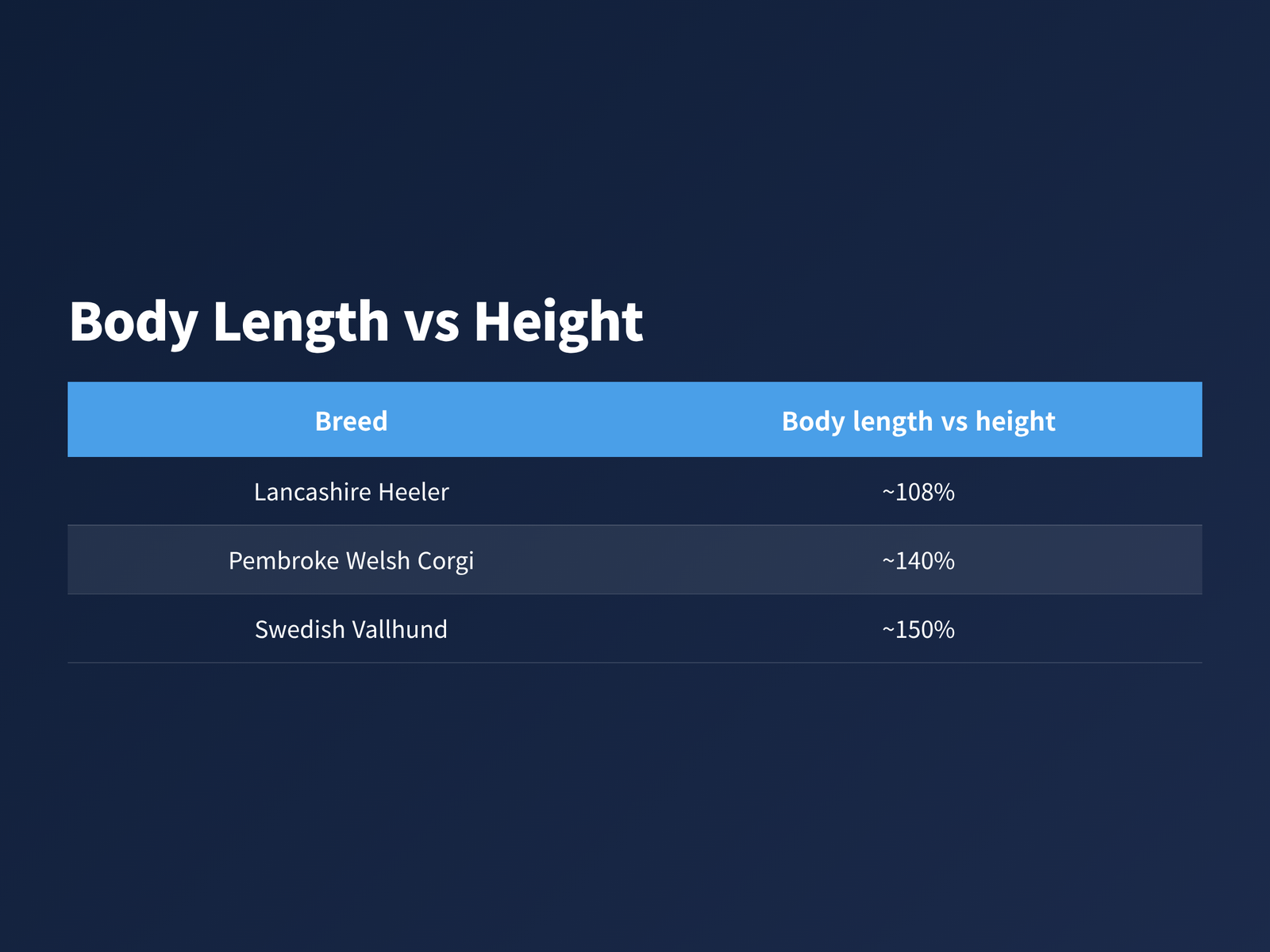
A Lancashire Heeler is not nearly as long-backed as a Pembroke Welsh Corgi. The AKC standard says the Lancashire Heeler’s body length is “approximately 1 inch longer than height at withers.” The Pembroke Welsh Corgi standard sets body length at “approximately 40 percent greater than” the distance from the withers to the ground. That proportion gap is the single clearest structural difference between the two breeds.
Put into percentages based on the AKC standards, a 12 in Lancashire Heeler male is roughly 108 percent as long as he is tall, while a Pembroke Welsh Corgi is about 140 percent. The Swedish Vallhund standard gives a height-to-length ratio of 2:3, which works out to about 150 percent. Among the three breeds, the Lancashire Heeler is the least elongated. Jeff Kestner, an AKC-licensed judge with the United States Lancashire Heeler Club, notes that “the Heeler is purposely built low to the ground,” but low does not mean long in this breed.
This matters for gear. Fit advice written for long-backed breeds does not transfer automatically to a Lancashire Heeler, whose body is close to square by comparison. Measuring the individual dog gives a better guide than borrowing sizing logic from corgi owners.
Which coat colors and coat lengths does each breed standard reject?
The Lancashire Heeler standard accepts only black and tan or liver and tan, while the Pembroke Welsh Corgi standard accepts four color options. The Kennel Club standard states that for the Lancashire Heeler “any other colour or combination is unacceptable.” The AKC standard also treats white markings as undesirable, including a small white spot on the chest.
The Pembroke Welsh Corgi standard allows red, sable, fawn, and black and tan, with or without white markings. Color faults for the Pembroke Welsh Corgi, known as whitelies, bluies and mismarks, are very seriously penalized.
Coat length draws a hard line in both breeds. The Lancashire Heeler should carry a “weather resistant, short, thick, hard, flat topcoat,” and a long or excessively wavy coat is “highly undesirable.” The Pembroke Welsh Corgi standard calls “fluffies,” a coat of extreme length with exaggerated feathering, a “Very Serious Fault.” The AKC Lancashire Heeler standard lists no disqualifications at all, so these points are faults rather than grounds for removal from the show ring.
How much grooming and exercise does each breed need, according to the kennel clubs?
The Kennel Club suggests grooming a Lancashire Heeler once a week and exercising the breed for up to 1 hour per day. The Kennel Club also describes the Lancashire Heeler coat as short and shedding, so the breed should not be treated as low-shedding. The AKC advises daily brushing for the Pembroke Welsh Corgi and says the Pembroke sheds “a fair amount on a daily basis.”
The kennel clubs have not published a matching exercise figure for the Pembroke Welsh Corgi in the sources reviewed here, so no direct exercise comparison is offered. The Lancashire Heeler was developed as a working cattle dog, and the Kennel Club notes the Lancashire Heeler also has terrier instincts when rabbiting and ratting. How that translates to a daily routine depends on the individual dog.
Which health screenings should a Lancashire Heeler breeder be able to show?
A Lancashire Heeler breeder should be able to show results for primary lens luxation (PLL), Collie eye anomaly (CEA) and patellar luxation testing. According to the AKC, the national breed club requires those three tests for its members, recommends annual eye and patella recertification, and treats hip and elbow evaluations as optional. The Kennel Club lists DNA tests for CEA/CH and PLL for the breed.
Buyers can ask for the parents’ PLL, CEA and patella results and for confirmation that the puppies were eye-certified by a board-certified veterinary ophthalmologist before sale, as the AKC describes. The University of Cambridge Canine Genetics Centre has reported that the known PLL variant was absent in some Lancashire Heeler PLL cases, so a DNA test may not catch every case. Screening records are not a health guarantee, so consult your veterinarian with any questions about an individual dog.
Why are Lancashire Heelers so hard to find?
Lancashire Heelers are hard to find because very few are bred each year. The Kennel Club classifies the Lancashire Heeler as a vulnerable native breed, a status that applies to breeds with 300 or fewer UK puppy registrations in the previous year. The Kennel Club counted 35 breeds in that category in 2024.
Jeff Kestner of the United States Lancashire Heeler Club puts the scarcity plainly: “As a result, breeders aren’t producing many of these dogs anywhere in the world.” In the UK, the Kennel Club Assured Breeders listing for the Lancashire Heeler is one place to start a search. Breeder Sheryl Bradbury offers a caution for anyone who does find a litter: “I always caution buyers to not let a puppy’s cuteness fool you.”
Frequently asked questions
Is a Lancashire Heeler smaller than a corgi?
A Lancashire Heeler is about the same height as a Pembroke Welsh Corgi but lighter, at 9 to 17 lb against up to 30 lb for a Pembroke male. The Lancashire Heeler is also much shorter in the body.
Is the Lancashire Heeler related to the Swedish Vallhund?
The AKC breed history notes that, genetically, the coats and colors of the Lancashire Heeler and the Swedish Vallhund are closely related. The Swedish Vallhund is longer in proportion, with a 2:3 height-to-length ratio.
How long does a Lancashire Heeler live?
The AKC gives a lifespan of 12 to 15 years for the Lancashire Heeler, and the Kennel Club states “over 12 years.”
Is a Lancashire Heeler a good fit for a first-time owner?
That depends on the household. The breed standard describes the temperament as “courageous, happy, affectionate to owner,” and breeder Sheryl Bradbury calls the Lancashire Heeler “a breed that will work hard all day and is happy to curl up at your side and watch the TV news at night.”
Sources
- The Kennel Club, “Lancashire Heeler breed standard”, updated 2025-04-01 – https://thekennelclub.org.uk/breed-standards/pastoral/lancashire-heeler
- The Kennel Club, Breed Information Centre, “Lancashire Heeler” – https://thekennelclub.org.uk/services/public/breed/display.aspx?id=5175
- The Kennel Club, “Top vulnerable breeds to compete at Crufts 2025” – https://www.thekennelclub.org.uk/media-centre/2025/february/top-vulnerable-breeds-to-compete-at-crufts-2025/
- American Kennel Club, “Official Standard of the Lancashire Heeler”, approved 2017-10-09, effective 2018-06-27 – https://images.akc.org/pdf/breeds/standards/Lancashire_Heeler.pdf
- American Kennel Club, “Official Standard of the Pembroke Welsh Corgi”, approved 1972-06-13 – https://images.akc.org/pdf/breeds/standards/PembrokeWelshCorgi.pdf
- American Kennel Club, “Official Standard of the Swedish Vallhund”, effective 2005-09-01 – https://images.akc.org/pdf/breeds/standards/SwedishVallhund.pdf
- American Kennel Club, “American Kennel Club’s Pack Expands in 2024”, 2024-01-03 – https://www.akc.org/press-releases/american-kennel-clubs-pack-expands-2024/
- American Kennel Club, “Meet the Lancashire Heeler, AKC’s Newest Recognized Dog Breed” (Ranny Green), 2024-01-04 – https://www.akc.org/expert-advice/dog-breeds/lancashire-heeler-newest-akc-recognized-breed/
- American Kennel Club, “Lancashire Heeler History: From Viking Passengers to Valued Herders” (Elaine Waldorf Gewirtz), 2024-01-08 – https://www.akc.org/expert-advice/dog-breeds/lancashire-heeler-breed-history/
- American Kennel Club, “Breed Weight Chart”, updated 2023-04-26 – https://www.akc.org/expert-advice/nutrition/breed-weight-chart/
- American Kennel Club, “Breeds by Year Recognized” – https://www.akc.org/press-center/articles-resources/facts-and-stats/breeds-year-recognized/
- American Kennel Club, “Is the Pembroke Welsh Corgi a Good Fit for Your Lifestyle?” (Micaela Erickson), 2026-02-24 – https://www.akc.org/expert-advice/dog-breeds/pembroke-welsh-corgi-right-for-you/
- University of Cambridge, Canine Genetics Centre, “Primary lens luxation in the Lancashire Heeler”, 2025-04-04 – https://www.canine-genetics.org.uk/primary-lens-luxation-in-the-lancashire-heeler/