The Coton de Tulear and the Havanese stand at nearly the same height, but kennel club standards treat them very differently on color, coat and show trimming. A Coton de Tulear must be white with no definite black, while a Havanese may be almost any color, and neither breed is proven hypoallergenic. The Coton de Tulear is a small white companion breed from Madagascar; the American Kennel Club (AKC) calls the Havanese “the only dog breed native to Cuba.” Figures below come from the FCI, AKC, Royal Kennel Club and Canadian Kennel Club (CKC) standards.
How big is a Coton de Tulear compared with a Havanese?
Under the FCI standards, a Coton de Tulear and a Havanese overlap almost completely in height. The FCI sets Coton de Tulear males at 26–28 cm and females at 23–25 cm, with a tolerance of +2 cm and −1 cm. The FCI Havanese standard gives one range for both sexes, 23–27 cm, with a tolerance of 21–29 cm. The AKC Havanese standard describes an ideal of 9–10½ in and an acceptable range of 8½–11½ in.
Weight is where the two breed standards split. The FCI gives Coton de Tulear weights of 4–6 kg maximum for males and 3.5–5 kg maximum for females, and the AKC elaboration lists an ideal of 9–15 lb for males and 8–13 lb for females. No kennel club sets a numeric weight for the Havanese; the CKC says only “weight proportionate to height and bone.”
Why do kennel clubs give different size ranges for the same breed?
Each kennel club writes and revises its own breed standard, so the same breed can carry slightly different numbers in different countries. The Coton de Tulear shows this clearly, because four major registries publish separate male and female height ranges:
- FCI: males 26–28 cm, females 23–25 cm (tolerance +2/−1 cm)
- AKC elaboration: ideal males 10–11 in, ideal females 9–10 in
- Royal Kennel Club (UK): males 25–30 cm, females 22–27 cm
- Canadian Kennel Club: males 25–28 cm, females 23–25 cm (tolerance +2/−1 cm)
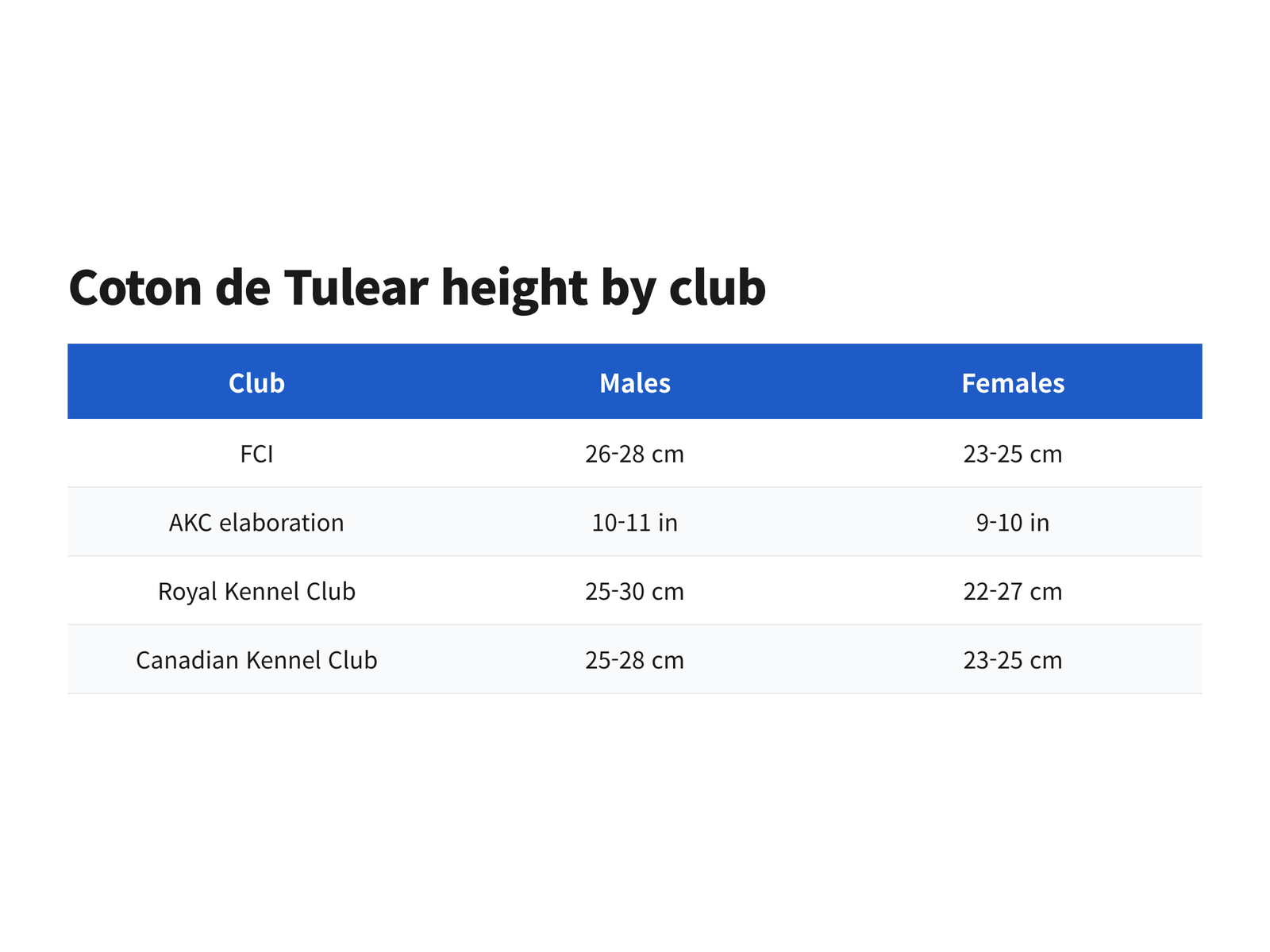
In practice, a Coton de Tulear female at 26 cm fits the Royal Kennel Club range of 22–27 cm but sits above the FCI range of 23–25 cm before tolerance. The Royal Kennel Club states that its figures are a guide and individual dogs may be larger or smaller. The AKC elaboration sets height disqualifications: any bitch “less than 8.5 inches or taller than 11 inches” (minimum not applied under 12 months) and any dog “less than 9.5 inches or taller than 12 inches.”
Do the Coton de Tulear and Havanese have the same coat?
No, the Coton de Tulear and the Havanese have different coat textures and different undercoat rules. The FCI describes the Coton de Tulear coat as “very soft and supple, with the texture of cotton,” and the CKC adds that it is “never hard or rough.” The Royal Kennel Club standard reads: “Of unique cotton texture without woolly undercoat.” The AKC adds: “Their long coat requires daily grooming.” For skin or coat concerns beyond routine brushing, consult your veterinarian.
The Havanese coat is silkier and longer. The FCI Havanese standard describes the topcoat as “very long (12–18 cm in an adult), soft, flat or wavy,” with an undercoat that is “woolly and not very developed, and is often totally absent.” The Royal Kennel Club describes the Havanese as “full coated with an undercoat.” Faults differ too: the FCI and CKC disqualify tightly curled, woolly or silky hair on a Coton de Tulear, while the AKC disqualifies a coarse, wiry or short, smooth Havanese coat.
Why can a Havanese come in almost any color while a Coton must be white?
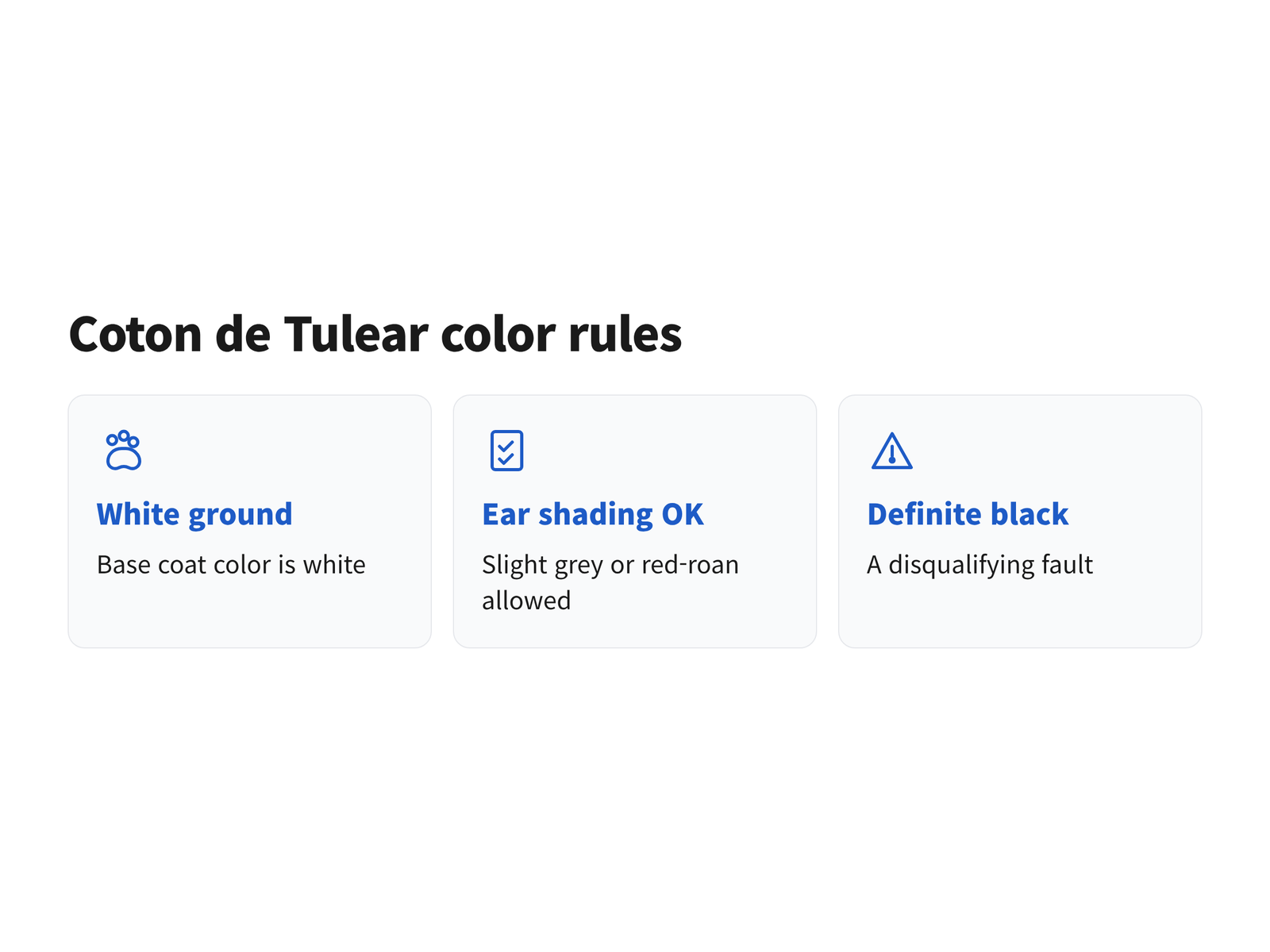
The Coton de Tulear standards are built around a white ground color, while the Havanese standards accept nearly every color. The FCI permits only slight light grey or red-roan shading on a Coton de Tulear’s ears, and the Royal Kennel Club states: “Any other colour or combination of colours unacceptable.” The FCI and CKC disqualify a Coton that is “Heavily marked; any marking of a definite black.” The AKC elaboration adds: “Black on the body is a disqualification at any age.”
The AKC elaboration says Coton de Tulear puppies under 12 months may show light tan, light brown, dark brown, chestnut or grey, which may fade by one year. Adults over 12 months may carry light tan shading on up to 5% of the body.
The Havanese standards take the opposite approach to color. The Royal Kennel Club allows “any colour or combination of colours permissible, except merle.” The FCI Havanese standard lists fawn, black, havana-brown, tobacco and reddish-brown, along with patches and tan markings.
Can you trim a Havanese or a Coton de Tulear for the show ring?
For the show ring, the Havanese standards forbid scissoring and trimming, while the Coton de Tulear standards set no such ban. The FCI Havanese standard forbids all grooming, any use of scissors to even out coat length, and all trimming, with exceptions for the feet and slight tidying of the forehead and muzzle. The AKC Havanese standard adds: “No other trimming or sculpting of the coat is permitted.”
The Coton de Tulear rules focus on coat length instead. The AKC elaboration says the coat does not need to reach the ground, and adult coats that stop 1–3 in above the ground are equally acceptable. No scissoring ban appears in the Coton de Tulear standards. Both sets of rules describe the ideal show dog, not grooming rules for a pet at home.
Is the Coton de Tulear or the Havanese really hypoallergenic?
No, neither the Coton de Tulear nor the Havanese is truly hypoallergenic. The American Kennel Club states that “there are no 100% hypoallergenic dogs, dog breeds, or mixed-breeds.” The AKC also explains: “Dander, which clings to pet hair, is what causes most pet allergies in people.”
The strongest evidence is a 2012 peer-reviewed study by Vredegoor and colleagues in the Journal of Allergy and Clinical Immunology. The researchers measured the dog allergen Can f 1 and found higher levels in so-called hypoallergenic breeds: a hair geometric mean of 2.26 versus 0.77 μg/g, and coat levels of 27.04 versus 12.98 μg/g (n = 196 versus 160). Airborne allergen levels showed no breed difference. The authors concluded: “There is no evidence for the classification of certain dog breeds as being ‘hypoallergenic.'”
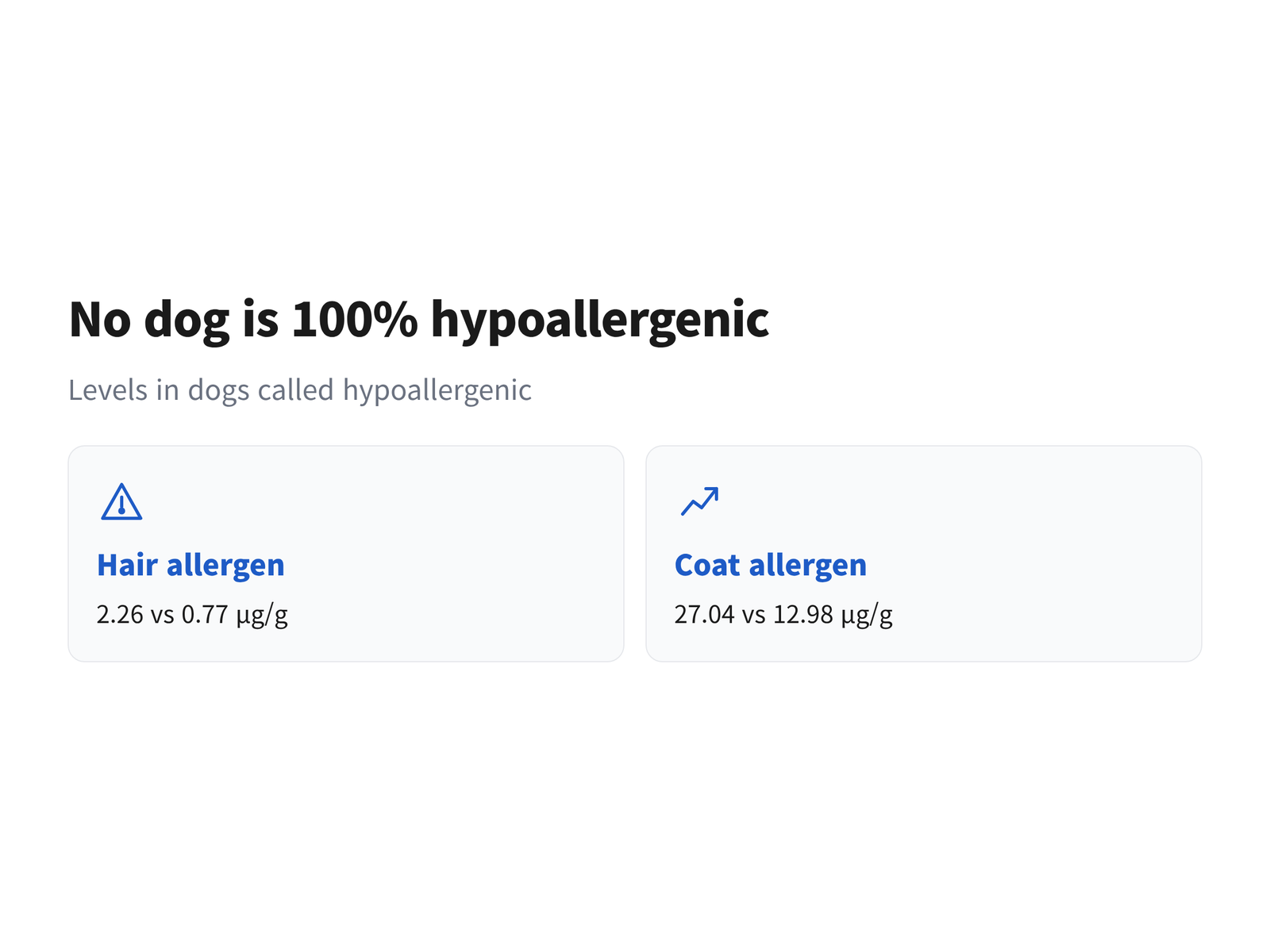
That study compared the Labradoodle, Poodle, Spanish Waterdog and Airedale Terrier against Labrador Retrievers. Neither the Coton de Tulear nor the Havanese was included, so the study offers no allergen data on either breed. If you have a dog allergy, talk with your doctor or an allergist before choosing a breed.
Coton de Tulear vs Havanese at a glance
| Coton de Tulear | Havanese | |
|---|---|---|
| Height (FCI) | M 26–28 cm, F 23–25 cm | 23–27 cm (tolerance 21–29) |
| Weight in standard | M 4–6 kg, F 3.5–5 kg | None set |
| Color | White only, no definite black | Almost any (UK: not merle) |
| Coat | Cotton texture, no woolly undercoat | Silky, light undercoat or none |
| Show trimming | No scissoring ban found | Scissoring and trimming forbidden |
Frequently asked questions
Can a Coton de Tulear have black markings?
Not under the show standards. The FCI, CKC and AKC rules all disqualify definite black on a Coton de Tulear, although puppies under 12 months may show darker shading that can fade by one year.
Does the Havanese have a weight standard?
No. The FCI, the Royal Kennel Club and the CKC set no numeric Havanese weight, and the CKC asks only for “weight proportionate to height and bone,” so any Havanese weight range on a comparison site comes from outside the breed standards.
Why is the Coton de Tulear Non-Sporting at the AKC but the Havanese Toy?
Placement depends on the registry. The AKC places the Coton de Tulear in the Non-Sporting Group and the Havanese in Toy, while the FCI puts both in Group 9, Companion and Toy, and the Royal Kennel Club lists both as Toy.
Sources
- Fédération Cynologique Internationale, “FCI-Standard N° 283 Coton de Tuléar,” valid 25.11.1999 — https://WWW.FCI.BE/Nomenclature/Standards/283g09-en.pdf
- Fédération Cynologique Internationale, “FCI-Standard N° 250 Havanese / Bichon Havanais,” valid 31.10.2016 — https://WWW.FCI.BE/Nomenclature/Standards/250g09-en.pdf
- American Kennel Club / USACTC, “Coton de Tulear study guide,” approved 2019-11-06 — https://www.akc.org/wp-content/uploads/2021/06/Coton-study-guide.pdf
- American Kennel Club, Havanese breed standard, approved 2011-08-09 (off-site copy) — https://a.storyblok.com/f/92981/x/dcb9377336/akc-havanese.pdf
- American Kennel Club, “A Royal Dog and Expert Hunter Join AKC Family,” 2014-04-28 — https://www.akc.org/press-releases/a-royal-dog-and-expert-hunter-join-akc-family/
- American Kennel Club, “Hypoallergenic Dogs” — https://www.akc.org/dog-breeds/hypoallergenic-dogs/
- American Kennel Club, “Hypoallergenic Dog Breeds,” updated 2026-08-17 — https://www.akc.org/expert-advice/dog-breeds/hypoallergenic-dog-breeds/
- American Kennel Club, “FAQ: Allergies” — https://www.akc.org/about/faq-allergies/2/
- American Kennel Club, “Havanese History: Bouncing Back From Exile,” updated 2026-10-29 — https://www.akc.org/expert-advice/dog-breeds/havanese-history-bouncing-back-from-exile/
- American Kennel Club, Havanese breed page — https://www.akc.org/dog-breeds/havanese/
- Royal Kennel Club (UK), “Coton de Tulear breed standard,” updated 2026-04-01 — https://www.royalkennelclub.com/breed-standards/toy/coton-de-tulear
- Royal Kennel Club (UK), “Havanese breed standard,” updated 2025-04 — https://www.royalkennelclub.com/breed-standards/toy/havanese
- Canadian Kennel Club, “Coton de Tulear breed standard,” effective 2007-01 — https://www.ckc.ca/CanadianKennelClub/media/Breed-Standards/Group%205/Coton-De-Tulear.pdf
- Canadian Kennel Club, “Havanese breed standard,” effective 2011-01 — https://www.ckc.ca/CanadianKennelClub/media/Breed-Standards/Group%205/Havanese.pdf
- Vredegoor DW, Willemse T, Chapman MD, Heederik DJJ, Krop EJM, “Can f 1 levels in hair and homes of different dog breeds: Lack of evidence to describe any dog breed as hypoallergenic,” Journal of Allergy and Clinical Immunology, 2012;130(4):904-909.e7, doi:10.1016/j.jaci.2012.05.013 — https://research-portal.uu.nl/en/publications/can-f-1-levels-in-hair-and-homes-of-different-dog-breeds-lack-of-/