In most United States national parks, no. The National Park Service applies pet rules to a dog whether that dog walks or is carried, and Yellowstone National Park names arms, strollers, backpacks and carriers in writing. A five kilogram miniature dachshund gets no size exemption. This guide covers the federal leash limit, what a campground booking does and does not permit, where a small dog can legally walk, and why a low-slung dog needs raised bedding in fall.

Can you carry a small dog on a national park trail where dogs are not allowed?
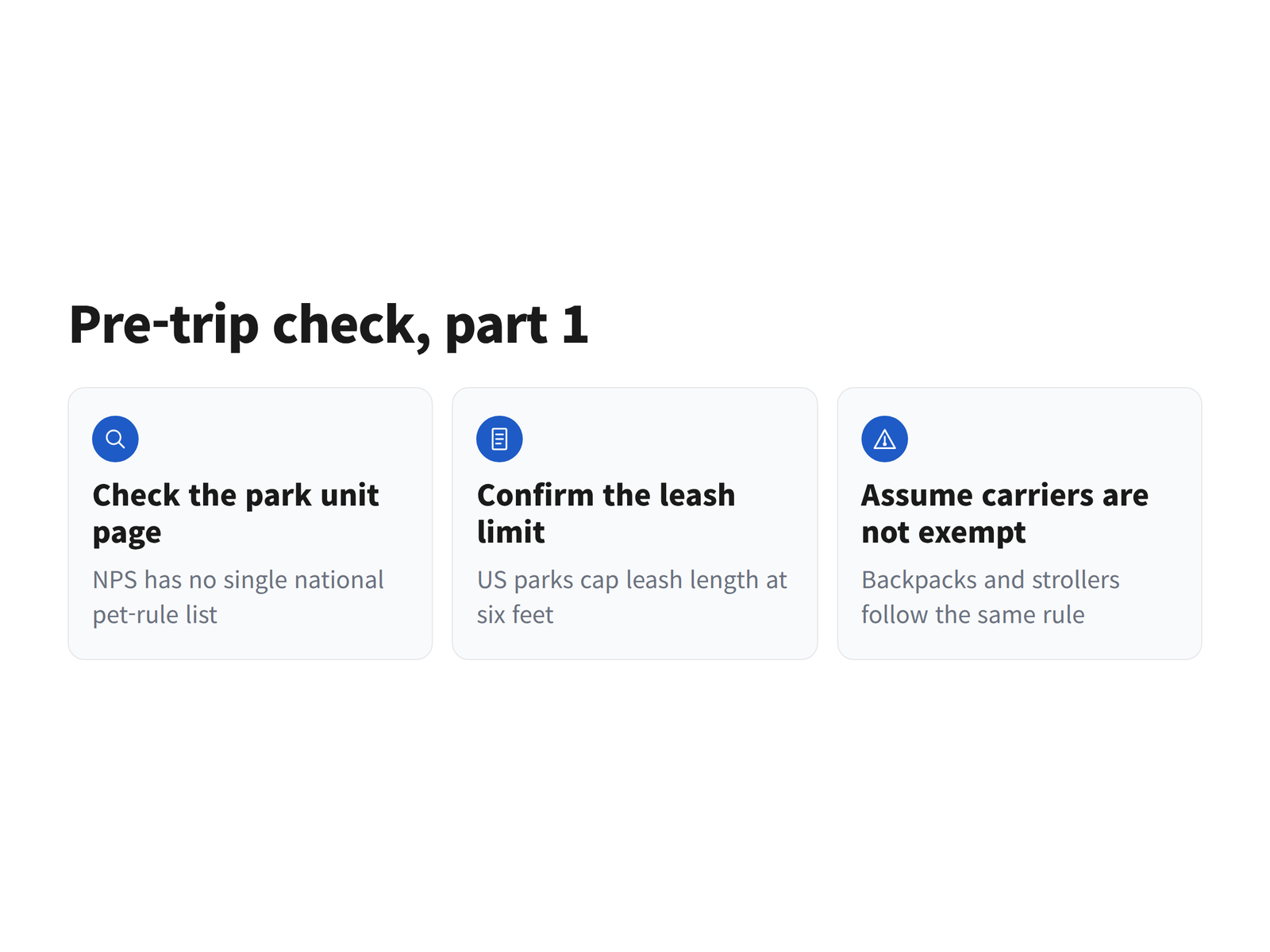
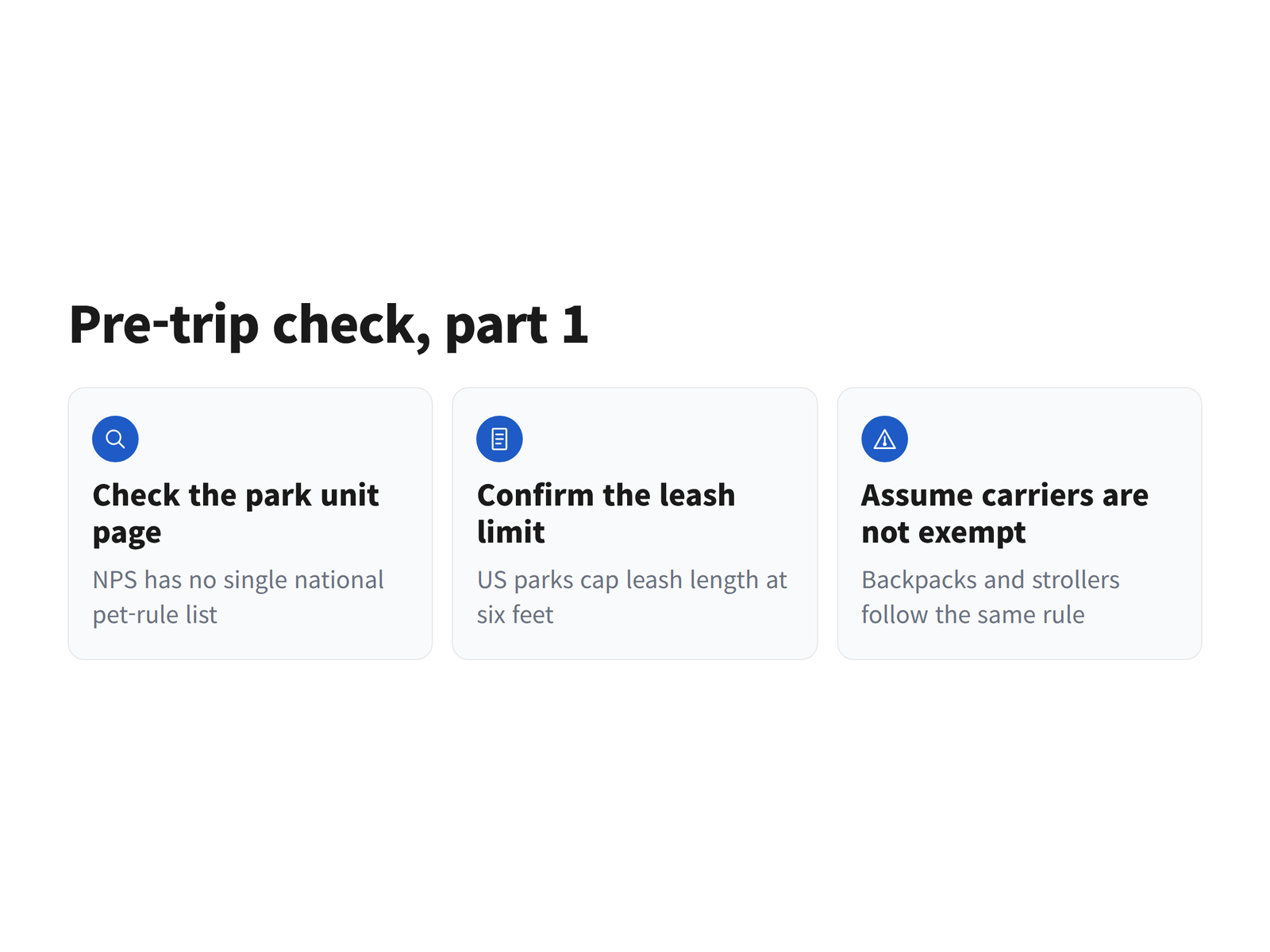
No. A park unit that closes its trails to pets does not exempt a dog held in arms, a stroller, a backpack or a carrier. Yellowstone National Park states plainly: “Carried pets (in arms, strollers, backpacks, carriers, etc.) are also not allowed in these areas.” Yosemite National Park adds: “There are no exceptions to these pet regulations for carried pets.” Size is not the variable the rule turns on, so a four kilogram dog inside a pack is treated the same as a retriever on a lead.
How long can a dog’s leash be in a US national park?
Six feet, or about 1.8 metres. Federal regulation 36 CFR 2.15(a)(2) prohibits “failing to crate, cage, restrain on a leash which shall not exceed six feet in length, or otherwise physically confine a pet at all times.” The rule sets a length ceiling rather than a behaviour standard, and it has not been amended since 3 January 2017. Cross-border trips add a trap. Parks Canada allows a leash of up to 3 metres, roughly 9.8 feet, in its protected places. A leash that is legal on a Canadian road trip exceeds the United States limit inside a national park.
Can a small dog stay at a national park campground if trails are closed to dogs?
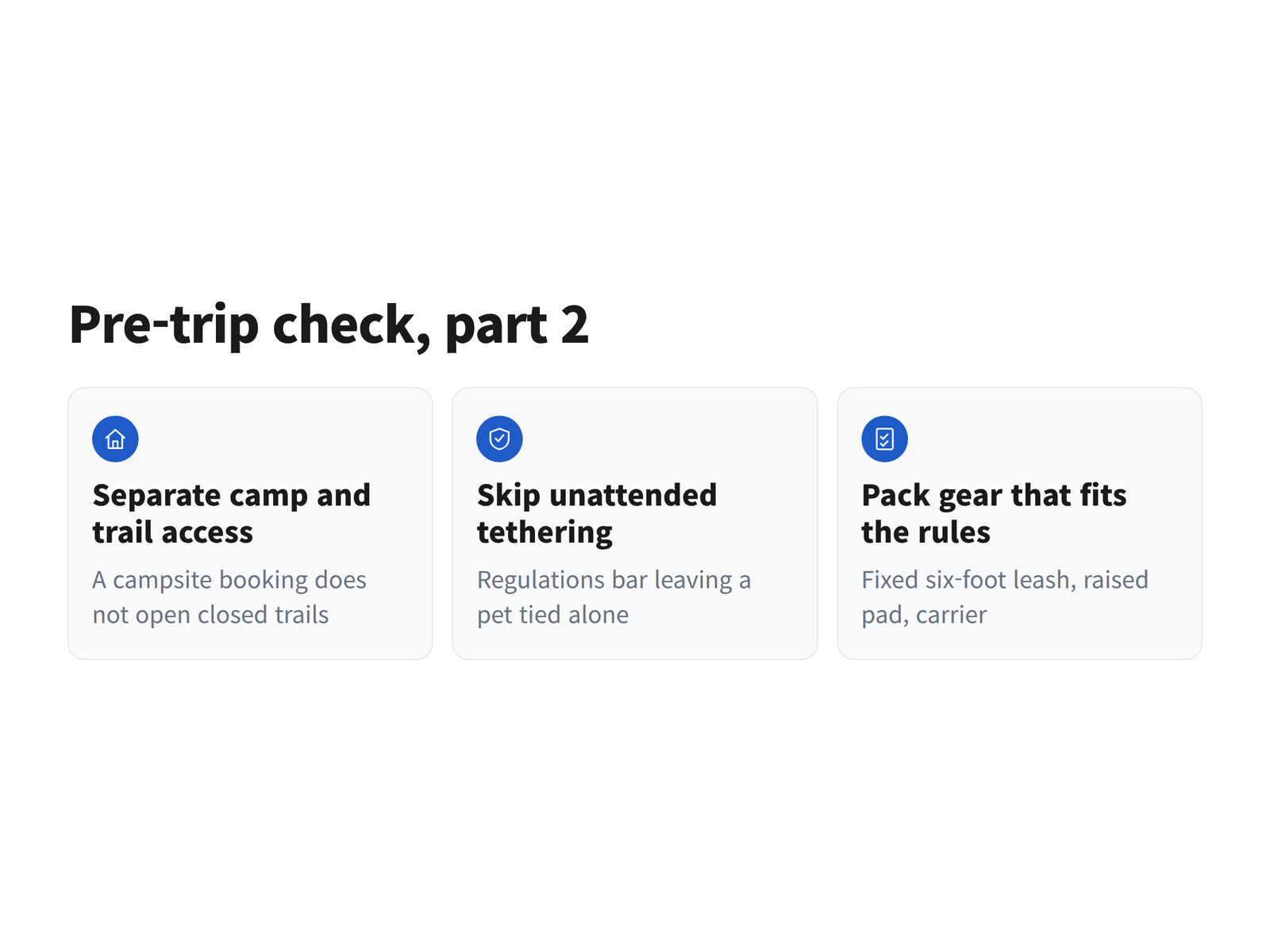
Usually yes, and the campground booking is the part most owners get right. Rocky Mountain National Park allows leashed pets “only in the following areas: Along established roads or in parking areas In established campgrounds and picnic areas.” Yosemite National Park permits dogs in its campgrounds apart from walk-in and group sites, with Camp 4 named as an exclusion. A confirmed campsite, however, grants nothing beyond that campsite. Rocky Mountain National Park states that “Pets are prohibited on ALL Rocky Mountain National Park trails, tundra, and meadows.” Sleeping inside the park boundary and hiking inside the park boundary are two separate permissions.
Can you leave a dog tied at a campsite while you hike?
No, and this is the plan that most often collapses on arrival. 36 CFR 2.15(a)(3) prohibits “leaving a pet unattended and tied to an object, except in designated areas or under conditions which may be established by the superintendent.” Yellowstone National Park restates it as “Pets may not be left unattended or tied to objects.” A National Park Service camping guidance page from 10 July 2018 describes a long leash or tether as a way to let a dog explore a campsite, yet 36 CFR 2.15 caps leash length at six feet and forbids unattended tethering. Where guidance and regulation disagree, the regulation is the enforceable text.
Which national parks actually let a dog on the trail?
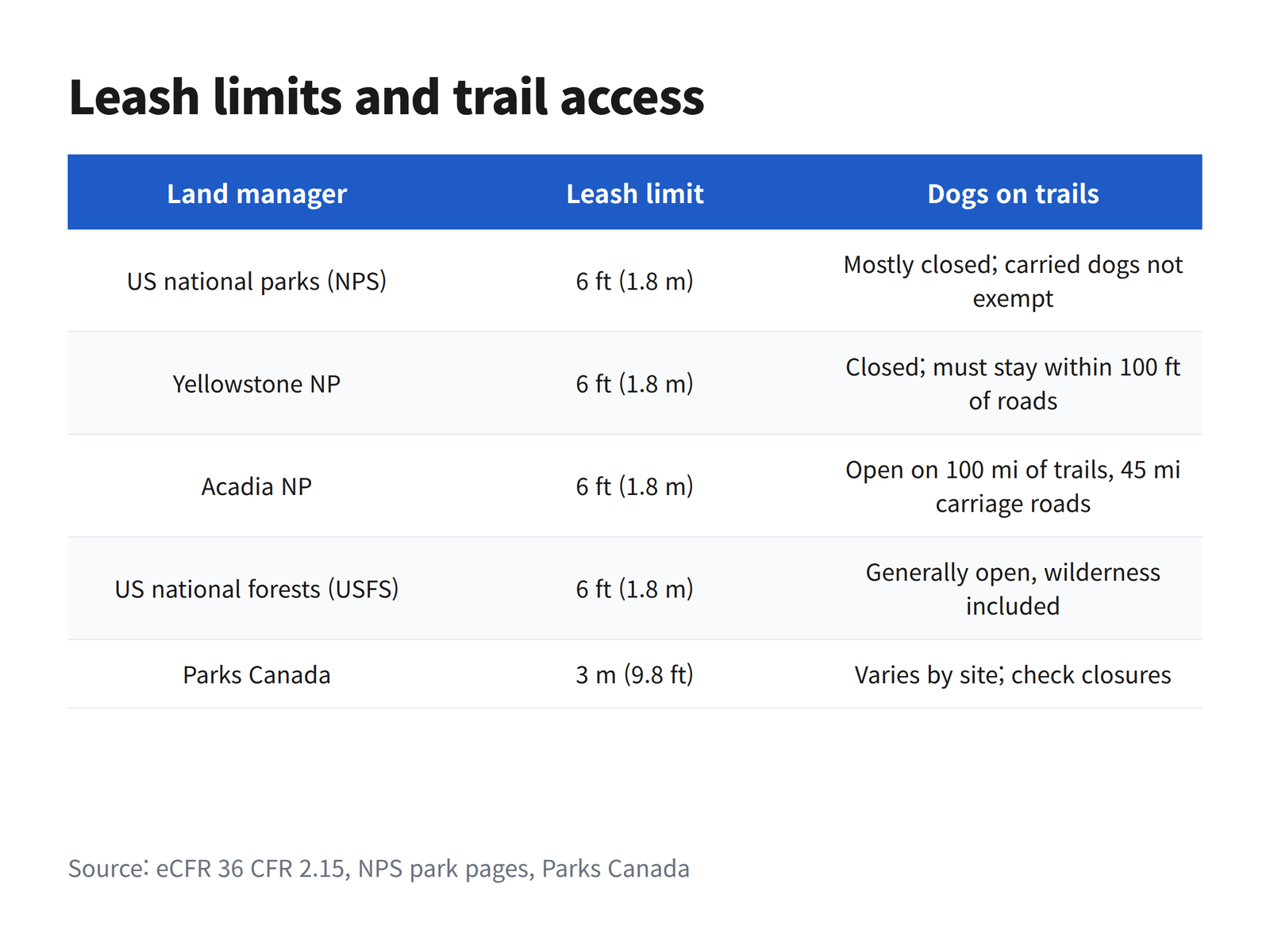
Acadia National Park is the clearest exception among the five parks checked here. Acadia opens roughly 100 miles, or 161 kilometres, of hiking trails plus 45 miles, 72 kilometres, of carriage roads to dogs on a six-foot leash. Grand Canyon National Park permits leashed dogs on trails above the South Rim, at Mather Campground, Desert View Campground, Trailer Village and throughout developed areas, while inner canyon trails and shuttle buses stay closed. Yellowstone National Park confines pets to developed areas within 100 feet, 30.5 metres, of roads, parking areas and campgrounds.
| Land manager | Leash limit | Dogs on trails |
|---|---|---|
| US national parks (NPS) | 6 ft (1.8 m) | Mostly closed; carried dogs not exempt |
| Yellowstone NP | 6 ft (1.8 m) | Closed; must stay within 100 ft of roads |
| Acadia NP | 6 ft (1.8 m) | Open on 100 mi of trails, 45 mi carriage roads |
| US national forests (USFS) | 6 ft (1.8 m) | Generally open, wilderness included |
| Parks Canada | 3 m (9.8 ft) | Varies by site; check closures |
The National Park Service does not publish a single national list, and its own hiking page says only that “Many parks do not allow pets on hiking trails or boardwalks. Always check with your park before bringing your pet.” Verify the specific park unit rather than a general count.
Why does a short-legged dog get cold faster on a fall campsite?
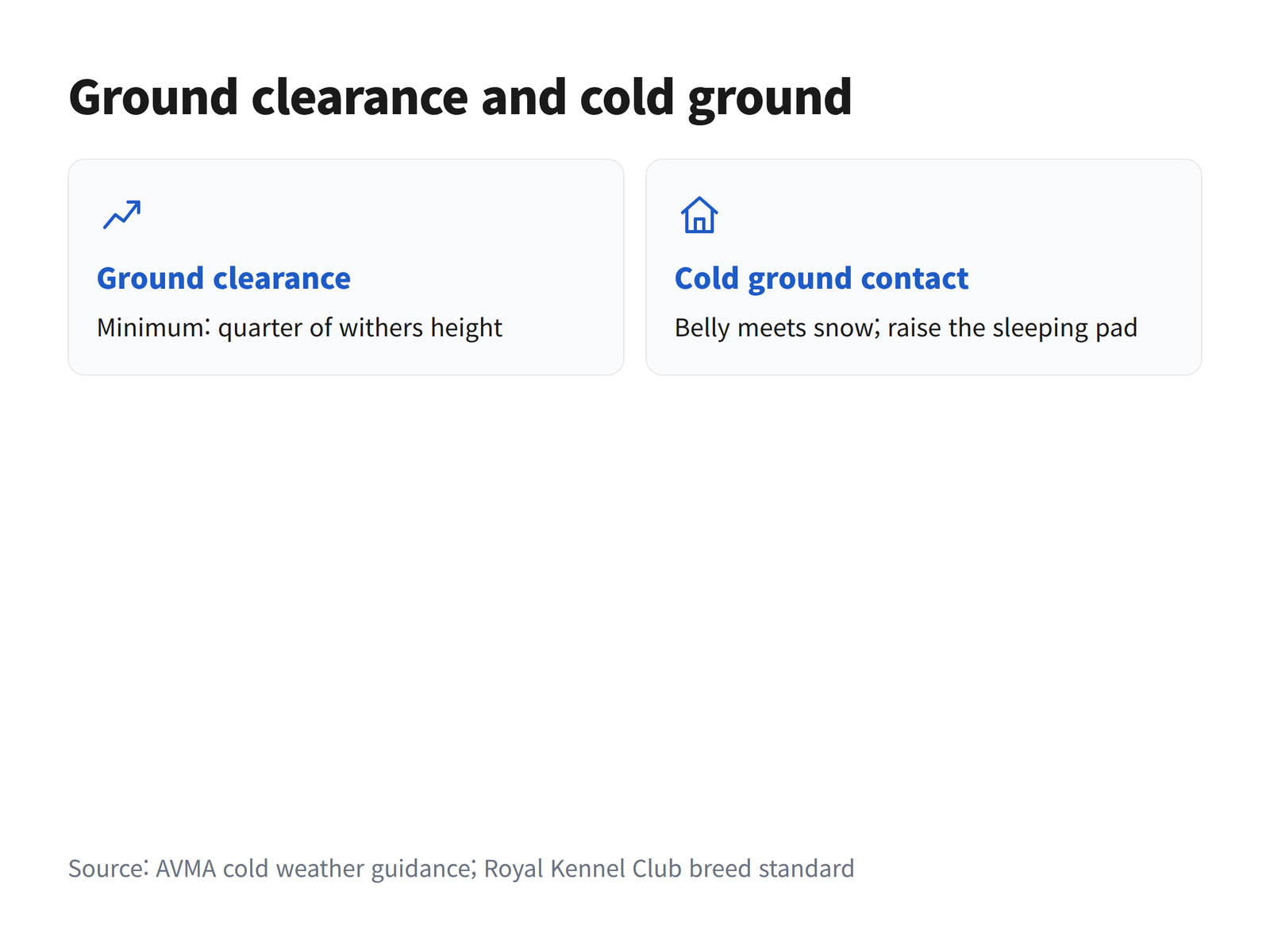
Ground contact, not body weight, drives the heat loss. The American Veterinary Medical Association states that “Short-legged pets may become cold faster because their bellies and bodies are more likely to come into contact with snow-covered ground.” A dachshund sits close to that ground by design. The Royal Kennel Club breed standard for the Miniature Long Haired Dachshund asks for a “compact, well-muscled body, with enough ground clearance, not less than one quarter of the height at the withers, to allow free movement,” a minimum rather than a generous margin. The American Veterinary Medical Association advises raising sleeping surfaces off the ground to limit heat loss into it, and adds: “If you need help determining your pet’s temperature limits, consult your veterinarian.”
Do national forest campgrounds have different dog rules than national parks?
Yes, and a national forest is the practical fallback when the goal is walking. The USDA Forest Service states that “Domestic pets are allowed in the Sierra National Forest and wilderness areas,” including trails, with the same six-foot leash guidance. Sierra National Forest warns visitors directly that “National Parks Do Not Permit Pets on any trail.” The forest rules are looser, not absent. Sierra National Forest limits a single campsite to two pets, and instructs owners: “At night keep your dog and other pets inside an enclosed vehicle or tent.” California State Parks takes a similar line, requiring that “Overnight campers must keep their dog in a tent or vehicle.”
What does the National Park Service B.A.R.K. Ranger pledge ask of a dog owner?
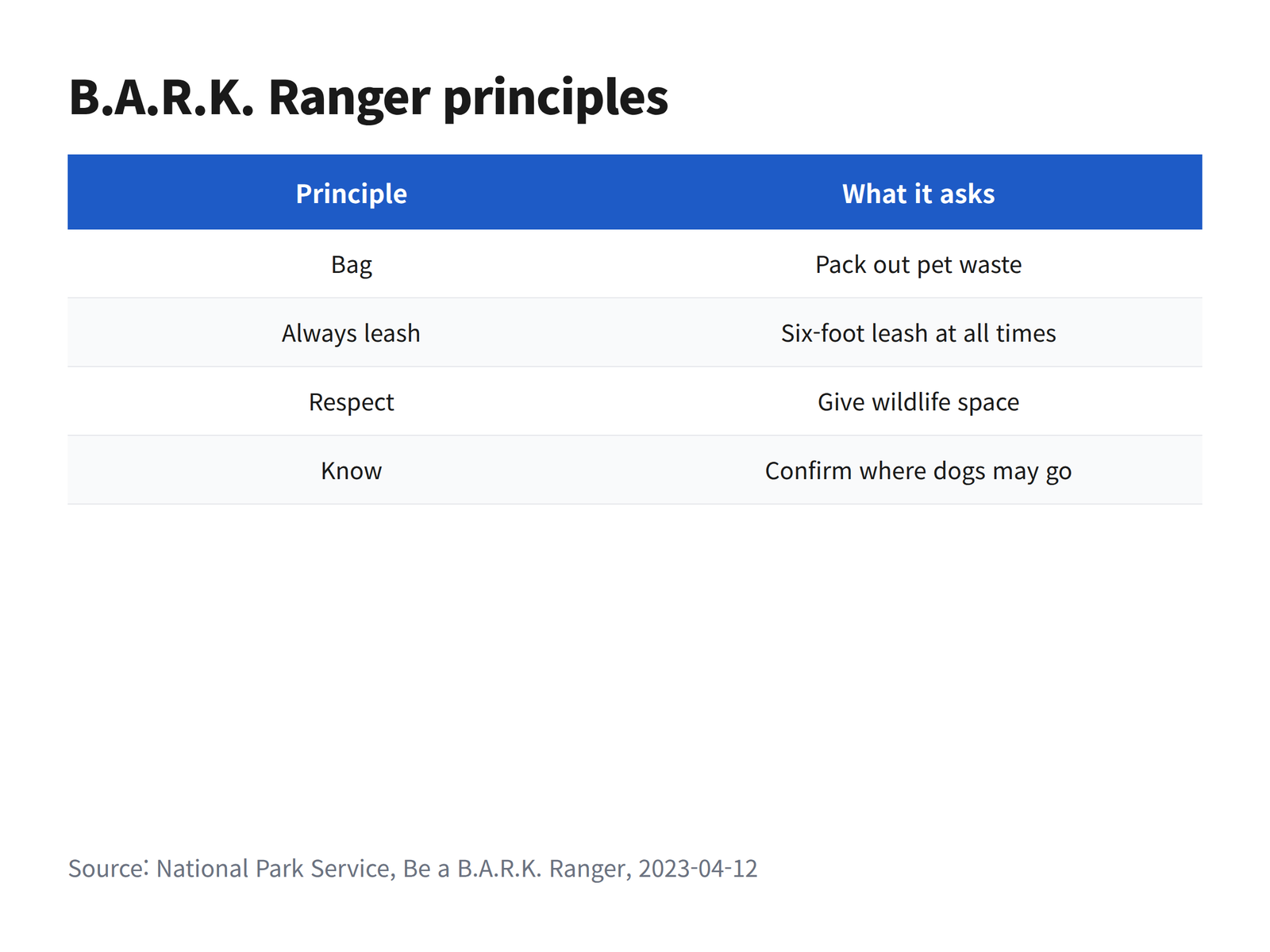
Four things: “Bag your pet’s waste / Always leash your pet / Respect wildlife / Know where you can go.” The National Park Service published that checklist on 12 April 2023. The fourth point carries the weight for a small dog. Knowing where you can go is the step that separates a legal fall trip from a citation, because 36 CFR 2.15 also prohibits letting a pet make noise that frightens wildlife, and 36 CFR 2.15(d) allows an impounded pet to be disposed of after 72 hours.
Build a fall packing list around the rules rather than the gear. A six-foot fixed-length leash, an elevated sleeping pad and a carrier for transport between developed areas all fit what the regulations allow, and none of them buys trail access.
Frequently asked questions
Does a carrier or stroller change anything at Yellowstone or Yosemite? No. Yellowstone National Park lists carriers, strollers and backpacks among the methods that are still not allowed in closed areas, and Yosemite National Park states there are no exceptions for carried pets.
Is a 3 metre leash from Canada acceptable in a US national park? No. Parks Canada permits up to 3 metres, while 36 CFR 2.15(a)(2) caps a leash at six feet, so the Canadian leash is over the United States limit.
Can a dog be left in a vehicle at a campsite instead? Rocky Mountain National Park prohibits leaving a pet unattended in a vehicle where that creates a danger to the animal, and Acadia National Park instructs visitors not to leave a pet unattended at campsites or in cars. Grand Canyon National Park listed a South Rim kennel near Maswik Lodge, 07:30 to 17:00, on 928-638-0534 as of 25 September 2025, requiring proof of rabies, DHLP, bordetella and parvo vaccination.
Which of the five parks checked here is friendliest to a small dog? Acadia National Park, with about 100 miles of trails and 45 miles of carriage roads open on a six-foot leash.
Sources
- U.S. Government Publishing Office, eCFR, “36 CFR 2.15 — Pets”, current text, no amendment since 2017-01-03 — https://www.ecfr.gov/current/title-36/chapter-I/part-2/section-2.15
- National Park Service, “Pets — Yellowstone National Park”, updated 2026-07-29 — https://www.nps.gov/yell/planyourvisit/pets.htm
- National Park Service, “Pets — Yosemite National Park”, updated 2026-06-24 — https://www.nps.gov/yose/planyourvisit/pets.htm
- National Park Service, “Pets — Rocky Mountain National Park”, updated 2018-09-24 — https://www.nps.gov/romo/planyourvisit/pets.htm
- National Park Service, “Pets — Grand Canyon National Park”, updated 2025-09-25 — https://www.nps.gov/grca/planyourvisit/pets.htm
- National Park Service, “Pets — Acadia National Park”, updated 2026-09-02 — https://www.nps.gov/acad/planyourvisit/pets.htm
- National Park Service, “Hiking with Pets”, updated 2024-06-28 — https://www.nps.gov/subjects/trails/hiking-with-pets.htm
- National Park Service, “Camping with Pets”, updated 2018-07-10 — https://www.nps.gov/subjects/camping/camping-with-pets.htm
- National Park Service, “Be a B.A.R.K. Ranger”, updated 2023-04-12 — https://www.nps.gov/subjects/pets/be-a-bark-ranger.htm
- USDA Forest Service, “Pets in the Forest & Wilderness — Sierra National Forest”, updated 2026-04-16 — https://www.fs.usda.gov/r05/sierra/wilderness/pets-forest-wilderness
- Parks Canada, “Dogs in Parks Canada’s protected places”, updated 2022-11-26 — https://parks.canada.ca/voyage-travel/regles-rules/chien-dog
- American Veterinary Medical Association, “Cold weather animal safety”, publication date not stated on page — https://www.avma.org/resources-tools/pet-owners/petcare/cold-weather-animal-safety
- The Royal Kennel Club, “Breed Standard — Dachshund (Miniature Long Haired)”, updated 2025-04-01 — https://www.royalkennelclub.com/breed-standards/hound/dachshund-miniature-long-haired
- California State Parks, “Visiting State Parks With Your Dog”, update date not stated on page — https://www.parks.ca.gov/Dogs