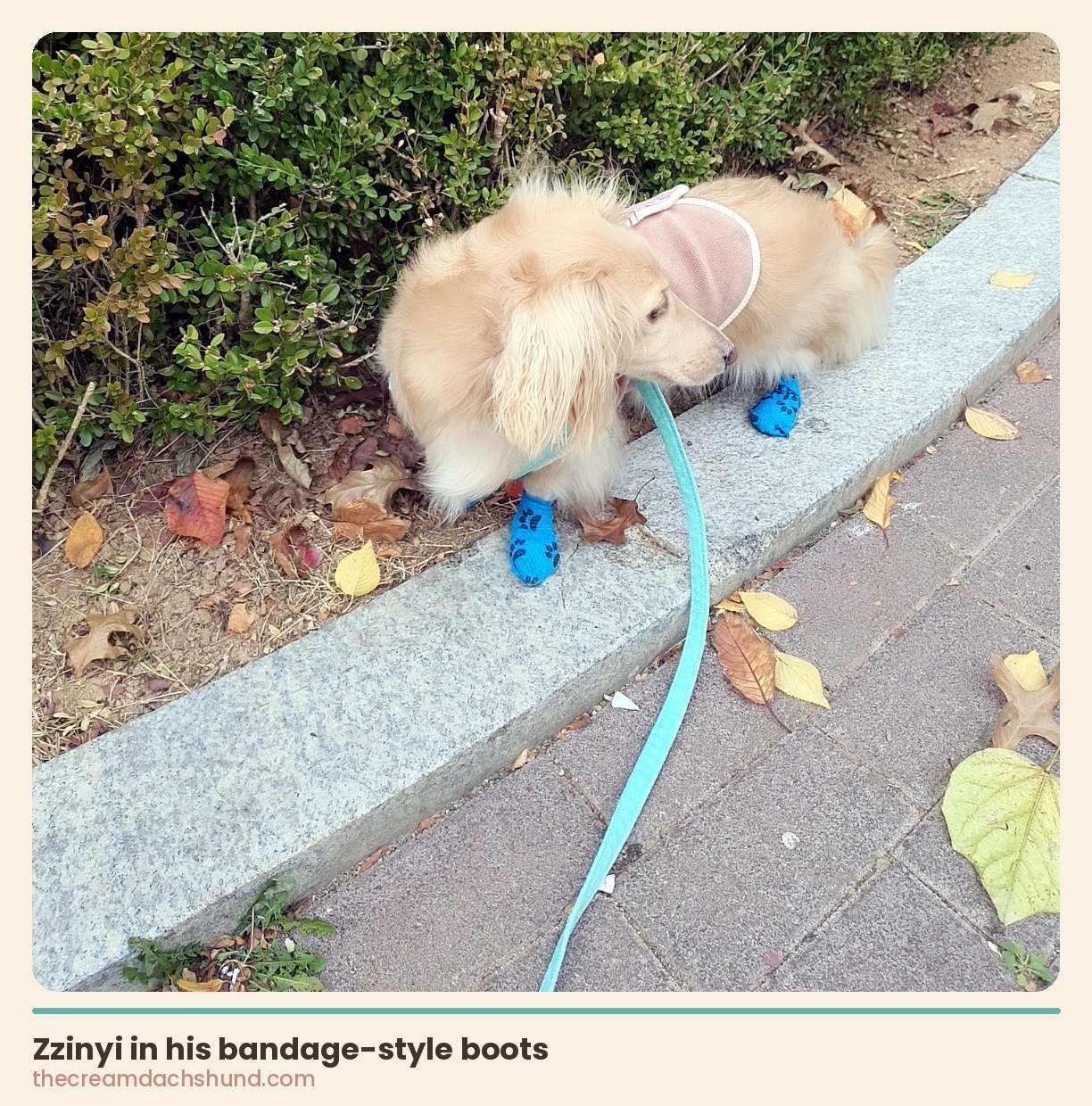
If you’ve seen those bright, paw-print disposable boots wrapped around a dog’s feet like little bandages and wondered whether they actually work, we can tell you from experience. We put a set of bandage-style dog shoes on our cream longhaired dachshund, Zzinyi, for a real fall walk — leaves, gravel, uneven curbs and all. Below is our honest take on how they fit a small, long-backed dog, how long they held up, and whether we’d buy them again. If you’re weighing bandage-style boots against a knit sock or a rubber-sole option, the comparison further down should help too.
What Are Bandage-Style Dog Shoes?
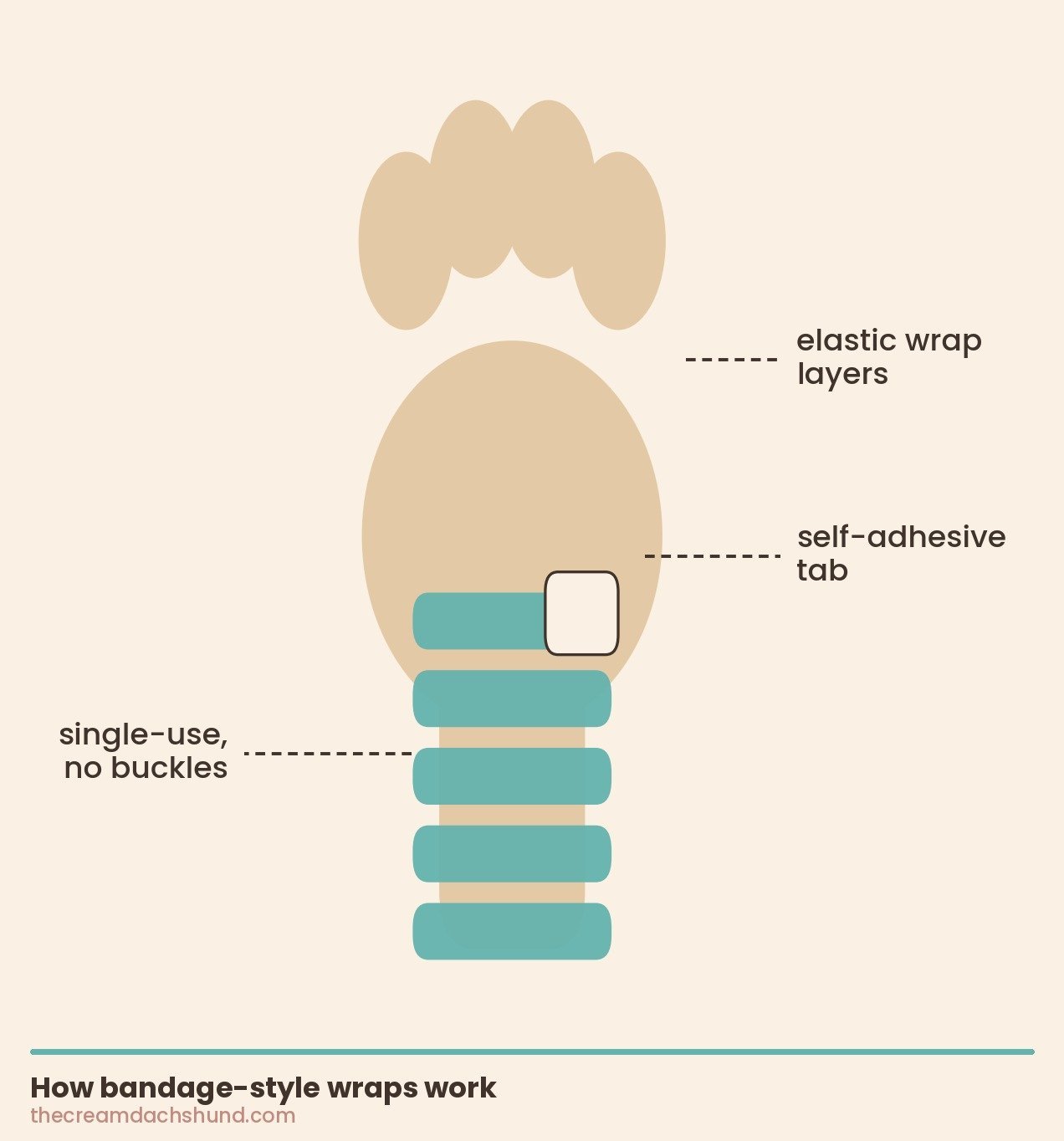
Unlike boots with velcro straps, zippers, or buckles, bandage-style dog shoes are built more like a human athletic wrap. It’s a stretchy, self-adhesive strip that spirals around the paw and lower leg, sticking to itself rather than clasping shut. Most are pre-cut for one-time use, which is why they’re usually sold in multi-packs of four or more rather than as a single reusable pair.
They’re marketed mainly as a lightweight, low-cost way to cover a paw for a single outing — after a nail trim gone slightly wrong, on a muddy trail, or simply to keep debris out of a coat as fluffy as Zzinyi’s. For a broader look at boot styles and what to check before buying, the American Kennel Club’s guide to choosing dog boots is a solid starting point.
Why We Tried Bandage-Style Boots on Zzinyi
Zzinyi is a cream longhaired dachshund, which means his feet all but disappear under feathering by his ankles. On walks through fall leaf litter, twigs and grass seeds work their way into that fur far more easily than they would on a short-coated dog. We wanted something we could slip on quickly before a walk without wrestling with velcro tabs that tend to catch in his coat, so a wrap-style, no-buckle boot seemed worth testing.
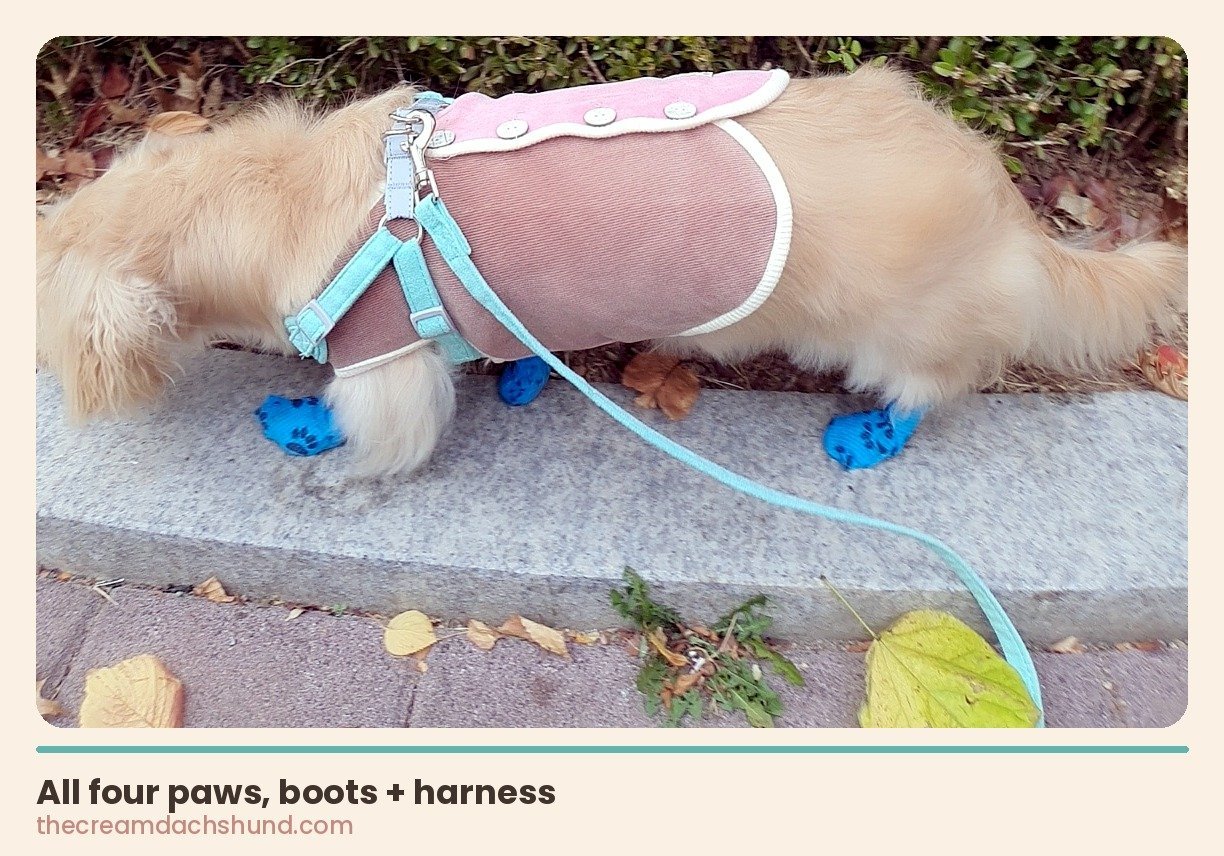
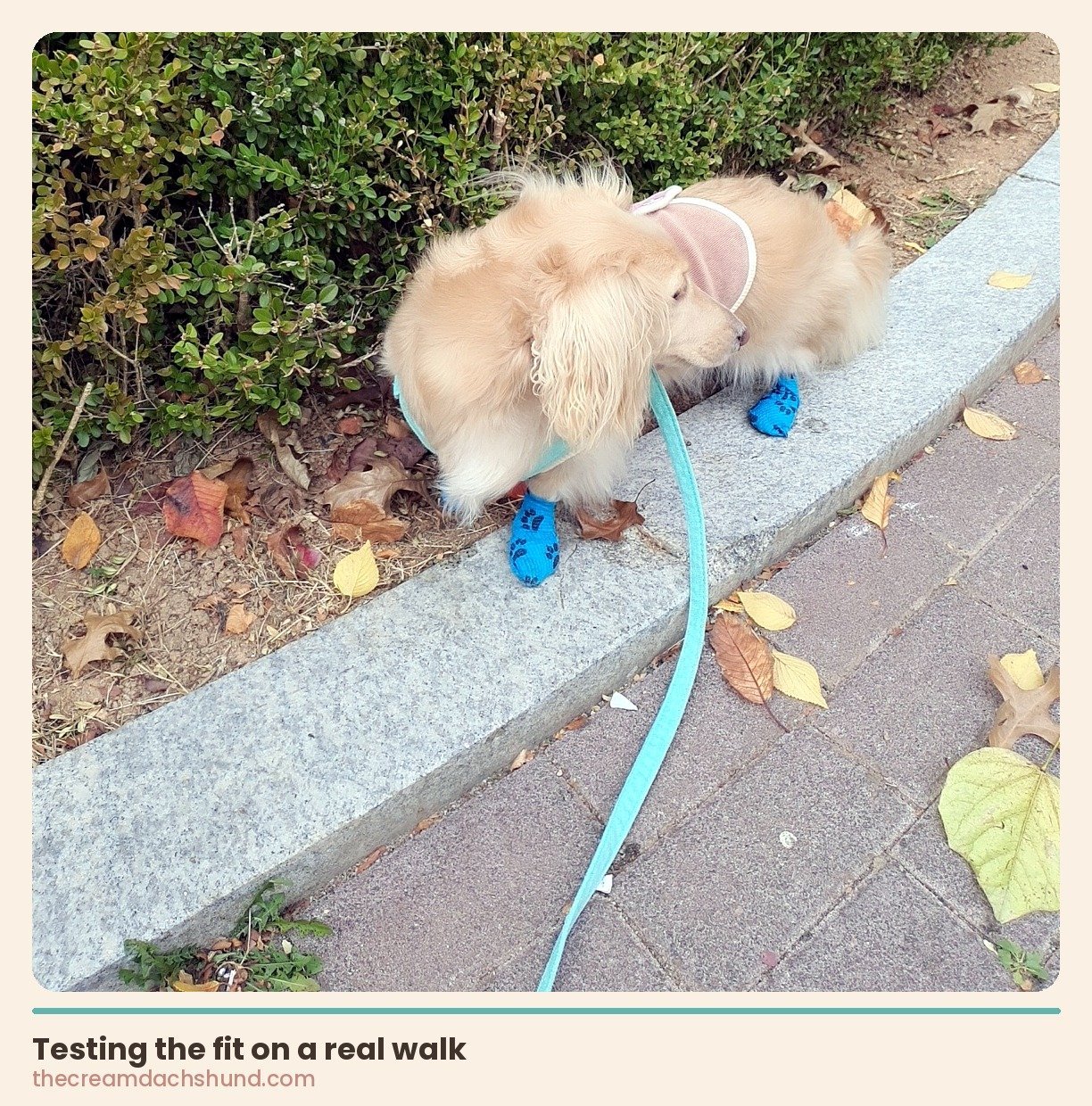
We picked a bright blue pair with a small paw-print pattern — easy to spot on the sidewalk if one came loose — and put all four on before heading out, along with his usual harness cover for the walk.
Fit & Sizing: How They Held Up on a Dachshund’s Paws
Dachshund paws are small, low to the ground, and — because of the breed’s long back and short legs — carry weight differently than a leggier dog’s feet. We were curious whether a wrap wide enough to stay in place wouldn’t also end up too bulky for such a small paw.
In practice, the elastic gave enough that we could wind it snugly around Zzinyi’s paw without it feeling too tight, and the self-adhesive tab held through the first ten minutes without needing a full re-wrap. That said, we did have to press the tab back down twice more over the course of the walk, since his constant sniffing and pawing at the ground worked the edge loose faster than we expected.
Durability During a Real Walk
We tested them on the kind of walk Zzinyi actually takes — sidewalk, a granite curb, and a bit of dirt and dry leaves along a hedge line. Over about 20 minutes of sniffing and walking:
- The front boots held up better than the back ones — his back paws seemed to drag slightly more against the curb edge while he stopped to sniff.
- One boot developed a small snag in the fabric from a twig, though it didn’t tear through completely.
- By the end of the walk, all four boots were still on, just visibly looser than when we started.
Pros
- Fast to put on — no buckles or velcro to fight with in a fluffy coat
- Inexpensive enough to treat as single-use without feeling wasteful
- Bright color and paw-print pattern make a lost boot easy to spot on the ground
Cons
- The adhesive loosens with repeated ground-sniffing and paw-lifting
- Not designed to be reused for more than one, maybe two, short walks
- Less protective against sharp gravel or hot pavement than a rubber-sole boot
Bandage-Style vs. Other Dog Boot Types
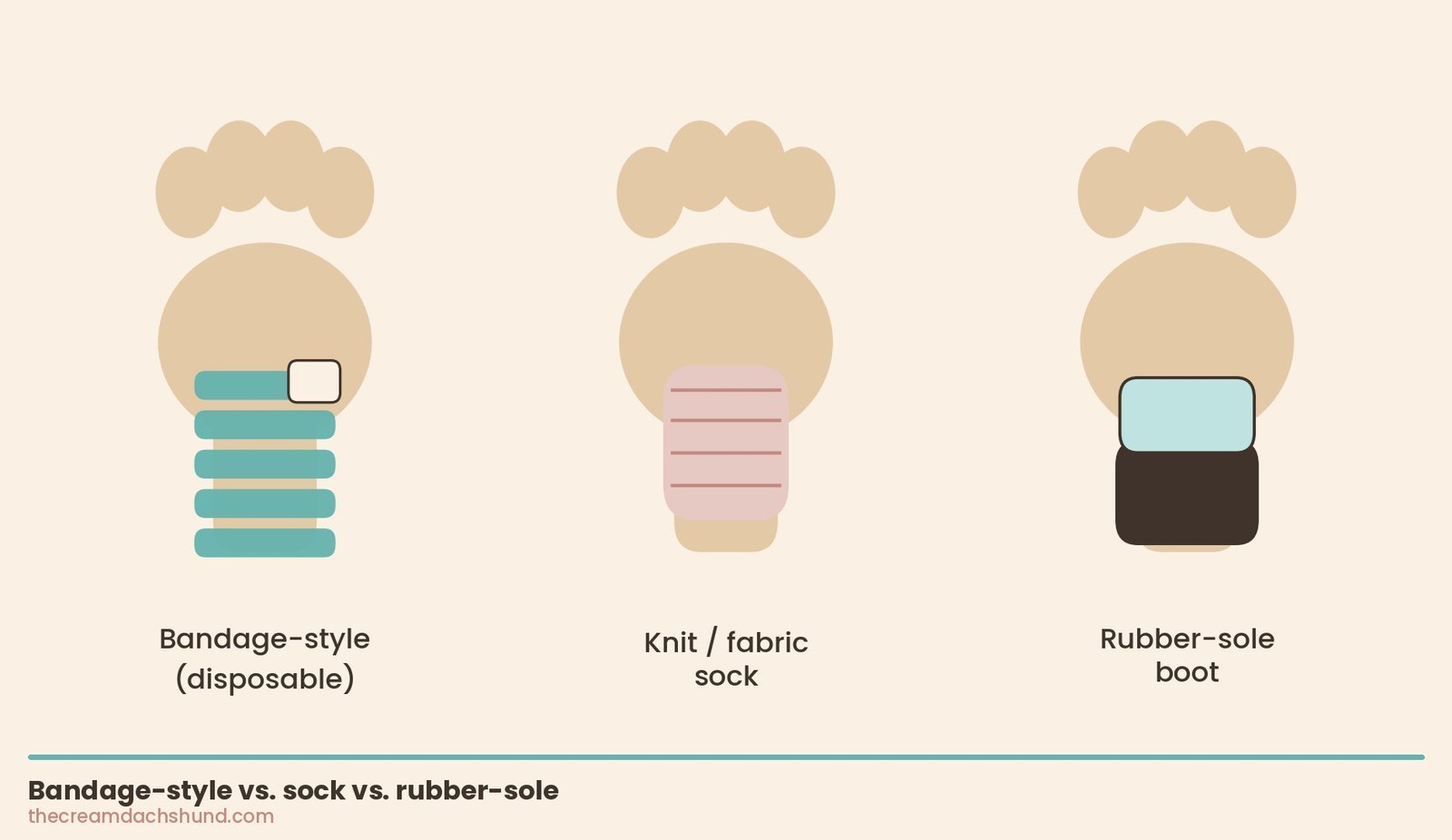
If you’re comparing bandage-style wraps to the more familiar sock or rubber-sole boots, here’s how they stack up based on our experience and general product design differences — not a lab test:
| Feature | Bandage-Style (disposable) | Knit / Fabric Sock | Rubber-Sole Boot |
|---|---|---|---|
| Best for | One-off outdoor coverage | Indoor floors, light dust | Repeated wear on rough or hot ground |
| Reusable? | No — single or limited use | Yes, usually machine washable | Yes, most durable long-term |
| Grip on smooth floors | Minimal | Moderate, grippy sole print | Best |
| Ease of putting on | Fast, no buckles | Fast, slip-on | Slower, straps or velcro |
| Typical price range | $ (sold in multi-packs) | $$ | $$$ |
Tips for Getting Bandage-Style Boots to Stay On
A few things we’d do differently next time, based on how the wrap behaved on Zzinyi:
- Trim the fur around the paw first — the wrap sticks to itself, not to hair, so trimmed feathering helps it hold. This pairs well with a regular deshedding and paw-trim routine.
- Start wrapping at the base of the toes and spiral upward, overlapping by about half the width on each pass.
- Press the adhesive tab down firmly, and check it again a few minutes into the walk.
- Keep a spare boot or two in your pocket in case one works loose.
Are Bandage-Style Dog Boots Worth It? Our Verdict
For an occasional walk where you need quick paw coverage — after grooming, over a small cut, or through a patch of debris — bandage-style dog shoes did the job for Zzinyi. We wouldn’t reach for them as a daily solution or for anything longer than a short walk, since the adhesive is the first thing to give out. If he needed boots for daily wear or colder winter walks, we’d size him for a rubber-sole boot instead.
For more on choosing the right coat and harness pairing for a long-backed dog like Zzinyi, see our gear guide for long-backed dogs, and if matting around the paws is part of what’s pushing you toward boots in the first place, our coat care and matting guide covers that too.
Want more real gear tests like this one? We share what actually works — and what doesn’t — for a small long-haired dog before you spend money on it. Join our email list to get new posts as soon as we publish them.
FAQ
How long do bandage-style dog boots last during a walk?
In our test, they held up for about a 20-minute walk before the adhesive started to loosen. Treat them as single-use rather than something to reuse across multiple outings.
Are bandage-style boots safe for long-haired breeds like dachshunds?
They can work well since there’s no velcro to snag in feathering, but trim the fur around the paw first so the wrap can stick to itself properly. As with any boot, watch for signs of discomfort and remove them if your dog is chewing at them excessively or a paw looks swollen — check with your veterinarian if you’re unsure.
Can bandage-style dog shoes be reused?
Most are designed as single-use — the adhesive generally won’t hold a strong seal a second time. If you want a reusable option, a knit sock or rubber-sole boot will hold up better across multiple walks.
Do small dogs like dachshunds really need boots for walking?
Not always — plenty of dogs walk comfortably without them. Boots make the most sense on hot pavement, icy sidewalks, rough gravel, or while a paw is healing. Consult your veterinarian if you’re addressing a specific injury or skin issue.