Sneezing after rolling in grass usually settles within a minute or two, and what happens after that minute is the part worth watching. A dog that walks with its nose at ground level meets dried seed heads, grass blades and pollen at the exact height those things sit. Those triggers do not behave the same way afterwards. The season differs, the timing differs, and one detail keeps repeating in the veterinary literature: which side of the nose the signs stay on.
Why does a dog that carries its nose low meet more grass debris?
Exposure height explains it, not a special sensitivity. A short-legged dog works at the level where dried seed heads sit, so it meets more of them on the same walk. The American Kennel Club breed standard describes the Dachshund as “Low to ground, long in body and short of leg,” and states: “Being a scenting dog with short legs, it holds its nose low to the ground.” That standard was approved on 2017-11-14 and took effect on 2018-01-01.
The King County Noxious Weed Control Program records where foxtail grasses grow — “dry, sunny patches of dirt (i.e. along sidewalks, open fields, lawns, dog parks)” — which is path edges, worn lawn and park verges, the ground a nose-down dog covers first. That describes opportunity for contact. It is not evidence that short-legged breeds sneeze more often than other dogs, and none of the sources here measured that comparison.
Is a sneezing fit right after grass an allergy or something inhaled?
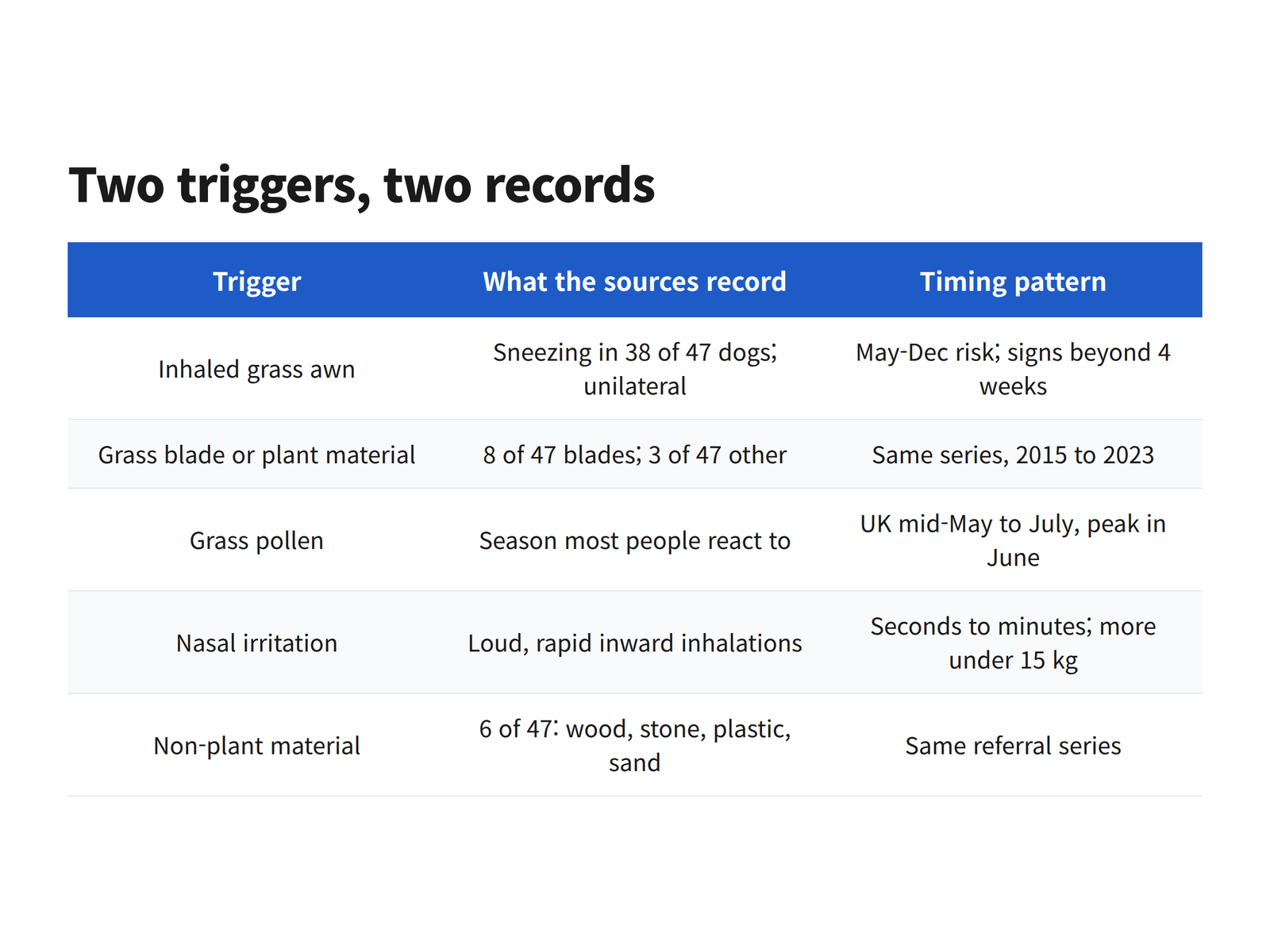
The sources separate the two by season and by side of the nose, not by how dramatic the sneezing sounds. Neither pattern settles the question on its own. Comparing a grass seed sneeze with a pollen sneeze in a small dog starts with the calendar and ends with a veterinary examination. A grass awn is a physical object that has to be found; pollen is a seasonal exposure. In a 2025 referral series of 47 dogs published in Animals, grass awns accounted for 30 of the confirmed nasal foreign bodies, grass blades for 8, and other plant material for 3 — plant matter in 41 of 47 cases. Sneezing was recorded in 38 of those dogs.
| Trigger | What the sources record | Timing pattern in the sources |
|---|---|---|
| Inhaled grass awn | Sneezing in 38 of 47 dogs; reported findings unilateral, left 19 and right 11 | US risk window May to December; 27 of 47 dogs had signs beyond 4 weeks |
| Grass blade or other plant material | Grass blades 8 of 47; other plant material 3 of 47 | Same referral series, cases from 2015 to 2023 |
| Grass pollen | Met Office lists grass pollen as the season most people react to | UK mid-May to July, peak in the first two weeks of June |
| Nasopharyngeal irritation | Multiple loud, rapid, inward inhalations with the glottis closed | Episode lasts seconds to minutes; more frequent under 15 kg |
| Non-plant material | 6 of 47 cases: wood, mineralised plant, stone, plastic, sand, sticks | Same referral series |
How is a reverse sneeze different from an ordinary sneeze?
The airflow runs the other way. In a reverse sneeze the air moves inward while the glottis stays closed, which is why it sounds like snorting rather than a sneeze. Cornell University College of Veterinary Medicine, through its Riney Canine Health Center, describes the reflex directly: “Irritation in the nasopharynx initiates a reflex that results in a series of multiple, loud, sudden, rapid inhalations.”
As of 2026-09-05 that page records an episode as lasting seconds to minutes, and reports reverse sneezing as more frequent in dogs under 15 kg (33 lb). That weight class covers the whole breed: the American Kennel Club standard puts the standard Dachshund at 16 to 32 lb and the miniature at 11 lb and under at twelve months or older. Small size is not protective here. Cornell also notes that frequent or severe episodes are worth raising with a veterinarian.
Why does a grass awn not work its way back out?
The barbs point away from the tip, so movement drives the awn forward and never backward. The structure has no reverse gear. The American Kennel Club quotes veterinary medical advisor Dr. Rebecca Greenstein, DVM: “Foxtails have rigid, bristly, arrow-shaped seeds that act as migrating foreign bodies,” and, on an embedded seed, “They cannot reverse direction once embedded in the skin.”
King County describes the same geometry as velcro-like barbs pointing away from the tip. PDSA, writing in July 2020, records the consequence: “Once a grass seed is under the skin, it’s possible for it to start migrating around the body.” Waiting for an awn to fall out on its own is not a plan the structure supports, and removal is a veterinary procedure.
What does a post-walk coat check not cover?
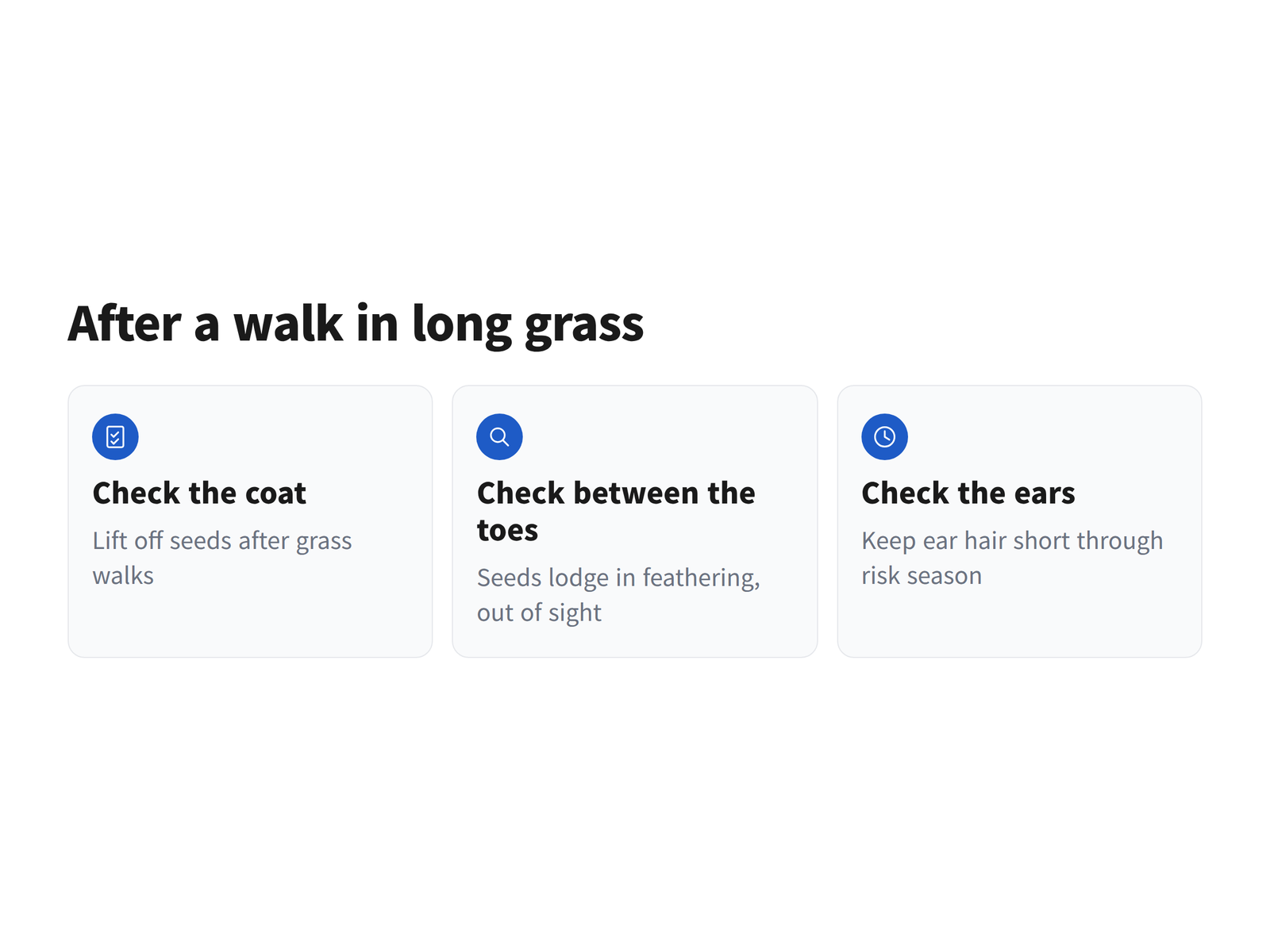
A coat check does not reach the nasal cavity. It finds seeds sitting on fur, ears and paws, which is a different location from anything already inhaled. Blue Cross and The Royal Kennel Club both frame the after-walk routine around coat, ears and feet. The Royal Kennel Club, in an article by veterinary surgeon Marc Abraham, states: “Dogs with hairy ears and hairy feet are more at risk if walked in meadows or woodlands,” and describes seeds that “attach themselves easily to an animal’s fur and burrow into the skin.” On a longhaired small breed the coat works as a carrier — feathering on the ears, chest and feet picks seeds up and holds them.
The nasal foreign bodies in the 2025 Animals series, by contrast, needed computed tomography and rhinoscopy to confirm. Both checks are worth doing, and neither clears the other. What the routine covers, following Blue Cross and PDSA:
- Check the coat after any walk in long or dried grass and lift off seeds straight away.
- Work through the feathering on ears, chest and between the toes, where seeds lodge out of sight.
- Keep the hair around ears and feet short through the risk season.
- Avoid patches of tall, dried grass where seed heads have already hardened.
A fine-toothed comb makes that pass quicker on a longhaired coat than fingers alone, since feathering hides a dry seed head well enough that a hand sweep misses it. The check is a habit rather than a one-off: PDSA puts it as “Always check your dog for grass seeds after walks in long grass.”
Which months carry grass awn risk, and which months carry grass pollen?
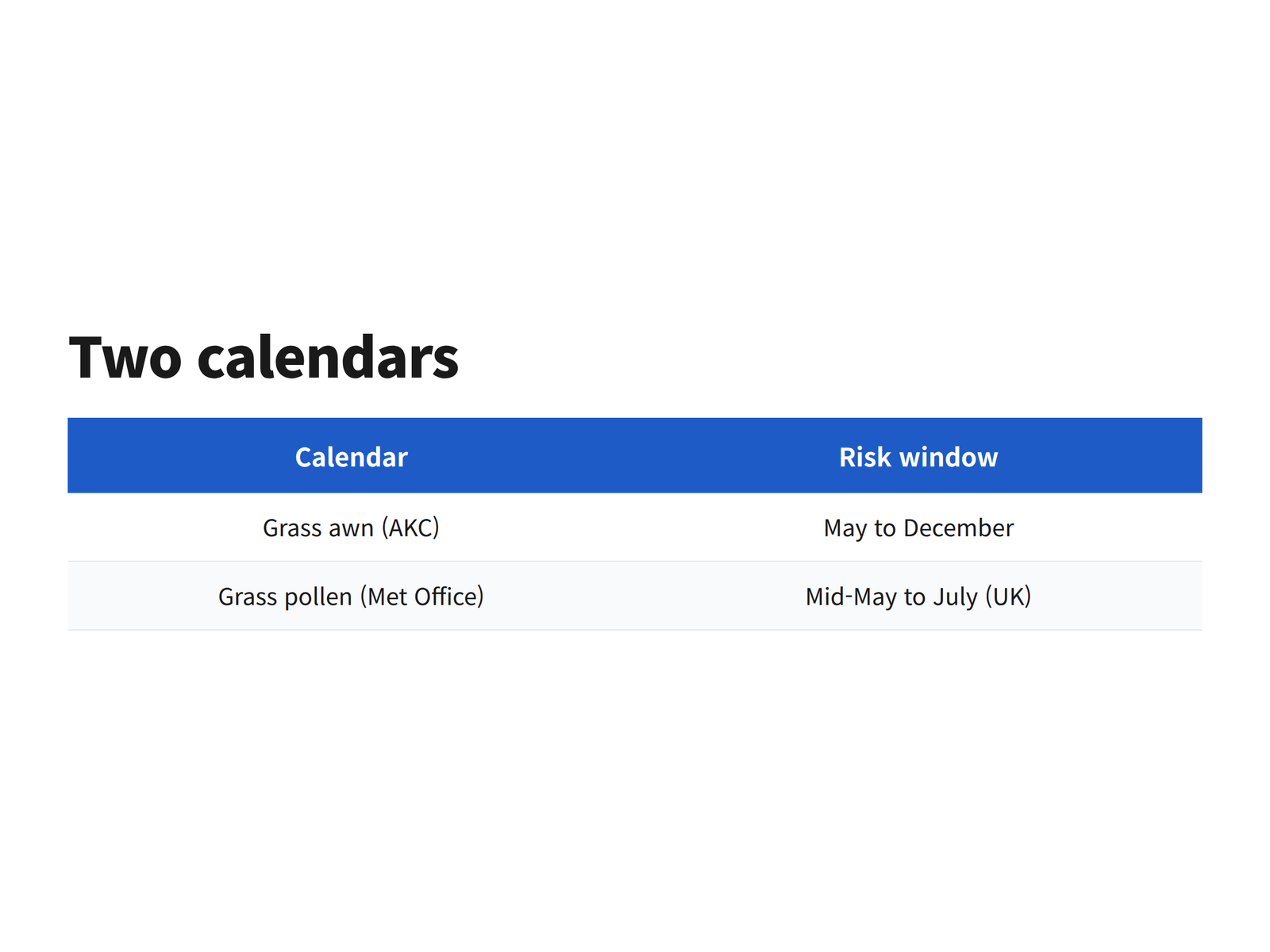
They are two separate calendars, and collapsing them into one summer allergy season hides half the year. The awn window is far longer. The American Kennel Club, in guidance updated on 2026-08-28, puts the hazardous foxtail period at May through December, once seed heads have dried and hardened, with variation by region. Grass pollen runs on a shorter clock: as of 2026-09-05 the Met Office lists the UK grass pollen season as mid-May to July, with a first peak in the first two weeks of June and a smaller second peak in the first two weeks of July. Those are UK figures and do not transfer to other countries. A September sneeze after a dry-grass walk falls outside the UK grass pollen season and well inside the foxtail window.
When should you contact your veterinarian about sneezing after a grass walk?
Blue Cross puts the threshold plainly: “If you think your dog has a grass seed injury, contact your vet for advice.” If sneezing is one-sided, persistent beyond a few days, or involves nasal discharge or bleeding, consult your veterinarian — this cannot be diagnosed from a blog post.
The 2025 Animals series is useful here for what it says about waiting. Across the 47 dogs, 27 had shown signs for more than four weeks before referral and only 20 were acute at four weeks or less, so a long, tolerated sneeze was the common history rather than the unusual one. Alongside sneezing in 38 dogs, the series recorded epistaxis in 17 and nasal discharge in 16. Reported findings were unilateral, with the side recorded as left in 19 cases and right in 11. A pattern that stays on one side is an observation worth reporting, not a conclusion an owner can reach at home.
Frequently asked questions
Does a single sneezing fit after a grass walk mean something is stuck? No. A short burst of sneezing that stops and does not return is not what the referral literature describes. The pattern that brought dogs to referral in the 2025 Animals series was persistent — 27 of 47 dogs had signs for more than four weeks.
Can an inhaled grass awn come back out on its own? The structure argues against it. The American Kennel Club quotes Dr. Rebecca Greenstein, DVM, on embedded seeds: “They cannot reverse direction once embedded in the skin.” King County describes barbs angled away from the tip, so movement carries the seed forward.
Is reverse sneezing the same thing as sneezing out a seed? No. Cornell’s Riney Canine Health Center describes reverse sneezing as inward inhalations with the glottis closed, lasting seconds to minutes, and more frequent in dogs under 15 kg. It is a reflex pattern, not evidence of what triggered it.
Why do dogs roll in grass in the first place? Scent is part of it. The American Kennel Club quotes trainer Rachel Lane, M.Sc., CPDT-KA, CBCC-KA: “When they come across a novel, strong, stinky scent, they might be thrilled to have found something so fun to interact with.”
Sources
- American Kennel Club, “Are Foxtails Harmful to Dogs? What Every Owner Should Know”, updated 2026-08-28 — https://www.akc.org/expert-advice/health/foxtails-theyre-dangerous-dogs/
- American Kennel Club, “Official Standard of the Dachshund”, approved 2017-11-14, effective 2018-01-01 — https://images.akc.org/pdf/judges/groups/Hound_Group.pdf
- American Kennel Club, “Why Do Dogs Roll in Smelly Stuff?”, updated 2026-07-22 — https://www.akc.org/expert-advice/lifestyle/why-dogs-roll-smelly-stuff/
- Cornell University College of Veterinary Medicine, Riney Canine Health Center, “Reverse Sneezing”, page consulted 2026-09-05 — https://www.vet.cornell.edu/departments-centers-and-institutes/riney-canine-health-center/canine-health-topics/reverse-sneezing
- Blue Cross, “Grass Seeds and Dogs”, last reviewed 2026-08-28, approved by Róisín Bolger MRCVS — https://www.bluecross.org.uk/advice/dog/health-and-injuries/grass-seeds-and-dogs
- The Royal Kennel Club, “Grass seeds”, by Marc Abraham MRCVS, page consulted 2026-09-05 — https://www.royalkennelclub.com/health-and-dog-care/health-dog-care/health/health-and-care/a-z-of-health-and-care-issues/grass-seeds
- PDSA, “Grass seeds in dogs”, July 2020 — https://www.pdsa.org.uk/pet-help-and-advice/pet-health-hub/conditions/grass-seeds-in-dogs
- Met Office, “When is hay fever season in the UK?”, page consulted 2026-09-05 — https://weather.metoffice.gov.uk/warnings-and-advice/seasonal-advice/health-wellbeing/pollen/when-is-hayfever-season
- King County Noxious Weed Control Program, “Foxtail Grasses and Dogs: Identifying, Understanding, and Taking Action”, 2026-01-14 — https://kingcountyweeds.com/2026/01/14/foxtail-grasses/
- Fantaconi N, Parry AT, Labrador J, Perez Lopez LA, Agthe P. “Comparative Diagnostic Value of Computed Tomography Lung and Bone Window Settings for the Detection of Nasal Foreign Bodies in 47 Dogs Presented to Two UK Referral Hospitals (2015-2023)”, Animals 2025;15(18):2684 — https://doi.org/10.3390/ani15182684