The FCI sets dachshund size classes by chest measurement in centimetres, while the American Kennel Club and the Royal Kennel Club set them by body weight. That split is why the same dog can register as a miniature in one country and fall outside the class in another. FCI Standard No. 148, published 2021-05-25, names three classes and carries no weight figure anywhere. Below are the numbers each registry publishes, the age rule that voids every puppy measurement, and the point where retail size charts stop matching any of them.
How are dachshund size classes actually decided?
It depends entirely on which registry is asking. The Federation Cynologique Internationale recognises three classes in Standard No. 148, published 2021-05-25: Standard, Miniature and Rabbit, also written as Kaninchen. Each class is a band of chest circumference in centimetres, split by sex. The American Kennel Club recognises two sizes and separates them by weight. The Royal Kennel Club, whose Miniature Long Haired Dachshund page was last updated 2025-04-01, also works from weight and gives the miniature its own breed standard entry.
The American Kennel Club states the rule plainly in its Official Standard of the Dachshund, effective 2018-01-01: dachshunds are “bred and shown in two sizes, standard and miniature; miniatures are not a separate classification but compete in a class division for ’11 pounds and under at 12 months of age and older.'” So an American miniature is a show division defined by a scale reading, not a separate registry class.
Why does the FCI measure the chest instead of the weight?
Because the FCI standard describes the dachshund as a set of proportions, and a chest band captures those proportions in a way a scale reading cannot. FCI Standard No. 148 opens by calling the breed “Low, short legged, elongated but compact build, very muscular with cheeky, challenging head carriage.” It then fixes the build numerically: body length to height at the withers of roughly 1.7-1.8 to 1, and ground clearance of about one third of the height at the withers.
On a dog built to that ratio, weight is spread along a long spine and a deep rib cage rather than stacked into a compact frame. Two dachshunds can hit the same number on a scale with visibly different chest depth. The chest band measures the part of the body that harnesses, coats, carriers and crates have to clear. The word “weight” does not appear in FCI Standard No. 148 at all.
Which class does a 31 cm chest fall into – miniature or rabbit?
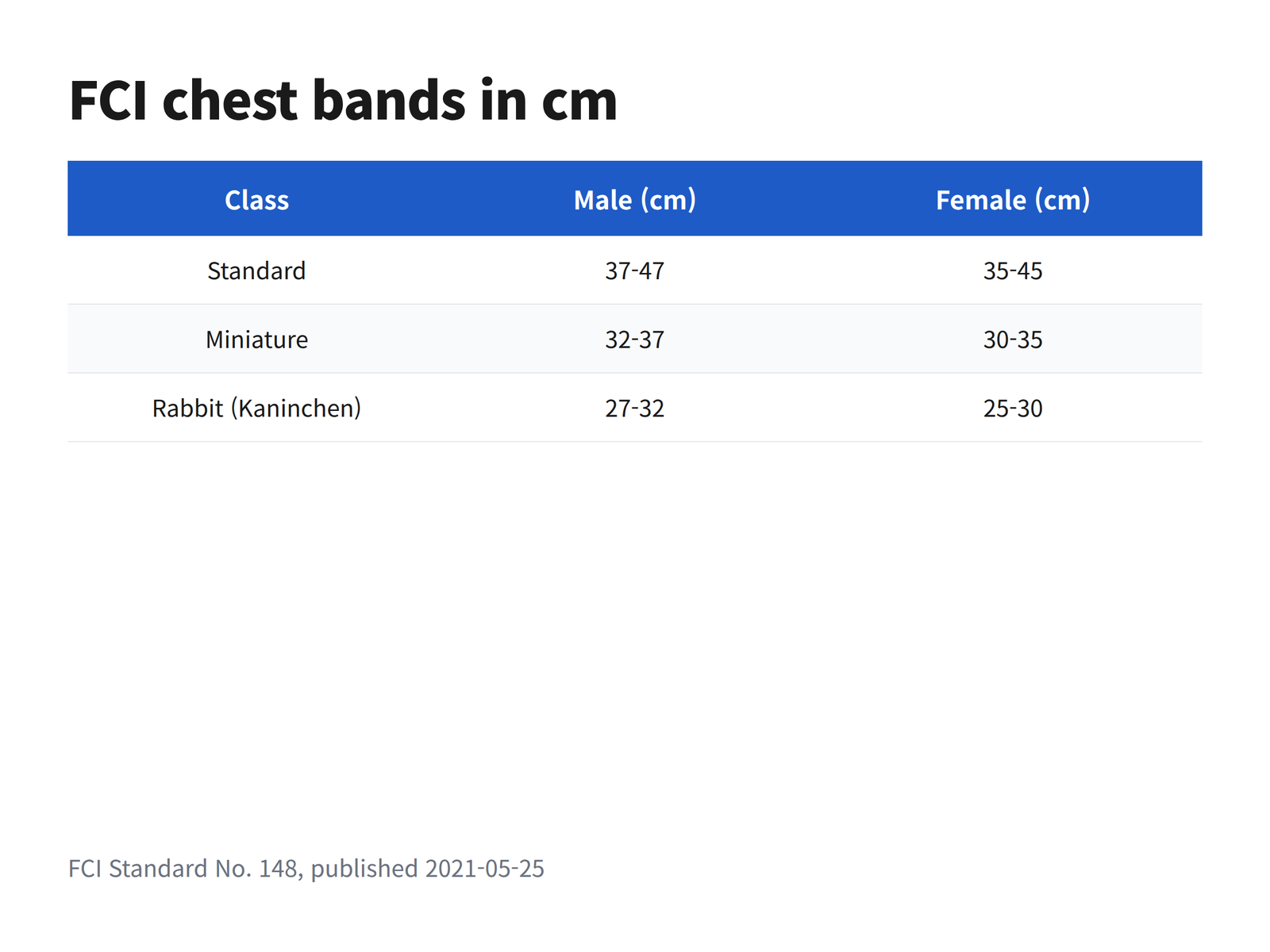
For a male it falls in the Rabbit class, and for a female it falls in the Miniature class. The FCI bands published 2021-05-25 are sex-split, which is the single detail most size charts drop. The full set reads as follows.
- Standard: males 37-47 cm, females 35-45 cm
- Miniature: males 32-37 cm, females 30-35 cm
- Rabbit (Kaninchen): males 27-32 cm, females 25-30 cm
A male at 31 cm sits inside the Rabbit band of 27-32 cm and below the Miniature floor of 32 cm. A female at 31 cm sits inside the Miniature band of 30-35 cm and above the Rabbit ceiling of 30 cm. Same tape reading, different FCI class. Any page that quotes a single “30-35 cm” miniature band with no sex split is repeating the older wording, which appears in the World Union of Teckel Clubs commentary approved 2001-08-10 rather than in the standard currently in force.
Why can the same dog be a miniature in the United States but not in Germany?
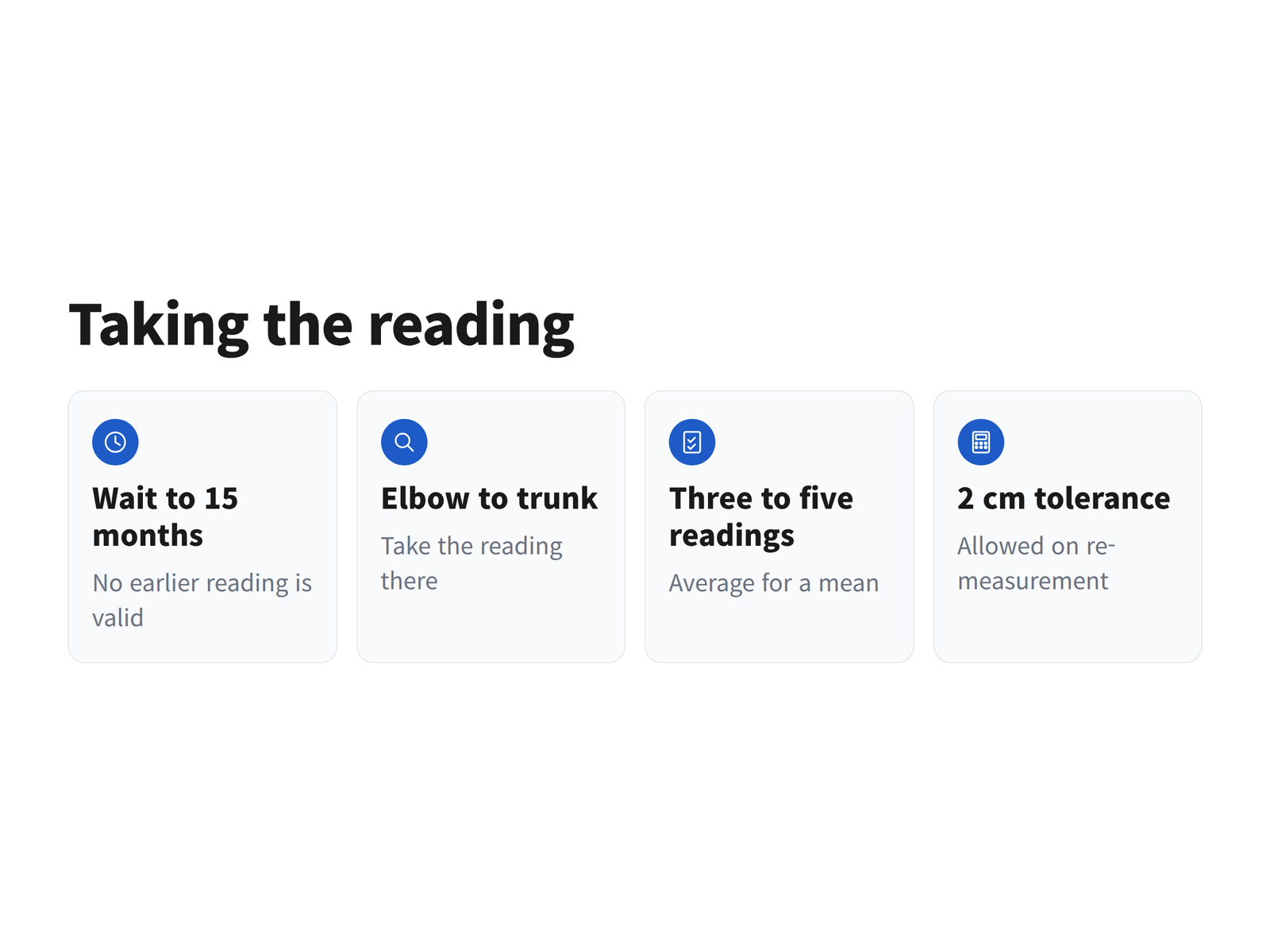
Because the two standards test different things at different ages. The American Kennel Club test is 11 pounds and under at 12 months of age and older. The FCI test is a chest band in centimetres taken at 15 months or older. A light dog with a deep chest can clear the American Kennel Club threshold and still measure above the FCI miniature ceiling, and a dog can pass one document while failing the other with no contradiction.
| Standard | What decides the class | Miniature threshold |
|---|---|---|
| FCI No. 148, published 2021-05-25 | Chest at 15 months or older | Males 32-37 cm, females 30-35 cm |
| AKC standard, effective 2018-01-01 | Weight at 12 months or older | 11 pounds and under |
| Royal Kennel Club, updated 2025-04-01 | Weight, listed as its own breed | Ideal 4.5 kg, maximum 5 kg |
| FCI Rabbit class, published 2021-05-25 | Chest at 15 months or older | Males 27-32 cm, females 25-30 cm |
| WUT commentary, approved 2001-08-10 | Chest, elbow to trunk | 30-35 cm, three to five readings |
The American Kennel Club also publishes a usual weight range of 16 to 32 pounds for the standard size. The Royal Kennel Club gives the miniature an ideal weight of 4.5 kg, or 10 lb, with a desired maximum of 5 kg, or 11 lb. The FCI Rabbit class has no American Kennel Club or Royal Kennel Club equivalent at all.
Is a teacup or tweenie dachshund a recognised size?
No. The words teacup, toy and tweenie appear in none of the three published standards. The FCI names Standard, Miniature and Rabbit. The American Kennel Club names standard and miniature. The Royal Kennel Club lists standard and miniature varieties separated by coat type, with the Miniature Long Haired Dachshund holding its own breed standard page in the hound group.
There is no fourth class and no intermediate class in any of those documents. A dog sold under one of those labels is a dachshund whose measurements sit somewhere inside or outside the published bands, and the label carries no registry meaning. Before buying gear sized to such a label, take a tape reading instead.
How do you measure a dachshund’s chest correctly?
Wait until the dog is at least 15 months old, then take several readings and average them. FCI Standard No. 148 specifies “Chest Circumference measured when at least 15 months old”, which means no puppy measurement and no size predictor can output a valid FCI class. The World Union of Teckel Clubs commentary approved 2001-08-10 sets out the procedure it used against the 2001 edition of the standard.
- Take the reading between the elbow and the trunk. The commentary states: “A correct measurement shall be taken between the elbow and the trunk.”
- Take three to five readings. The commentary states: “Three to five measurements are necessary in order to reach a correct mean measurement.”
- Allow a 2 cm tolerance on any later re-measurement, so one tape reading is never a classification on its own.
A registration measurement is not a gear measurement. For a harness, the American Kennel Club advises checking fit by sliding two fingers under the straps, and writer Gemma Johnstone adds in its 2022-02-16 harness guide: “Ensure the girth strap is not sitting behind the rib cage towards the stomach or squeezing into the back of the front legs.” Do not feed an FCI band straight into a retail size chart, because the two measurements are not defined at the same point on the body.
Why do weight-based size charts fail on a long-backed dog?
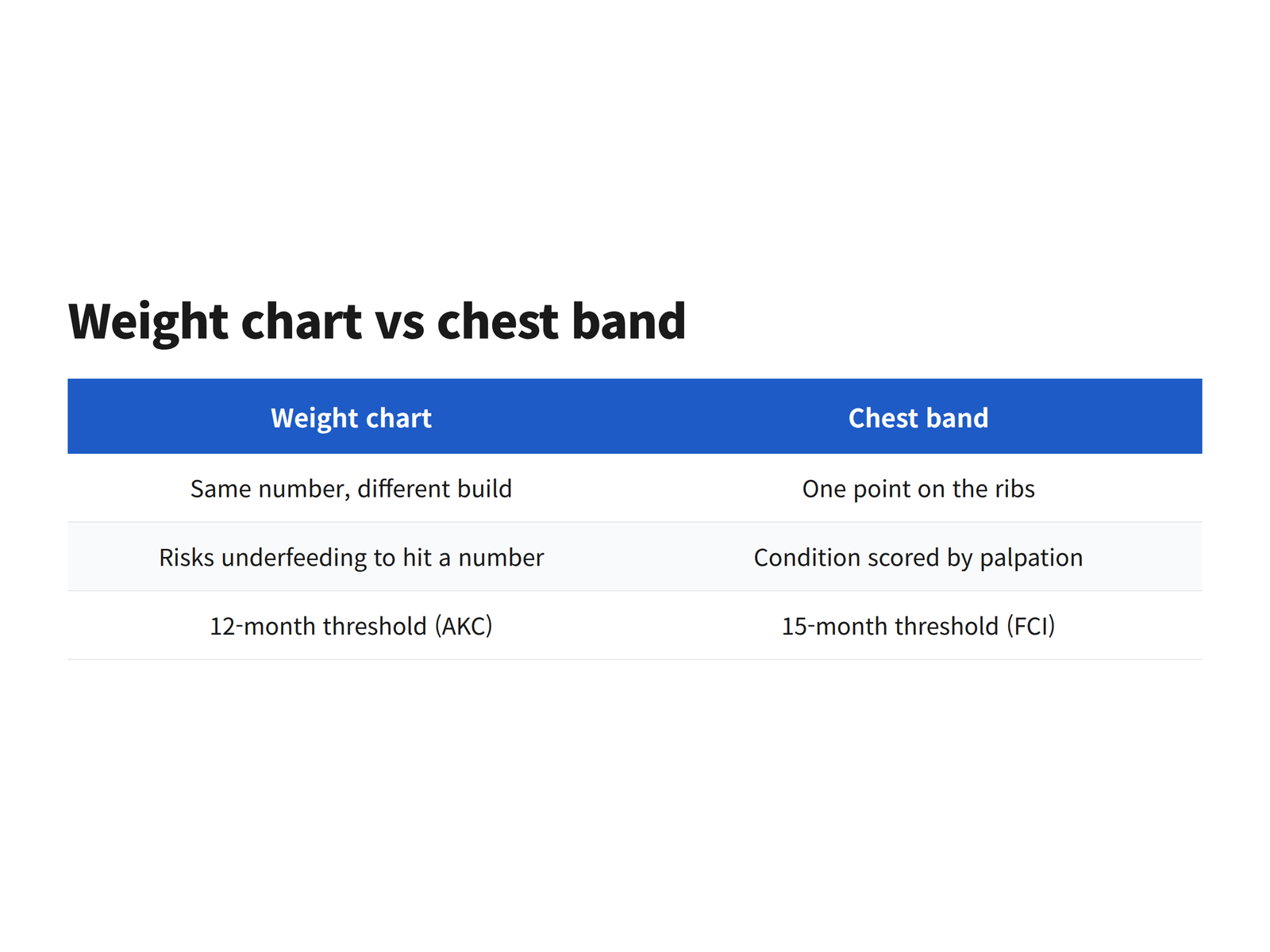
Because a weight number describes mass, not shape, and a dachshund’s problem is shape. On a body built to roughly 1.7-1.8 to 1 in length against height, the same weight can sit as a deep rib cage on one dog and as a slack abdomen on another. A harness or coat sized from the scale reading then lands in the wrong place on the ribs.
Weight limits also invite the wrong fix. The Royal Kennel Club standard, updated 2025-04-01, states that “Exhibits which appear thin and undernourished unacceptable”, so its own weight ceiling is not meant to be reached by underfeeding. The American Animal Hospital Association scores condition on a 9-point scale in its 2021 Nutrition and Weight Management Guidelines, with 4 to 5 as ideal, assessed by palpating the ribs and looking at the waist and abdominal tuck rather than by reading a single figure. Body condition and body weight are health matters, so consult your veterinarian about what is appropriate for your own dachshund rather than working from a breed-standard number.
Frequently asked questions
Can a puppy be classed as a miniature dachshund? Not under the FCI rule. FCI Standard No. 148 requires the chest circumference to be measured at 15 months or older, so no earlier reading produces a valid class. The American Kennel Club threshold applies at 12 months of age and older.
Does the FCI publish a weight limit for miniatures? No. FCI Standard No. 148, published 2021-05-25, contains no weight figure for any of its three size classes. A tool that converts a weight input into an FCI class is inventing that mapping.
Can my dachshund change class between measurements? It can sit on a border. The World Union of Teckel Clubs commentary allows a 2 cm tolerance on later readings and asks for three to five readings to reach a mean, so a borderline dog can read either side of a band on different days.
Sources
- Federation Cynologique Internationale, “FCI-Standard No. 148 – Dachshund”, published 2021-05-25 – https://www.fci.be/nomenclature/Standards/148g04-en.pdf
- American Kennel Club, “Official Standard of the Dachshund”, effective 2018-01-01 – https://images.akc.org/pdf/breeds/standards/Official_Standard_Dachshund.pdf
- The Royal Kennel Club, “Breed Standard – Dachshund (Miniature Long Haired)”, last updated 2025-04-01 – https://www.royalkennelclub.com/breed-standards/hound/dachshund-miniature-long-haired
- World Union of Teckel Clubs, “Commentary to the FCI standard for Dachshunds”, approved 2001-08-10 – https://www.weltunionteckel.com/_rec/uploads/offizielles/wut_commentary_final_2.pdf
- American Animal Hospital Association, “Canine Body Condition Score”, 2021 Nutrition and Weight Management Guidelines – https://www.aaha.org/wp-content/uploads/globalassets/02-guidelines/2021-nutrition-and-weight-management/resourcepdfs/nutritiongl_bcs.pdf
- American Kennel Club, Gemma Johnstone, “Dog Harness Sizes: The Importance of a Well-Fitting Dog Harness”, 2022-02-16 – https://www.akc.org/expert-advice/lifestyle/the-importance-of-a-well-fitting-harness/