On a longhaired dachshund the coat is longest exactly where the dog sits closest to the ground: under the neck, on the forechest, along the underside, on the ears and behind the legs. That is the American Kennel Club’s own description. So the question of what not to trim on a longhaired dachshund has a checkable answer rather than a stylistic one. Three breed authorities treat those areas as coat that is meant to be present, and only one zone on the whole dog is named as excess in any written standard.
Which parts of a longhaired dachshund’s coat should never be trimmed?
Four zones: the ear feathering, the tail flag, the coat on the throat, forechest and underside, and the feathering behind the legs. The AKC Official Standard of the Dachshund, approved 2017-11-14 and effective 2018-01-01, describes the coat as “longer under the neck and on forechest, the underside of the body, the ears and behind the legs.”
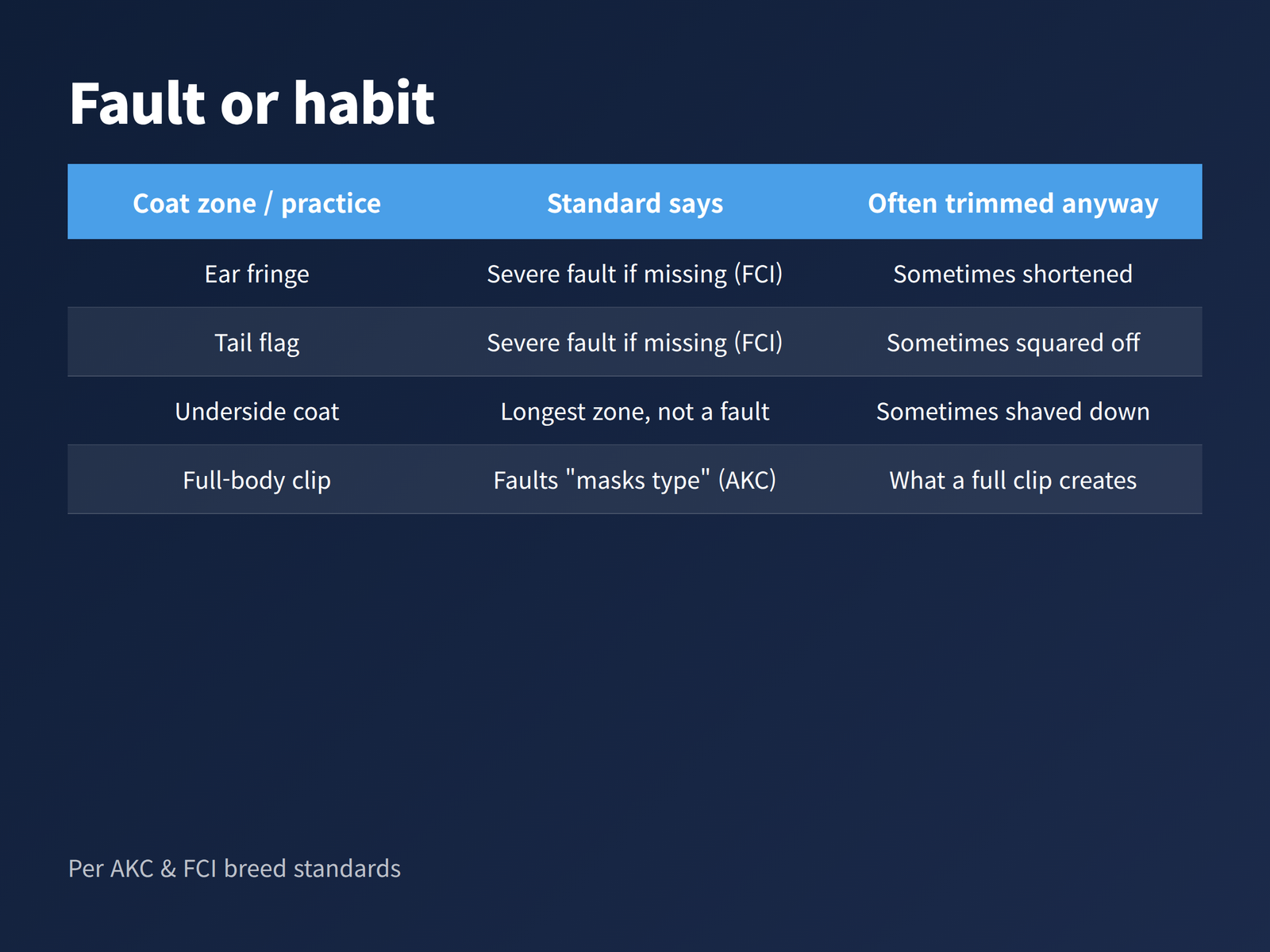
The Fédération Cynologique Internationale makes two of those zones enforceable. FCI Standard N° 148, dated 14.03.2022, lists lack of ear feathering and lack of flag among the severe faults for the Long-haired variety. Shortening a dachshund’s ear fringe or squaring off the tail is not a neutral tidy-up; it removes something a breed standard requires.
Length everywhere is not the goal either. The AKC standard also faults “equally long hair over the whole body” and “too profuse a coat which masks type” — the pattern a full-body clip produces.
Which coat zones do the standards protect, and which one do they call excess?
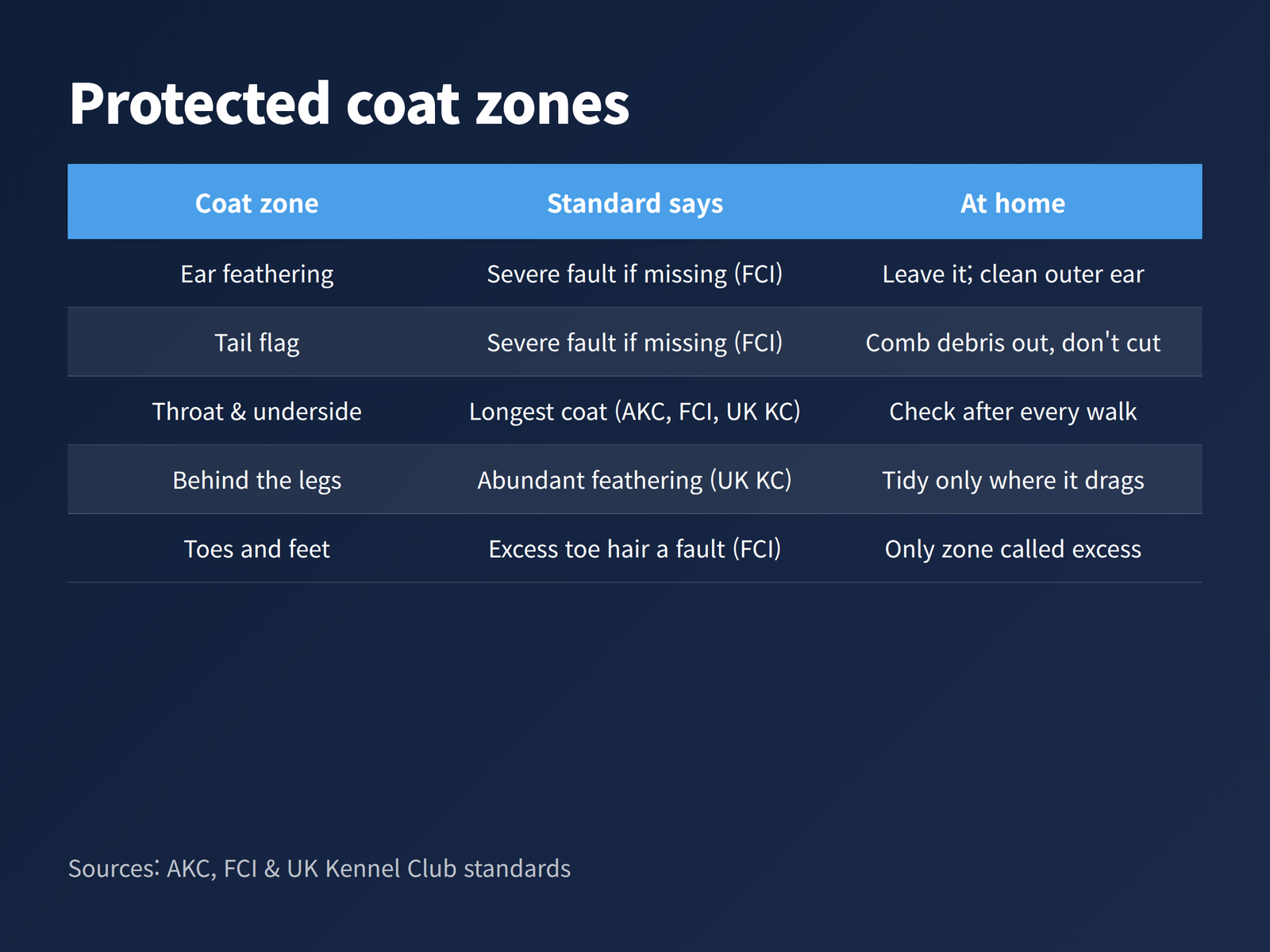
The answer sits in three documents, not one. The table sets each zone against the standard that governs it, so a grooming request can be checked against a document rather than a preference. All three authorities agree on where the coat belongs; only the FCI names a zone with too much of it.
| Coat zone | What the breed standards say | What that means at home |
|---|---|---|
| Ear feathering | Must pass the lower ear edge; lack of it a severe fault (FCI) | Leave the length; clean the outer ear |
| Tail flag | Longest on the tail underside; lack of flag a severe fault (FCI) | Comb debris out, do not cut it out |
| Throat, forechest, underside | Longest coat on the dog (AKC, FCI, UK Kennel Club) | Check after every walk |
| Behind the legs | Abundant feathering behind the legs (UK Kennel Club) | Tidy only where it drags |
| Toes and feet | Excessive toe hair a severe fault (FCI) | The one zone standards call excess |
Why does the coat on the underside get dirty before the coat on the back?
Because the underside is the lowest part of the dog and the longest part of the coat. The two published ground-clearance figures disagree, so both are worth knowing: The Kennel Club (UK) standard, last updated 2025-04-01, requires not less than one quarter of the height at the withers, while FCI Standard N° 148 describes about one third. Either way, a longhaired dachshund carries its longest coat through whatever the ground holds.
Grass seeds are the risk worth naming, though no source ties them to height. Marc Abraham, a veterinary surgeon writing for The Kennel Club, notes that “breeds with hairy ears and hairy feet are more at risk if walked in meadows or woodlands where these grasses commonly grow in abundance.” Blue Cross, in a page reviewed 2026-08-28, advises inspecting the fur after a walk and removing seeds straight away. The underside coat needs a check, not a cut: shortening it contradicts three standards and still would not replace the inspection.

Is the hair between the toes the one place that should actually come off?
Yes, and it is the only zone any standard singles out that way. FCI Standard N° 148 lists excessive toe hair among the severe faults for the Long-haired variety. Every other coat zone in that document carries a fault clause pointing in the opposite direction.
The AKC treats the work as a professional job. Its at-home grooming article of 2026-09-02 states that “hair growing between the toes can mat easily and may need a careful trim from a professional,” and its paw care article of 2026-03-18 recommends “having a professional carefully trim the hair between your dog’s pads” to stop snowballs forming.
No authoritative source specifies a blade number, a millimetre length or a scissor type. The AKC National Core Professional Dog Grooming Educational Standards, updated 2024-01-26, lists sanitary trims as a competency at item PPGP7.8 without defining any method. Standards set the target look; the groomer chooses the tool.
Does trimming the hair between the pads stop a dog slipping on hard floors?
No published primary source establishes that it does. The claim appears constantly on grooming sites, yet the AKC gives a different reason for the trim: preventing ice and snow balls. No veterinary body, breed authority or peer-reviewed journal was found measuring traction before and after a pad trim.
The nearest controlled measurement is not about hair. Bieber and colleagues, in Frontiers in Veterinary Science in 2022, measured ground reaction forces in five Labrador Retrievers wearing boots and found a consistent rise in centre-of-pressure area, with contact area and stride length unchanged. Boots on five large dogs say nothing reliable about hair on a small longhaired one.
Nail length is the variable with authority behind it. The AKC states that “long nails can turn a sound paw into a splayed foot and reduce traction,” and recommends a trim every three to four weeks. Footing matters to owners of long-backed dogs for a reason: Packer and colleagues recorded intervertebral disc disease in 15.7 percent of 2,031 surveyed dachshunds in 2016. Your dog’s spine or gait is a veterinarian’s question, not a grooming one.

Should a longhaired dachshund ever be shaved down?
Only for surgical necessity, or for severe matting that cannot be safely brushed out. Those are the two reasons the AKC accepts, and a shaved double coat does not simply grow back the way it was.
The AKC explains the mechanism directly: “Shaving a double coat removes both the undercoat and topcoat. Because the two layers grow back at different rates, the undercoat may outpace the topcoat as it regrows, creating an uneven coat that no longer functions properly.” Summer heat is not on the list. Teri Becker DiMarino, President of the California Professional Pet Groomers Association, puts it plainly: “Shaving doesn’t do anything to cool dogs off because a dog’s cooling system is different than ours.”
The alternative is carding and raking rather than cutting. AKC grooming standards item PPGP7.3 directs groomers to “remove the undercoat by carding and undercoat raking, especially for dogs with double coats.” An undercoat rake and a metal comb reduce bulk without taking off the topcoat.
How do you clean a feathered drop ear without plucking it?
Externally, and with the ear leather held shut during a bath. The AKC National Core Professional Dog Grooming Educational Standards of 2024-01-26 are explicit at item PSPP2.7 D: “Avoid plucking internal ear hair; gentle external cleaning is permittable.” Item PSPP2.6 C adds “pinch the ear leather closed while bathing,” which keeps water out of a drop ear already sitting against the head, and PSPP2.5 B allows cotton balls for earwax on the outer ear.
Anything past the outer ear belongs to a clinician. Consult your veterinarian before treating redness, odour, discharge or head shaking in a longhaired dachshund, and before starting any ear product. Grooming decisions stop where a diagnosis begins.
How often does a long coat need this kind of check?
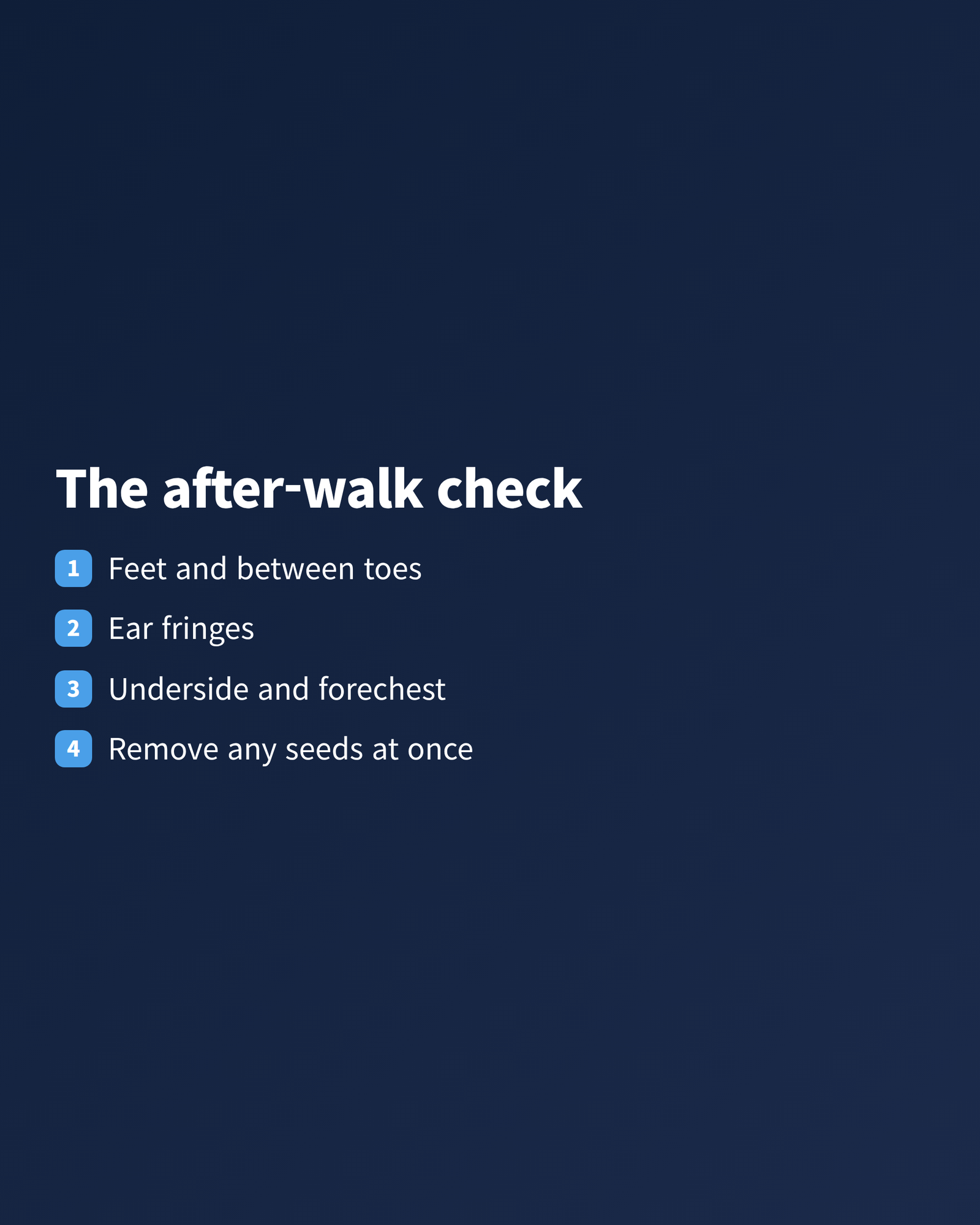
Daily for brushing, every three to four weeks for nails, and after every walk for the underside and feet. The AKC’s 2026-09-02 grooming article notes that long-coated breeds often do best with daily brushing, while its 2026-09-01 article on double coats recommends combing two to three times weekly.
Clipping intervals carry the weakest date. Blue Cross suggests every 4 to 12 weeks with daily brushing between sessions, but that page was last updated 2017-07-26, so treat it as a rough frame rather than a current figure. Blue Cross also cautions that “it’s not always necessary to bath dogs, unless they are dirty or have skin problems,” since frequent washing strips the coat’s natural oils.
Certified Master Groomer Jennifer Bishop-Jenkins frames it well: “Recognizing your dog’s coat type is so important when grooming your dog. There are different ways to groom a dog, depending on its coat type.” For this build that means checks on protected coat and a short list of exceptions.
A longhaired dachshund’s coat is not a maintenance problem to be cut down to size. Three standards describe the same distribution of length, two attach fault clauses to removing it, and only the toes are named as excess. The rest is combing, checking after walks, and leaving the feet to a groomer.
Frequently asked questions
Is a longhaired dachshund a double-coated breed? FCI Standard N° 148 describes the Long-haired variety’s coat as having an undercoat and lying close to the body, longer at the throat and underside. That is why AKC guidance on shaving regrowth applies here.
Can the tail flag be shortened if it picks up debris? Comb it out instead. The FCI standard lists lack of flag among the severe faults, so cutting the tail short trades a cleaning problem for a permanent one.
What is safe to trim at home? Little beyond tidying where leg or underside feathering drags. Both AKC articles covering the hair between the toes and pads recommend a professional.
Sources
- American Kennel Club, Official Standard of the Dachshund, approved 2017-11-14, effective 2018-01-01 — https://images.akc.org/pdf/breeds/standards/Official_Standard_Dachshund.pdf
- Fédération Cynologique Internationale, Dachshund, Standard N° 148, 14.03.2022 — https://www.fci.be/nomenclature/Standards/148g04-en.pdf
- The Kennel Club (UK), Dachshund (Long Haired) breed standard, last updated 2025-04-01 — https://www.royalkennelclub.com/breed-standards/hound/dachshund-long-haired/
- American Kennel Club, National Core Professional Dog Grooming Educational Standards, updated 2024-01-26 — https://www.akc.org/wp-content/uploads/2024/06/AKC-National-Core-Professional-Dog-Grooming-Educational-Standards.pdf
- American Kennel Club, “How to Groom Your Dog at Home: Easy Tips for Everyday Care”, 2026-09-02 — https://www.akc.org/expert-advice/health/how-to-groom-a-dog/
- American Kennel Club, “How to Care for and Clean Dog Paws and Paw Pads”, 2026-03-18 — https://www.akc.org/expert-advice/health/clean-dog-paws/
- American Kennel Club, “What Is a Double-Coated Dog? Coat Types, Grooming, and Care”, 2026-09-01 — https://www.akc.org/expert-advice/dog-breeds/double-coated-dog-breeds/
- American Kennel Club, “How to Trim Your Dog’s Nails at Home”, updated 2026-06-01 — https://www.akc.org/expert-advice/health/how-to-trim-dogs-nails-safely/
- Blue Cross, “Grass Seeds and Dogs”, reviewed 2026-08-28, approved by Róisín Bolger BVMS MRCVS — https://www.bluecross.org.uk/advice/dog/health-and-injuries/grass-seeds-and-dogs
- Blue Cross, “How to groom your dog”, last updated 2017-07-26 — https://www.bluecross.org.uk/pet-advice/how-groom-dog
- The Kennel Club (UK), “Grass seeds”, authored by Marc Abraham, veterinary surgeon — https://www.royalkennelclub.com/health-and-dog-care/health-dog-care/health/health-and-care/a-z-of-health-and-care-issues/grass-seeds/
- Packer RMA, Seath IJ, O’Neill DG, De Decker S, Volk HA, “DachsLife 2015: an investigation of lifestyle associations with the risk of intervertebral disc disease in Dachshunds”, Canine Genetics and Epidemiology, 2016 — https://doi.org/10.1186/s40575-016-0039-8
- Bieber B, Reicher B, Tichy A, Bockstahler B, “Changes in Ground Reaction Forces and Center of Pressure Parameters of Paws When Wearing Dog Boots in Dogs”, Frontiers in Veterinary Science, 2022, 9:906277 — https://www.frontiersin.org/journals/veterinary-science/articles/10.3389/fvets.2022.906277/full