No. “English cream” is not a color recorded by any dachshund breed standard. The color the registries actually record is “cream”, and none of the six documents checked for this article uses the word “English” as a color term. Cream is not accepted everywhere either. Under The Kennel Club in the United Kingdom, cream is a breed standard color in the miniature long-haired dachshund and not in the standard-size Long Haired, which is the single fact most puppy adverts leave out.

Is “English cream” a color that any dachshund registry recognizes?
No registry recognizes it. The term does not appear as a color in the American Kennel Club standard, the Dachshund Club of America colors sheet, The Kennel Club breed standards, FCI Standard No. 148, the Canadian Kennel Club standard or the United Kennel Club standard. That is a verified absence across all six documents, not an inference drawn from one of them.
The word “cream” does appear in four of those six. “English” is a marketing prefix attached to it in advertising, and no registry document assigns the prefix a meaning, a bloodline or a grade. The Kennel Club has been blunt about what that kind of labelling does, describing breeders as “effectively duping puppy buyers by claiming certain colours are ‘rare’ or advertising litters as colours that do not exist” in its media release of 2017-07-12.
Which registries list cream as an accepted dachshund color?
Four of the six accept cream, and one of those four accepts it only in part of the breed. The American Kennel Club standard approved 2017-11-14 and effective 2018-01-01 states that “One-colored Dachshunds include red and cream”, and its longhaired section reads “Color of Hair – Same as for the smooth Dachshund”, so the color list carries straight across to the longhaired variety. The Dachshund Club of America lists cream among the standard colors on its Colors & Patterns sheet, Version 0920.
| Registry | Cream in a longhaired dachshund | Blue (gray) and Isabella (fawn) |
|---|---|---|
| American Kennel Club (US) | Accepted in all varieties | Accepted as named bases |
| The Kennel Club (UK) | Accepted only in miniature long-haired | Unacceptable |
| FCI (international) | Not listed | Not listed |
| Canadian Kennel Club | Accepted | Accepted with tan or cream marks |
| United Kennel Club (US) | Not listed | Not listed |
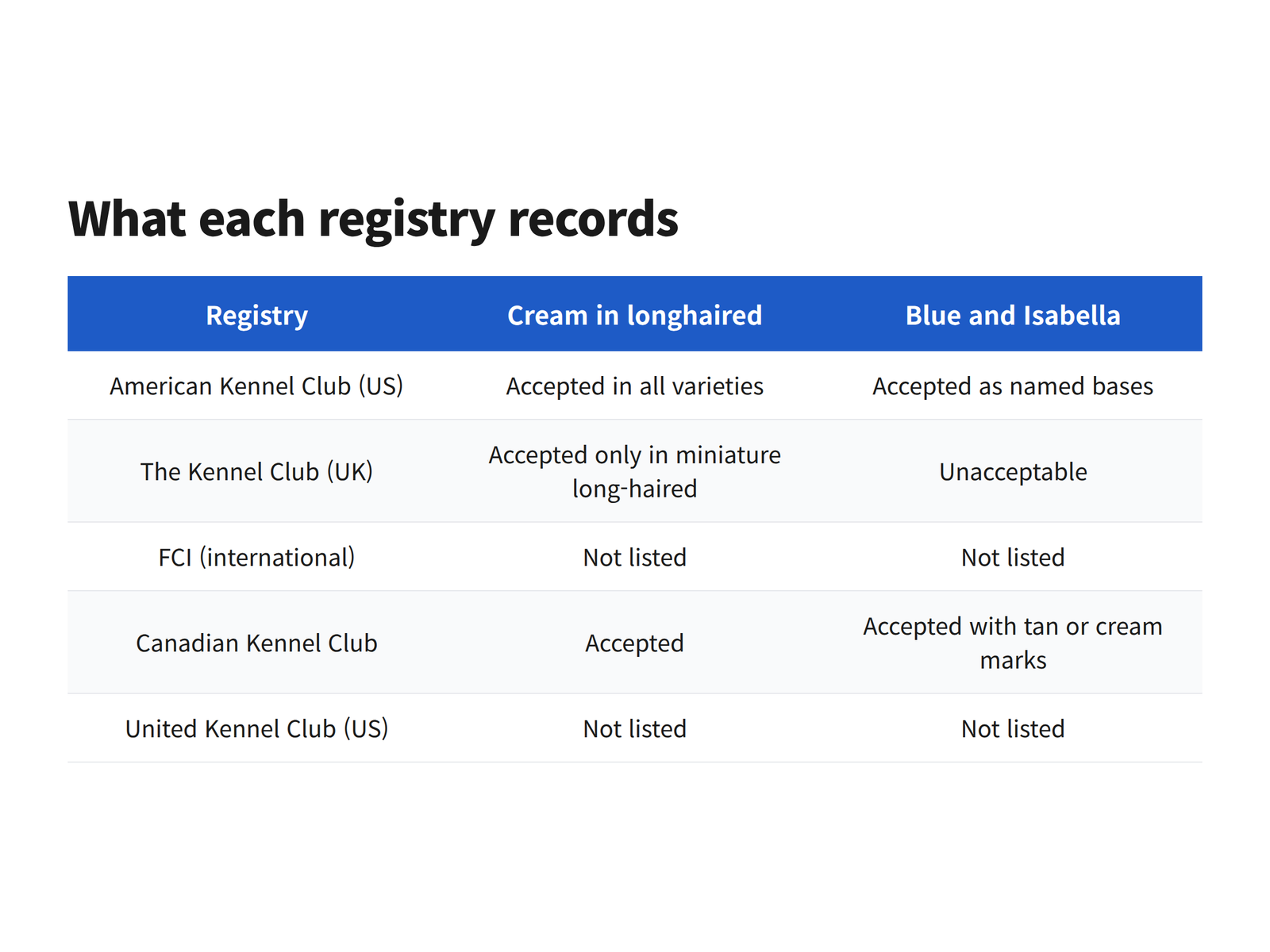
The two registries that omit cream omit it completely. FCI Standard No. 148, in force from 14.03.2022, gives the one-coloured dachshund as “Red. Red with black overcoat.” The United Kennel Club standard, revised 2008-01-01, gives “red (often called tan), red-yellow and yellow”. A cream dachshund has no color slot at all in the FCI standard of the breed’s country of origin. The Canadian Kennel Club lists cream both as a one-coloured option and inside combinations such as black-and-cream.
Why can a standard-size longhaired cream dachshund not be shown under Kennel Club rules?
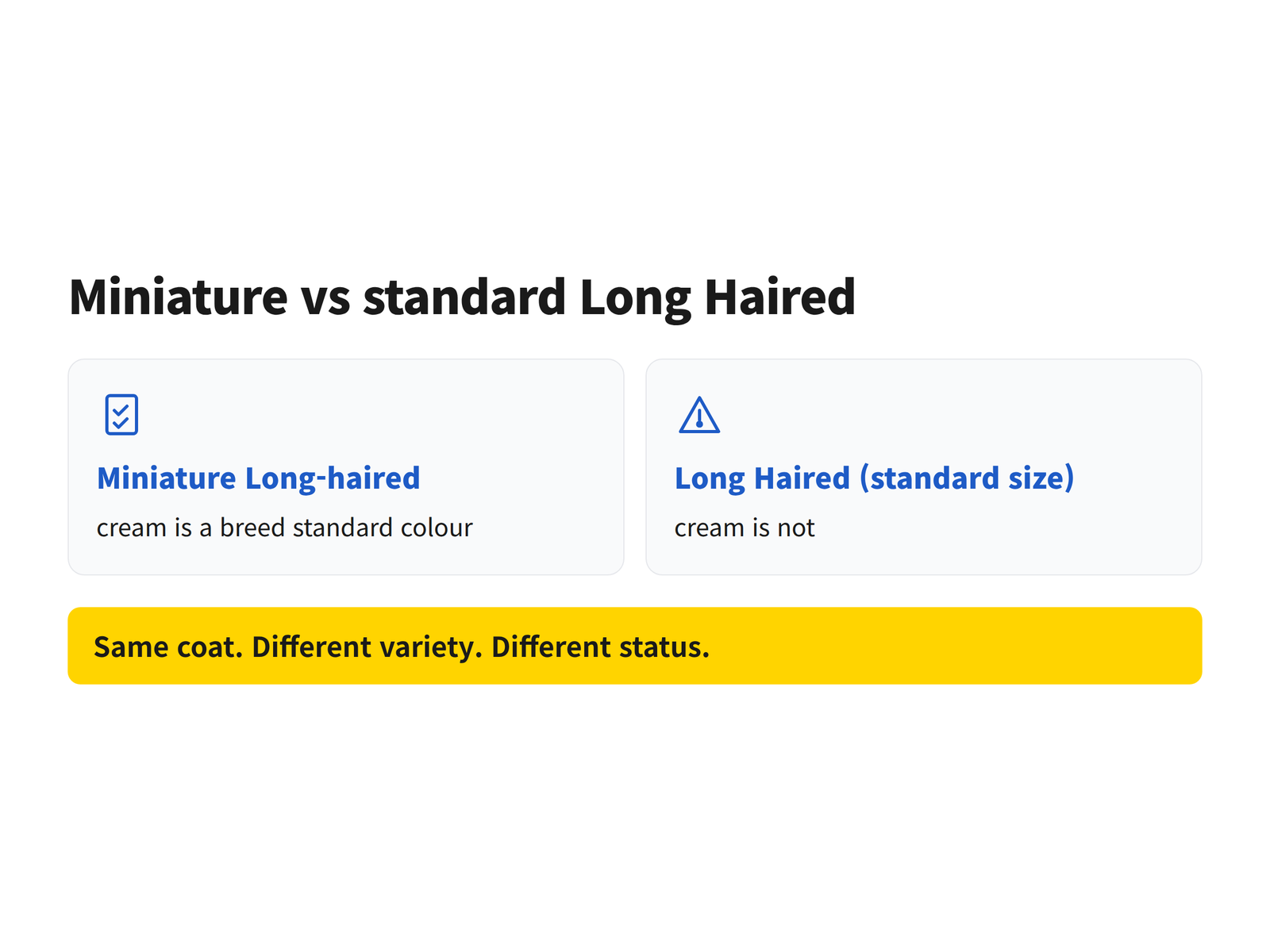
Because The Kennel Club grants cream to two miniature varieties only. The colour clause reads “Cream (fawn), interspersed black hairs are permissible”, and it sits under the heading “The following colours are acceptable only in the varieties specified: Miniature Smooth-haired and Miniature Long-haired”. The standard-size Long Haired is not on that list. Both standards were last updated 2025-04-01.
The reason this split exists at all is structural. The Kennel Club lists six separate dachshund breeds in its Breeds A to Z, each with its own breed standard page, while the American Kennel Club treats the smooth, wirehaired and longhaired dachshund as three varieties of one breed. Because the United Kingdom standards are separate documents, a colour clause can apply to one variety and not to its full-size counterpart. Two visually identical cream dogs can therefore hold two different registration statuses purely through size classification.
What does a non-breed standard colour registration actually mean?
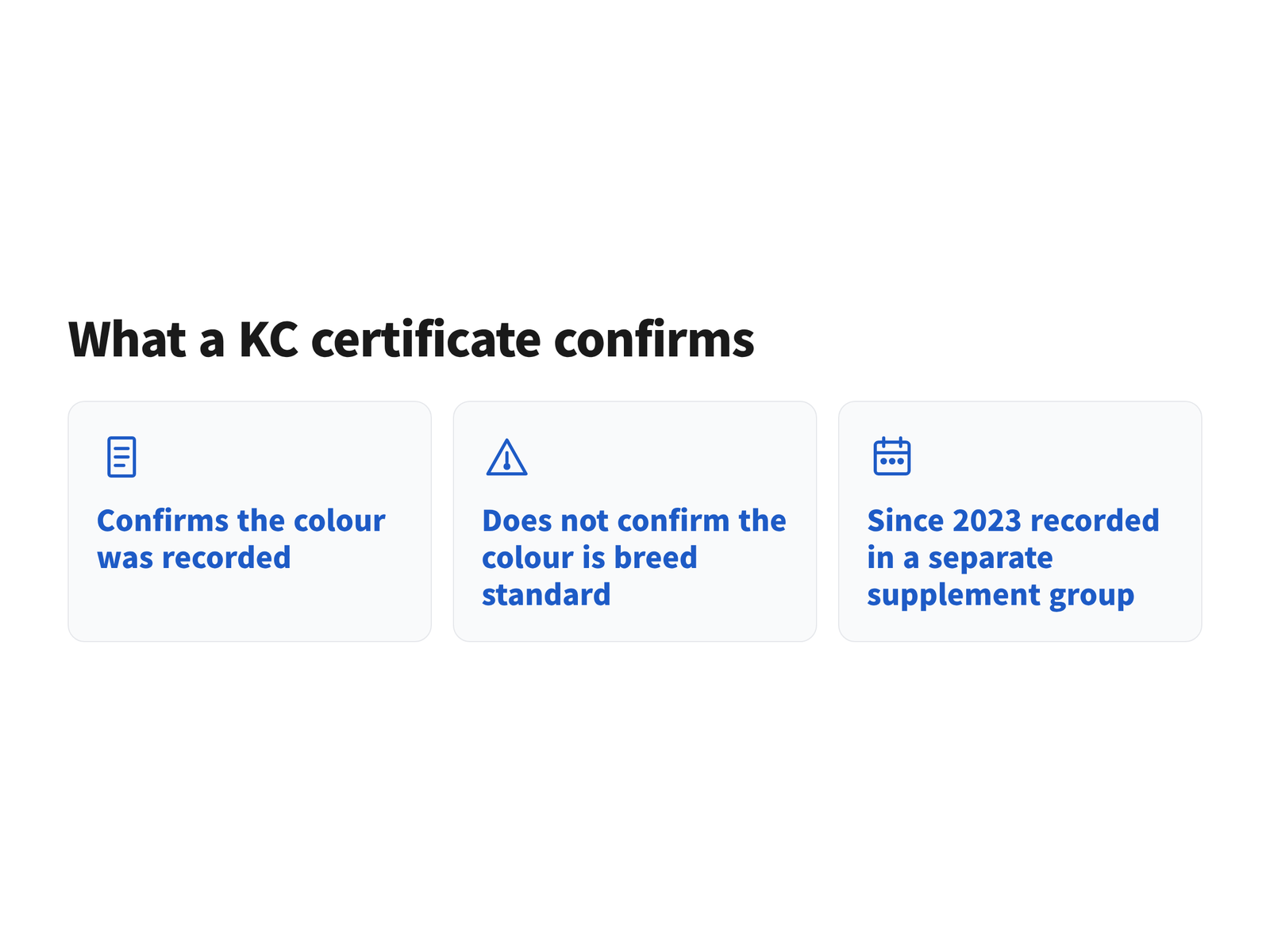
It means the puppy is registered, but the colour on the certificate sits outside the breed standard group. The Kennel Club used to offer a generic “Colour Not Recognised” option at registration. From 2017-07 breeders had to enter the specific colour manually instead, and the Dachshund Breed Council UK recorded on 2020-10-17 that “Breeders can no longer register puppies as CNR”, with colours split into breed standard and non-breed standard groups.
The system tightened again on 2023-03-23, when The Kennel Club approved the recommendations of its Non-breed Standard Colours Working Party. Breed standard and non-breed standard colours are now separated in the Breed Record Supplement, a Colour Watch system modelled on Breed Watch was approved, and owners of imported dogs must record the dog’s true colour from the full Kennel Club colour list. The Dachshund is one of the named breeds. Frank Kane, who chaired the working party, said the measures should “help protect the heritage of these wonderful breeds”.
A Kennel Club registration certificate therefore does not certify that the colour printed on it is a breed standard colour. It certifies only that a colour was recorded against that dog, and since 2023 the Breed Record Supplement grouping is where the difference between the two categories actually shows.
Which dachshund colors does the AKC accept that the Kennel Club rejects?
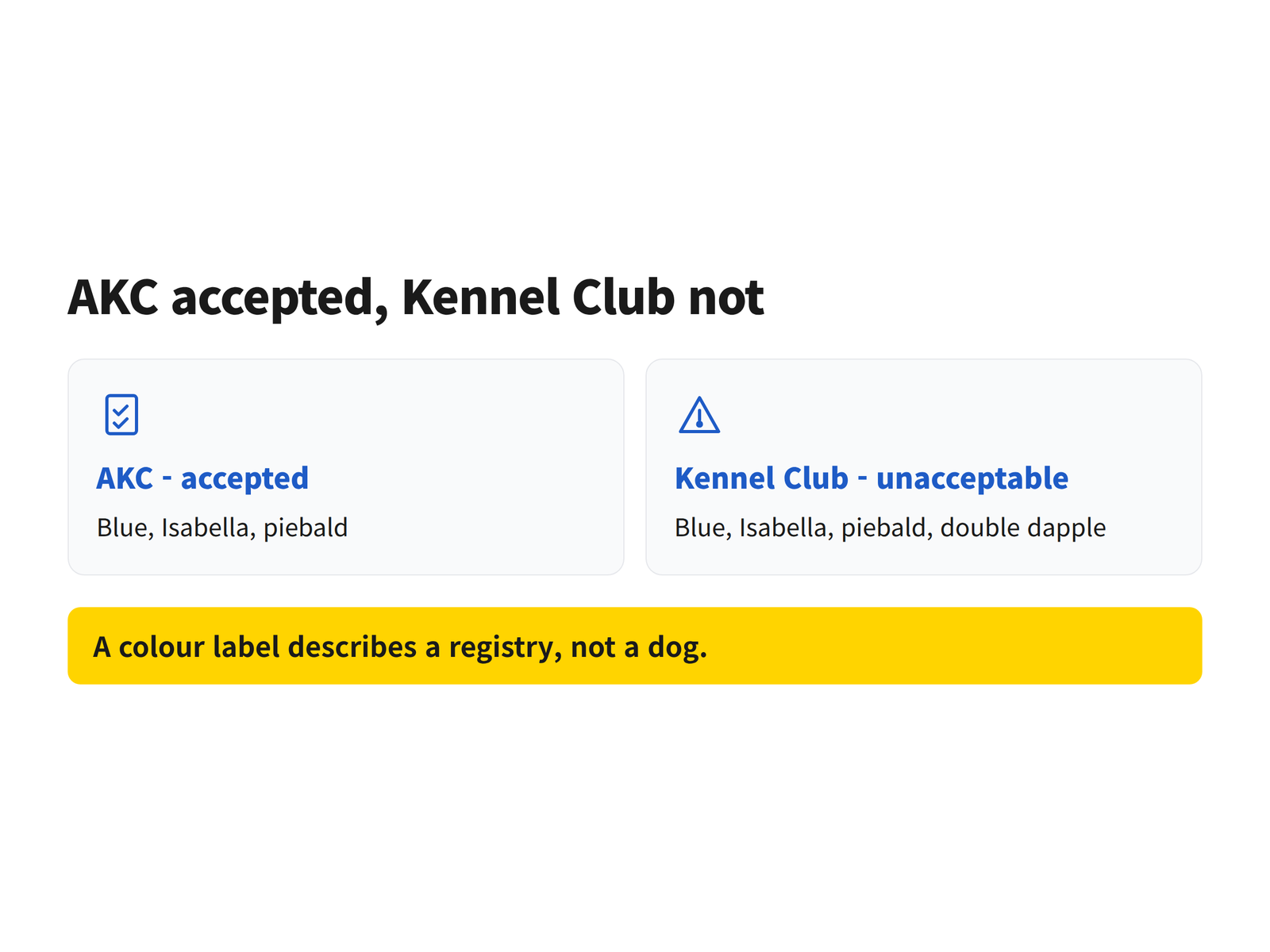
Blue (gray), Isabella (fawn) and white-marked piebald patterning. Each standard closes with a clause that decides everything after it. The American Kennel Club standard ends with “Colors or patterns other than those specified above are a disqualification”, wording repeated on the Dachshund Club of America breed standard page. The Kennel Club ends with “Double dapple (where varying amounts of white occur all over the body in addition to the dapple pattern), Isabella, blue and all other colours or patterns including piebald and tricolour are unacceptable.”
White is the clearest divide. Piebald is an accepted American Kennel Club pattern, with disqualifications sitting inside it for “blue eye(s), >50% white on head, white on any part of the ears/around the eyes or a pure white body”. The Kennel Club permits almost none: “In all colours no white permissible, save for a small patch on chest which is permitted but not desirable.” The same piebald dachshund is a standard color in the United States and an unacceptable colour in the United Kingdom.
The breed’s own bodies also attach a health warning to the dilute colors. The Dachshund Club of America states that “The colors Gray (Blue) & Fawn (Isabella) mentioned in the Standard are both dilutes of Black & Chocolate, respectively. These dilutes may also be associated with health issues, such as thin coats, skin sensitivity, vaccine failures and reduced lifespan.” The same document notes that double dapples “are more likely to carry health issues such as deafness, reduced eye size or missing eyes”, which is one reason the pattern sits on the Kennel Club unacceptable list.
Dachshund Health UK, a registered charity, reported that in a Spring 2018 survey of dilute dog owners 43% of dogs were described as showing colour dilution alopecia, and states plainly “We strongly recommend you do not buy a dilute coloured Dachshund”. Those are positions published by two breed organisations, not a prediction about any individual dog, so consult your veterinarian about any coat or skin concern in a dachshund you already own or plan to buy.
What should a puppy advert say about color before you pay a premium?
It should name the color the way a registry records it. A clear advert gives the registering body, the colour written on the registration paperwork, and whether that colour sits in the breed standard group for that exact variety. Caroline Kisko, Kennel Club Secretary, framed the buyer’s side of this in 2017: “These measures will send a clear message to anyone thinking of breeding a litter or buying a puppy that it is best to avoid doing so based upon one factor only – in this case, colour.”
Five things worth confirming on paper before money moves:
- The registering body, named in full
- The colour exactly as entered on the registration record
- The variety the puppy is registered under
- Whether that colour is breed standard for that variety
- Whether the litter was bred for anything beyond colour
No verified figure exists for what a colour name adds to a dachshund’s price, so none is offered here. A colour label describes a registry’s paperwork, not the dog standing in front of you.
Frequently asked questions
Is “English cream” simply another way of saying cream? On paper the registries only ever record “cream”. No standard examined defines “English” as a colour, a variety or a bloodline grade, so the prefix adds nothing to a registration record.
Is a clear cream different from a shaded cream? The American Kennel Club and Dachshund Club of America documents describe cream with or without a shading of interspersed dark hairs, and The Kennel Club clause allows interspersed black hairs. No registry document reviewed here separates the two into distinct registrable colours.
Can a non-breed standard colour dachshund still be registered in the United Kingdom? Yes. Non-breed standard colours remain registerable. Since the 2023-03-23 measures they are recorded separately in the Breed Record Supplement and fall under the approved Colour Watch system.
Does the FCI accept a cream dachshund? No. FCI Standard No. 148, dated 14.03.2022, names only “Red. Red with black overcoat.” for the one-coloured dachshund. Cream is absent from the document.
Sources
- American Kennel Club, “Official Standard of the Dachshund”, approved 2017-11-14, effective 2018-01-01 – https://images.akc.org/pdf/breeds/standards/Official_Standard_Dachshund.pdf
- Dachshund Club of America, “Breed Standard” – https://dachshundclubofamerica.org/breed-standard/
- Dachshund Club of America, “Dachshund Colors & Patterns”, Version 0920 – https://www.dachshundclubofamerica.org/wp-content/uploads/2022/02/Dachshund-Colors-and-Patterns.pdf
- The Kennel Club, “Dachshund (Long Haired) Breed Standard”, updated 2025-04-01 – https://www.royalkennelclub.com/breed-standards/hound/dachshund-long-haired/
- The Kennel Club, “Dachshund (Miniature Long Haired) Breed Standard”, updated 2025-04-01 – https://www.royalkennelclub.com/breed-standards/hound/dachshund-miniature-long-haired
- Federation Cynologique Internationale, “FCI Standard No. 148 – Dachshund”, 14.03.2022 – https://www.fci.be/Nomenclature/Standards/148g04-en.pdf
- Canadian Kennel Club, “Dachshund” official breed standard, Group 2 – https://www.ckc.ca/CanadianKennelClub/media/Breed-Standards/Group%202/Dachshund.pdf
- United Kennel Club, “Breed Standards: Dachshund”, revised 2008-01-01 – https://www.ukcdogs.com/dachshund
- The Kennel Club, “Kennel Club addresses issue of unrecognised colour registrations in pedigree dogs”, 2017-07-12 – https://www.royalkennelclub.com/about-us/resources/media-centre/2017/july/kennel-club-addresses-issue-of-unrecognised-colour-registrations-in-pedigree-dogs/
- The Kennel Club, “Measures approved for Colours Working Party”, 2023-03-23 – https://www.royalkennelclub.com/about-us/resources/media-centre/2023/march/measures-approved-for-colours-working-party/
- Dachshund Health UK, Registered Charity No. 1177400, “Dilute colour Dachshunds (Blue and Isabella) – know the health risks”, published 2018-11-11, updated 2023-06-30 – https://www.dachshundhealth.org.uk/welcome/2018/11/11/dilute-colour-dachshunds-blue-and-isabella-know-the-health-risks
- Dachshund Breed Council UK, “Updated list of registration colours and patterns”, 2020-10-17 – https://dachshundbreedcouncil.wordpress.com/2020/10/17/updated-list-of-registration-colours-and-patterns/