Winter walk advice covers coats and harnesses separately, and almost none of it says which one goes on first. For a low-slung dog with a long spine and short legs, that order changes how the harness grips, what the coat actually covers, and whether reflective gear stays visible after dark. The question of harness over or under a coat for a long-backed dog has no vendor-neutral answer on page one of Google. Below is what the American Kennel Club, the AVMA, the RSPCA and The Royal Kennel Club actually specify, and where the published record simply stops.

Should a dog harness go over or under a winter coat?
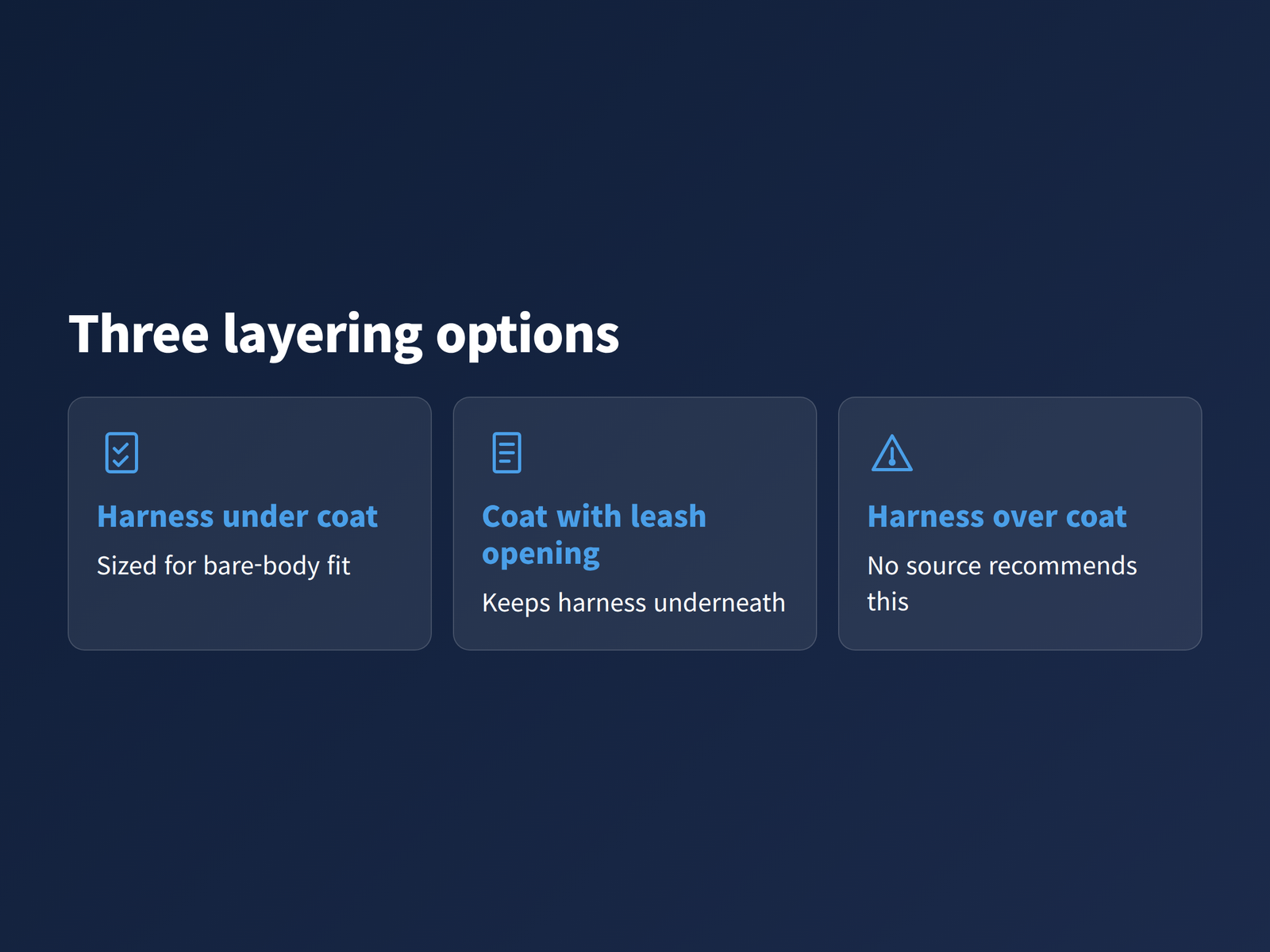
Put the harness against the dog’s body, under the coat, because no A-grade fitting guide consulted here addresses wearing a harness over a coat. The American Kennel Club’s measuring guide, updated 2026-08-10, tells owners to take back length, chest girth and neck girth directly on the standing dog, and to slip two fingers between the tape and the body. No primary source consulted here recommends buckling a harness on top of a coat. The one layered arrangement the American Kennel Club does describe is a jacket with “a built-in hole for the leash attachment of a harness to pass through”, which keeps the harness underneath while the leash still clips from the outside.
Why does layering order matter more for a long-backed dog?
Layering order matters more on a long-backed dog because the coat has to clear a longer back and a much lower body line than a square-built breed. The Royal Kennel Club breed standard for the Long Haired Dachshund, last updated 2025-04-01, calls for a “compact, well-muscled body, with enough ground clearance, not less than one quarter of the height at the withers”, and sets an ideal weight of 9-12 kg (20-26 lbs) for the standard size. A dog built that way carries its chest close to the ground, so a coat hem and a harness strap compete for the same narrow band of body.
How do you measure a long-backed dog for a coat and a harness?
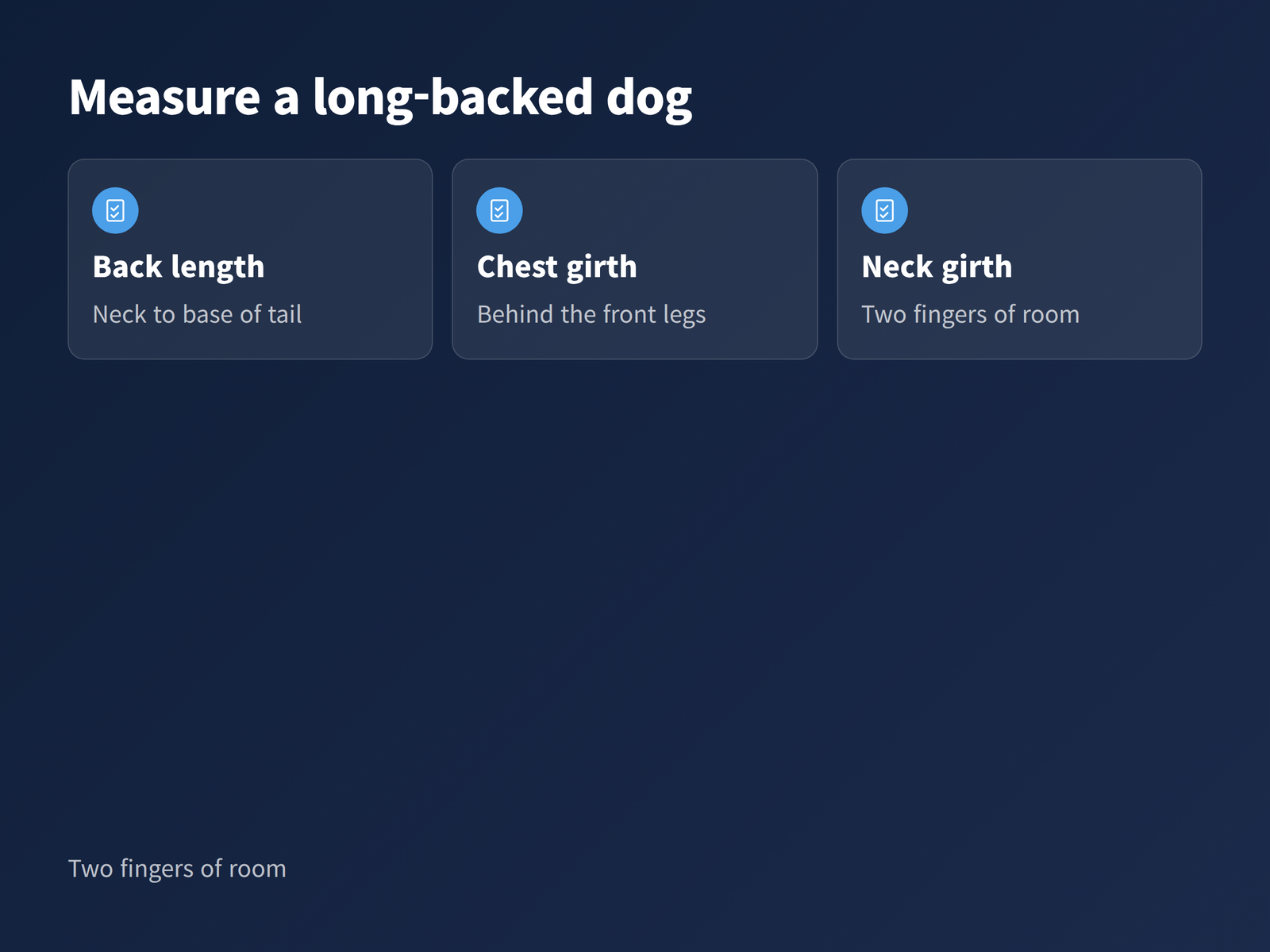
Take three measurements on a standing dog: back length, chest girth and neck girth. The American Kennel Club defines back length as the distance “from the base of the neck where it joins the body-usually where their collar sits-to the base of their tail”, and chest girth as the circumference “around the largest part of the rib cage, usually just behind the front legs”. Leave room for two fingers between the tape and the dog on every circumference. If a dog falls between two sizes, the American Kennel Club advises taking the larger size, which matters on long-backed breeds because the back length figure usually runs out before the girth figure does.
Why does a harness worn over a coat slip on a long-bodied dog?
A harness buckled over a coat slips because the girth number it was sized to no longer describes what the strap is actually gripping. The two-finger allowance that the American Kennel Club builds into the measurement gets filled by fabric, and padded fabric compresses and shifts as the dog moves. Fit is not a minor variable either: Palya et al., writing in PLOS ONE in 2022, reported that across four dogs, 28 trials, 53 parameters and 18 joint angles, “most parameters are significantly altered by the harnesses in about 2/3rd of the cases”. No source consulted publishes a slip rate for harnesses worn over coats, so treat the mechanism as the reason, not a statistic.
Which layering setups do primary sources actually support?
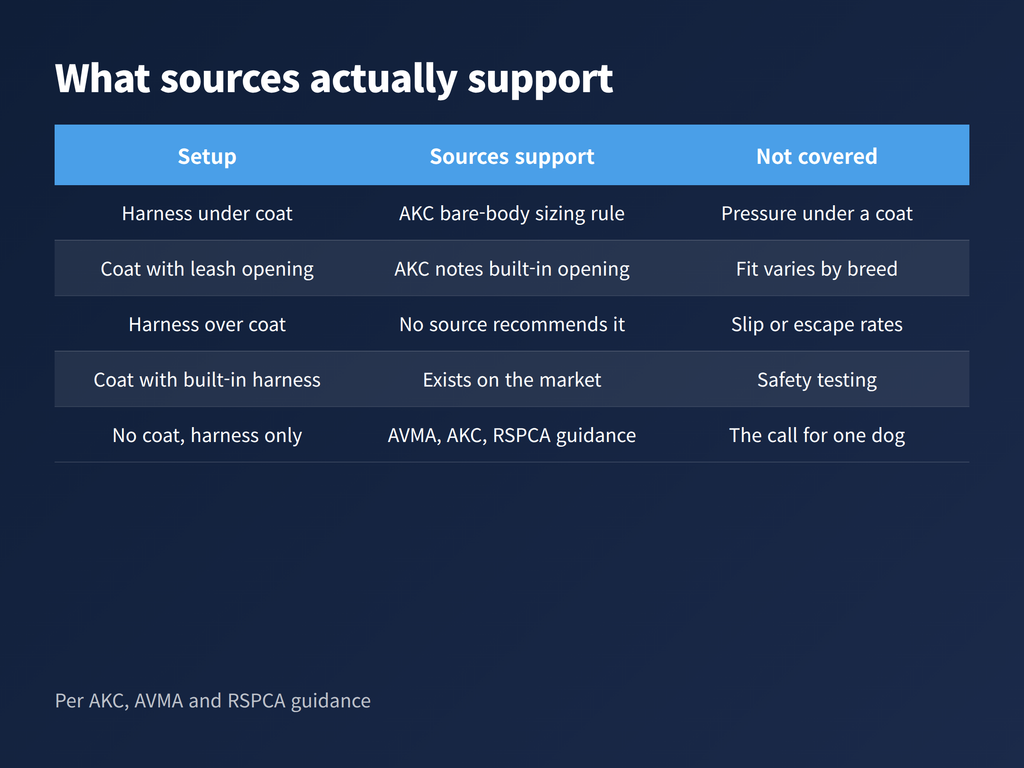
Only two setups have any primary-source backing, and the table below marks exactly where the evidence runs out. The right-hand column is the part vendor pages leave off.
| Layering setup | What primary sources support | What no consulted source covers |
|---|---|---|
| Harness under the coat | AKC sizing and two-finger rule assume bare-body measurement | Pressure or rubbing under a coat |
| Coat over a back-clip harness | AKC notes jackets with a built-in leash opening | Whether the opening sits right per breed |
| Harness over the coat | No A-grade source recommends this order | Slip or escape rates |
| Coat with a built-in harness | Category exists on the market | Strength and safety testing |
| No coat, harness only | AVMA, AKC, RSPCA list which dogs need a coat | The call for one individual dog |
What does a winter coat leave uncovered on a low-slung dog?
A winter coat leaves the belly, the lower chest and the legs exposed, which is the exact zone a short-legged dog drags through slush. The American Veterinary Medical Association states that “short-legged pets may become cold faster because their bellies and bodies are more likely to come into contact with snow-covered ground”. The RSPCA advises owners to “thoroughly wipe down your dog’s paws and tummy after walks to remove grit and rock salt”, and Blue Cross warns that road salt is toxic if a dog licks it off.
Coat coverage is not the only variable on a low-slung dog, since the American Veterinary Medical Association also notes that “short-haired pets feel the cold faster because they have less protection”, which stacks with a low body line on a short-coated dog. A coat that stops at the ribs does not remove either job.
Does a coat hide the reflective gear on dark winter walks?
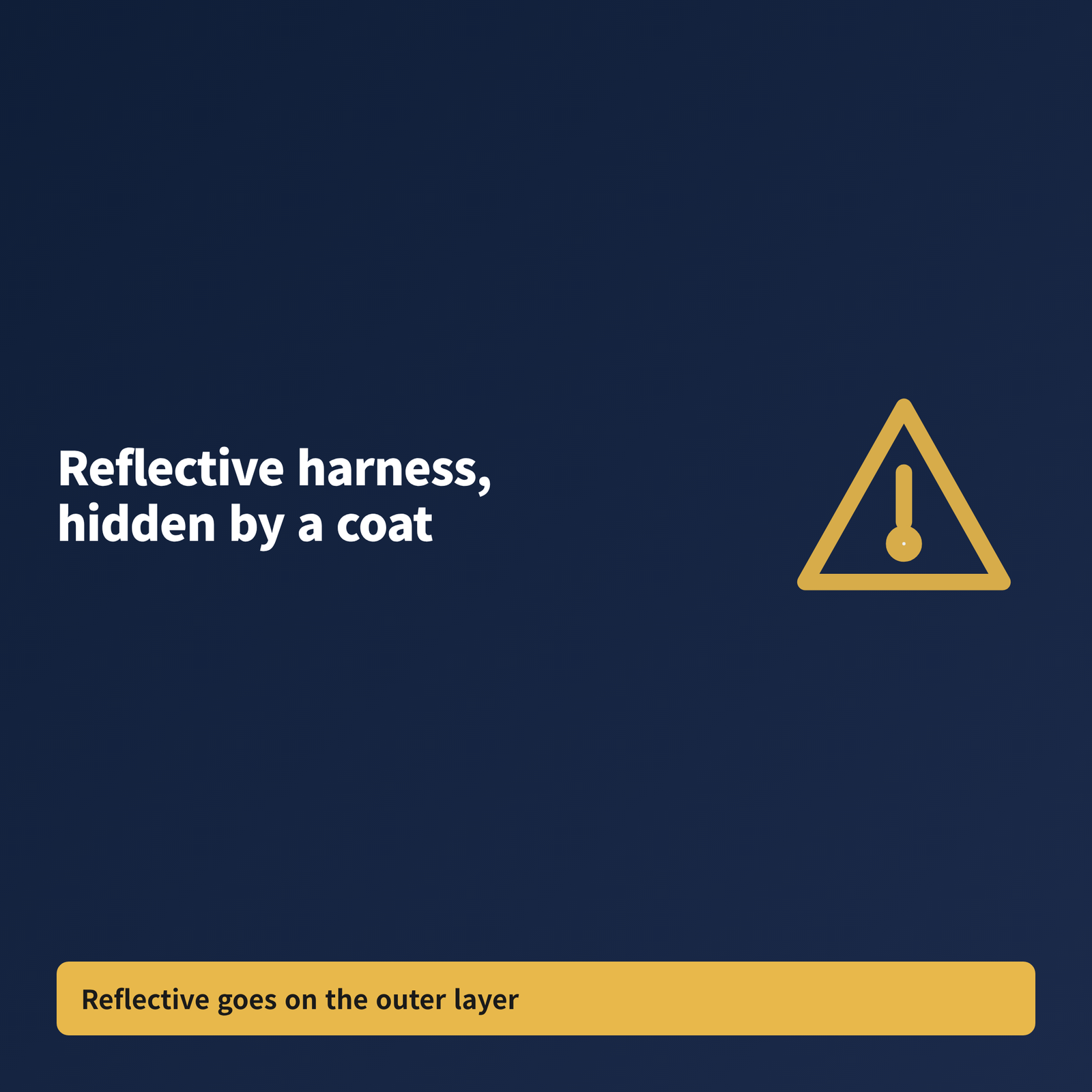
A coat worn over a reflective harness covers the reflective panels, which defeats the point of buying them. Blue Cross recommends a “good quality flashing or reflective collar or harness” for walks in the dark, and that advice only works if the reflective element is on whichever layer ends up outermost. On a long-backed dog the harness sits low on the ribs to begin with, so a coat that reaches the elbows can hide most of it. Check the visibility of the finished, fully dressed dog rather than the harness on its own.
When is a coat the wrong answer for a cold walk?
A wet coat is worse than no coat. The American Veterinary Medical Association states plainly that “wet sweaters or coats can actually make your dog colder”, and a low-slung dog soaks its coat hem first on wet ground. Blue Cross notes that thickly double-coated breeds such as Labradors, Huskies and German Shepherds usually need no extra layer at all. The RSPCA adds that a coat should be snug without restricting movement, and PDSA puts the same test more usefully: “your dog should be able to move freely in their coat and do everything they usually do without the coat on.”
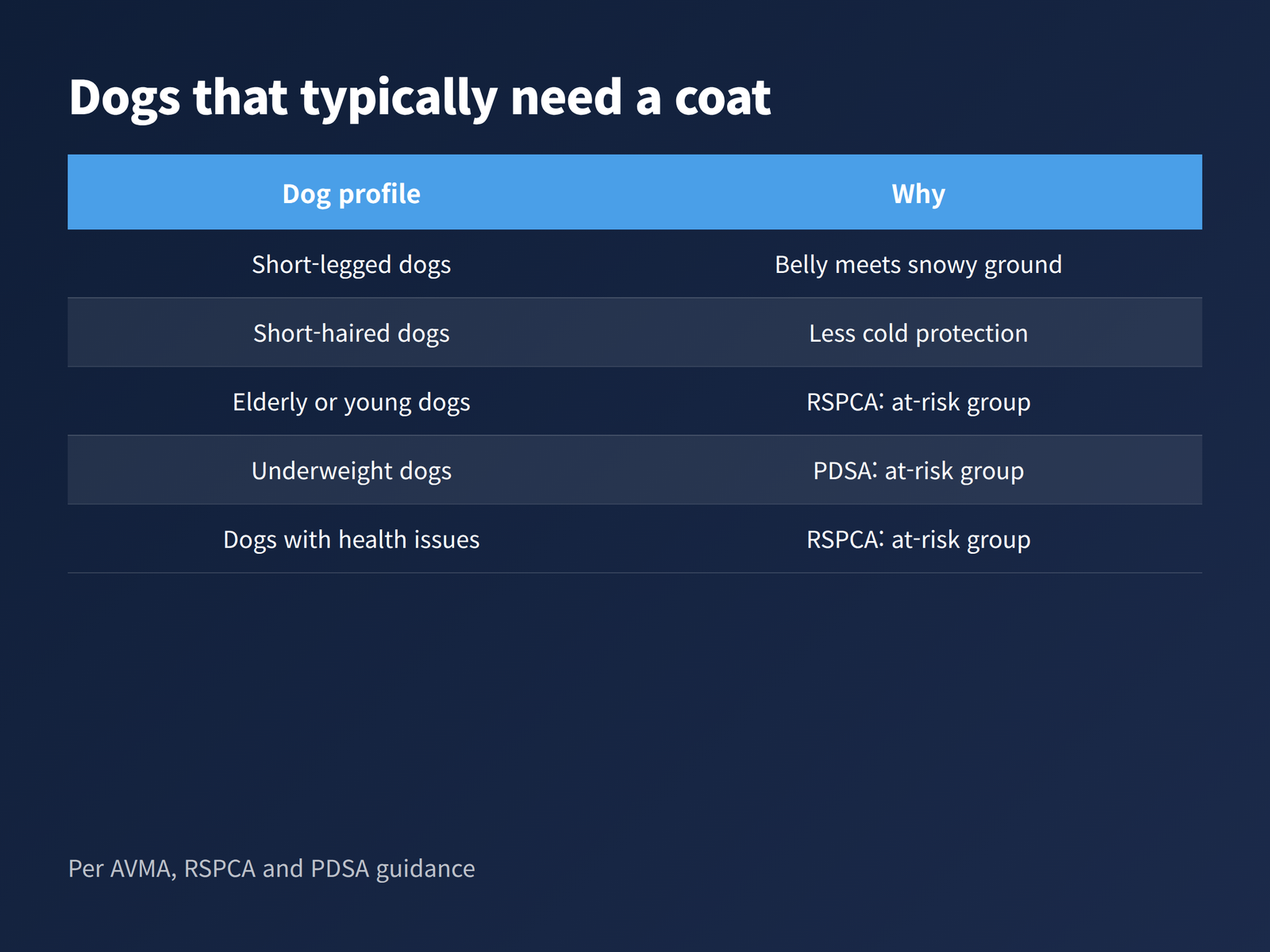
If your dog is very young, elderly, underweight or has a health condition, talk to your veterinarian before changing winter walk routines. The RSPCA’s often-quoted limit of 20 minutes per outing applies to dogs with heart disease, not to healthy dogs in general, and the same source recommends keeping indoor temperatures between 10°C and 25°C over winter. No consulted source sets a temperature threshold at which a coat becomes necessary, so treat any specific number circulating online with suspicion.

Frequently asked questions
Can a harness go over a coat if the coat is thin? No consulted primary source recommends a harness over any coat, thin or padded. A thin shell still fills the two-finger allowance the American Kennel Club builds into a girth measurement, and there is no published data on how much slip that causes.
Is a coat with a built-in harness a safe shortcut? That product category exists, but no A-grade source consulted has published strength or safety testing for it. Treat it as unverified rather than as either safe or unsafe.
Which measurement fails first on a long-backed dog? No consulted source ranks which measurement fails first, so treat that as unconfirmed. What the sources do give you is the check itself: the American Kennel Club lists back length, chest girth and neck girth as three separate figures, and the Royal Kennel Club standard describes a body with ground clearance no less than a quarter of the height at the withers, so read all three against a size chart rather than trusting one.
Does the harness itself change how a dog moves? Yes. Palya et al. found most gait parameters significantly altered in about two thirds of cases, and concluded there is no single superior harness, only a best fit for a specific dog and use.
Sources
- American Veterinary Medical Association, “Cold weather animal safety”, accessed 2026-09-09 – https://www.avma.org/resources-tools/pet-owners/petcare/cold-weather-animal-safety
- American Kennel Club, “Does My Dog Need a Winter Coat? Choosing the Best Winter Coat for Your Dog”, updated 2025-11-14 – https://www.akc.org/expert-advice/lifestyle/dog-winter-coat/
- American Kennel Club, “How to Measure Your Dog for Clothes and Gear”, updated 2026-08-10 – https://www.akc.org/expert-advice/lifestyle/measure-dog-gear/
- The Royal Kennel Club, “Breed Standard: Dachshund (Long Haired)”, last updated 2025-04-01 – https://www.royalkennelclub.com/breed-standards/hound/dachshund-long-haired/
- RSPCA, “Winter & cold weather care for dogs”, accessed 2026-09-09 – https://www.rspca.org.uk/adviceandwelfare/seasonal/winter/pets/dogs
- Blue Cross, “Advice for dogs and puppies in winter”, reviewed 2023-01-20 – https://www.bluecross.org.uk/advice/dog/dogs-in-winter
- Palya Z, Racz K, Nagymate G, Kiss RM, “Development of a detailed canine gait analysis method for evaluating harnesses: A pilot study”, PLOS ONE, 2022;17(3):e0264299 – https://journals.plos.org/plosone/article?id=10.1371%2Fjournal.pone.0264299
- PDSA, “Vet Q&A: Does my dog need to wear a coat on winter walks?”, 2019-10-28 – https://www.pdsa.org.uk/what-we-do/blog/vet-qa-does-my-dog-need-to-wear-a-coat-on-winter-walks