If you are shopping for a raised dog bowl for a long-backed small dog, the honest starting point is that the evidence you are looking for does not exist. Every peer-reviewed study on feeding height was run on large and giant breeds. No kennel club or veterinary body publishes a bowl height figure for small dogs. That does not make a stand wrong, and it does not make it right. It means the decision rests on fit, hygiene, and your veterinarian rather than on a published number.

Does a raised bowl actually help a long-backed small dog?
No published study has measured whether a raised bowl helps a small dog at all. The two peer-reviewed papers on feeding height, Glickman et al. in the Journal of the American Veterinary Medical Association (2000) and Louise Anne Buckley’s knowledge summary in Veterinary Evidence (16 January 2017), both drew on large and giant breed populations. The Glickman cohort covered 1,637 dogs across 11 breeds, all at least six months old. A miniature dachshund at an ideal weight of 4.5 kg (10 lb) under The Kennel Club standard appears nowhere in that data set. Absence of data is not a safety finding, and a raised dog bowl for a long-backed small dog is best treated as an unstudied choice rather than an upgrade.
What does the bloat research really say about raised feeders?
The bloat research says the evidence is thin and points in conflicting directions. Glickman et al. reported that “approximately 20 and 52% of cases of GDV among the large breed and giant breed dogs, respectively, were attributed to having a raised feed bowl,” drawn from that cohort of 1,637 dogs with a 6% cumulative incidence over the study period. Buckley located only two studies on the question, and their conclusions did not agree.
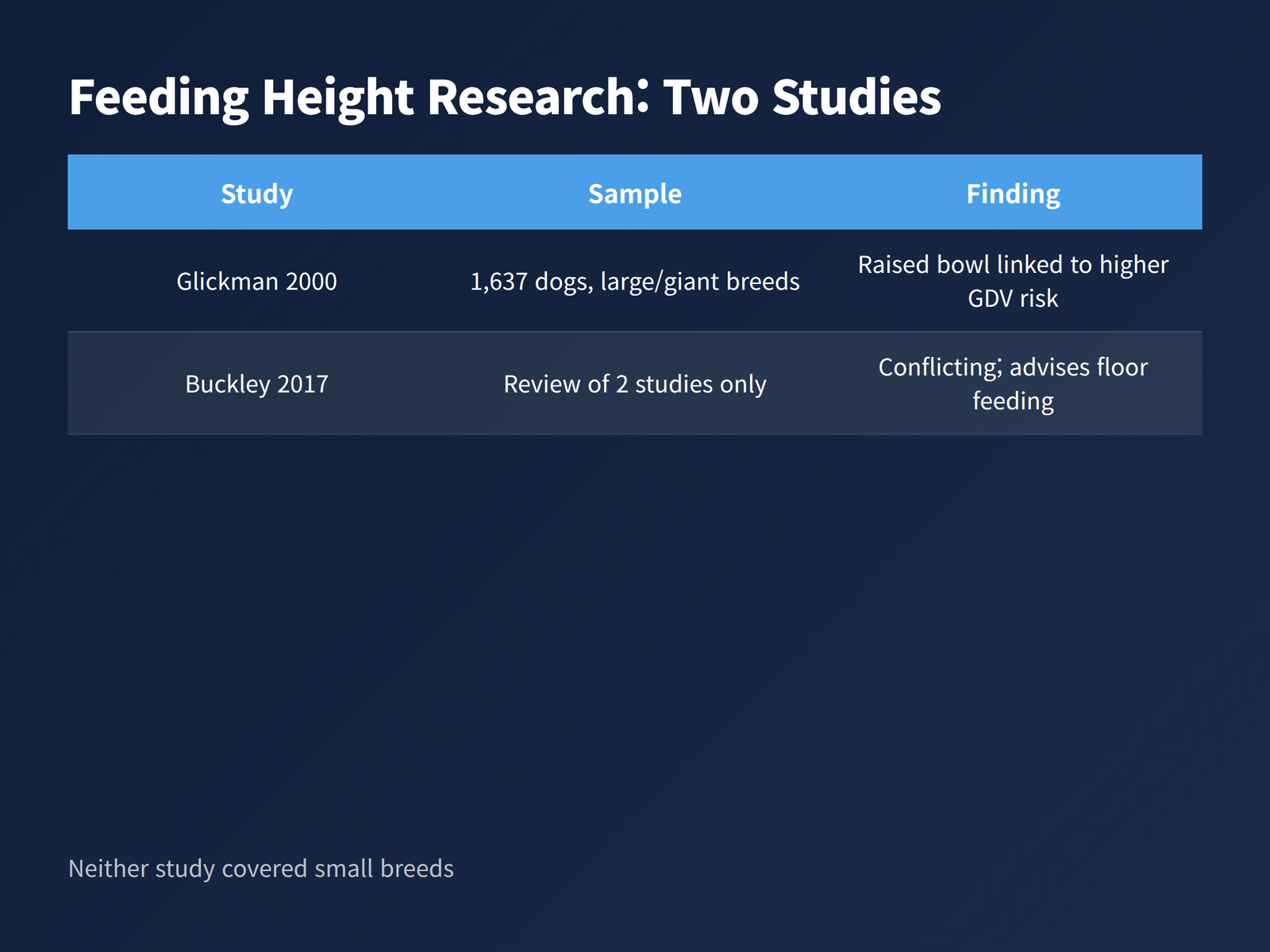
Height thresholds in the literature run in opposite directions between size classes. Buckley reports greater risk with bowls one foot or lower in large breeds, and greater risk with bowls above one foot in giant breeds. Two findings pointing opposite ways is exactly why the evidence base is described as conflicting rather than settled. Buckley’s own recommendation was direct: “The safest option in the absence of further evidence is to advise that owners of ‘at risk’ dogs feed from a feeder on the floor.”
The American Kennel Club goes further on its own bowl page, updated 4 March 2026, warning that “elevated dog bowls can lead to an increased risk of bloat, a serious condition that can be fatal.” Consult your veterinarian before changing feeding height, particularly for a dog with any known digestive or spinal condition.
How high should the bowl sit for a dog that is built low to the ground?
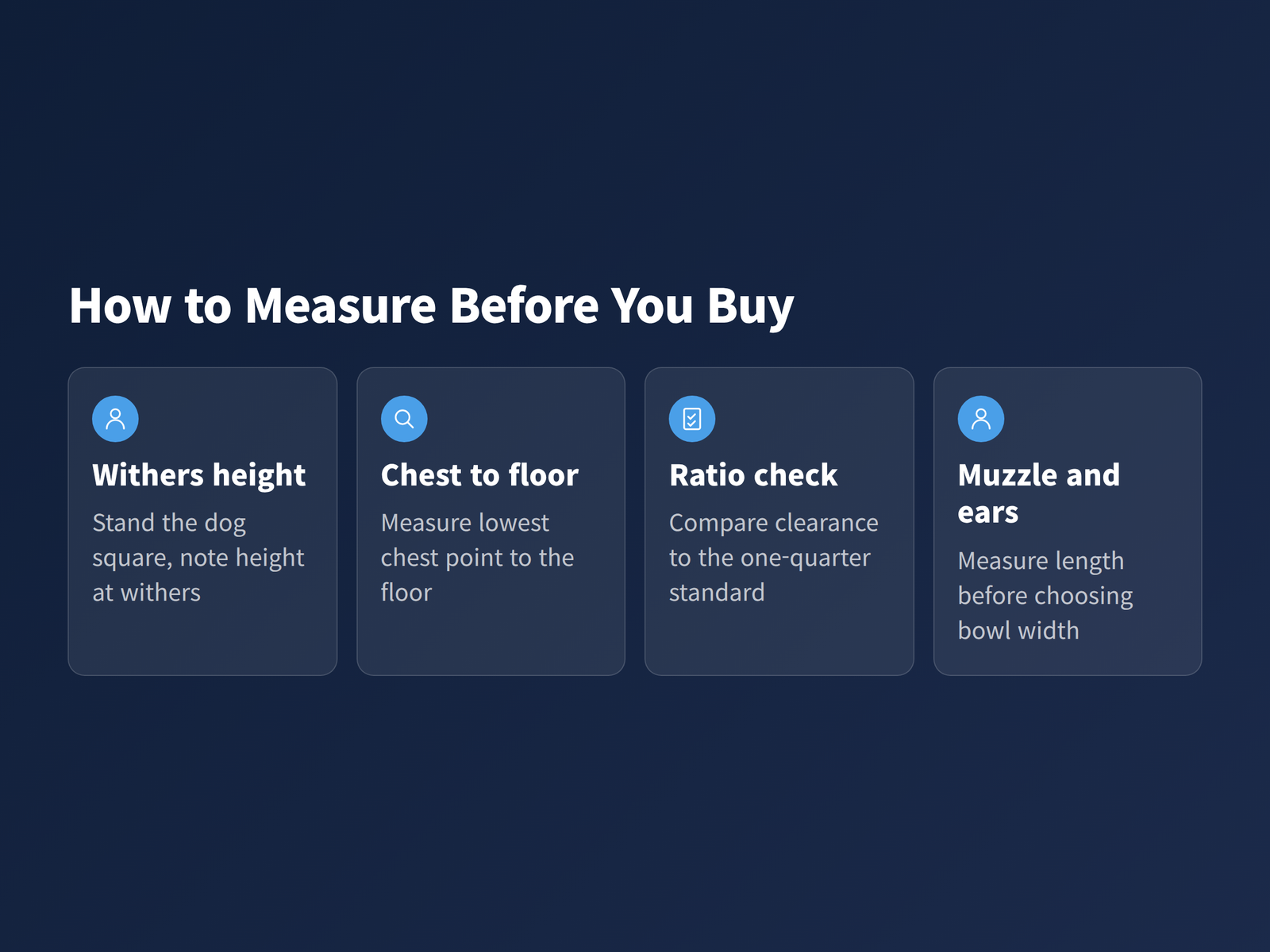
There is no published height figure to give you, so measure the dog instead of copying a number from a product page. The Kennel Club standard for the Miniature Long Haired Dachshund, last updated 1 April 2025, asks for a “compact, well-muscled body, with enough ground clearance, not less than one quarter of the height at the withers, to allow free movement.” The American Kennel Club official standard, effective 1 January 2018, describes the breed as “low to ground, long in body and short of leg, with robust muscular development.”

Those two standards describe reach geometry, not health risk. On a long, low dog the chest meets a tall stand before the legs do, which changes how the dog balances over a dish. Treat that as a fit observation and nothing more. The practical sequence looks like this:
- Stand the dog square on a level floor and note the height at the withers.
- Measure from the lowest point of the chest to the floor.
- Check that clearance against the one quarter ratio in the written standard.
- Measure muzzle length and ear length before choosing bowl width and depth.
Do not convert any of those numbers into a bowl rim height. The elbow height and wrist height rules circulating online come from retailer blogs, not from a veterinary or kennel body.
Which bowl shape suits a long-muzzled, long-eared small dog?
Shape matters more than height for a long-eared breed, and the American Kennel Club recommends a narrow-mouthed bowl for exactly that build. The stated reason is that narrower dishes “can prevent your dog’s ears from getting into the bowl, to prevent ear infections and help you go longer in between grooming sessions.” A long-haired dachshund carries both a long muzzle and heavy ear feathering, so a wide shallow dish pulls coat through food at every meal.
Narrow-mouthed bowls and low stainless dishes are widely sold, and neither carries a published performance figure for small breeds. Choose on ear clearance and muzzle reach, then verify the dog can eat without bracing awkwardly.
Is whisker fatigue a reason to buy a wider bowl?
Whisker fatigue is not a documented reason to buy anything. The term surfaced in 2017 alongside pet bowl marketing, and dvm360 names Hepper, Pet Fusion, and Dr. Catsby among the companies promoting it, after searches of the Journal of the American Veterinary Medical Association, the American Journal of Veterinary Research, and the Journal of Feline Medicine and Surgery returned no results for it.
As quoted by dvm360 in June 2017, Thomas Meyer, DVM, MS, then president of the American Veterinary Medical Association, said: “While a cat’s whiskers are very sensitive, there is currently no evidence showing that whiskers rubbing against food bowls causes cats stress or discomfort.” In the same article, feline practitioner Elizabeth Colleran, DVM, MS, DABVP, put it more plainly: “There is absolutely no data to support it as ‘a thing.'” Both statements are about cats. The dog version of the whisker fatigue claim is a later marketing extension with no peer-reviewed basis at all.
How often should a dog bowl be washed, and does the material matter?
Wash after every meal, and the washing temperature matters far more than the material. The U.S. Food and Drug Administration, Center for Veterinary Medicine, in guidance current as of 23 May 2024, instructs owners to “wash pet food bowls and scooping and measuring utensils with soap and hot water after each use,” and adds: “Do not use your pet’s food bowl as a scooping or measuring utensil.”

Luisana et al., publishing in PLOS ONE on 6 April 2022 from 417 owner surveys and 68 food dish swabs, found that only 4.7% of dog owners were aware of the FDA guidance. In that sample 22% washed dishes weekly on average, 34% washed their hands after feeding, and 33% prepared dog food on human kitchen counters. Water above 160°F (71°C) lowered aerobic plate counts by 1.5 units on the log scale compared with cold or lukewarm water, while bowl material showed no significant effect on pre-treatment counts. Buying stainless steel and washing it weekly is the worse trade. One caution on routines: only 8% of respondents given a washing protocol said they were likely to sustain it long term.
When is upright or elevated feeding actually prescribed?
Upright feeding is prescribed when a veterinarian is managing a diagnosed esophageal condition, not as a general comfort upgrade. The Comparative Neuromuscular Laboratory at the University of California San Diego, describing feeding chairs for dogs with megaesophagus, states that “maintaining that position for 10-15 minutes following feeding is a cornerstone of treatment.”

That is a treatment protocol for a diagnosed condition under veterinary direction. It is not evidence that raising a healthy small dog’s dinner improves digestion, and it should never be used as a self-directed remedy. If your dog regurgitates after meals, coughs while eating, or loses weight, consult your veterinarian rather than buying a stand.
Marketing claims checked against the evidence
| Marketing claim | What the evidence shows | Who it applies to |
|---|---|---|
| Prevents bloat | Two studies, conflicting results | Large and giant breeds |
| Easier on joints and spine | No peer-reviewed study located | Nobody, evidence absent |
| Improves digestion | Prescribed for diagnosed esophageal disease | Dogs under vet direction |
| Wide bowl stops whisker fatigue | No evidence, term began with cat bowls | Claim started for cats |
| Steel bowls stay cleaner | Material no effect, wash heat did | All dogs |

Frequently asked questions
Is a raised bowl unsafe for a dachshund? Nobody can answer that from published data. The gastric dilatation-volvulus research covered large and giant breeds only, and the American Kennel Club still advises speaking with a veterinarian before using an elevated bowl.
What bowl height should an 11 lb dog use? No veterinary or kennel body publishes one. The Kennel Club sets ground clearance at not less than one quarter of wither height as a conformation requirement, which describes the dog rather than the dish.
Is stainless steel better than plastic? Not for cleanliness on its own. Luisana et al. found no significant material effect on aerobic plate counts, while water above 160°F (71°C) cut counts by 1.5 log units.
Does a raised bowl help a dog with reflux? Upright feeding held for 10 to 15 minutes is a documented management step for diagnosed esophageal disease under veterinary direction, not a general remedy.
Sources
- U.S. Food and Drug Administration, Center for Veterinary Medicine, “Tips for Safe Handling of Pet Food and Treats”, content current as of 2024-05-23 — https://www.fda.gov/animal-veterinary/animal-health-literacy/tips-safe-handling-pet-food-and-treats
- Glickman LT et al., “Non-dietary risk factors for gastric dilatation-volvulus in large and giant breed dogs”, Journal of the American Veterinary Medical Association 217:1492-1499, 2000 — https://avmajournals.avma.org/view/journals/javma/217/10/javma.2000.217.1492.xml
- Buckley LA, “Are Dogs That Are Fed from a Raised Bowl at an Increased Risk of Gastric Dilation Volvulus Compared with Floor-Fed Dogs?”, Veterinary Evidence Vol. 2 No. 1, 2017-01-16, DOI 10.18849/ve.v2i1.57 — https://veterinaryevidence.org/index.php/ve/article/view/57
- Luisana E, Saker K, Jaykus L-A, Getty C, “Survey evaluation of dog owners’ feeding practices and dog bowls’ hygiene assessment in domestic settings”, PLOS ONE, 2022-04-06, DOI 10.1371/journal.pone.0259478 — https://journals.plos.org/plosone/article?id=10.1371%2Fjournal.pone.0259478
- American Kennel Club, “Official Standard of the Dachshund”, approved 2017-11-14, effective 2018-01-01 — https://images.akc.org/pdf/breeds/standards/Official_Standard_Dachshund.pdf
- The Kennel Club (UK), “Breed Standard — Dachshund (Miniature Long Haired)”, updated 2025-04-01 — https://www.royalkennelclub.com/breed-standards/hound/dachshund-miniature-long-haired/
- University of California San Diego, Comparative Neuromuscular Laboratory, “Bailey Chair: Feeding Chair For Dogs With Megaesophagus”, contribution credited to Dr. Diane Shelton — https://vetneuromuscular.ucsd.edu/cases/2014/September.html
- American Kennel Club Expert Advice, “Dog Bowls: Choosing the Right Dog Bowl for Your Dog”, updated 2026-03-04 — https://www.akc.org/expert-advice/nutrition/choosing-right-dog-bowl/
- dvm360, “Whisker fatigue: Did pet bowl companies invent a feline malady?”, 2017-06-12 — https://www.dvm360.com/view/whisker-fatigue-did-pet-bowl-companies-invent-feline-malady