An undercoat deshedding tool is built to pull loose undercoat out of thick double coats, and the brand behind the best known version does not recommend it for the Long-haired Dachshund. That line sits on the manufacturer’s own breed guide, which answers most of the question about a deshedding tool for a longhaired dachshund before any blade touches a dog. The rest is coat mapping, and the American Kennel Club and the Royal Kennel Club both describe exactly where the long hair sits.
Why is an undercoat deshedding tool not recommended for a longhaired dachshund?
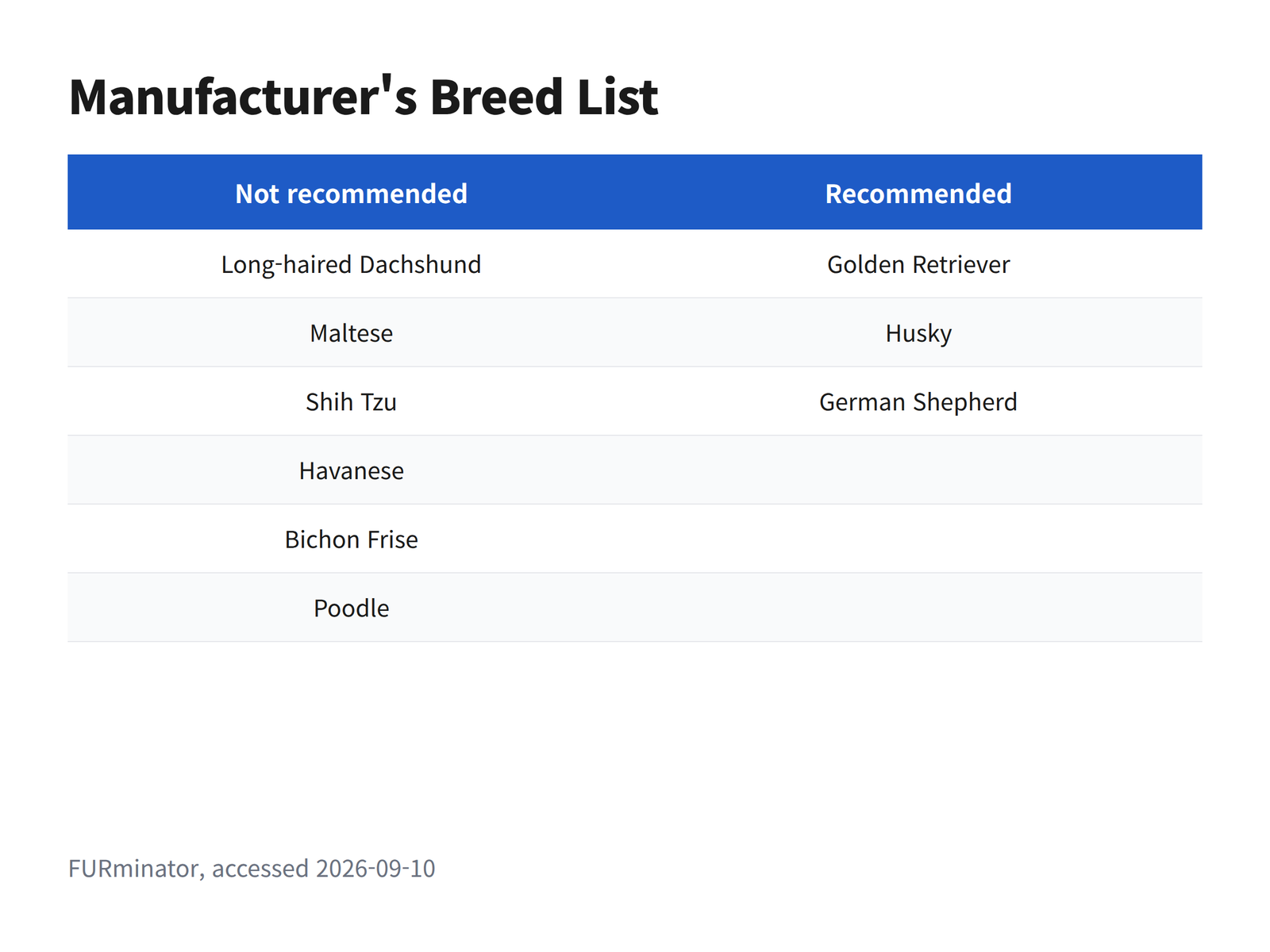
The manufacturer excluded the breed variety itself. According to the FURminator brand guide, “The FURminator® Undercoat deShedding Tool should not be used on non-shedding breeds or on pets with particularly sensitive skin.” As of 2026-09-10, that guide lists the Long-haired Dachshund among the breeds it does not recommend, together with the Maltese, Shih Tzu, Havanese, Bichon Frise and Poodle. The same brand names Golden Retrievers, Huskies and German Shepherds as the dogs the tool was built around, calling them breeds with a dense undercoat.
The detail most grooming articles miss is that the Smooth Dachshund is not on that exclusion list. The manufacturer splits one breed by coat variety, so the objection is about coat structure rather than about dachshunds in general. The brand also limits its own list, stating that “Some breeds have coat textures that vary between individual dogs. Not all dogs in these breeds shed.” The accurate reading is not that the tool is banned, but that the company making it left the longhaired variety out of the recommended group.
Where does a longhaired dachshund actually have long hair?
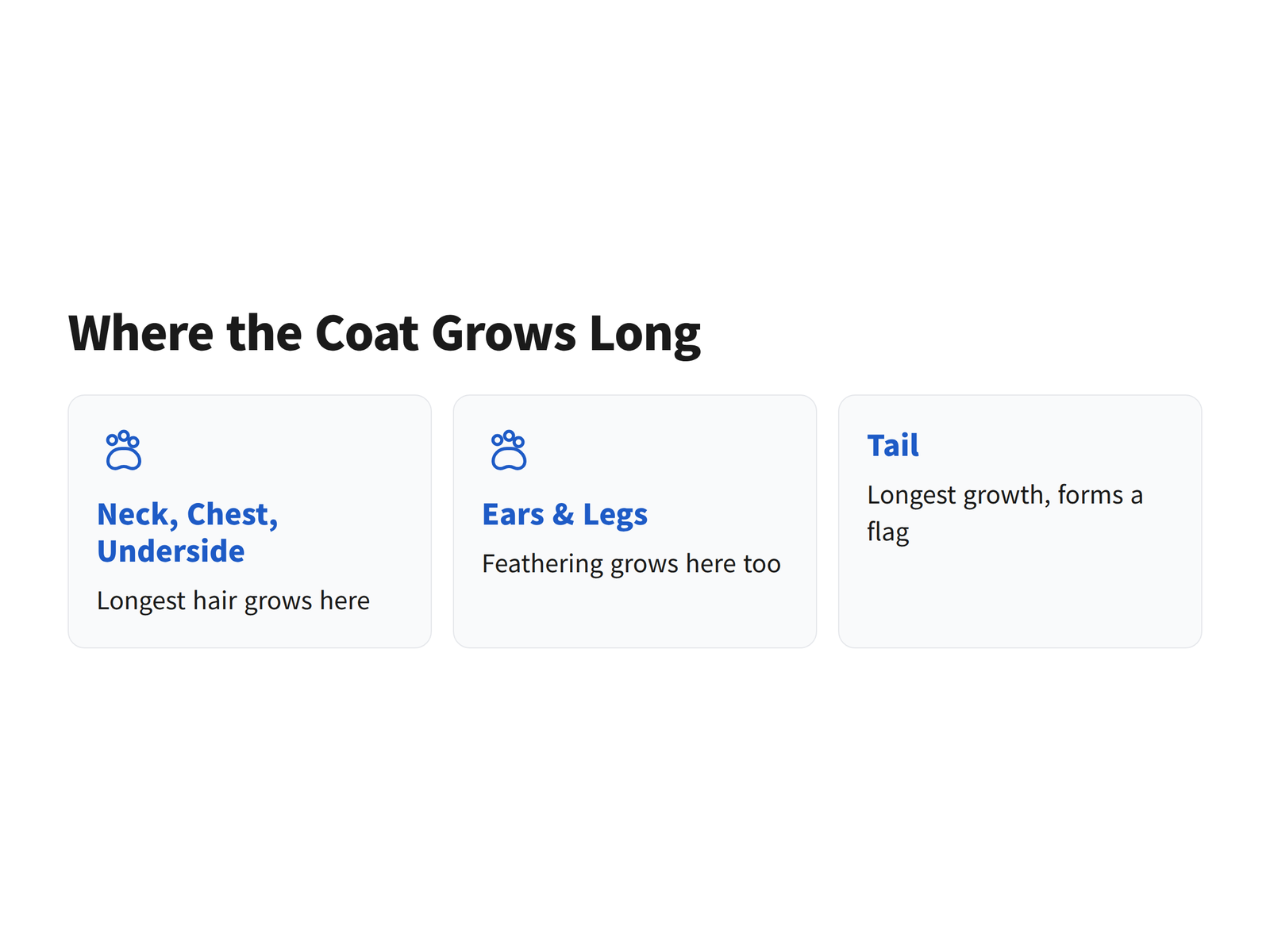
The long hair is concentrated, not spread evenly. The American Kennel Club Official Standard of the Dachshund, effective 2018-01-01, describes the longhaired coat this way: “The sleek, glistening, often slightly wavy hair is longer under the neck and on forechest, the underside of the body, the ears and behind the legs.” The tail carries the most dramatic growth of all, where “the hair attains its greatest length here and forms a veritable flag.”
The Royal Kennel Club standard, last updated 2025-04-01, maps the same regions: “Soft and straight, or only slightly waved; longest under neck, on underparts of body, and behind legs, where it forms abundant feathering, on tail where it forms a flag.” Both standards then treat an even coat as a defect, and the American Kennel Club lists “equally long hair over the whole body” among the faults. A tool designed to sweep a uniformly dense double coat across a whole dog is aimed at a coat pattern the standards exclude.
Does a longhaired dachshund have an undercoat to remove?
No authoritative source settles that question. Neither the American Kennel Club standard nor the Royal Kennel Club standard mentions an undercoat for the longhaired variety at all. Grooming blogs assert both answers with equal confidence, and none of them cite a breed registry or a veterinary body. The only verified fact is narrower and more useful: the manufacturer of the deshedding tool placed the Long-haired Dachshund outside its recommended group.
That gap matters for tool choice. An undercoat tool has nothing defined to work on unless a dog genuinely carries a dense undercoat, and the manufacturer advises checking with a veterinarian when the coat type is unclear. If you are unsure whether your dog has an undercoat, or the skin under the feathering looks red or flaky, consult your veterinarian before using any tool with a blade. The same statement excludes pets with particularly sensitive skin regardless of breed, so skin condition outranks any breed list.
Which brush is meant for which coat type?
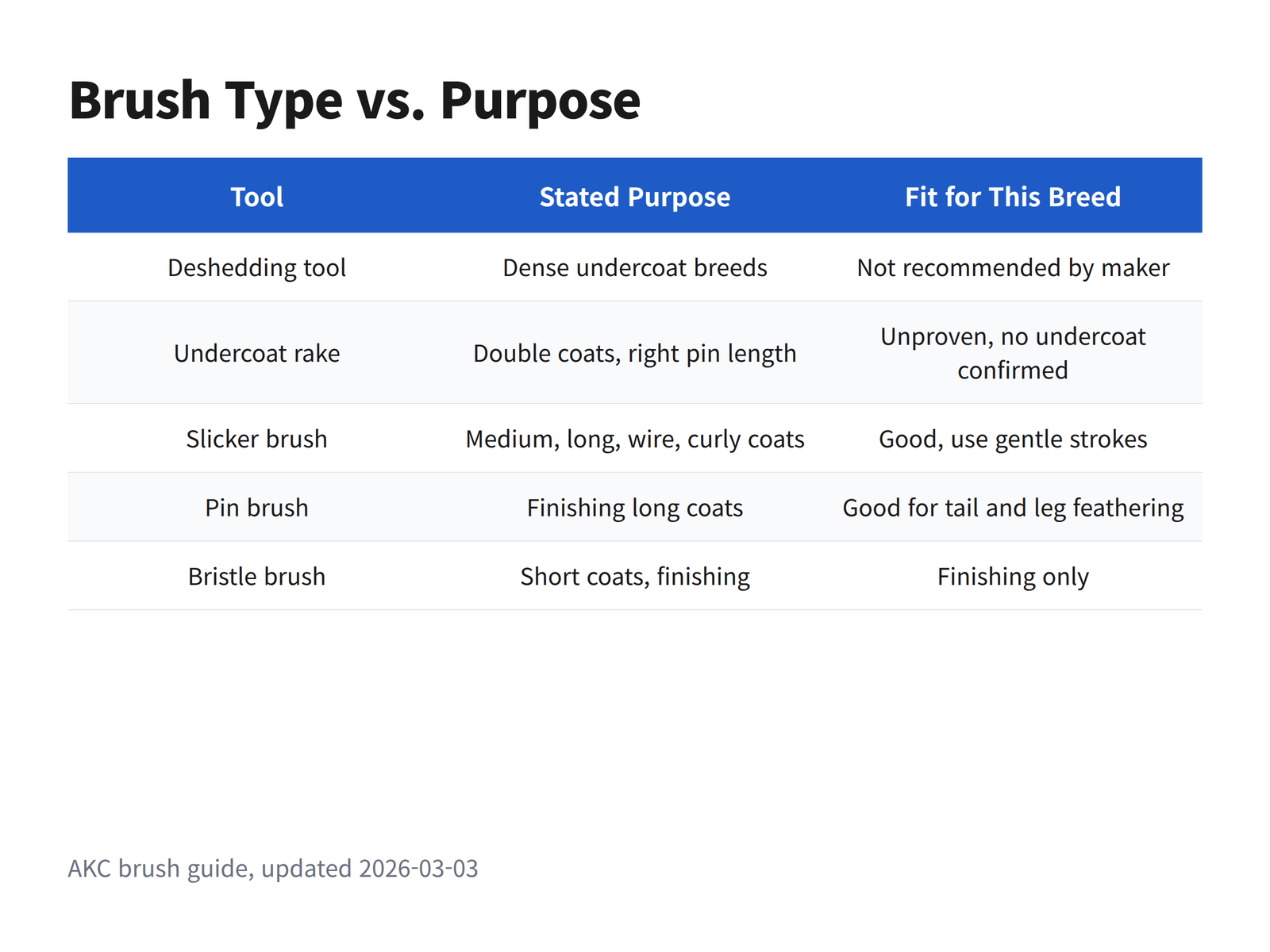
Each brush type has a stated purpose, and the American Kennel Club brush guide, updated 2026-03-03, spells most of them out. The table below records what each source says a tool is for, not how the tools perform against each other.
| Tool | What the source says it is for | Fit for a longhaired dachshund |
|---|---|---|
| Undercoat deshedding tool | For breeds with a dense undercoat, such as Golden Retrievers or Huskies | Maker lists the breed as not recommended |
| Undercoat rake | For double coated breeds of all fur lengths, with the correct pin length | No standard describes an undercoat, so the match is unproven |
| Slicker brush | For medium, long, wire and curly coated dogs; removes and prevents mats | Listed for long coats; use short gentle strokes |
| Pin brush | Finishing brush for long coated breeds, smooths hair and lifts dirt | Suits the tail flag and leg feathering |
| Bristle brush | For short coated dogs and for finishing double coats | Finishing only, not a working brush |
The undercoat rake carries one caution of its own. The American Kennel Club notes that you must choose the correct pin length for a dog’s coat length, so picking the right category of tool is only half the decision.
How should you position a long-backed dog while brushing the underside?
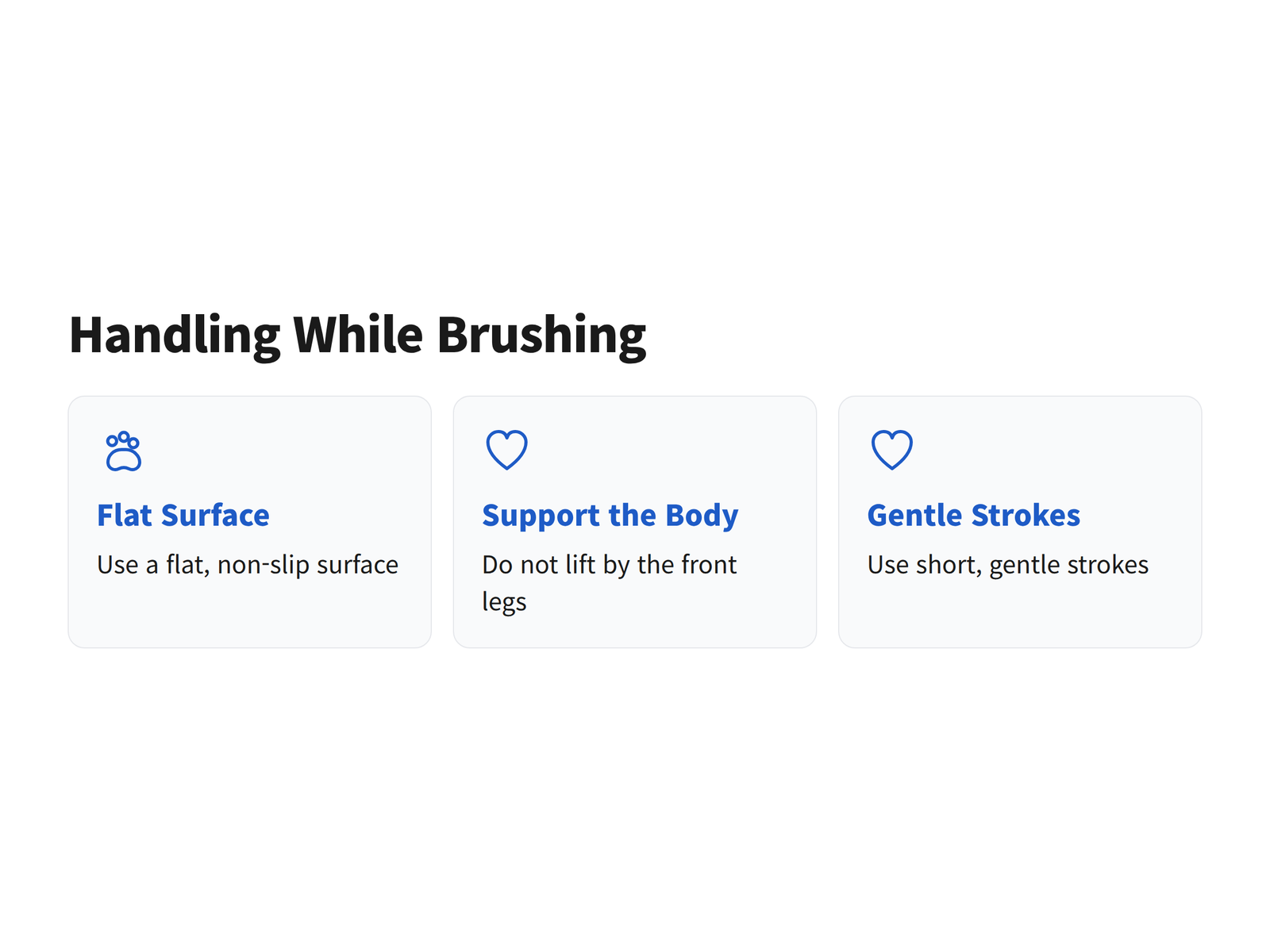
Work on a flat, non slip surface and support the body rather than lifting the dog upright by the front legs. Most of a longhaired dachshund’s feathering sits under the neck, along the underside and behind the legs, the areas hardest to reach on a dog built low and long. The American Kennel Club standard defines a Miniature Dachshund as 11 pounds and under at 12 months of age and older, with the standard size usually between 16 and 32 pounds, so most of this handling happens one handed.
Back health is why grooming posture gets discussed at all in this breed. The DachsLife 2015 study in Canine Genetics and Epidemiology, published 2016-11-05, surveyed 2,031 dachshunds and reported intervertebral disc disease in 15.7 percent, with a 95 percent confidence interval of 14.1 to 17.3, ranging from 24.4 percent in Standard Smooth-Haired dogs to 7.1 percent in Standard Wire-Haired dogs. The authors called their lifestyle findings “hypothesis-generating,” so no grooming position should be sold as protective. What is documented is the stroke itself. RSPCA Australia advises that “it is important to use short and gentle strokes and make sure you do not pull hard or scrape the dog’s skin.”
How often does a long coat need brushing?
Frequent short sessions beat occasional long ones, and welfare bodies put the interval close to daily. RSPCA Australia states that double coated dogs “should normally be groomed every day,” and Blue Cross describes long and rough coated dogs as needing clipping “anything from every four to 12 weeks, with regular – usually daily – maintenance brushes.” The Royal Kennel Club sets the ideal weight for a Miniature Long Haired Dachshund at 4.5 kg, about 10 pounds, so a full session covers a small amount of coat.
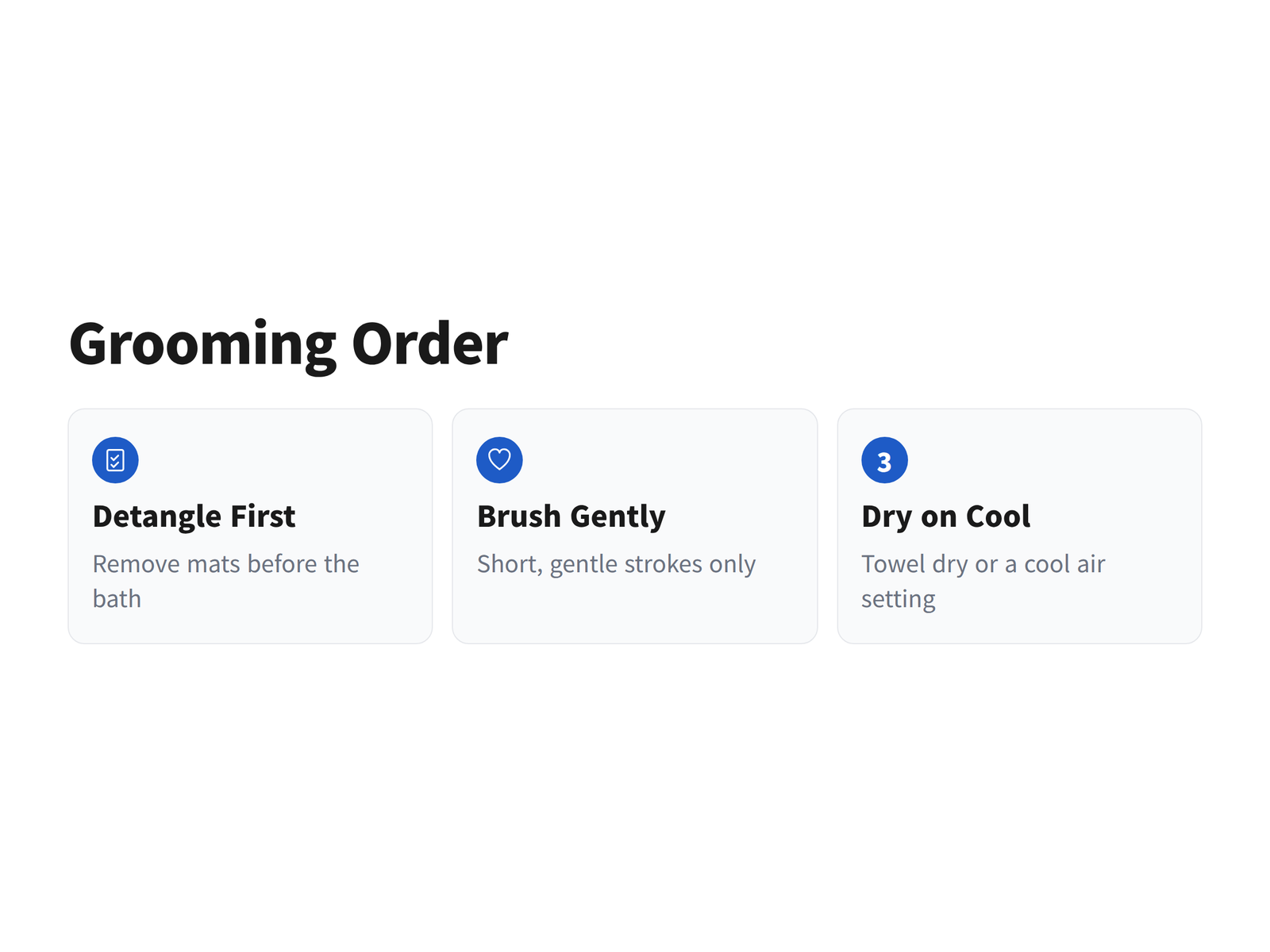
Order matters as much as frequency. Blue Cross is direct about the sequence: “Detangle any matts before washing as they will only get worse during shampooing.” After a bath, the same charity advises towel drying, or a hairdryer on a cool setting for a dog comfortable with one. Blue Cross also suggests checking a slicker brush for pins that stick out at odd angles and avoiding heavy pressure, which is how a suitable brush still causes trouble.
Frequently asked questions
Can a deshedding tool be used just on the tail flag? The manufacturer’s guidance excludes the Long-haired Dachshund as a variety and gives no exception for a single body part. The American Kennel Club describes the pin brush as a finishing brush that smooths long coats, which is the category built for a tail flag and leg feathering.
Should a matted coat be bathed first? No. Blue Cross states plainly that mats must be detangled before washing because shampooing makes them worse. If a mat sits tight against the skin, a professional groomer is safer than working at it with a blade.
Is clipping a longhaired dachshund a good alternative to brushing? Clipping is a separate skill, not a shortcut around coat care. RSPCA Australia notes that using electric clippers safely requires skill and that a trusted, reputable professional groomer is usually advisable.
Sources
- American Kennel Club, “Official Standard of the Dachshund,” approved 2017-11-14, effective 2018-01-01 – https://images.akc.org/pdf/breeds/standards/Official_Standard_Dachshund.pdf
- The Royal Kennel Club, “Breed Standard – Dachshund (Miniature Long Haired),” last updated 2025-04-01 – https://www.royalkennelclub.com/breed-standards/hound/dachshund-miniature-long-haired
- American Kennel Club, “Dog Brushes: How to Choose the Right Dog Brush for Your Pet,” updated 2026-03-03 – https://www.akc.org/expert-advice/health/types-dog-brushes-shedding/
- RSPCA Australia Knowledgebase, “Why and how should I groom my dog?,” updated 2022-01-19 – https://kb.rspca.org.au/categories/companion-animals/dogs/caring-for-my-dog/why-and-how-should-i-groom-my-dog
- Blue Cross, “How to groom your dog,” updated 2017-07-26 – https://www.bluecross.org.uk/advice/dog/how-to-groom-a-dog
- FURminator (Spectrum Brands), “Dog breeds that are not recommended for a deShedding tool,” accessed 2026-09-10 – https://www.furminator.net/guide/deshed/which-dog-breeds-are-not-recommended-for-an-undercoat-deshedding-tool
- FURminator (Spectrum Brands), “Dogs with undercoat: recommended breeds for deshedding,” accessed 2026-09-10 – https://www.furminator.net/guide/deshed/which-dog-breeds-are-recommended-for-an-undercoat-deshedding-tool
- Packer RMA et al., “DachsLife 2015: an investigation of lifestyle associations with the risk of intervertebral disc disease in Dachshunds,” Canine Genetics and Epidemiology, 2016-11-05 – link.springer.com/article/10.1186/s40575-016-0039-8