A dachshund advertised as a tweenie has no registry status. The word describes a real weight band, but it appears in no published breed standard from the American Kennel Club, The Royal Kennel Club or the Fédération Cynologique Internationale. Each of those three bodies defines dachshund size in writing, and each uses a different rule. Reading the actual wording shows where the unnamed band sits, and why it exists under two registries and vanishes under the third.
Is “tweenie” an official dachshund size?
No. Tweenie is an informal owner and seller label for a dachshund whose adult weight sits between the miniature limit and the usual standard range, and it appears in no published breed standard.
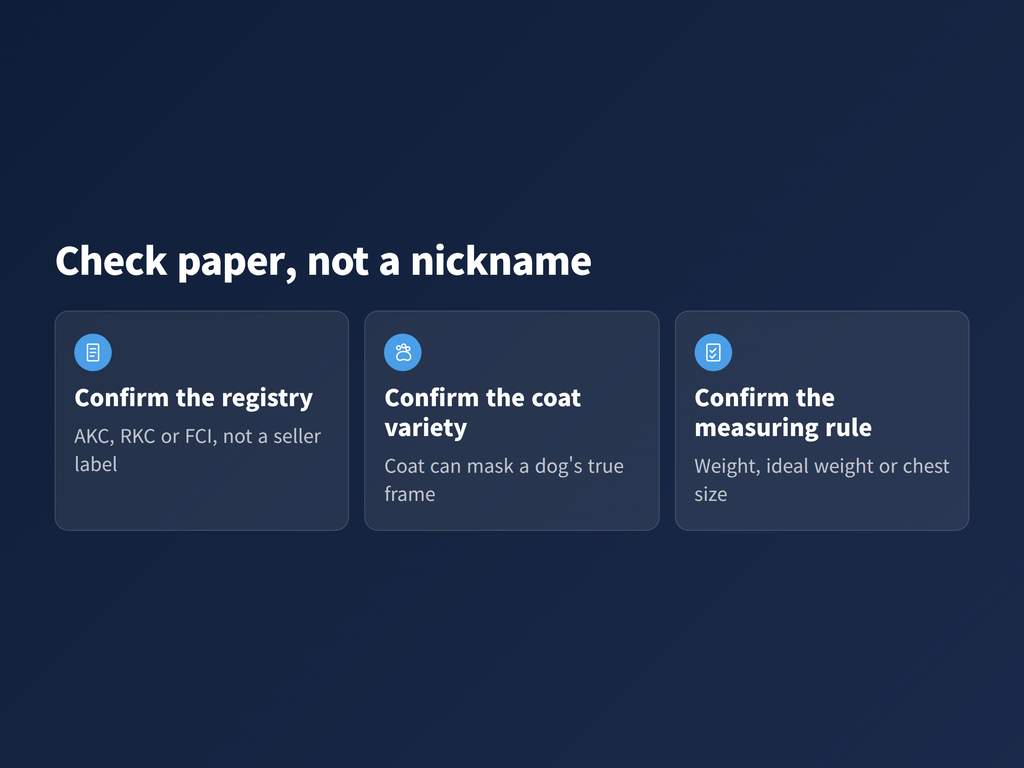
Three primary documents were checked for the word. The American Kennel Club standard was approved on 2017-11-14 and took effect on 2018-01-01. The Royal Kennel Club breed standards for the dachshund were last updated on 2025-04-01. Fédération Cynologique Internationale Standard no. 148 carries the date 2022-03-14. None of the three names a third size tier, and none uses the word tweenie anywhere in its text. A dog in that weight band is still registered simply as a Dachshund.
What sizes does the American Kennel Club actually recognize for a dachshund?
The American Kennel Club recognizes one dachshund breed in three coat varieties and two sizes, and it treats miniature as a competition class rather than a separate classification.
The standard states that the breed “is bred with three varieties of coat: (1) Smooth; (2) Wirehaired; (3) Longhaired and is shown in two sizes, standard and miniature.” On the miniature division it is more specific: “miniatures are not a separate classification but compete in a class division for ’11 pounds and under at 12 months of age and older.'”
That age clause is the part almost every summary drops. The rule is not 11 pounds on its own. A nine-month-old longhaired puppy weighing 10 pounds has not yet met it, because the American Kennel Club wording fixes the weight to an age. The same standard describes the standard size as “usually between 16 and 32 pounds.”

Why does the Royal Kennel Club list six separate dachshund breeds instead of sizes?
The Royal Kennel Club does not treat size as a division inside one breed. It registers six separate dachshund breeds in the Hound group: Long Haired, Miniature Long Haired, Smooth Haired, Miniature Smooth Haired, Wire Haired and Miniature Wire Haired.
Each of those six carries its own breed standard with its own weight wording. The Dachshund (Long Haired) standard gives an “Ideal weight: 9-12 kgs (20-26 lbs).” The Dachshund (Miniature Long Haired) standard reads: “Miniature ideal weight; 4.5 kgs (10 lbs). Desired maximum weight 5kgs (11 lbs). Exhibits which appear thin and undernourished unacceptable.”
Two reputable British sources do not agree here. The Royal Kennel Club standard sets a desired maximum of 5 kg (11 lb) for a miniature, while the Dachshund Breed Council’s owner-facing size guide gives 4.5-5.5 kg (10-12 lb). Both figures are published; neither cancels the other. If you have questions about your own dog’s weight or growth, consult your veterinarian rather than a chart.
How does the FCI measure dachshund size differently from the AKC?
The Fédération Cynologique Internationale ignores weight entirely and sorts dachshunds by chest circumference, “measured when at least 15 months old.”
Standard no. 148, dated 2022-03-14, publishes separate ranges for males and females. Standard covers males over 37 cm up to 47 cm and females over 35 cm up to 45 cm. Miniature covers males over 32 cm up to 37 cm and females over 30 cm up to 35 cm. Rabbit covers males 27 cm up to 32 cm and females 25 cm up to 30 cm.
Pages that still quote a flat 30 cm and 35 cm pair are quoting a superseded text. The current standard is sex-separated, caps every category and puts a floor under the smallest one.
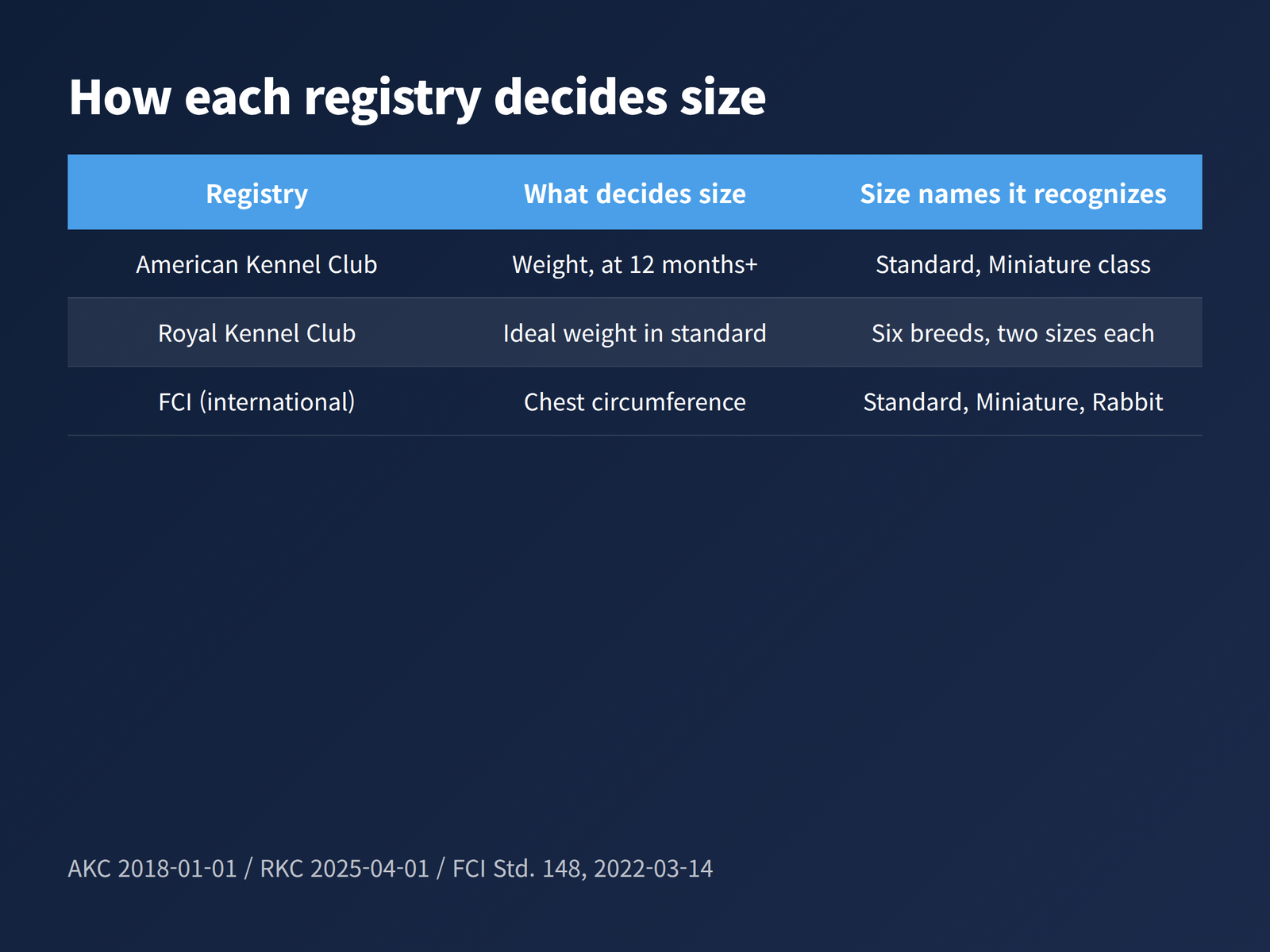
| Registry | What decides size | Size names it recognizes |
|---|---|---|
| American Kennel Club (US) | Weight, at 12 months and older | Standard, Miniature class division |
| Royal Kennel Club (UK) | Ideal weight in the standard | Six breeds, three coats each in two sizes |
| FCI (international) | Chest circumference at 15 months | Standard, Miniature, Rabbit |
| Dachshund Breed Council (UK) | Owner-facing weight and height guidance | Standard, Miniature |
| Seller and marketplace listings | No published rule | Tweenie, teacup, toy – none recognized |
What happens to a long haired dachshund that weighs between 11 and 16 pounds?
On paper, nothing happens. The dog stays a Dachshund, because the American Kennel Club standard never names that band at all.
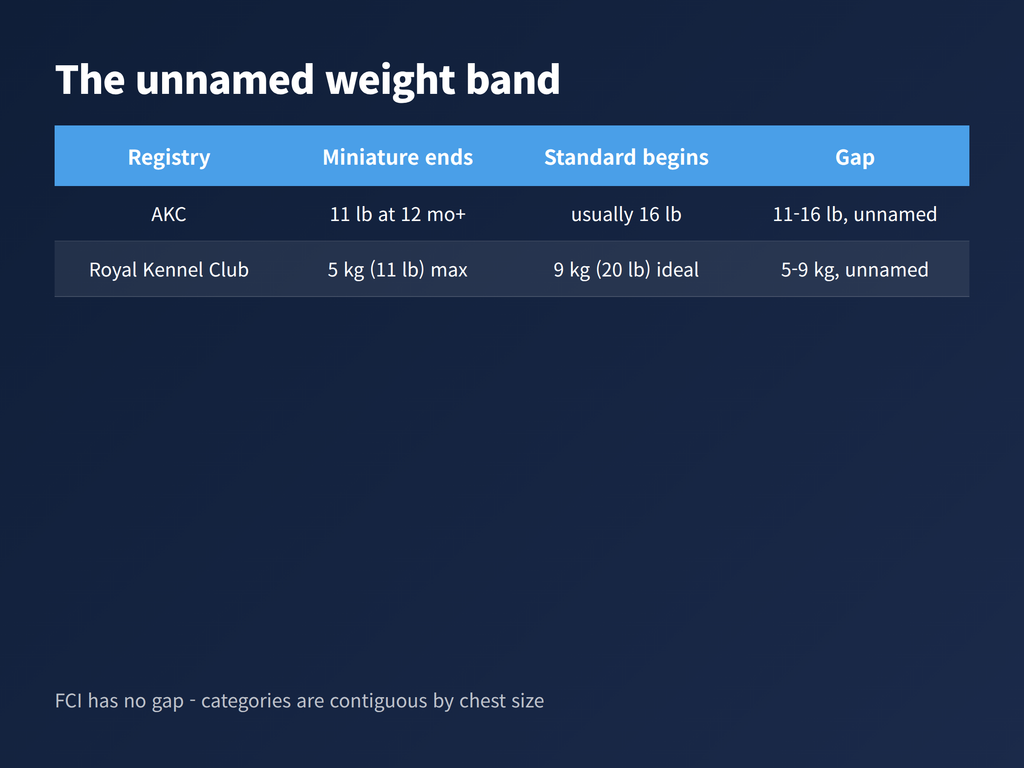
Read the two American Kennel Club figures side by side. Miniature ends at 11 pounds at 12 months and older. Standard is described as “usually between 16 and 32 pounds.” The stretch above 11 pounds and below 16 pounds carries no name in the standard, and that unnamed stretch is exactly what owners and sellers fill with the word tweenie.
The Royal Kennel Club wording leaves a similar hole. Miniature Long Haired has a desired maximum of 5 kg (11 lb) and Long Haired an ideal weight of 9-12 kg (20-26 lb), so the range above 5 kg and below 9 kg is unnamed too.
Under Fédération Cynologique Internationale rules the hole closes. Miniature males run up to 37 cm and Standard males begin above 37 cm, so the two categories touch. A tweenie cannot exist under FCI wording, because every measured dog lands inside one chest-circumference category.
Why do sellers advertise tweenie and teacup dachshunds at all?
Because an unnamed band still needs a word, and marketplace copy supplies one that registries never wrote. A search for this size label returns a puppy marketplace listing tweenie dachshunds for sale at the top of the results.
The party defining the term is the party selling the dogs, and no listing discloses that the word has no registry backing. Teacup and toy work the same way, and Standard no. 148 shows the structural reason plainly. The smallest recognized FCI category, Rabbit, starts at 27 cm for males and 25 cm for females. A dog measuring below that floor falls outside the size scheme altogether rather than into a smaller named tier.
None of that speaks to a dog’s health. It records only what the three registries recognize on paper.
Does a size label tell you anything about a long-backed dog’s body length?
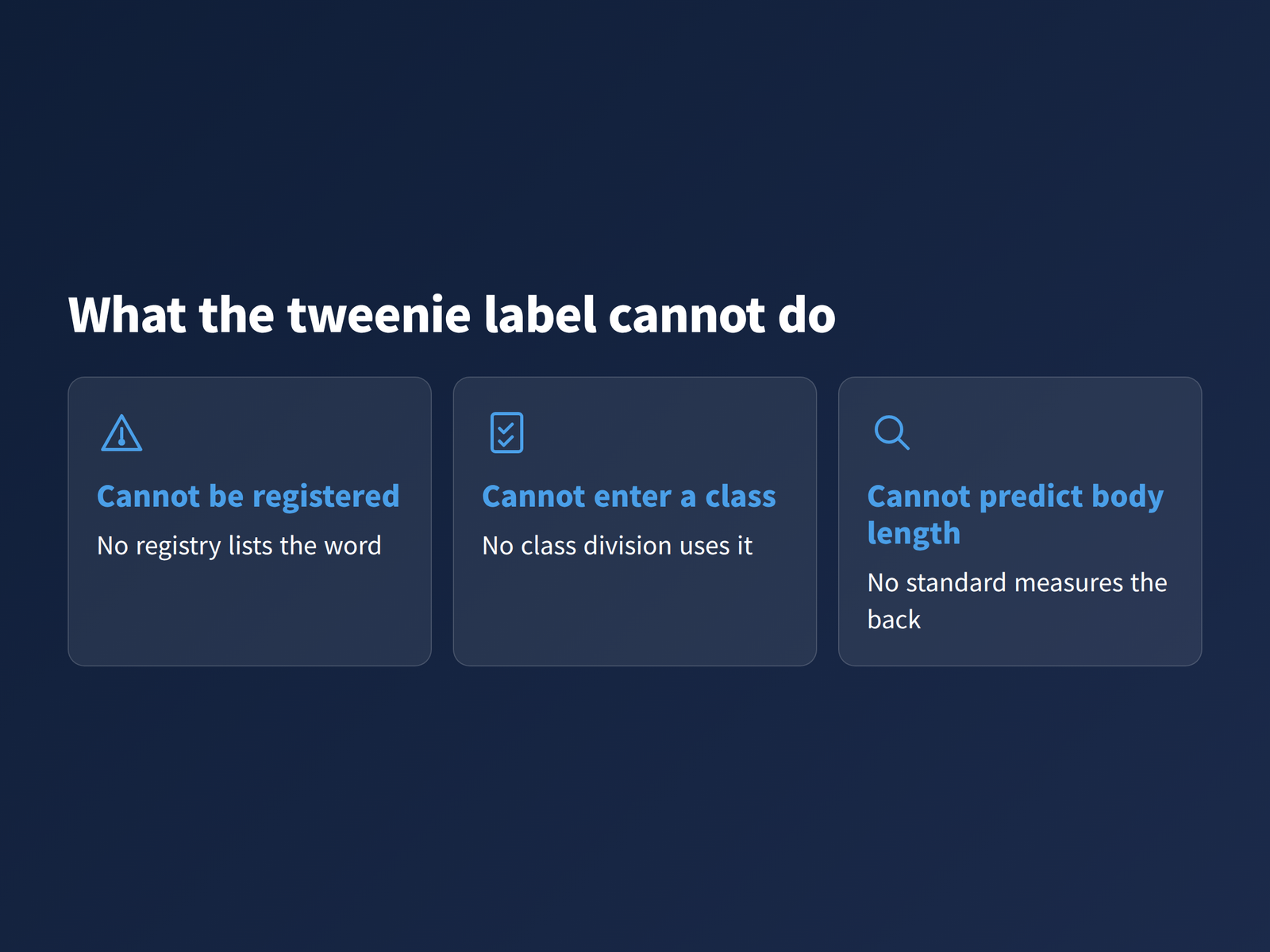
No. Every figure in every standard examined is a weight or a chest measurement, and no registry publishes a back-length or body-length figure for the dachshund.
That gap matters more for this breed than for most. A miniature label predicts nothing about how long a dog’s back is, and back length is the measurement that governs whether a coat, a carrier, a crate or a ramp actually fits. Two dachshunds at the same 11 pounds can need different lengths of gear.
Coat volume widens the mismatch on a longhaired dog. The American Kennel Club standard itself treats excess coat as a fault, noting that “too profuse a coat which masks type, equally long hair over the whole body, a curly coat, or a pronounced parting on the back are faults.” Coat that masks type also masks frame, so a longhaired dachshund can look a size up from its measurements. Measure the dog and skip the label.
Frequently asked questions
Can a tweenie dachshund be registered as a tweenie? No. The word is not a breed, a variety or a class division under the American Kennel Club, The Royal Kennel Club or the Fédération Cynologique Internationale. Registration paperwork records the breed, not the nickname.
Is an 11-pound dachshund automatically a miniature under AKC rules? Not automatically. The American Kennel Club class division reads “11 pounds and under at 12 months of age and older,” so the age condition has to be met as well as the weight.
Which registry has no tweenie gap? The Fédération Cynologique Internationale. Its Standard no. 148 categories are contiguous by chest circumference, so a measured dog always lands inside one of them.
Do the UK and US agree on what a miniature dachshund is? Not on paper. The Royal Kennel Club registers Miniature Long Haired as its own breed, while the American Kennel Club treats miniature as a class division within a single breed.
Sources
- American Kennel Club, “Official Standard of the Dachshund”, approved 2017-11-14, effective 2018-01-01 – https://images.akc.org/pdf/breeds/standards/Official_Standard_Dachshund.pdf
- Dachshund Club of America, “Breed Standard” (AKC parent club, full standard text) – https://www.dachshundclubofamerica.org/breed-standard/
- American Kennel Club, “Breed Varieties” list – https://images.akc.org/pdf/Breed_Varieties.pdf
- Fédération Cynologique Internationale, Standard no. 148, Dachshund, 2022-03-14 – http://www.fci.be/Nomenclature/Standards/148g04-en.pdf
- The Royal Kennel Club, Breed Standard, Dachshund (Long Haired), updated 2025-04-01 – https://www.royalkennelclub.com/breed-standards/hound/dachshund-long-haired
- The Royal Kennel Club, Breed Standard, Dachshund (Miniature Long Haired), updated 2025-04-01 – https://www.royalkennelclub.com/breed-standards/hound/dachshund-miniature-long-haired
- The Royal Kennel Club, Breeds A-Z, Hound group dachshund entries – https://www.royalkennelclub.com/search/breeds-a-to-z/breeds/hound/dachshund-miniature-long-haired/
- Dachshund Breed Council (UK), “A Guide to Dachshund Sizes: Miniature v Standard”, undated at access – https://dachshundbreedcouncil.org.uk/breed-info-history/a-guide-to-dachshund-sizes-miniature-and-standard/