A longhaired dachshund can carry extra weight in plain sight. The breed’s coat grows thickest over the exact areas the usual overweight checks look at, so the outline you see is partly hair. A body condition score is a hands-on assessment of body fat graded on a 9-point scale, and the World Small Animal Veterinary Association sets the target plainly: “The goal for most pets is a BCS of 4 to 5 of 9.” On this coat, that score has to be read with your hands.
Why can a long coat hide an overweight dachshund?
Because the longest hair on this breed grows exactly where the visual checks are aimed. The Royal Kennel Club breed standard for the Miniature Long Haired Dachshund, last updated 2025-04-01, describes the coat as “Soft and straight, or only slightly waved; longest under neck, on underparts of body, and behind legs, where it forms abundant feathering, on tail where it forms a flag.” The waist check and the abdominal tuck check both read a silhouette, and the feathering on the underparts and behind the legs sits directly over that silhouette. The World Small Animal Veterinary Association states the consequence directly: “Palpation is required for accurately assessing BCS and MCS, especially in animals with medium to long hair coats.”
What does the standard three-step body condition check miss on a longhaired dog?
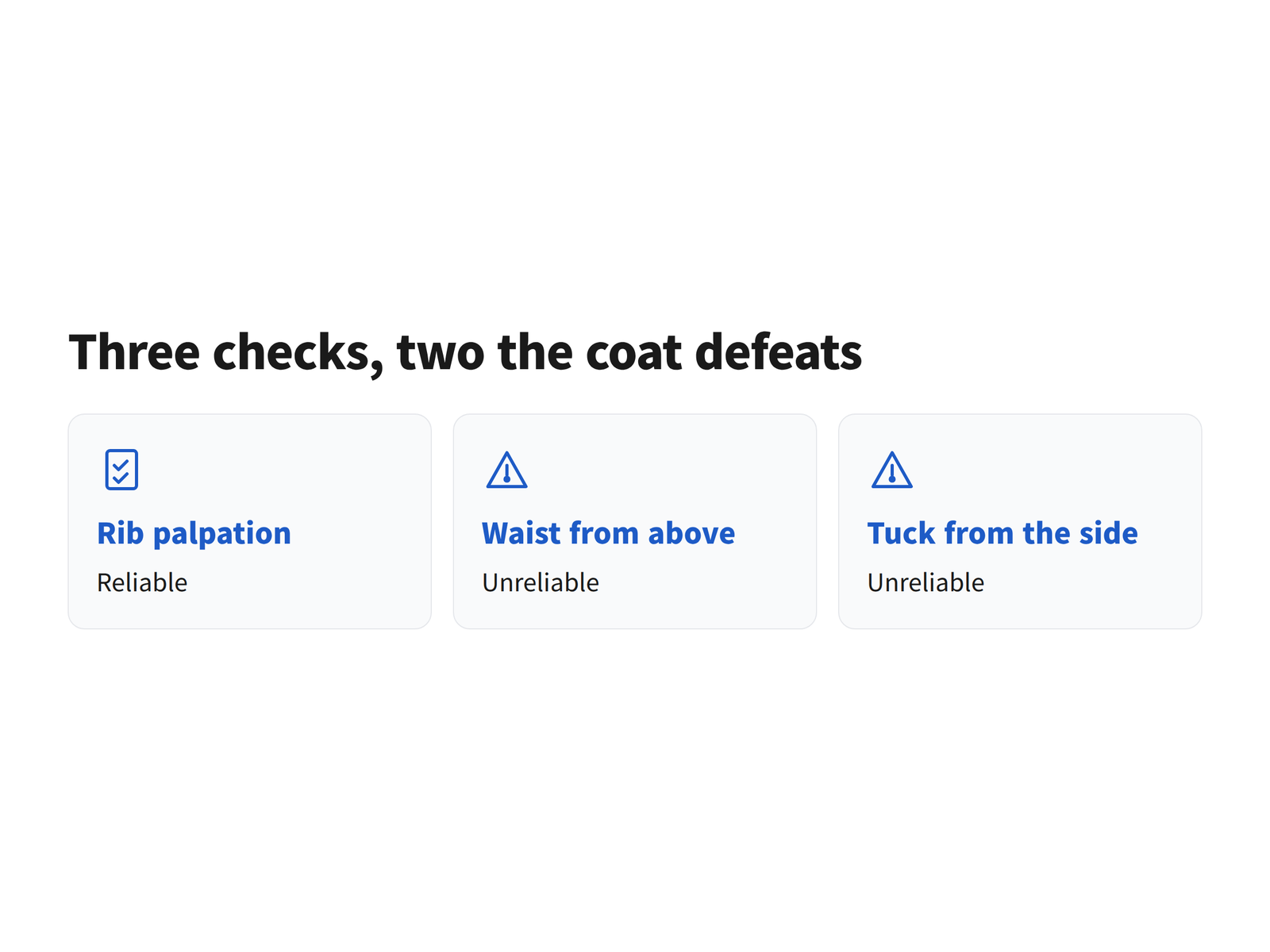
Two of its three steps lose reliability, which leaves touch carrying the result. The familiar method is ribs, waist from above, tuck from the side. On a longhaired dachshund the two viewing steps are reading coat, not fat, so a dog above the target score can still present a clean outline from across the room.
Owner scoring already runs low before the coat is factored in. Söder et al. (2023, Veterinary Sciences) found owners scored their own dogs lower than veterinary staff in 35% of observations, an owner mean of 4.6 against a professional 5.2 (p less than 0.0001). After one standardised lesson the owner mean moved to 5.1 and the gap disappeared (p = 0.99). The fix was training, not a new tool.
How do you body condition score a longhaired dachshund with your hands?
Work through the hands-on steps in order and treat the scale reading as background. The People’s Dispensary for Sick Animals sets the criteria for each touch point, and the World Small Animal Veterinary Association supplies the 9-point scale the result sits on.
- Weigh the dog and log the figure as a trend line. The American Veterinary Medical Association puts it as “A healthy weight isn’t simply a number on a scale.”
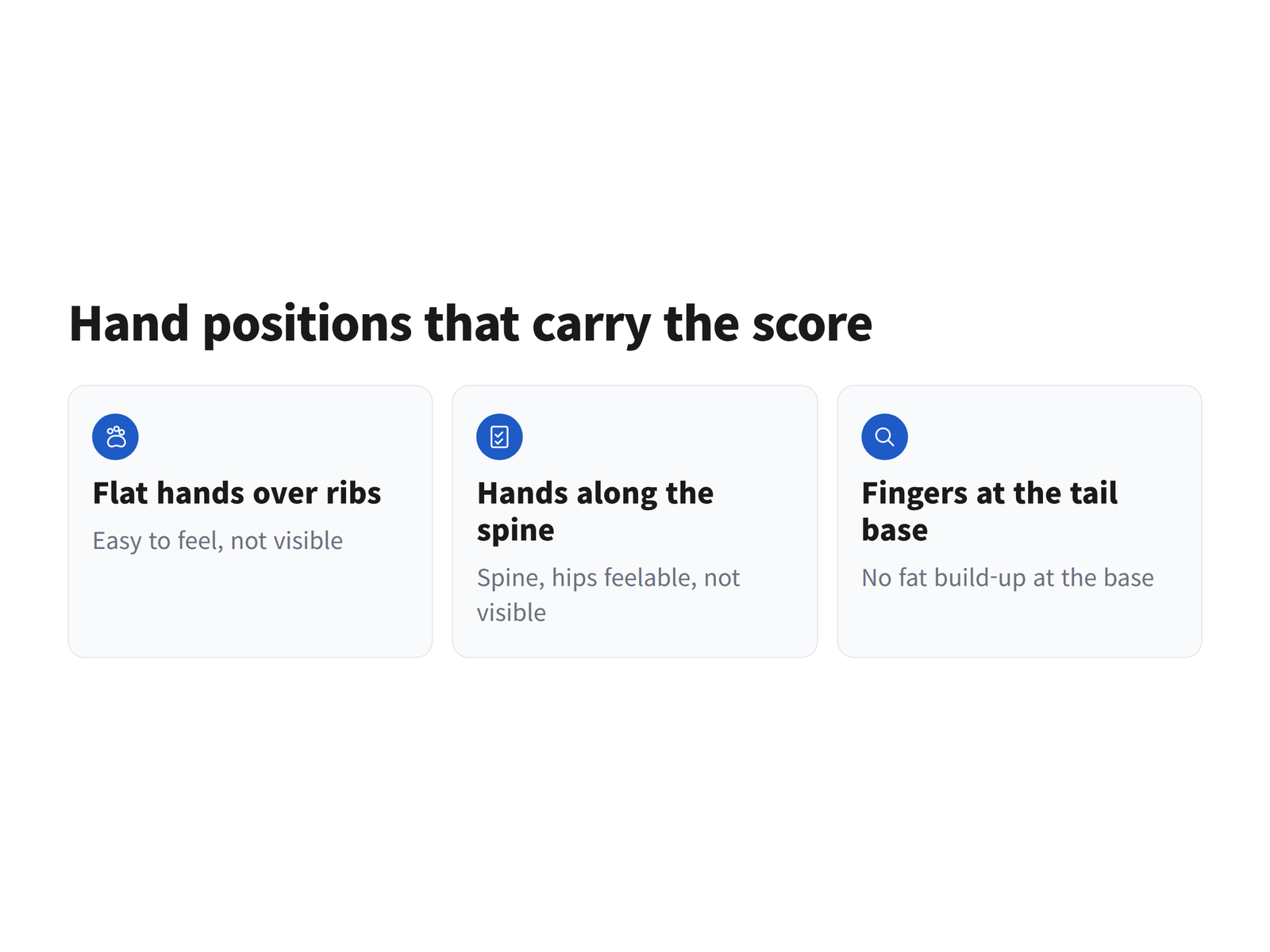
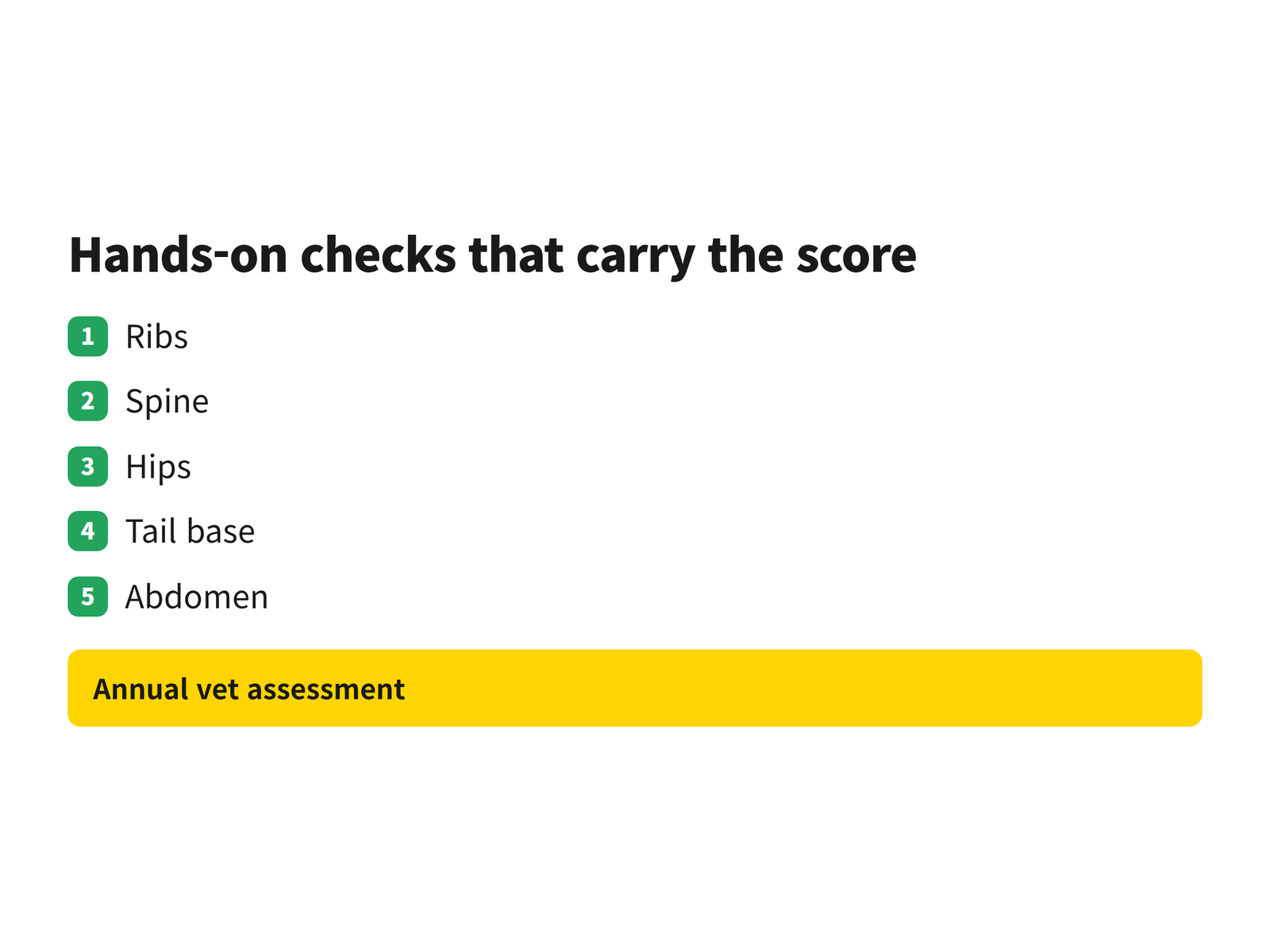
- Run both flat hands along the sides of the chest with light pressure. Ribs should be easy to feel with the skin moving freely over them, and should not be visible.
- Run both hands along the back. Spine and hipbones should be feelable under the skin without being visible.
- Feel the base of the tail. There should be no build-up of fat there.
- Feel under the abdomen. It should go in rather than bulge out.
- Look from above and from the side last, knowing this step is the weakest one on a long coat.
- Place the result on the 9-point scale and aim for 4 to 5.
Visible bones are not automatically a signal to feed more. The People’s Dispensary for Sick Animals criterion is that the spine and hipbones are feelable without being visible, so a dachshund whose bones show is a reason to ask a veterinarian rather than to change meals on a hunch.
Which body condition checks hold up on a long coat?
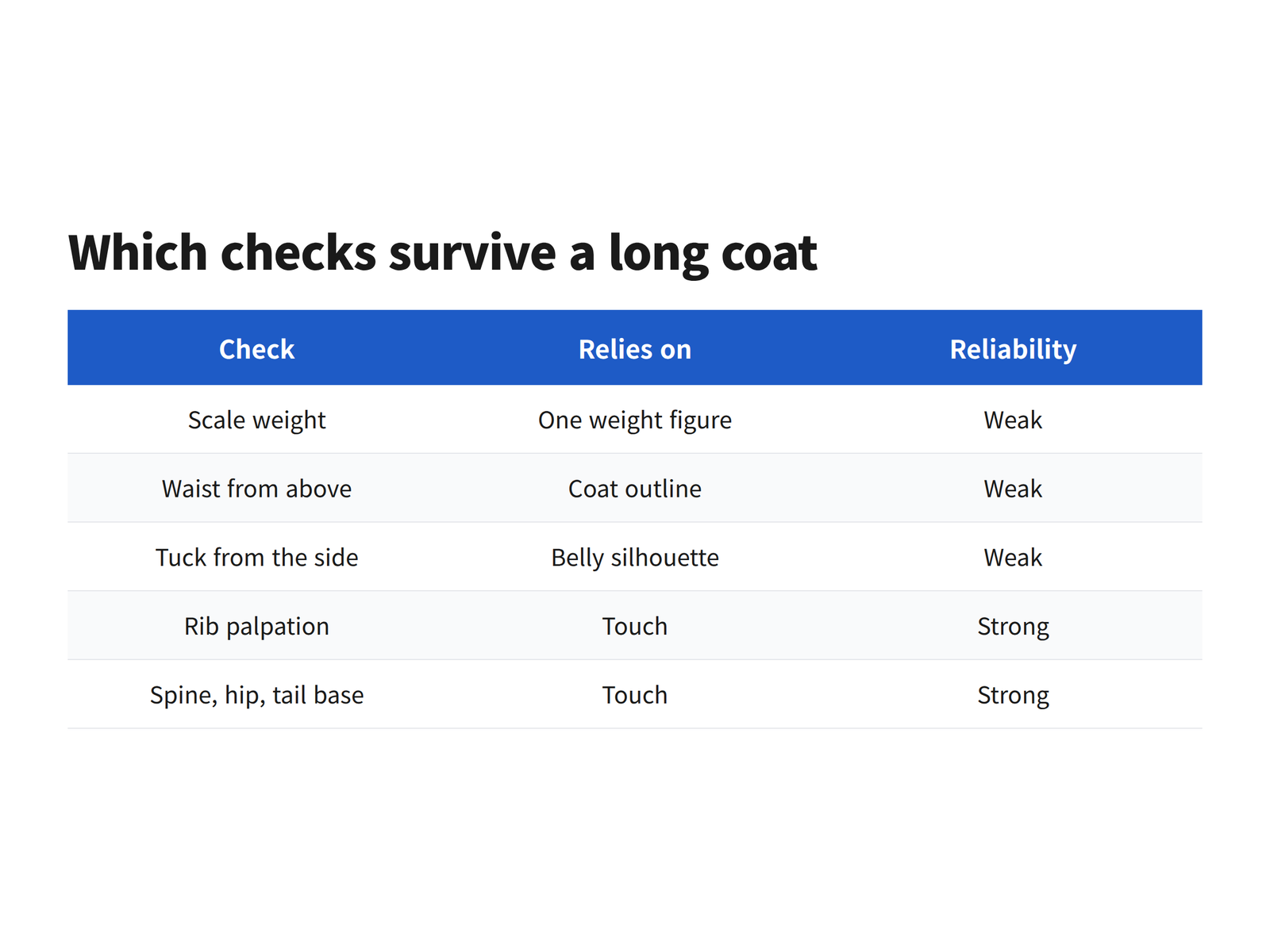
Touch-based checks hold up and silhouette-based checks do not. The table below sorts the five common checks by what each one actually relies on.
| Check | What it relies on | Reliability on a long coat |
|---|---|---|
| Scale weight | One weight figure | Weak alone, breed ranges do not predict ideal score |
| Waist from above | Coat outline | Weak, feathering sits on the underparts |
| Tuck from the side | Belly silhouette | Weak, same feathering covers the area judged |
| Rib palpation | Touch | Strong, palpation required per WSAVA |
| Spine, hip, tail base | Touch | Strong, all three are hands-on criteria |
Is a dachshund weight chart enough to judge a healthy weight?
No, a weight chart is a reference range rather than a body fat test. Smith et al. (2018, Journal of Animal Physiology and Animal Nutrition, n = 140 purebred dogs) concluded that published breed-specific body weight ranges are not a good predictor of an ideal body condition score. A dachshund can sit inside the published window and still score above 5, or sit above the window and score 4 to 5.
Dachshund Health UK, registered charity number 1177400, puts the same point in one line: “Your dog’s Body Condition Score is more important than what it weighs.” The American Animal Hospital Association agrees on method, describing body condition scoring as the most accurate way to judge whether a pet is overweight because it evaluates fat coverage, waist shape and abdominal tuck rather than weight alone. A home scale and a soft measuring tape are still worth keeping for the trend line.
What is the ideal weight for a miniature longhaired dachshund?
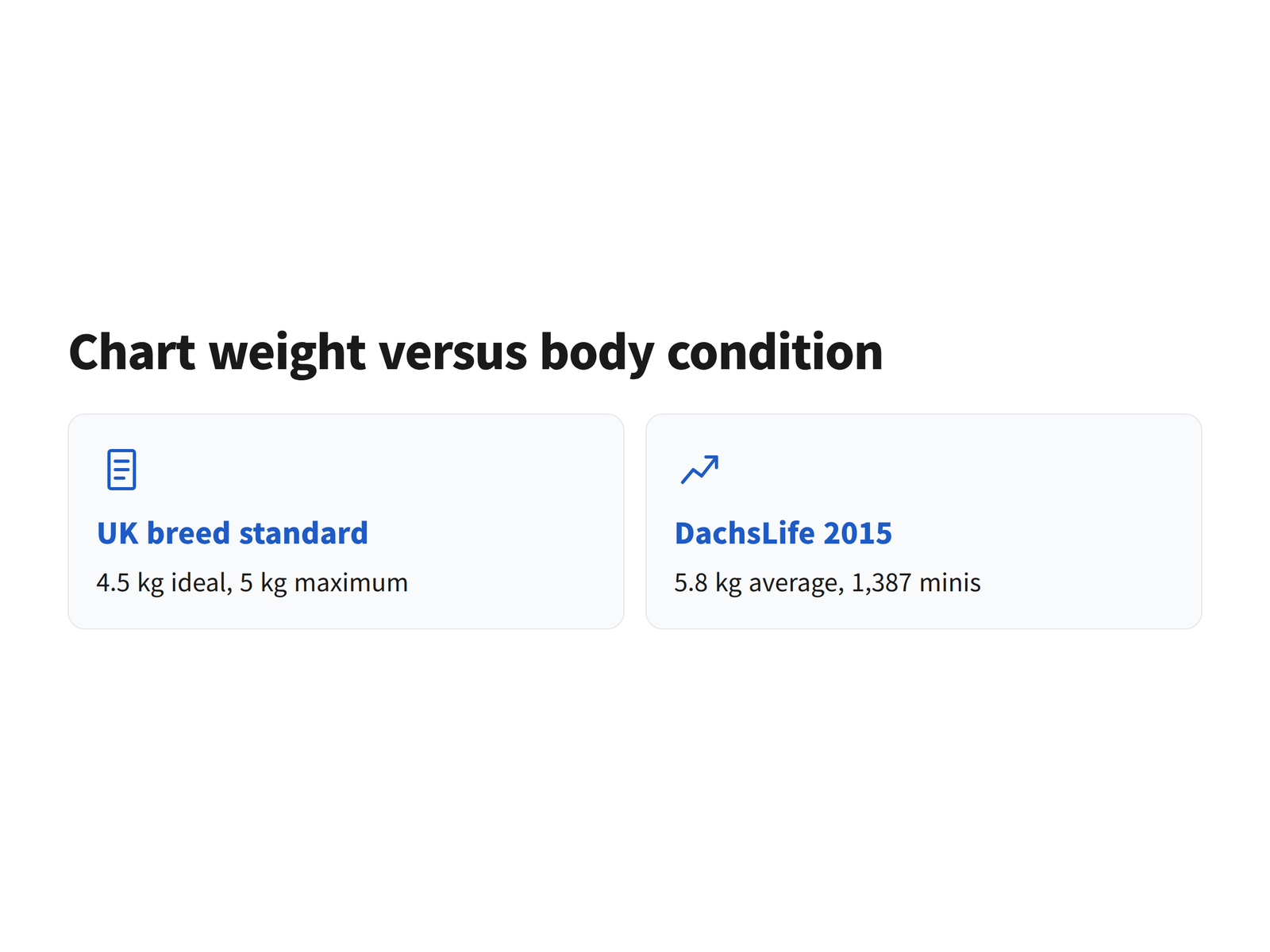
The UK breed standard gives 4.5 kg (10 lb) as ideal and 5 kg (11 lb) as the desired maximum. That figure comes from the Royal Kennel Club standard for the Miniature Long Haired Dachshund, updated 2025-04-01, and it describes the show ring rather than a health threshold.
Real dogs sit higher. The DachsLife 2015 survey run by Dachshund Health UK recorded an average of 5.8 kg across 1,387 miniatures, with 80% falling between 4 and 8 kg; standards (n = 577) averaged 10.9 kg with 80% between 6 and 15 kg. Read those as the population, not as a target. The score in your hands decides whether a given dachshund at 6 kg is carrying fat or frame.
Does being overweight actually raise a dachshund’s spinal risk?
The evidence is genuinely split, and both findings deserve to be stated. Packer et al. (2013, PLOS ONE) reported that in high-risk breeds, exemplified there by the Miniature Dachshund, even being moderately overweight increased the risk of thoracolumbar intervertebral disc extrusion. That same study population was 46.2% above a body condition score of 5, with 13% at score 7, which describes the dogs studied rather than dachshunds nationally.
The follow-up disagreed. DachsLife 2015, published in Canine Genetics and Epidemiology (2016;3:8) and covering 2,031 dachshunds, reported that “Body condition score was not found to be a risk factor for IVDD.” Dachshund Health UK acknowledges the mismatch in its own words, noting the 2013 finding was not replicated in its 2015 survey. The same survey found dogs exercising under 30 minutes a day had increased odds and dogs exercising over an hour had reduced odds, which are survey associations rather than proof of cause.
Body condition still has a measured link to lifespan elsewhere. Lawler et al. (2008, British Journal of Nutrition) followed Labrador Retrievers under 25% diet restriction and recorded a median lifespan of 13.0 years against 11.2 years in controls, with mean scores of 4.6 against 6.7 at ages six to twelve.
How often should you check a longhaired dachshund’s body condition?
Often enough that a slow change is caught, with a professional check at least once a year. Dachshund Health UK advises an annual veterinary body condition assessment, and running the hands-on steps yourself between visits gives you the trend the coat would otherwise absorb.
Scoring at home is not a diagnosis. The American Veterinary Medical Association lists arthritis, diabetes, high blood pressure, breathing problems, back problems, kidney disease and certain cancers among conditions linked to excess weight in pets, and its instruction to owners is short: “Have an honest conversation with your veterinarian about your pet’s weight.” Consult your veterinarian before changing food, portions or exercise, and ask them to confirm the score you are reading.
Frequently asked questions
Can you tell from a photo whether a longhaired dachshund is overweight? Not reliably. A photo shows the coat outline, and the Royal Kennel Club standard places the longest feathering on the underparts and behind the legs, over the waist and tuck a photo would judge.
Does a puppy coat change the answer? The same rule applies. The World Small Animal Veterinary Association ties the palpation requirement to medium and long hair coats generally, so hands-on scoring is the method at any age.
Is there a dachshund-specific body condition scale? No separate breed scale was found. Dachshund Health UK points owners to a general size assessment tool, and the 9-point scale with a 4 to 5 target is what the World Small Animal Veterinary Association publishes.
What if the score sits at 6 or 7? Take the reading to a veterinarian rather than setting a diet yourself. The American Veterinary Medical Association directs owners to their veterinarian for recommendations tailored to the individual dog.
Sources
- World Small Animal Veterinary Association, “WSAVA Nutritional Assessment Guidelines”, Journal of Small Animal Practice, 2011 — https://wsava.org/wp-content/uploads/2020/01/WSAVA-Nutrition-Assessment-Guidelines-2011-JSAP.pdf
- American Veterinary Medical Association, “Your pet’s healthy weight”, accessed 2026-09-11 — https://www.avma.org/resources-tools/pet-owners/petcare/your-pets-healthy-weight
- American Animal Hospital Association, “Is my pet overweight?”, updated 2025-12-16 — https://www.aaha.org/resources/is-my-pet-overweight/
- The Royal Kennel Club, “Breed Standard — Dachshund (Miniature Long Haired)”, updated 2025-04-01 — https://www.royalkennelclub.com/breed-standards/hound/dachshund-miniature-long-haired
- People’s Dispensary for Sick Animals, “Your dog’s Body Condition Score” — https://www.pdsa.org.uk/get-involved/our-campaigns/weigh-up/your-dog/your-dogs-body-shape/your-dogs-body-condition-score
- Packer RMA, Hendricks A, Volk HA, Shihab NK, Burn CC, “How Long and Low Can You Go?”, PLOS ONE, 2013 — https://journals.plos.org/plosone/article?id=10.1371%2Fjournal.pone.0069650
- Packer RMA, Seath IJ, O’Neill DG, De Decker S, Volk HA, “DachsLife 2015: an investigation of lifestyle associations with the risk of intervertebral disc disease in Dachshunds”, Canine Genetics and Epidemiology 2016;3:8, DOI 10.1186/s40575-016-0039-8
- Smith EG, Davis K, Sulsh L, Harvey SC, Fowler KE, “Canine recommended breed weight ranges are not a good predictor of an ideal body condition score”, Journal of Animal Physiology and Animal Nutrition 102(4), 2018 — https://oro.open.ac.uk/90488
- Lawler DF et al., “Diet restriction and ageing in the dog”, British Journal of Nutrition 99(4), 2008 — https://www.cambridge.org/core/journals/british-journal-of-nutrition/article/diet-restriction-and-ageing-in-the-dog-major-observations-over-two-decades/3DDCC1DDF5A7D85518684AA687FBA63E
- Söder J et al., “Dog Owners’ Perceptions of Canine Body Composition”, Veterinary Sciences 10(7):447, 2023 — https://www.mdpi.com/2306-7381/10/7/447
- Dachshund Health UK, “Dachshund IVDD — Body condition” — https://www.dachshund-ivdd.uk/lifestyle-advice/body-condition/