Mid-September sits outside the preparation window Blue Cross recommends, which opens four to six months before bonfire night. A short runway still leaves real options. In a survey of 1,225 dogs, the measure owners rated most effective cost nothing, while several products marketed hardest for firework season sat near the bottom of the same table. What follows is what still fits into a few weeks for small breeds, and what is better left on the shelf.
Is it too late to prepare a small dog for fireworks this season?
No, but the goal shifts from full desensitisation to damage limitation. Blue Cross recommends starting sound training four to six months before bonfire night, so a September start falls outside that window. The Royal Kennel Club sets a lower floor: short sessions several times a day for at least two weeks, or several times a week across several months. Two weeks of daily practice is reachable from mid-September, and it targets counterconditioning, the highest-scoring measure in the Riemer 2020 survey.
Timing matters for a second reason. In the Riemer 2019 study of 1,225 dogs, 45 percent of firework fears had appeared before the dog turned one, at a median onset age of one year. Dogs trained before any fear developed showed a median welfare impairment score of 1 for puppies and 2 for adults, against 4 for untrained dogs. Small breeds that have never reacted badly have the most to gain from a short block of preparation now.
How far in advance do welfare organisations say noise training should start?
Guidance ranges from two weeks to six months, and the organisations do not agree. Blue Cross states: “We recommend starting this training around four to six months before bonfire night so that you have plenty of time to get them used to the sounds.” The Royal Kennel Club sets a shorter floor, advising short sessions several times daily for a minimum of two weeks, or several times weekly over several months. Treat six months as the ideal and two weeks as the shortest span carrying an official recommendation.
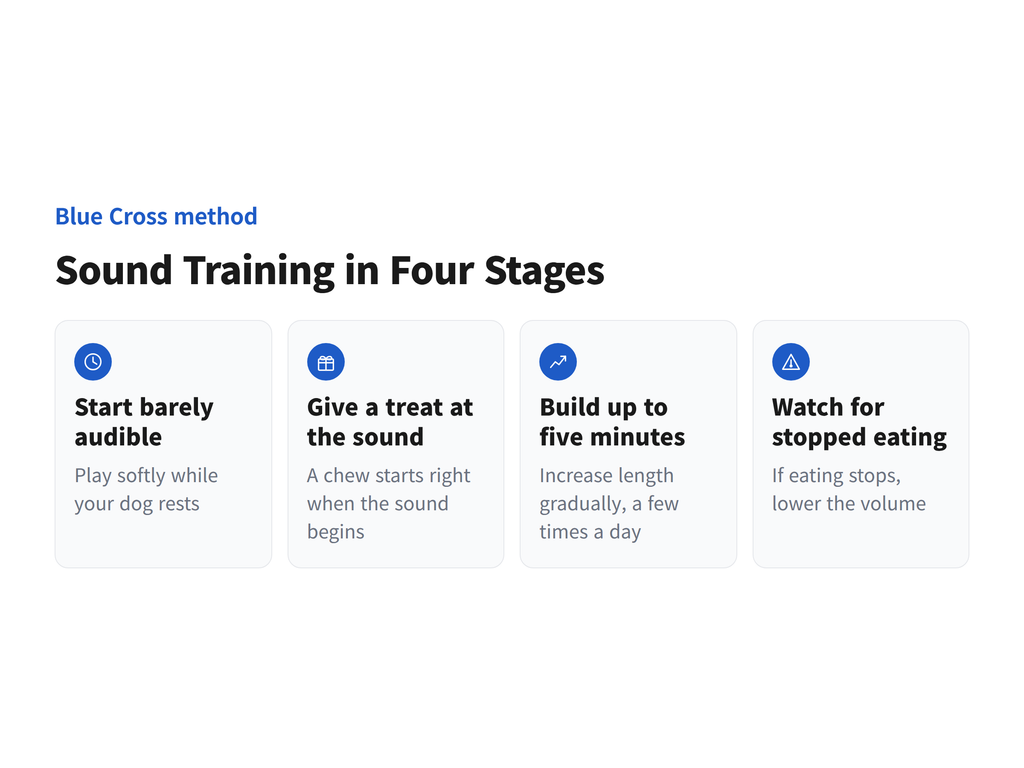
The Blue Cross method is specific enough to follow without guesswork. Start the recording barely audible while the dog is resting, running one to two minutes at first, then building to five minutes a few times a day. Give a chew or a food toy as soon as the sound begins; Blue Cross notes that “they’ll learn that firework sounds mean a tasty treat.” If a dog stops eating while the sound plays, the volume is too high, so drop back to the comfortable level and raise it only once the dog is clearly relaxed.
Are small breeds actually more afraid of fireworks than large breeds?
Not reliably, and firework fear does not track body size the way general fearfulness does. McGreevy et al. 2013, covering 8,301 dogs across 49 breeds, reported that “across the breeds, behavior becomes more problematic as height decreases,” with non-social fear rising significantly as breed height fell (p<0.001). That finding concerns fearfulness in general, and the firework-specific evidence points elsewhere.
In Riemer 2019, welfare impairment from fireworks was highest in mixed-breed dogs, followed by herding dogs, while companion breeds, molossians and retrievers scored lower. Salonen et al. 2020, a study of 13,715 Finnish pet dogs, placed the Lagotto Romagnolo, the Wheaten Terrier and mixed breeds in the most noise-sensitive group, with the Miniature Schnauzer among the least sensitive. Small breeds sit on both ends of that distribution, so treat the individual dog, not the size category, as the starting point.
Prevalence figures shift with the threshold used. Salonen et al. 2020 recorded high-level firework fear in 26 percent of dogs and noise sensitivity of any kind in 32 percent, while Riemer 2019 counted 52.2 percent showing at least partial firework fear. Between 26 and 52 percent of pet dogs are affected, depending on how severe the reaction must be before it counts.
Which firework calming measures do owners rate as working, and which do not?
Counterconditioning ranks highest at 70.8 percent, and pheromone products lowest of the non-prescription options at 28.8 percent. The figures below come from the Riemer 2020 survey of owner-reported outcomes in the Journal of Veterinary Behavior.
| Measure | Owners reporting improvement | Dogs |
|---|---|---|
| Food right after a noise | 70.8% | 694 |
| Relaxation training | 69.3% | 433 |
| Recorded-sound training | 54.4% | 377 |
| Pressure vests | 44% | 300 |
| Pheromone products | 28.8% | 316 |
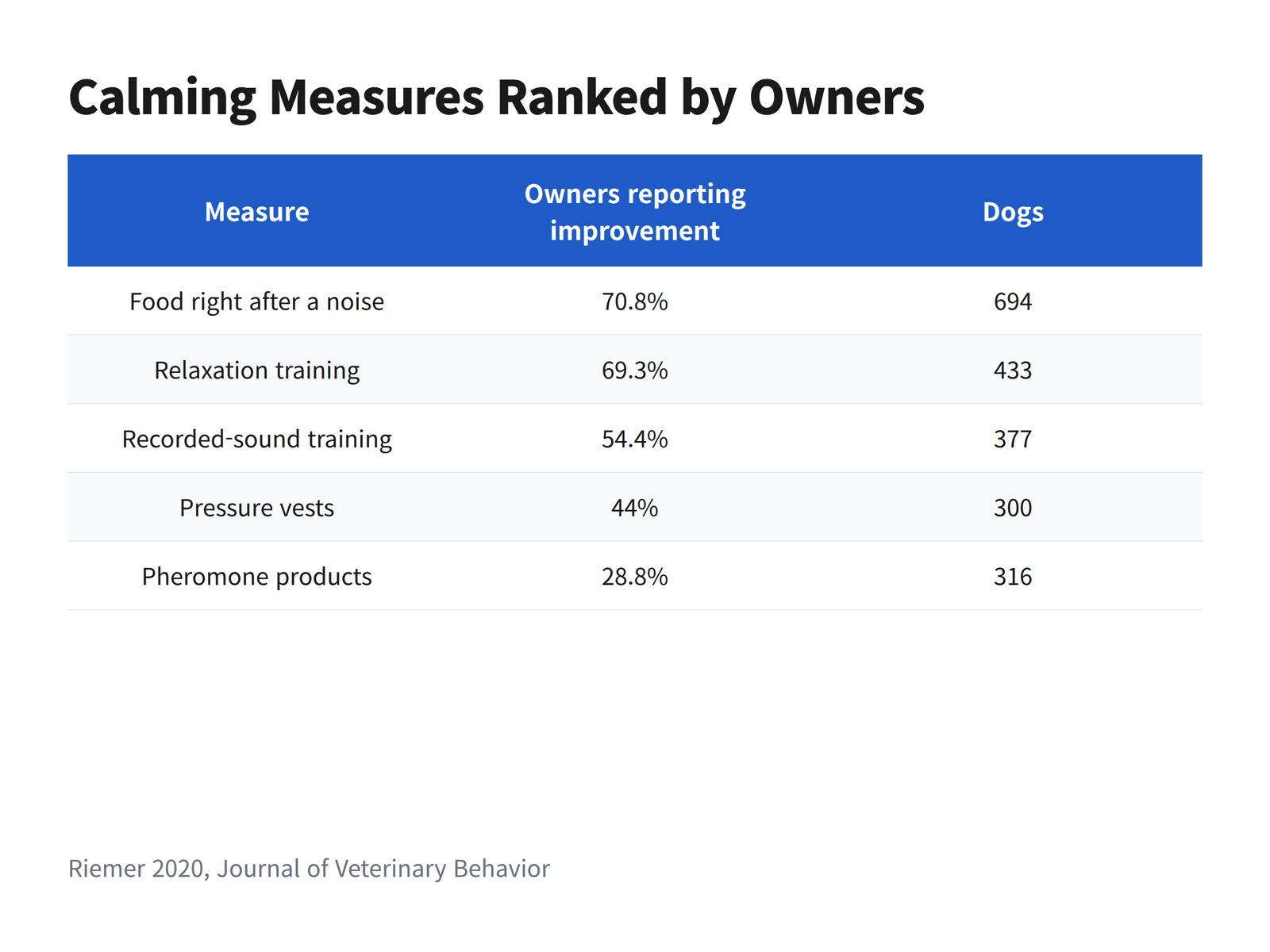
The ordering inverts the usual shopping list. Nutraceuticals at 27.0 percent, pheromone products at 28.8 percent and essential oils at 31.1 percent fall into the band Riemer treated as consistent with a placebo effect, while the highest-scoring measure has no purchase price at all. Pressure vests landed mid-table at 44 percent across 300 dogs, making them a reasonable add-on rather than a plan. Riemer writes that counterconditioning “appears to be extremely effective in preventing the development of firework fears in the first place.”
Prescription options also exist, and that is a conversation for your veterinarian rather than for a blog post. If a small dog’s reaction is severe, involves panic or injury, or has clearly worsened, consult your veterinarian before working through any product list.
Does comforting a frightened small dog make the fear worse?
No, and two of the organisations most often cited on the subject say so directly. The Royal Kennel Club advises that “if they come to you for comfort, then you should respond to them in a calm and soothing way and shouldn’t ignore them.” The American Kennel Club, in guidance updated on 10 June 2026, is blunter: “You absolutely can and should comfort your dog if he’s afraid.” The belief that reassurance reinforces fear is not what either body recommends.
What time are fireworks legally allowed until?
In the UK, GOV.UK states that “you must not set off fireworks between 11pm and 7am,” with named exceptions. Bonfire Night extends the cut-off to midnight, and New Year’s Eve, Diwali and Chinese New Year extend it to 1am. Breaching the rules can bring an unlimited fine and up to six months in prison, with an on-the-spot penalty of £90. These limits apply to the UK only, so readers elsewhere should check local rules.
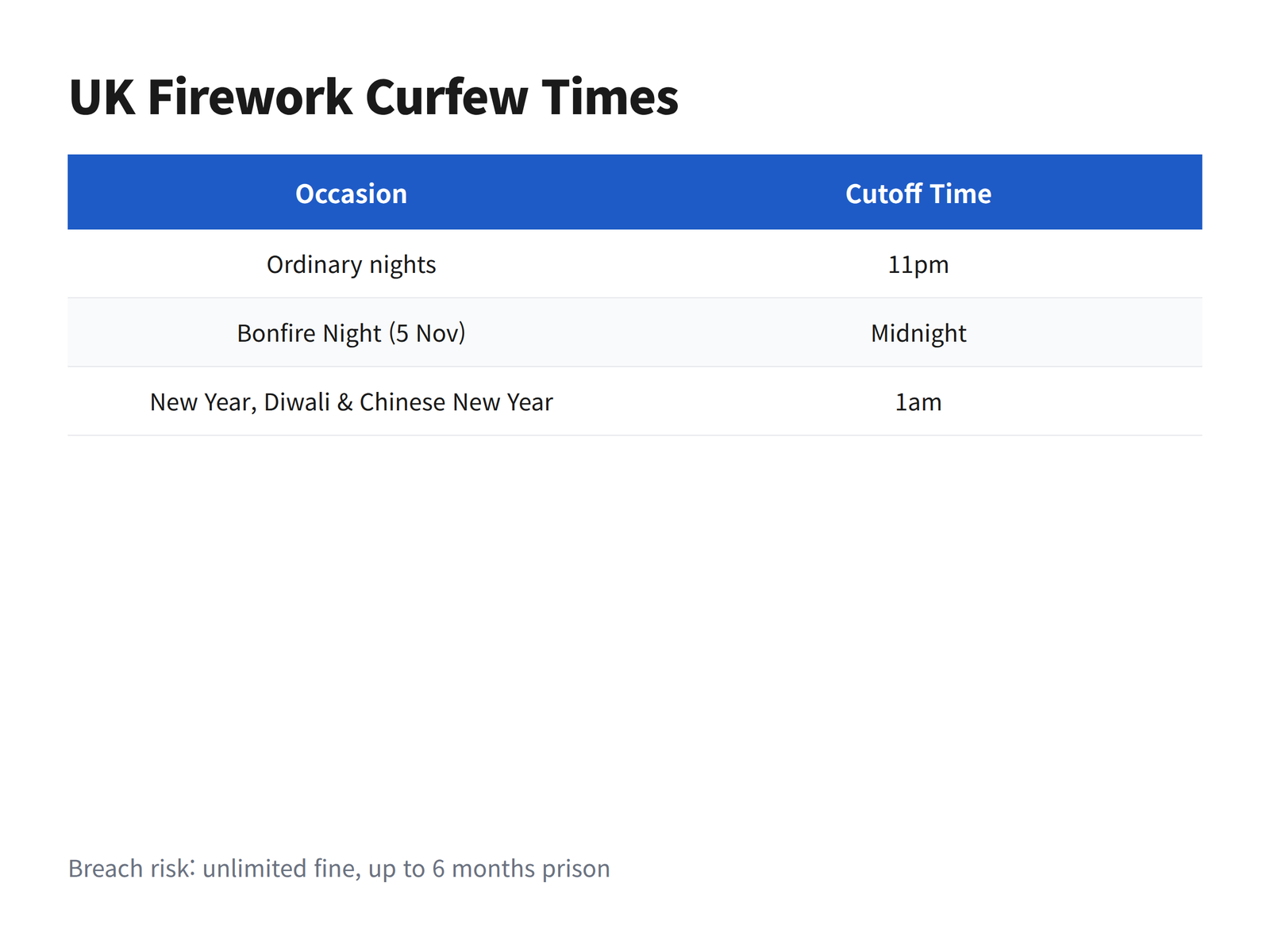
Legal cut-offs help less than the timetable suggests. RSPCA figures from a 2025 Savanta poll put the share of dogs negatively affected by fireworks at 60 percent, and 93 percent of owners surveyed had received no advance warning of a display. RSPCA data also shows 66 percent of those fireworks were set off at home rather than at organised events, with 44 percent of pets reported as frightened in the 2024 impact survey. Planning around published event schedules covers only part of the risk.
What should change about walks and ID during firework season?
Move walks to before dusk and check the microchip record this week. The Royal Kennel Club reports that 53 percent of microchips hold incorrect owner details, which blocks the return of a dog that bolts. Blue Cross and the American Kennel Club both advise closing windows and curtains and finishing walks before dark, and the Royal Kennel Club advises keeping dogs on a lead through firework season, since a bang can trigger a panicked run.
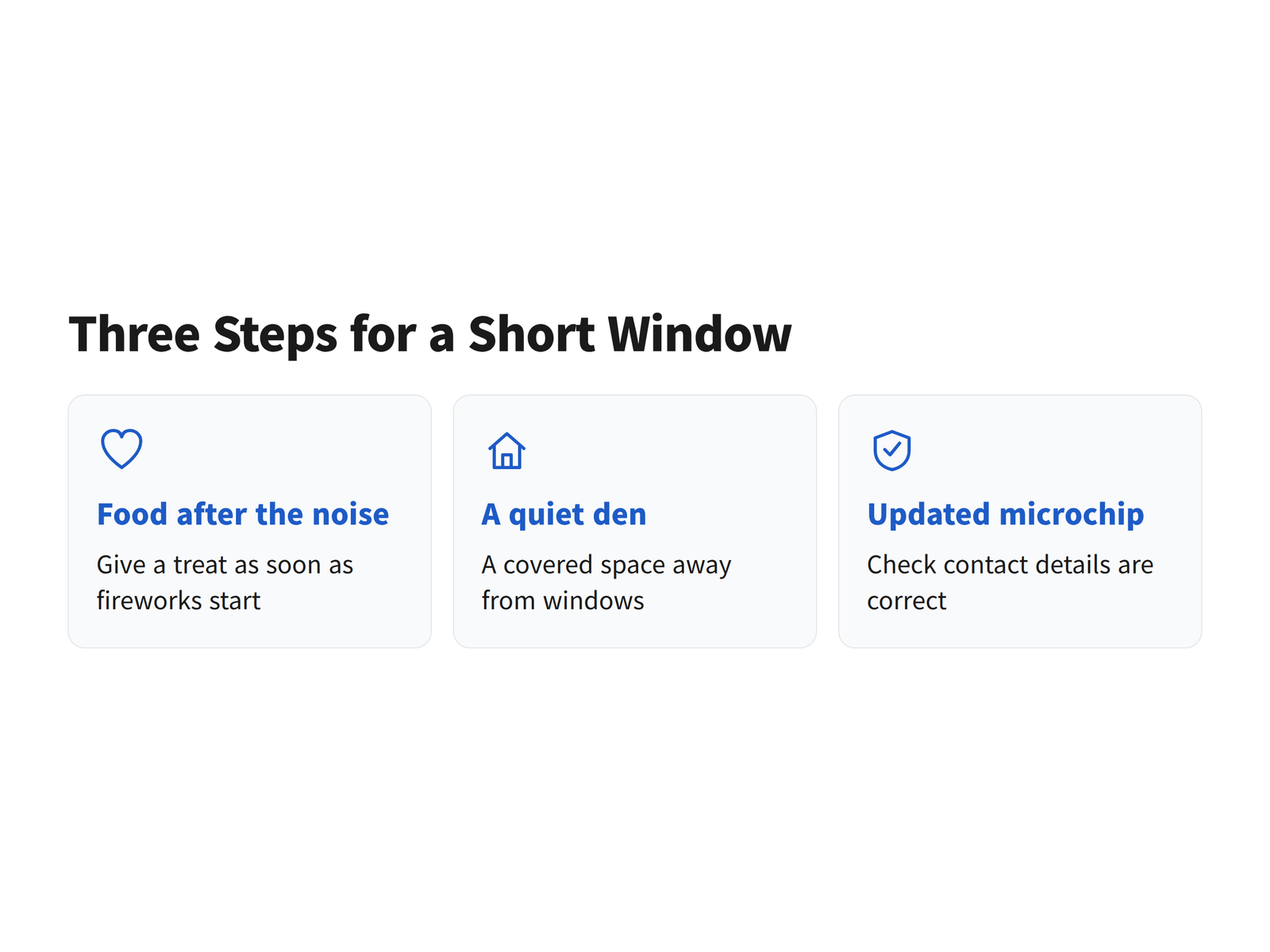
A den helps if it is built properly. The Royal Kennel Club suggests making “a safe den for your dog to retreat to if they feel scared,” adding that a thick duvet draped over the top improves sound insulation provided it is secured and cannot fall onto the dog. Place it away from windows. A crate is only useful if the dog already treats it as a safe place; the American Kennel Club recommends one on that condition, which rules out shutting a small dog into an unfamiliar crate on firework night.
Riemer 2019 found firework fear improved, held steady or worsened in roughly equal proportions over time, so the common claim that an untreated fear deepens every year is not supported by that dataset.
Frequently asked questions
Is two weeks enough to make a difference? Two weeks of short daily sessions matches the minimum the Royal Kennel Club describes, well below the four to six months Blue Cross recommends. Expect partial rather than complete progress.
Do pheromone diffusers and calming supplements work? In the Riemer 2020 survey, pheromone products reached 28.8 percent and nutraceuticals 27.0 percent, both within the range the author regarded as placebo-consistent.
Are small breeds automatically higher risk? No. Riemer 2019 placed companion breeds below mixed-breed and herding dogs for firework-related welfare impairment, and Salonen et al. 2020 listed the Miniature Schnauzer among the least noise-sensitive breeds.
When should a veterinarian be involved? When the reaction is severe, causes injury, or does not respond to training. Prescription options are decided in that consultation, not from a comparison table.
Sources
- GOV.UK, “Fireworks: the law”, current — https://www.gov.uk/fireworks-the-law
- The Royal Kennel Club, “Fireworks night and dogs”, no date stated — https://www.royalkennelclub.com/health-and-dog-care/health-dog-care/health/health-and-care/a-z-of-health-and-care-issues/fireworks
- RSPCA, “Keeping dogs, cats and other small pets safe during fireworks”, 2024 and 2025 survey data — https://www.rspca.org.uk/adviceandwelfare/fireworks/pets
- Blue Cross, “How to prepare your dog for fireworks”, published 2021-05-26 — https://www.bluecross.org.uk/advice/dog/behaviour-and-training/how-to-prepare-your-dog-for-fireworks
- American Kennel Club, “How to Keep Your Dog Calm During Fireworks”, Teresa Traverse, updated 2026-06-10 — https://www.akc.org/expert-advice/training/how-to-keep-your-dog-calm-during-fireworks/
- Riemer S., “Effectiveness of treatments for firework fears in dogs”, Journal of Veterinary Behavior 37:61-70, 2020 — https://doi.org/10.1016/j.jveb.2020.04.005
- Riemer S., “Not a one-way road – Severity, progression and prevention of firework fears in dogs”, PLOS ONE 14(9):e0218150, 2019 — https://journals.plos.org/plosone/article?id=10.1371%2Fjournal.pone.0218150
- Salonen M. et al., “Prevalence, comorbidity, and breed differences in canine anxiety in 13,700 Finnish pet dogs”, Scientific Reports 10:2962, 2020 — https://www.nature.com/articles/s41598-020-59837-z
- McGreevy PD et al., “Dog Behavior Co-Varies with Height, Bodyweight and Skull Shape”, PLoS ONE 8(12):e80529, 2013 — https://journals.plos.org/plosone/article?id=10.1371%2Fjournal.pone.0080529