Ask four veterinary and welfare organisations when a small dog becomes senior and you get four different answers spread across a four-year gap. The American Veterinary Medical Association says 8 to 11 years. The Royal Kennel Club says 12. Blue Cross says around nine to ten. The American Animal Hospital Association declines to name an age at all. The small breed senior age printed on most online charts is a convention rather than a biological event, and knowing which convention you are reading changes what you do about it.

When is a small breed dog considered senior?
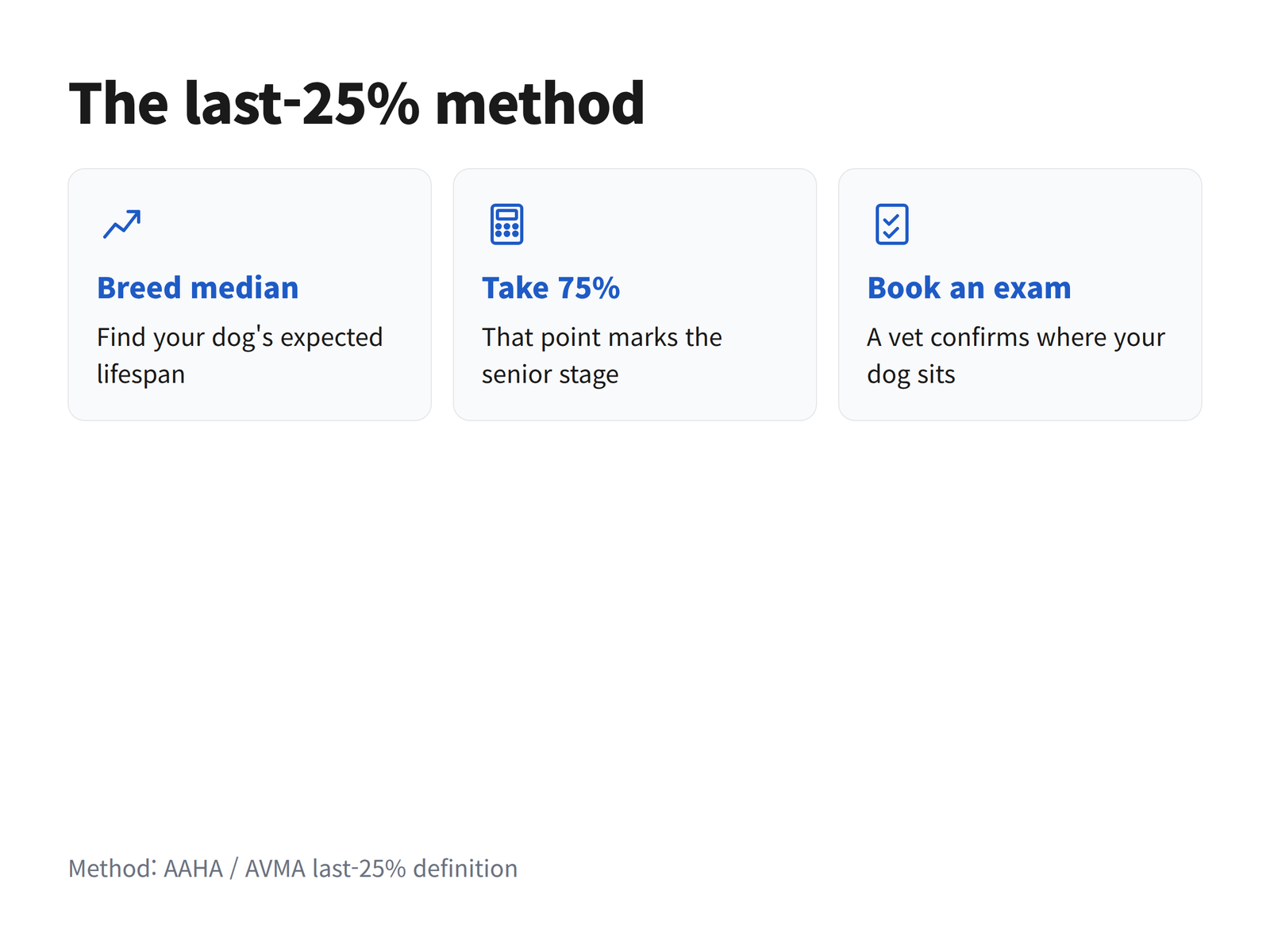
A small breed dog is considered senior during the last quarter of its expected lifespan, which lands somewhere between 8 and 12 years depending on which organisation is answering. The American Animal Hospital Association defines the senior stage as “the last 25% of estimated lifespan through end of life,” and the American Veterinary Medical Association uses the same proportional wording, describing a senior dog as one in “the last 25 percent of the estimated life span for their breed.” Neither definition contains a birthday. Both describe a position on a curve, which is why two dogs of identical age can sit on opposite sides of the line.
The American Animal Hospital Association is explicit about refusing a fixed number. Its 2023 Senior Care Guidelines state that “because of the variability in aging based on species and breed, there is no specific age for senior status.” Whether a particular small dog has entered that stage is a judgement an exam should make, not one a chart can make from a date of birth, so consult your veterinarian before acting on any age band. The chart tells you when to start asking.
Why does the 7-year rule not fit small dogs?
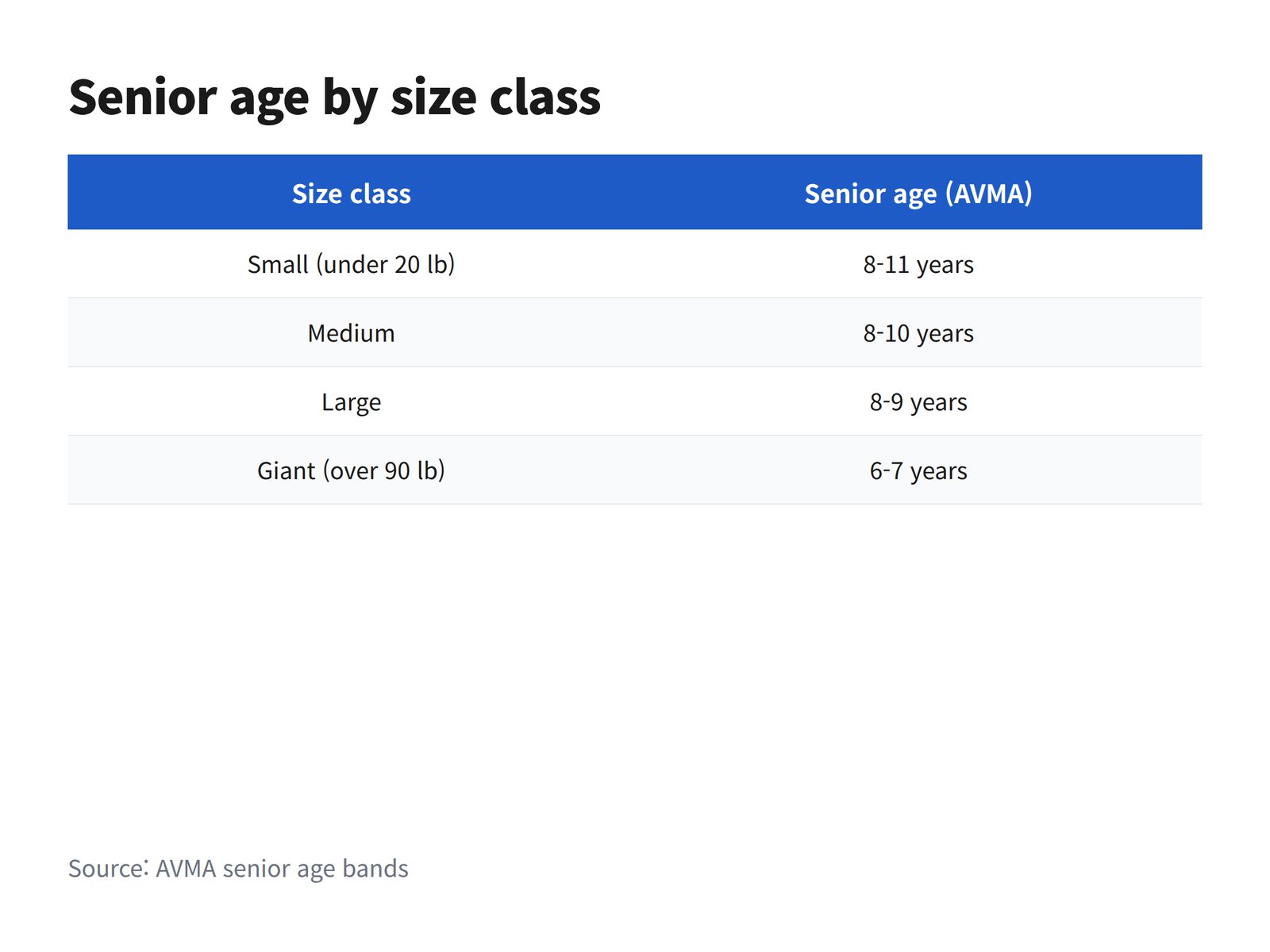
The seven-year rule does not fit small dogs because no major authority places the small breed senior threshold at seven. Blue Cross describes most dogs as middle-aged once they pass seven years, which is a different stage entirely. The American Veterinary Medical Association puts small and toy breeds under 20 lb (about 9 kg) at 8 to 11 years, medium breeds at 8 to 10, large breeds at 8 to 9, and giant breeds over 90 lb at 6 to 7 years.
Read that sequence in order and the seven-year figure turns out to belong to the giant breeds, not the small ones. Applied to a 6 kg dog, it arrives one to five years early. Blue Cross puts the small breed picture plainly: “Small dogs often live longer, and may not show signs of old age until they’re around nine to ten years old.” A seven-year-old small dog is closer to the middle of its life than the end of it.
Why do the official senior age charts disagree?
The charts disagree because they are not measuring the same thing. The American Animal Hospital Association measures a proportion of lifespan. The Royal Kennel Club bands dogs by body weight. Blue Cross describes when owners typically notice signs of ageing. Three different methods produce three different numbers, and a fourth appears if you apply the proportional definition to published lifespan data yourself.
| Authority | Senior threshold for a small dog | Basis given |
|---|---|---|
| AAHA 2023 Senior Care Guidelines | No fixed age stated | Last 25% of lifespan |
| American Veterinary Medical Association | 8 to 11 years (under 20 lb) | Last 25% of lifespan |
| The Royal Kennel Club | 12 years (up to 10 kg) | Body-weight banding |
| Blue Cross | Around 9 to 10 years | Observed signs of ageing |
| Scientific Reports 2024 plus AVMA definition | Roughly 9.5 years (calculated) | 75% of a 12.7-year median |
The Royal Kennel Club supplies the clearest evidence that the number is a convention. It bands a small dog as senior at 12 years, yet suggests beginning an ageing-support diet at 8 – a four-year gap inside one organisation’s own guidance. The bottom row of the table is arithmetic, not a published statistic: applying the American Veterinary Medical Association definition to the 2024 UK median figures gives roughly 9.5 years for small breeds overall.
Is a small breed always slower to age than a large breed?
No, and the exceptions are not rare ones. A 2024 Scientific Reports study of 584,734 UK dogs put the median life expectancy of small breeds at 12.7 years, medium breeds at 12.5, large breeds at 11.9, and all dogs combined at 12.5 years. Within the small-breed group the spread is far wider than the gap between size classes. The Miniature Dachshund median was 14.0 years and the Pug median 11.6, while the French Bulldog and the English Bulldog both came in at 9.8 years – below the large-breed median.
Apply the proportional definition to those medians and the ranking inverts. The calculation gives roughly 7.4 years for a French Bulldog and roughly 9.8 years for a Labrador Retriever, whose median was 13.1 years. A small flat-faced dog can therefore reach the senior stage around two and a half years earlier than a retriever more than three times its weight. The study still describes body size as “generally considered to be the greatest predictor of their lifespan,” but greatest predictor is not the same as only predictor. All of these medians come from a UK population.
Does a small dog need senior dog food at all?
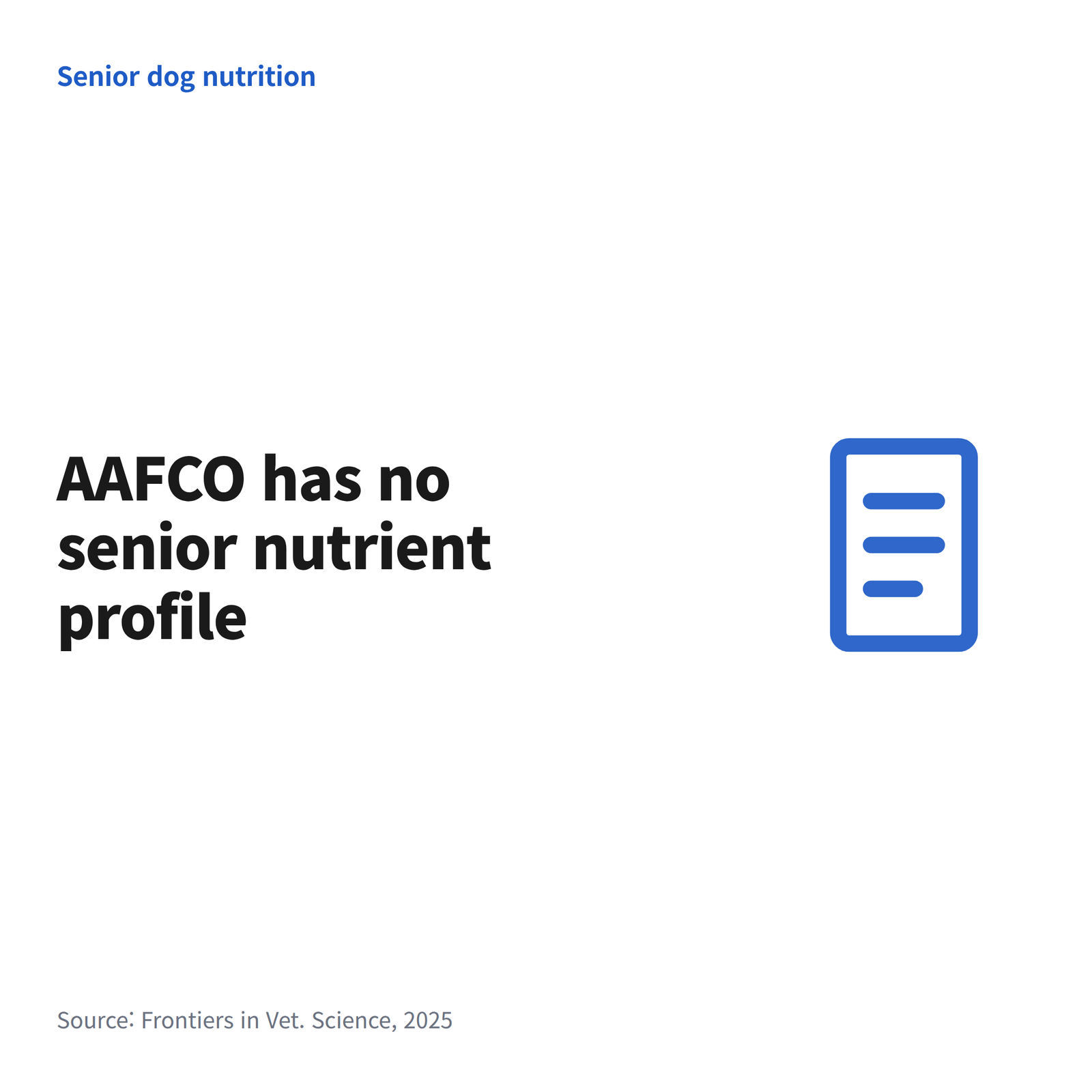
The honest answer is that nobody can tell you from the label, because “senior” is a marketing word rather than a regulated one. A 2025 Frontiers in Veterinary Science analysis states that “neither the Association of American Feed Control Officials (AAFCO), nor the National Research Council (NRC) have established a definition for senior life stage and as such, specific nutrient profiles for senior pets do not exist.” The same paper notes that “each manufacturer must determine what they believe a senior diet should be, which leads to wide nutrient variability and little consensus amongst diets marketed for senior dogs.”
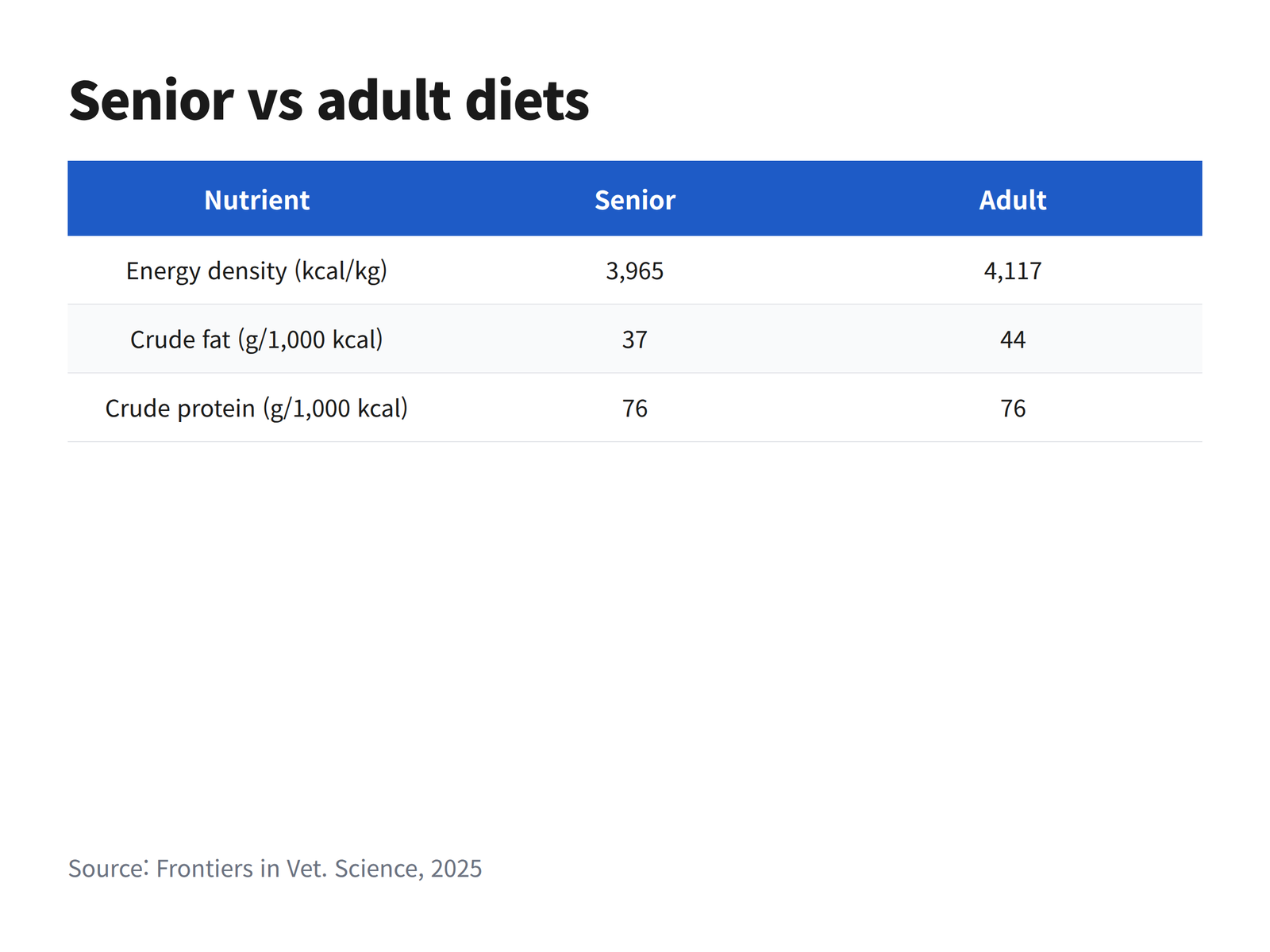
The measured gap between senior and adult recipes is also narrower than the packaging implies. Across 61 analysed diets, crude protein was identical in both groups at 76 g per 1,000 kcal. Only energy density (3,965 versus 4,117 kcal/kg dry matter) and crude fat (37 versus 44 g per 1,000 kcal) differed significantly. Separately, 18% of the products – 11 of 61 – failed at least one AAFCO requirement. That analysis examined nutrient composition only and tested no health outcomes, so it says nothing about whether a senior formula helps or harms. If you do change food, the Royal Kennel Club advises mixing a small amount of the new food into the current one and shifting the ratio gradually over 7 to 10 days.
How often should a senior small dog see a veterinarian?
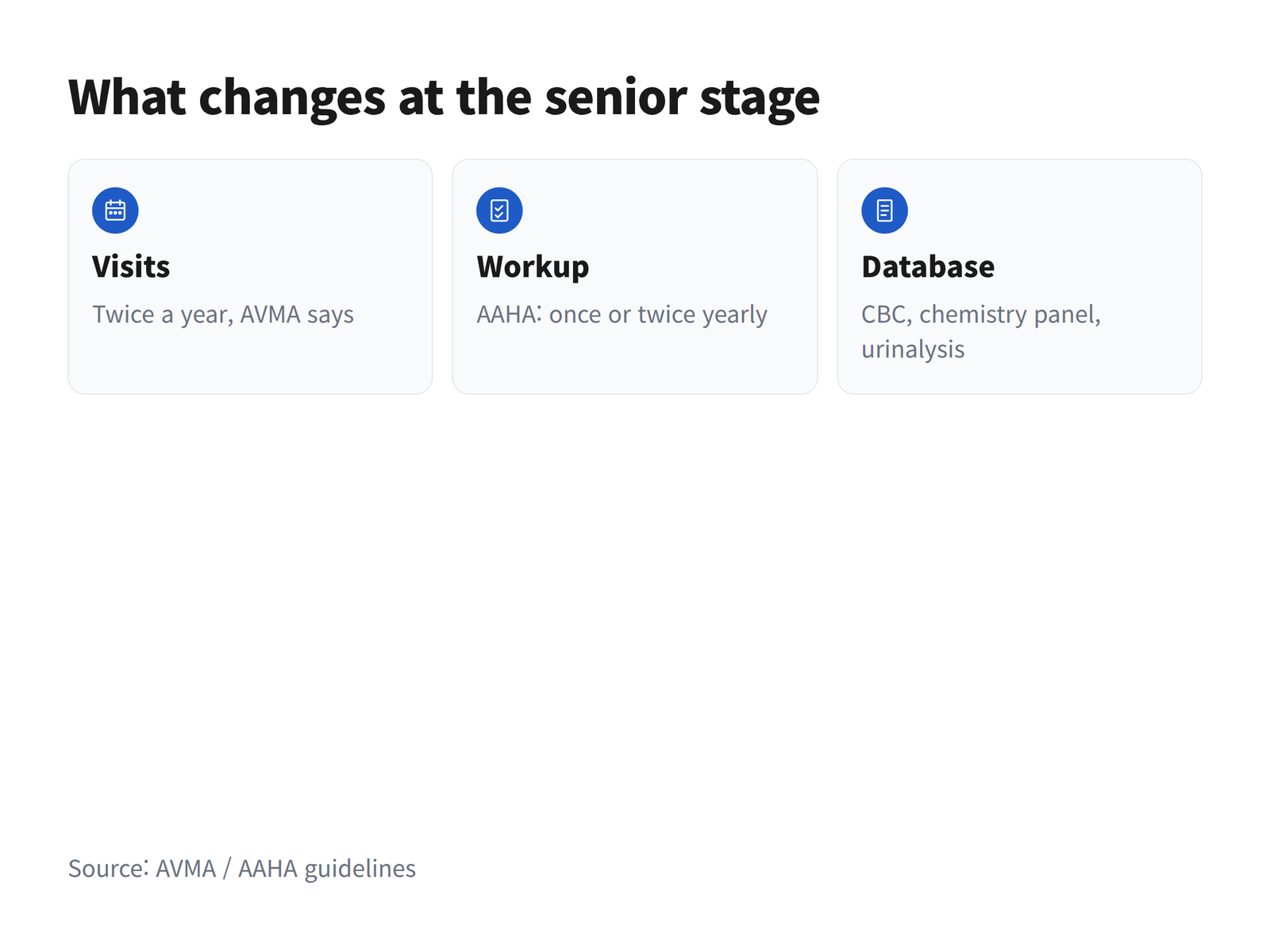
Twice a year is the figure most cited. The American Veterinary Medical Association states that “senior pets need to see a veterinarian twice a year or more so signs of illness or other problems can be found and treated early.” The American Animal Hospital Association words its own recommendation differently, scheduling a medical workup once or twice a year, so the two should be reported side by side rather than merged into a single number.
Underneath the visit schedule sits a defined set of tests. The American Animal Hospital Association lists a minimum database every 6 to 12 months: a complete blood count, a chemistry panel and a urinalysis. Its annual screening list also covers tick-borne disease, thyroxine (T4), blood pressure and NT-proBNP. Blue Cross suggests weighing a dog every one to two months across its whole life, which gives a veterinarian a trend line rather than a single reading. As the 2023 guidelines put it, “old age is not a disease.”
Frequently asked questions
Is there one correct senior age for a small dog?
No. The four organisations covered here give four answers ranging from “no fixed age” to 12 years. Each is internally consistent with its own method, and none of them is measuring what the others measure.
Does a heavier small dog become senior earlier than a lighter one?
Not necessarily within the small-breed group. The 2024 UK medians show breed-level variation of more than four years among small dogs, and the flat-faced breeds in that dataset had the shortest medians despite their size.
Should food change on the dog’s senior birthday?
There is no regulatory senior life stage to trigger such a change, and the measured differences between senior and adult recipes are small. Timing and suitability are questions for your veterinarian, who can weigh them against the individual dog’s health history.
What is the single most useful number to track?
Weight. Blue Cross recommends weighing every one to two months throughout life, which turns a set of isolated figures into a trend an exam can act on.
Sources
- American Veterinary Medical Association, “Caring for senior cats and dogs”, page read 2026-09-13 – https://www.avma.org/resources-tools/pet-owners/petcare/senior-pets
- American Animal Hospital Association, “2023 AAHA Senior Care Guidelines for Dogs and Cats”, published 2022-12-12 – https://www.aaha.org/resources/2023-aaha-senior-care-guidelines-for-dogs-and-cats/
- American Animal Hospital Association, “Defining the Senior Patient”, 2023 Senior Care Guidelines resource – https://www.aaha.org/resources/2023-aaha-senior-care-guidelines-for-dogs-and-cats/defining-the-senior-patient/
- The Royal Kennel Club, “Feeding your senior dog”, page read 2026-09-13 – https://www.royalkennelclub.com/health-and-dog-care/health-dog-care/health/health-and-care/a-z-of-health-and-care-issues/feeding-your-senior-dog
- Blue Cross, “Caring for Older Dogs”, page read 2026-09-13 – https://www.bluecross.org.uk/advice/dog/caring-for-older-dogs
- Scientific Reports, “Longevity of companion dog breeds: those at risk from early death”, published 2024-02-01 – https://www.nature.com/articles/s41598-023-50458-w
- Frontiers in Veterinary Science, “Exploratory analysis of nutrient composition of adult and senior dog diets”, published 2025-12-18 – https://www.frontiersin.org/journals/veterinary-science/articles/10.3389/fvets.2025.1717409/full