A Phalene is the drop-eared form of the Papillon, and whether that counts as a separate breed depends on which rulebook you open. The American Kennel Club, the United Kennel Club and the Royal Kennel Club register and judge both ear types as one breed. Federation Cynologique Internationale Standard No. 77 splits them into two varieties with their own awards. Both answers are correct inside their own system, and the gap is what confuses buyers reading a foreign pedigree.

Is a Phalene a separate breed from a Papillon?
Not under American or British rules – the Phalene is the drop-eared variety of the Papillon, described inside the same breed standard rather than a standard of its own. The Papillon Club of America, the AKC parent club, states that “in the U.S. and U.K., however, the two are considered varieties of the same breed, and are shown together.” The Royal Kennel Club standard, last updated in April 2025, takes the same line and simply names the type: “When the ears are completely dropped this type is known as the ‘Phalene’ (Moth).”
The answer changes inside FCI territory. FCI Standard No. 77, covering the Continental Toy Spaniel, names two varieties and judges them apart, so the same dog is one breed in Chicago and one of two varieties in Brussels, without a hair on the dog changing.
How does the American Kennel Club describe the drop-eared Phalene?
The AKC standard covers the drop ear in a single sentence and sets one hard condition: the ear must be completely down. The Official Standard of the Papillon, approved 1991-06-10 and effective 1991-07-31, reads: “Ears of the drop type, known as the Phalene, are similar to the erect type, but are carried drooping and must be completely down.” The same standard specifies ears of either type as large with rounded tips, set on the sides and toward the back of the head, with the erect type carried at roughly a 45-degree angle when the dog is alert.
The AKC-hosted Papillon judges’ study guide, prepared by the Papillon Club of America, puts it more bluntly: “The standard is the same for the Papillon & the Phalene except the ears on a Phalene must be completely down.” Everything else – the abundant, silky, straight coat with no undercoat, the parti-colour requirement, the outline – applies to both ear types unchanged.
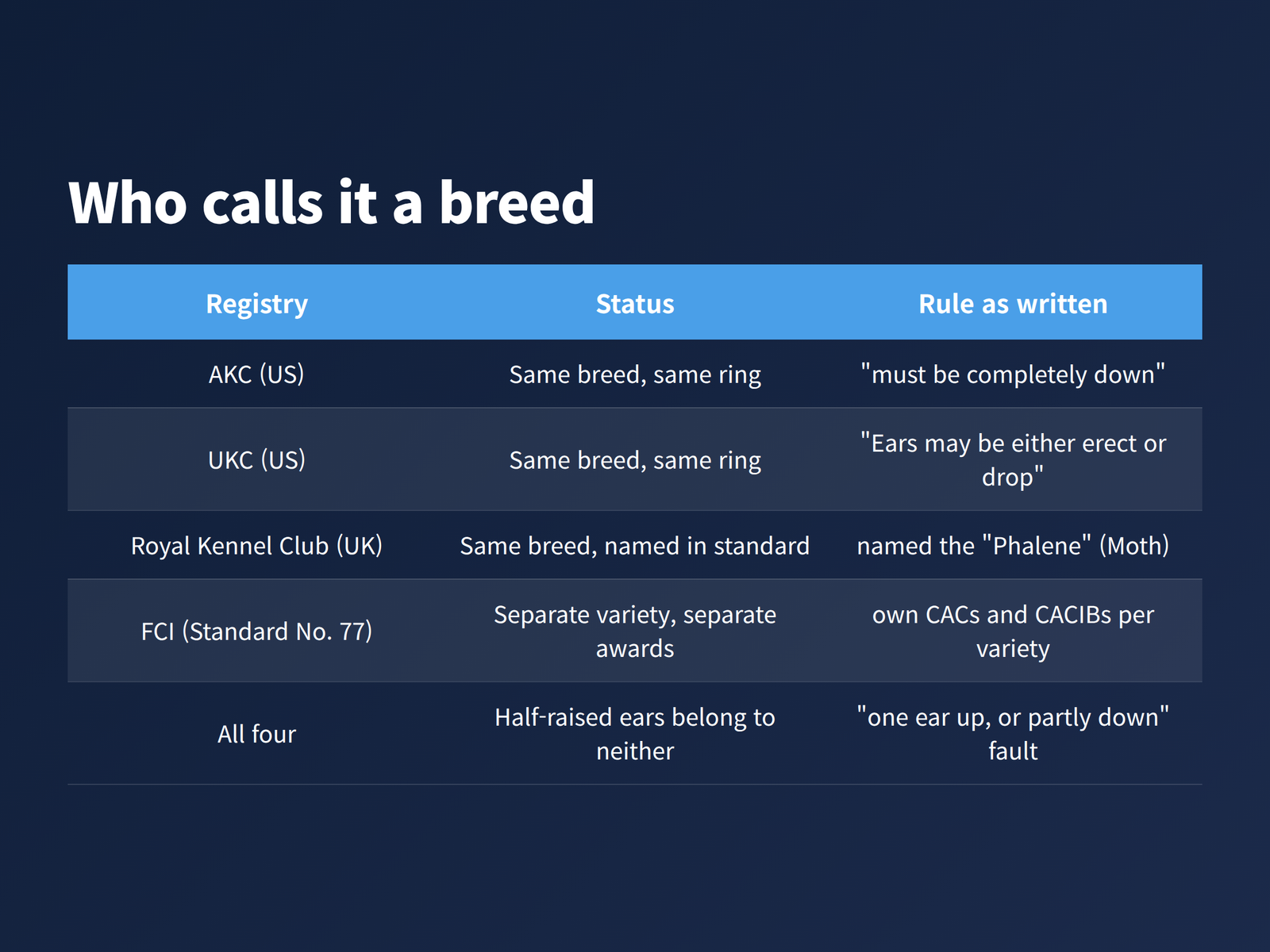
| Registry | Status of the drop-eared Phalene | Rule as written |
|---|---|---|
| American Kennel Club (US) | Same breed, same ring | One standard covers both; drop ears “must be completely down” |
| United Kennel Club (US) | Same breed, same ring | “Ears may be either erect or drop” |
| Royal Kennel Club (UK) | Same breed, named in the standard | “When the ears are completely dropped this type is known as the ‘Phalene’ (Moth)” |
| FCI (Standard No. 77) | Separate variety, separate awards | Each variety carries its own CACs and CACIBs |
| All four | Half-raised ears belong to neither | “One ear up, or ears partly down” is a listed fault |
Why does the FCI treat the Phalene and the Papillon as separate varieties?
The FCI treats them separately because Standard No. 77 is written around two named varieties, and the award system follows that split. The Continental Toy Spaniel sits in FCI Group 9, Companion and Toy Dogs, with Belgium and France as countries of origin and definitive acceptance dated 1954-01-01. The current standard was published on 1990-09-17.
The Papillon Club of America spells out the consequence: “In countries governed by the FCI, the Continental Toy Spaniel Phalene variety is judged as a separate variety from the Papillon, each variety having its own set of CAC’s and CACIB’s.” A European Phalene title and a US Papillon title are therefore not like-for-like, because the FCI dog competed only against its own ear variety.
What happens when a Papillon has one ear up and one ear down?
A half-raised ear belongs to neither variety – it is a named fault, not a third type. The AKC standard lists among its ear faults: “Ears small, pointed, set too high; one ear up, or ears partly down.” That line is still printed in the AKC Toy Group breed standards compilation dated 2026-04-30, confirming the 1991 text still governs.
This matters for anyone reading a sales listing. A dog carrying one ear up and one down is not a Phalene, and not a correct Papillon either. Ear carriage is also not always evident in a very young puppy, which is why the question keeps surfacing in breeder Q&A. Judges are told not to test the ear by hand: the instruction is “Never raise the ear of a Phalene when judging.”

Can a drop-eared Papillon be registered or shown as a Phalene in the United States?
No – there is no separate Phalene registration in the United States or the United Kingdom, so the paperwork says Papillon. The AKC, UKC and Royal Kennel Club each describe the drop ear inside the Papillon standard, and the UKC standard revised on 2017-05-01 says only that “Ears may be either erect or drop.” A buyer promised a registered Phalene in either country is getting a registered Papillon with drop ears.
The naming order also reverses what most listings imply. The Papillon Club of America records that “the Phalene (drop ear) was the original variety of the breed with the Papillon being a considerably later development.” The AKC entered its first Papillon, a dog named Joujou, in 1915.
Why is crossing the two ear varieties penalised under FCI rules?
Crossing the varieties is penalised because of what it does to ear carriage in the puppies. FCI Standard No. 77 states: “Cross-breeding of the two varieties often produces semi-erect ears, with drooping tip; this mixed form of ear carriage is a serious fault.” Planning a Papillon-to-Phalene mating on the assumption that ear type is cosmetic ignores the standard’s own prediction.
Read that wording precisely. FCI Standard No. 77 calls the mixed carriage a serious fault, which is a judging penalty, not a registration ban. No accessible FCI document says such a litter cannot be registered, and the distinction between a fault, a disqualification and a ban is exactly what breed summaries flatten.

Do the size limits change depending on ear type?
The size limits are identical for both ear types, and a correct drop ear rescues nothing. Under the AKC standard, height at the withers runs 8 to 11 inches, over 11 inches is a fault, and over 12 inches is a disqualification, whatever the ear carriage. The same standard disqualifies “an all-white dog or a dog with no white.”
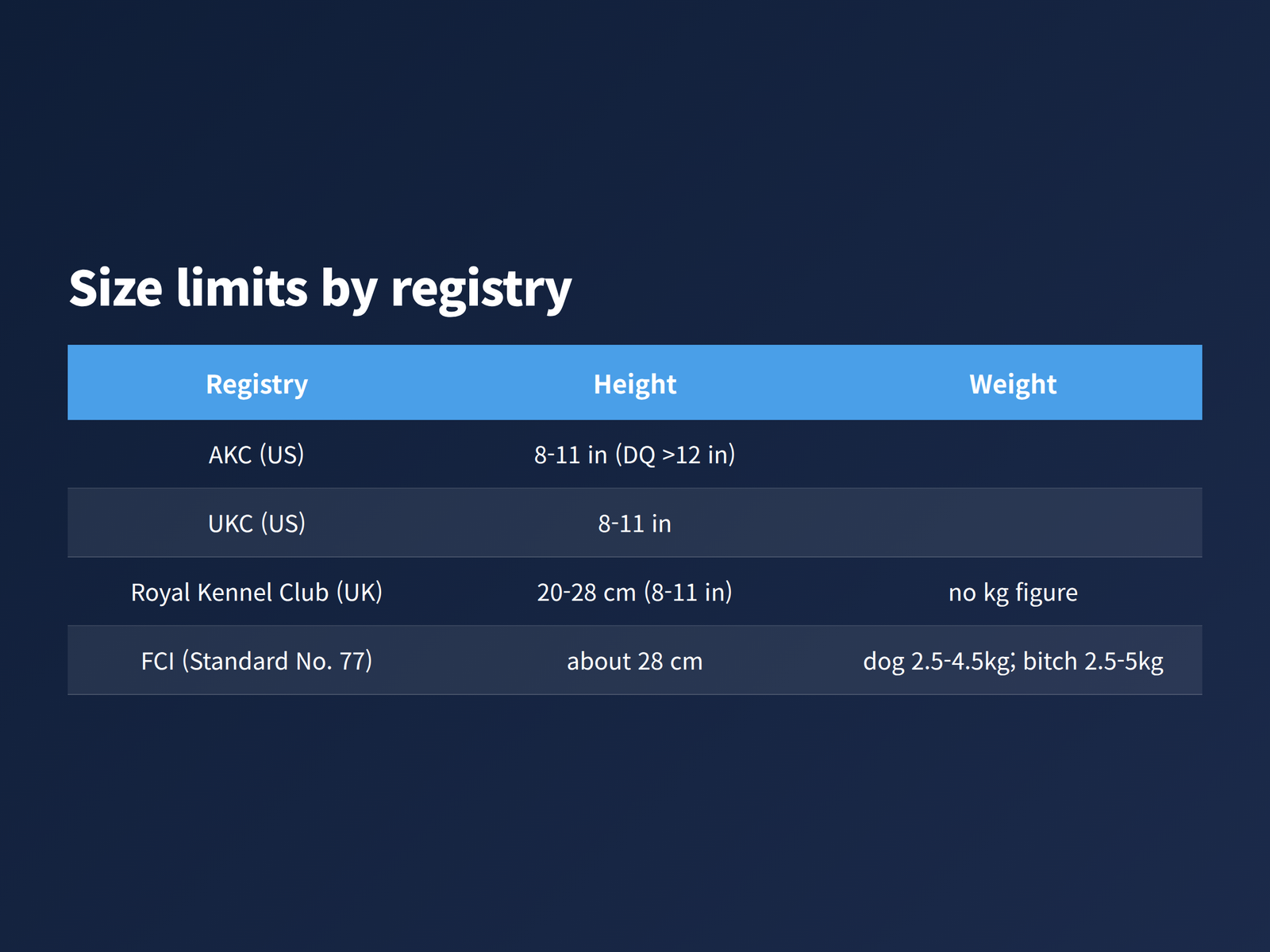
The four rulebooks state size differently, a second trap for anyone comparing pedigrees across borders:
- AKC: 8 to 11 inches, fault over 11 inches, disqualification over 12 inches
- UKC: 8 to 11 inches, with five disqualifications – cryptorchidism, viciousness or extreme shyness, an all-white dog, a dog with no white, albinism
- Royal Kennel Club: 20 to 28 cm (8 to 11 inches), with no kilogram figure stated
- FCI Standard No. 77: about 28 cm, plus two kilogram bands – under 2.5 kg, and 2.5 to 4.5 kg for dogs or 2.5 to 5 kg for bitches
How can you check which variety your dog belongs to?
Start with the ears at rest, then check the registry, because the two questions have different answers. The AKC standard requires drop-type ears to be completely down, so anything partly raised sits under the ear-fault line rather than the Phalene description. The registry then decides whether “Phalene” is a label your paperwork can carry at all.
- Confirm both ears hang completely down at rest.
- Check the registering body – AKC, UKC and Royal Kennel Club record the breed as Papillon whatever the ear carriage.
- Under an FCI member club, check which variety the dog was entered as, since CACs and CACIBs are awarded per variety.
- Measure height at the withers against the 8 to 11 inch window; over 12 inches is an AKC disqualification.

Frequently asked questions
Is the Phalene older than the Papillon? The Papillon Club of America states that “the Phalene (drop ear) was the original variety of the breed with the Papillon being a considerably later development.”
Does a Phalene have a different body standard from a Papillon? No. The AKC-hosted judges’ study guide states that “the standard is the same for the Papillon & the Phalene except the ears on a Phalene must be completely down.”
Can a judge lift a Phalene’s ear to check it? The AKC-hosted Papillon judges’ study guide instructs: “Never raise the ear of a Phalene when judging.”
Sources
- American Kennel Club, “Official Standard of the Papillon”, approved 1991-06-10, effective 1991-07-31 — https://images.akc.org/pdf/breeds/standards/Papillon.pdf
- American Kennel Club, “Toy Group Breed Standards” compilation, document dated 2026-04-30 — https://images.akc.org/pdf/judges/groups/Toy_Group.pdf
- Papillon Club of America, “The Papillon Breed Standard” judges’ study guide, hosted on akc.org, 2021 — https://www.akc.org/wp-content/uploads/2021/11/Papillon-Study-Guide.pdf
- United Kennel Club, “Papillon Official UKC Breed Standard”, revised 2017-05-01 — https://www.ukcdogs.com/docs/breeds/papillon-breed-standard.pdf
- Royal Kennel Club, “Papillon Breed Standard”, last updated April 2025 — https://www.royalkennelclub.com/breed-standards/toy/papillon
- Federation Cynologique Internationale, “Standard No. 77 – Continental Toy Spaniel”, published 1990-09-17, English translation 1998-04-06 — https://www.fci.be/Nomenclature/Standards/077g09-en.pdf
- Federation Cynologique Internationale, breed nomenclature entry, Continental Toy Spaniel No. 77, definitive acceptance 1954-01-01 — https://www.fci.be/en/nomenclature/CONTINENTAL-TOY-SPANIEL-77.html
- Papillon Club of America, “Articles – Phalenes” — https://papillonclub.org/articles-phalenes/
- Papillon Club of America, “Articles – Papillon FAQ” — https://papillonclub.org/articles-papillon-faq/
- American Kennel Club, “Pappy Anniversary: Papillon Joins AKC Century Club” — https://www.akc.org/expert-advice/news/pappy-anniversary-papillon-joins-akc-century-club/