A dog booster seat is a raised, semi-enclosed fabric seat that lifts a small dog high enough to see out of the window. That is containment and distraction prevention, not crash protection. In 2015 the Center for Pet Safety crash tested four pet travel seats at 30 mph alongside Subaru, and all four failed. No government standard exists that a pet travel restraint must pass before it goes on sale. This guide separates what a dog booster seat actually does from what a restraint has to do.
Why is a dog booster seat not a crash restraint for a small dog?
A dog booster seat is built to raise a small dog, not to manage crash forces. The American Kennel Club frames booster seats in comfort terms, visibility and reduced motion sickness, and publishes no crash performance data for them. The seat body is fabric and foam anchored by a strap loop around the vehicle seat back, so in a frontal impact it is only as strong as that loop and its stitching.
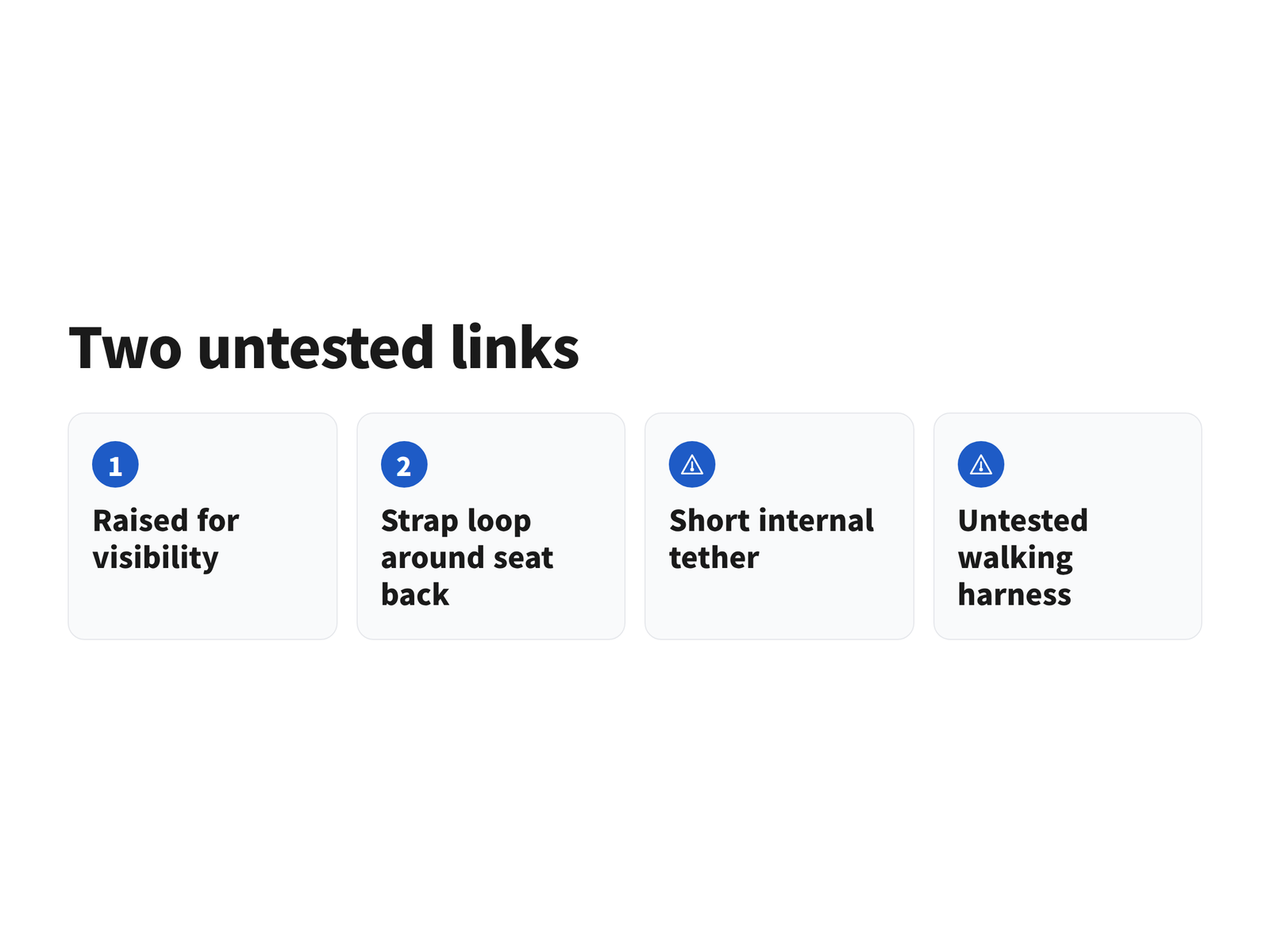
The Center for Pet Safety states that the majority of attachment connections for these products have not been tested. Inside the seat, a small dog is held by a short internal tether, usually clipped to the walking harness supplied in the box, and the Center for Pet Safety says most of those harness products have not been tested either. Two untested links sit between a small dog and the vehicle.
What happened when booster seats were actually crash tested?
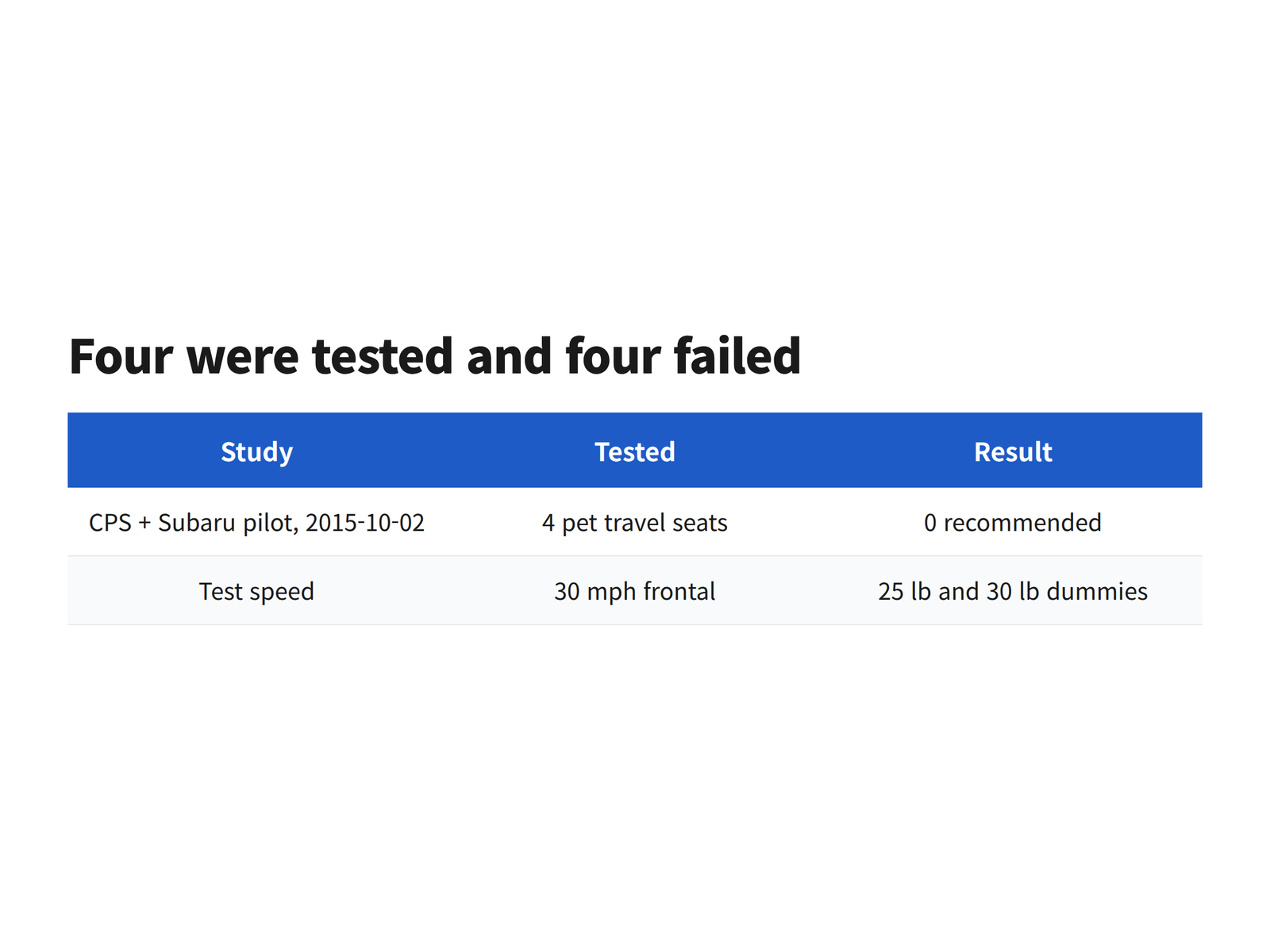
Four were tested and four failed. In the Pet Travel Seat Pilot Study published on 2 October 2015, the Center for Pet Safety and Subaru ran four products through a 30 mph frontal crash test: the PupSaver, the Snoozer Lookout I, the PetSmart Top Paw Booster and the Kurgo Skybox Booster. The test used 25 lb and 30 lb terrier crash test dogs. None of the four products was recommended for safe use.
The study summary puts it plainly: “A Pet Travel Seat may offer distraction prevention, but it will not likely offer crash protection.” Two limits belong with that result. It covers four named products tested in 2015, not every dog booster seat sold in 2026. And the dummies weighed 25 lb and 30 lb, the upper end of the booster seat weight range, so the outcome for a 3 to 5 kg dog in the same test is not established either way.
Does “crash tested” mean anything on a dog car seat?
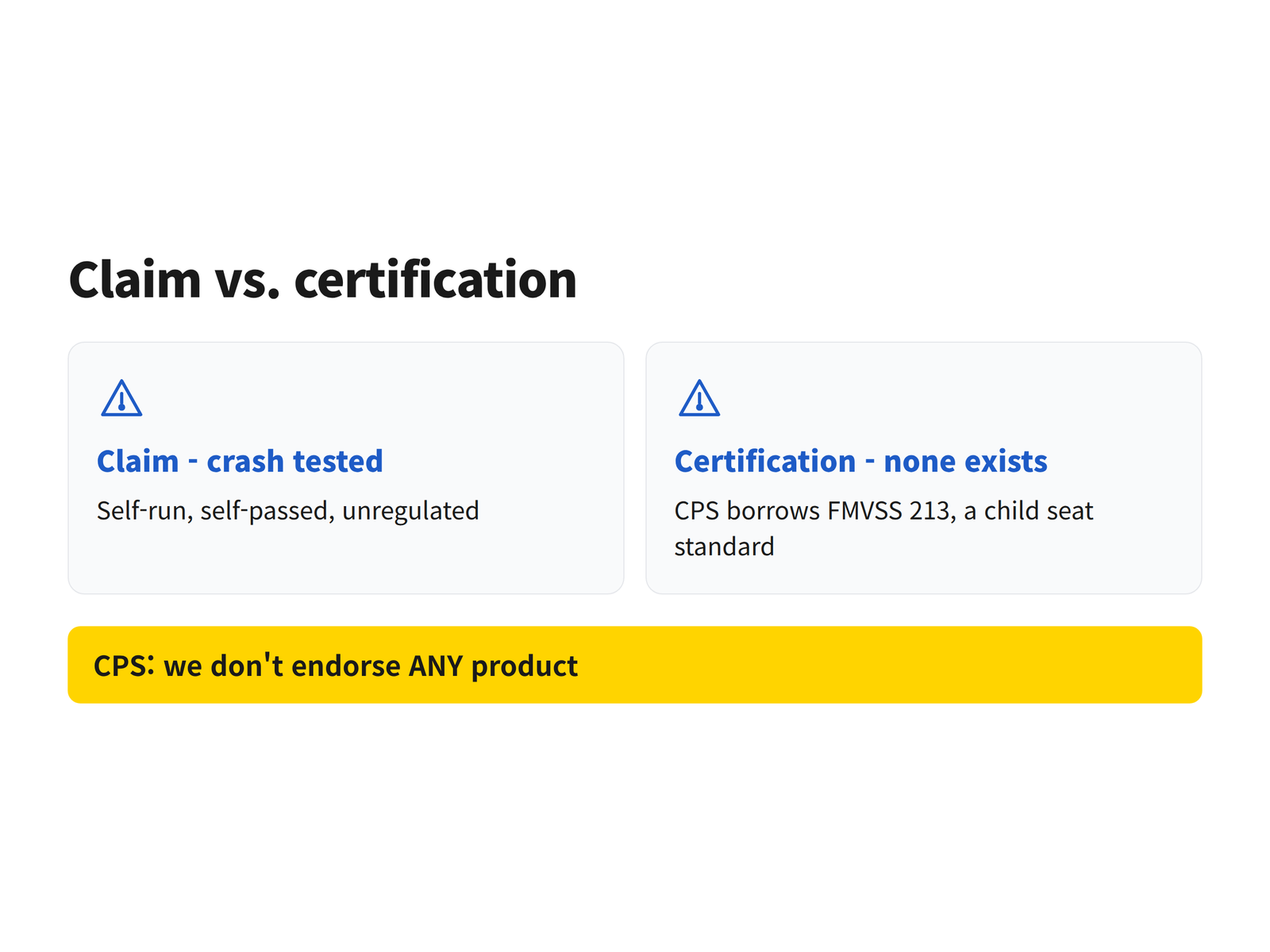
Not on its own. No government safety standard exists that a dog car restraint must pass before it is sold. Dr Elisa Mazzaferro, immediate past president of the Veterinary Emergency and Critical Care Society, told the American Veterinary Medical Association: “There’s recommendations but there are no rules.”
The Center for Pet Safety references the test conditions of FMVSS 213, the United States standard for child safety seats, precisely because no pet equivalent exists. A manufacturer can design its own test, pass its own test, and print “crash tested” on the box. The Center for Pet Safety also states that it does not endorse any product, so a brand that cites the organisation in its marketing is not carrying its endorsement.
Should a car tether ever clip to a small dog’s collar or walking harness?
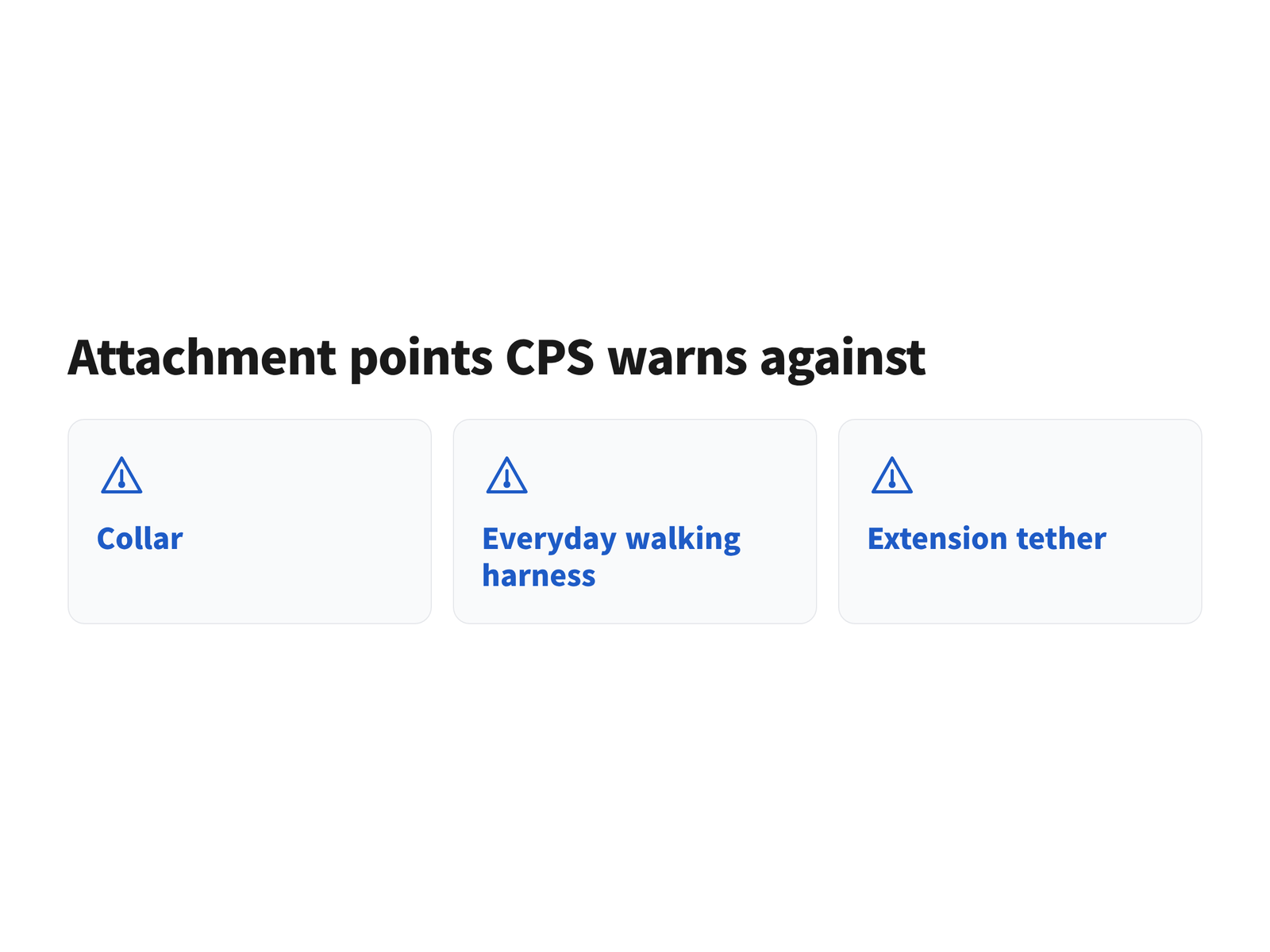
No, and the two main sources draw that line in different places. The American Kennel Club advises clipping to a harness rather than a collar: “Similarly to seat belts, dog car harnesses will securely keep your dog in place. Instead of clipping to their collar, they’re just in harness form.” The Center for Pet Safety goes further and tells owners “do not connect a safety device to your dog’s collar or walking harness.”
That gap matters for a small dog. Following the American Kennel Club wording alone still allows an everyday walking harness to become the crash attachment, which is outside its intended use. The Center for Pet Safety also warns that extension tethers increase the risks to a family and their pets, and advises consumers to look for harnesses that do not have an extension tether.
How much force does a small dog generate in a 30 mph stop?
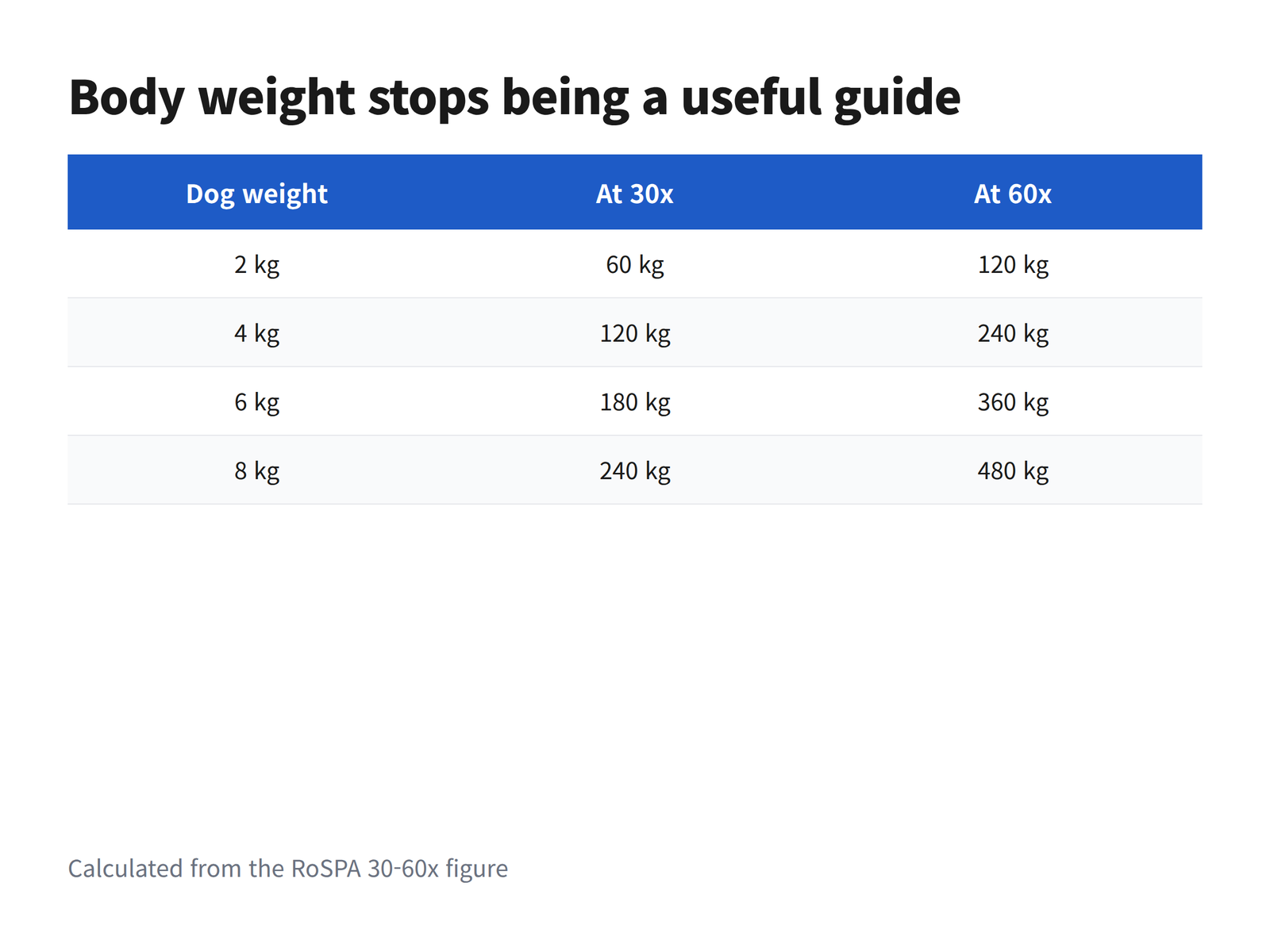
Body weight stops being a useful guide almost immediately. Becky Guy, Road Safety Manager for England at RoSPA, is quoted by The Royal Kennel Club: “At 30mph, an unrestrained dog could be thrown forward with a force of 30 to 60 times their own body weight.” Applying that 30-to-60-times figure to a 4 kg dog gives roughly 120 to 240 kg, and to an 8 kg dog roughly 240 to 480 kg. Those two figures are calculated from the RoSPA multiplier rather than published by RoSPA.
Habits have not caught up with that arithmetic. In the first half of 2024, 59% of UK drivers surveyed for The Royal Kennel Club had travelled with an unsecured dog, and 9% had let a dog sit on their lap. In the United States, an AAA survey in 2010 found more than 80% of drivers said they knew unrestrained pets were dangerous while only 16% used a restraint.
What does the Highway Code actually require for a dog in a car?
Rule 57 asks rather than commands. The full wording on GOV.UK reads: “When in a vehicle make sure dogs or other animals are suitably restrained so they cannot distract you while you are driving or injure you, or themselves, if you stop quickly. A seat belt harness, pet carrier, dog cage or dog guard are ways of restraining animals in cars.”
Rule 57 is advisory. It uses “make sure” rather than “MUST” and cites no legislation, unlike rules 48, 49 and 54 in the same GOV.UK section, so pages describing restraint as the law overstate it. A driver distracted by a loose dog can still face CD10, driving without due care and attention, which GOV.UK lists as 3 to 9 penalty points. Rule 57 also names a pet carrier without saying the carrier must be tested or how it should be secured.
How do the main restraint options compare for a small dog?
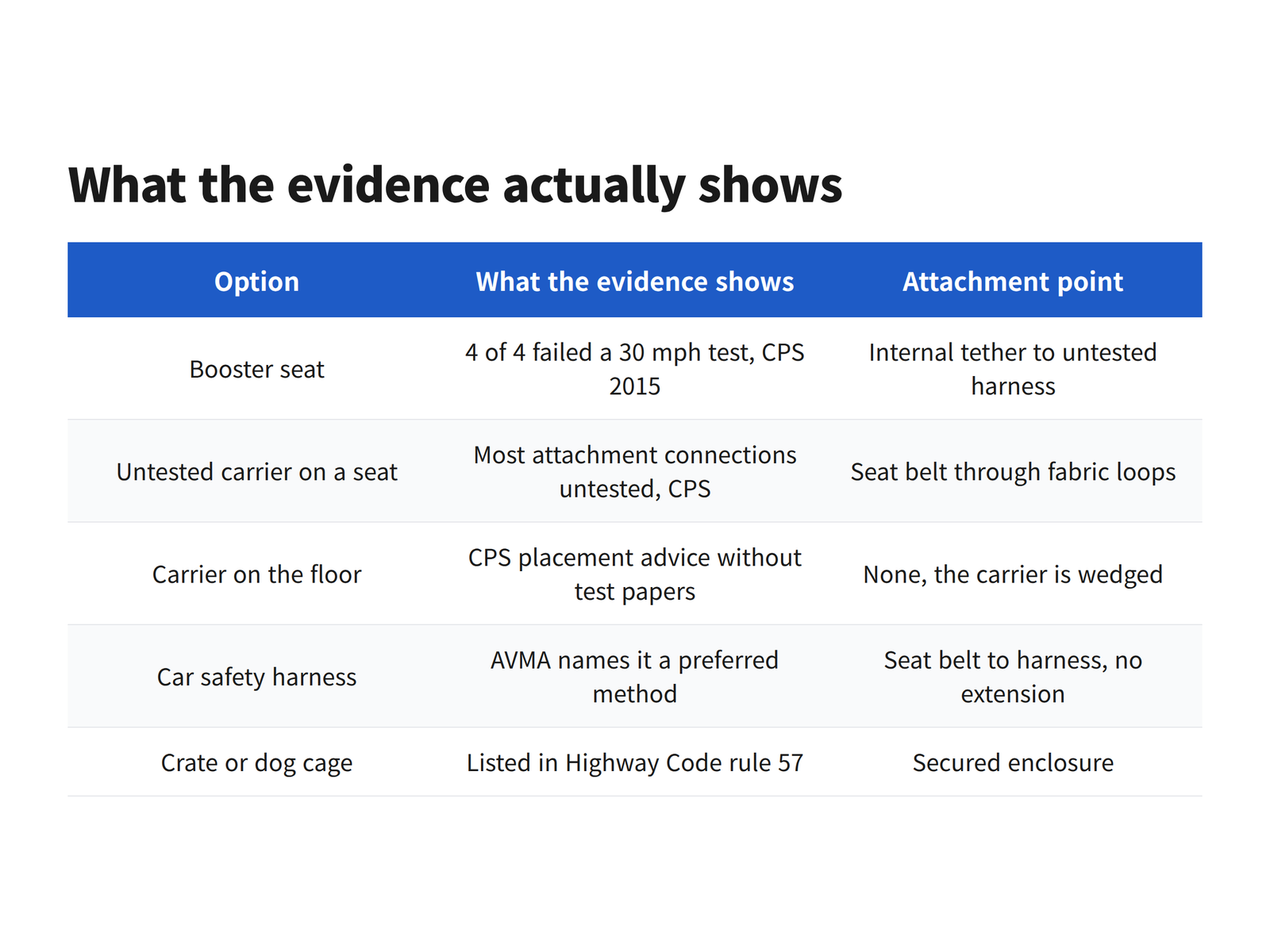
Evidence quality differs far more than price does. The table sets each option against what has been documented and where the load is carried.
| Option | What the evidence shows | Attachment point |
|---|---|---|
| Booster seat | 4 of 4 failed a 30 mph test, CPS 2015 | Internal tether to untested harness |
| Untested carrier on a seat | Most attachment connections untested, CPS | Seat belt through fabric loops |
| Carrier on the floor | CPS placement advice without test papers | None, the carrier is wedged |
| Car safety harness | AVMA names it a preferred method | Seat belt to harness, no extension |
| Crate or dog cage | Listed in Highway Code rule 57 | Secured enclosure |
Where should a small dog’s carrier go inside a car?
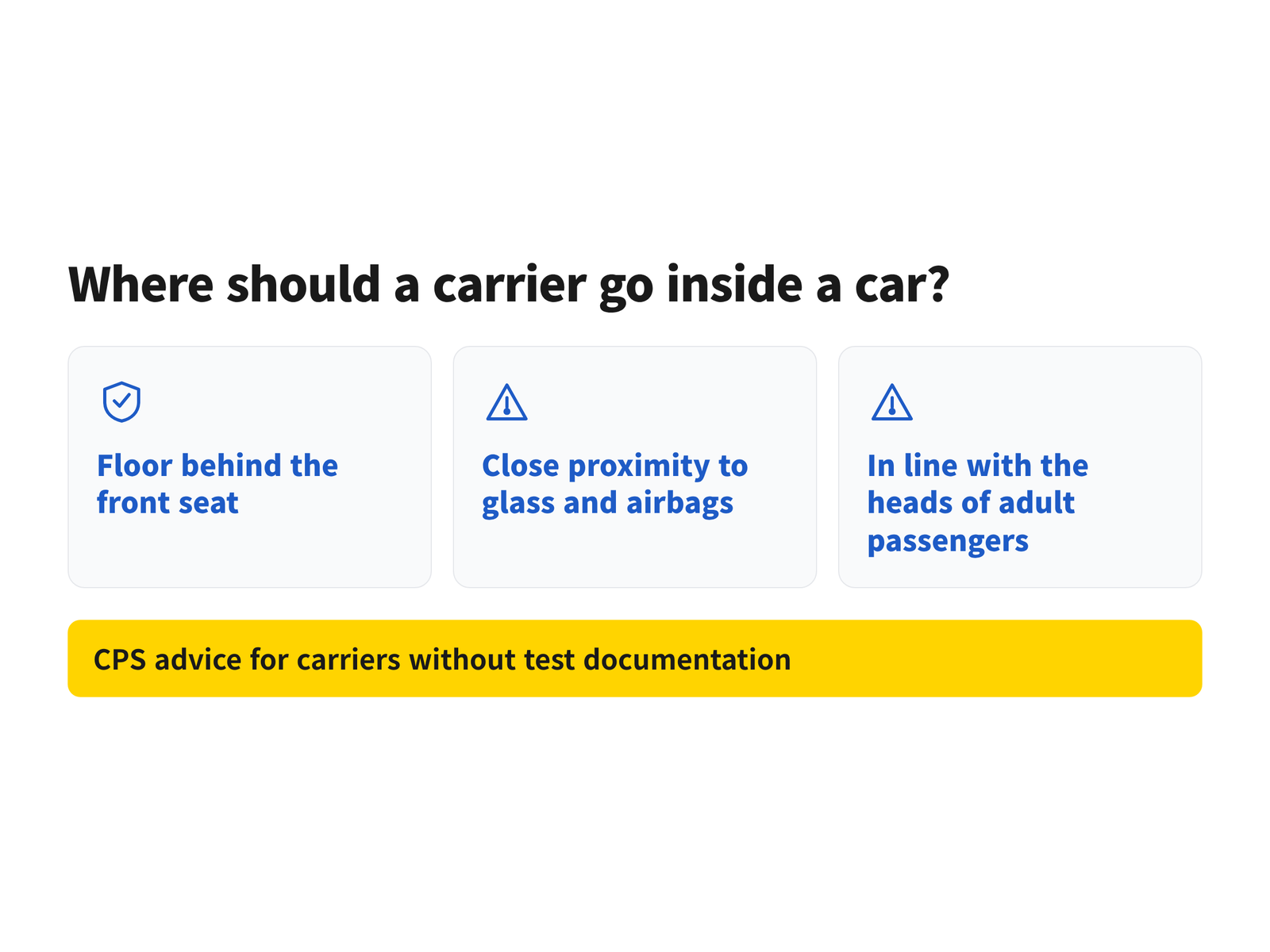
On the floor behind a front seat, when the carrier has no manufacturer crash-test documentation. The Center for Pet Safety advises owners of untested small carriers to place the carrier on the floor of the vehicle behind the driver or front passenger seat rather than belting it onto a seat. A dog booster seat does the opposite by design, and the Center for Pet Safety names the hazard zones that elevation creates: close proximity to glass and airbags, and positioning in line with the heads of adult passengers.
The American Veterinary Medical Association states that “it is unsafe for pets to be loose inside motor vehicles” and names the preferred alternative: “securing them in a species-appropriate enclosure of appropriate size, or fitting them with a properly designed, species-appropriate safety harness.” If a small dog is bought a booster seat mainly because of motion sickness or travel anxiety, consult your veterinarian about the underlying problem before choosing a product on comfort claims alone.
Frequently asked questions
Are dog booster seats safe for a small dog?
A dog booster seat stops a small dog wandering around the cabin, which helps with driver distraction. As crash protection, the only published test found four of four products failing at 30 mph.
Does a booster seat labelled crash tested pass a government standard?
No such standard exists for pet travel products. The Center for Pet Safety borrows the test conditions of FMVSS 213, a child safety seat standard, and a manufacturer can run and pass its own internal test before printing the phrase.
Can a car tether clip to the harness that came with the booster seat?
The Center for Pet Safety advises against connecting a safety device to a collar or a walking harness, and says most included harness products have not been tested. The American Veterinary Medical Association names a properly designed safety harness as a preferred method.
Is it illegal in the UK to drive with an unrestrained dog?
Highway Code rule 57 is advisory rather than a MUST and cites no legislation. A distracted driver can still be endorsed under CD10, which GOV.UK lists as 3 to 9 penalty points.
Sources
- GOV.UK, The Highway Code, “Rules about animals (47 to 58)”, rule 57 — current — https://www.gov.uk/guidance/the-highway-code/rules-about-animals-47-to-58
- GOV.UK, “Endorsement codes and penalty points”, CD10 — current — https://www.gov.uk/penalty-points-endorsements/endorsement-codes-and-penalty-points
- Center for Pet Safety and Subaru, “Pet Travel Seat Pilot Study” press release, 2015-10-02 — https://www.centerforpetsafety.org/wp-content/uploads/2015/10/Subaru-CPS-Pet-Travel-Seat-Pilot-Study-Press-Release-FINAL1.pdf
- Center for Pet Safety, “FAQs” — undated — https://www.centerforpetsafety.org/faqs/
- Center for Pet Safety, “Small carrier and booster seat advisory” — undated — https://www.centerforpetsafety.org/pet-parents/small-carrier-booster-seat-advisory/
- American Veterinary Medical Association, policy “Safe non-commercial transport of pets in motor vehicles” — undated — https://www.avma.org/resources-tools/avma-policies/safe-transport-pets-motor-vehicles
- American Veterinary Medical Association, news report on missing data and safety regulation for pets in vehicles, Coco Lederhouse, 2023-09-11 — https://www.avma.org/news/data-safety-regulations-lacking-when-it-comes-pets-and-vehicles
- American Kennel Club, “Dog Seat Belts: What You Need to Know to Keep Your Dog Safe”, Stephanie Gibeault MSc CPDT, updated 2026-03-10 — https://www.akc.org/expert-advice/travel/dog-seat-belts-what-you-need-to-know-to-keep-your-dog-safe/
- The Royal Kennel Club, “Focus on safe car travel this Road Safety Week 2024”, November 2024, carrying the RoSPA quotation — https://www.royalkennelclub.com/about-us/resources/media-centre/2024/november/focus-on-safe-car-travel-this-road-safety-week-2024