Ask whether a Bichon Frise is a toy breed and the honest answer is that it depends on which kennel club wrote the list. The American Kennel Club files the Bichon Frise in the Non-Sporting Group. The Royal Kennel Club (formerly The Kennel Club) files the same breed under Toy. Neither registry is wrong, because a breed group is a show-ring classification built mainly around the job a breed was originally developed to do, not a size bracket.
Is a Bichon Frise a toy breed?
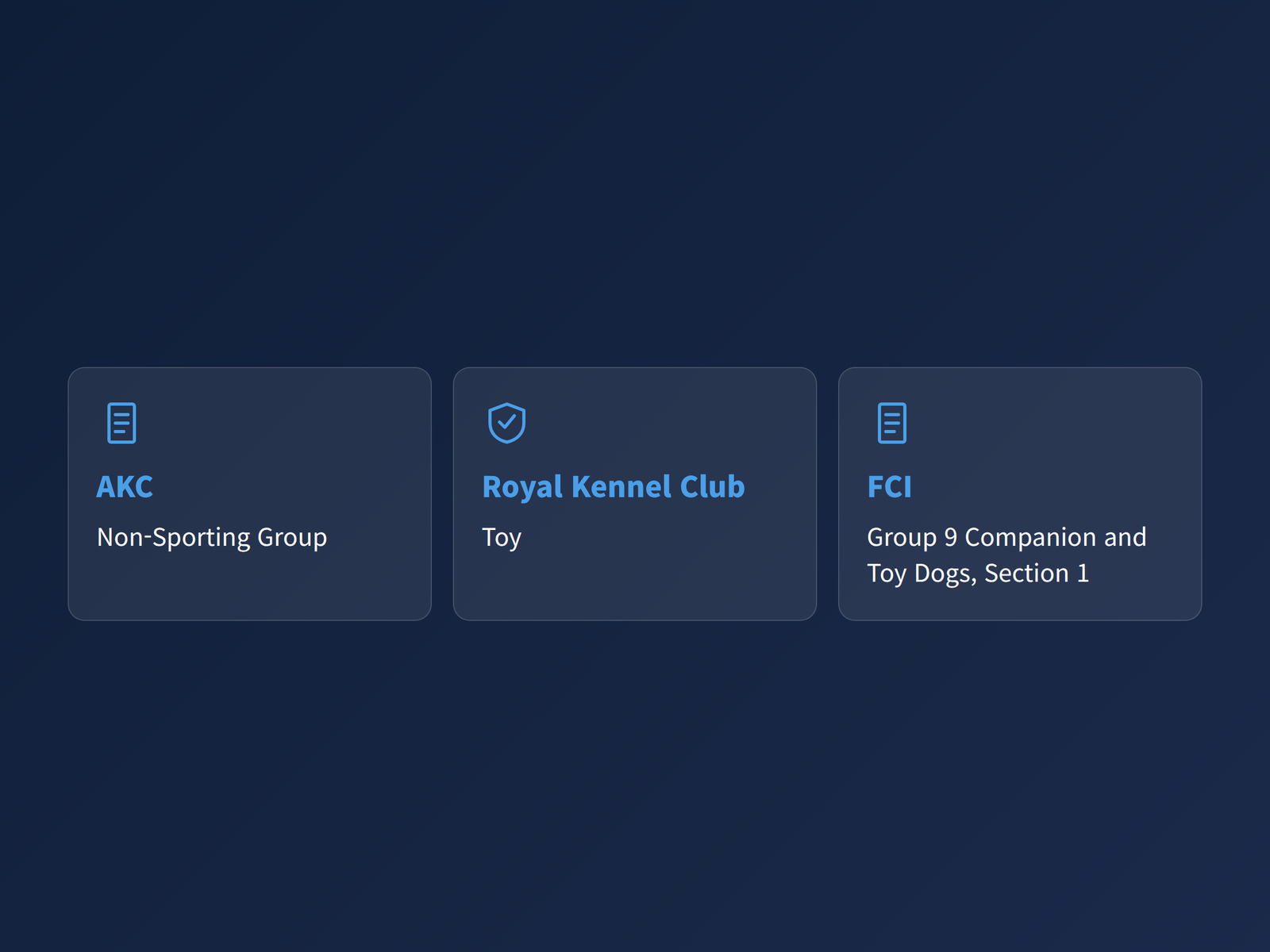
Under the American Kennel Club, no; under the Royal Kennel Club, yes. The AKC’s public breed list places the Bichon Frise in the Non-Sporting Group as of a 2026-09-15 check. The Royal Kennel Club publishes its Bichon Frise breed standard under Toy, with the standard last updated in 2025-04. The Fédération Cynologique Internationale takes a third route and places the breed in Group 9, Companion and Toy Dogs, Section 1 Bichons, under standard No. 215 published 2016-04-04. The United Kennel Club uses yet another label, Companion Dog Group, in a standard revised 2014-12-01.
So a Bichon Frise owner in Chicago and a Bichon Frise owner in Manchester can both quote an official source and reach opposite conclusions. The disagreement is administrative, not biological. The dog in front of you does not change when the paperwork does.
Why does the American Kennel Club put the Bichon Frise in the Non-Sporting Group?
Because AKC groups are sorted by original function rather than by weight. The American Kennel Club states that “Each group is organized by the original work that its breeds were developed to do,” in its group explainer updated 2026-03-05. A second AKC document, updated 2025-01-31, is blunter about how the seven groups actually came together: “Today the AKC’s seven groups are organized mostly by function—and a bit by tradition.”
The Non-Sporting Group is the residual category in that scheme. The AKC describes it as “those breeds that didn’t quite fit anywhere else, or whose job is long obsolete.” The group system itself dates to 1924, and the current count of seven groups arrived in 1983 when Herding was split out of Working. A small companion breed landing in Non-Sporting is therefore a filing outcome, not a statement that the Bichon Frise is large.
Which small breeds do the AKC and the Royal Kennel Club group differently?
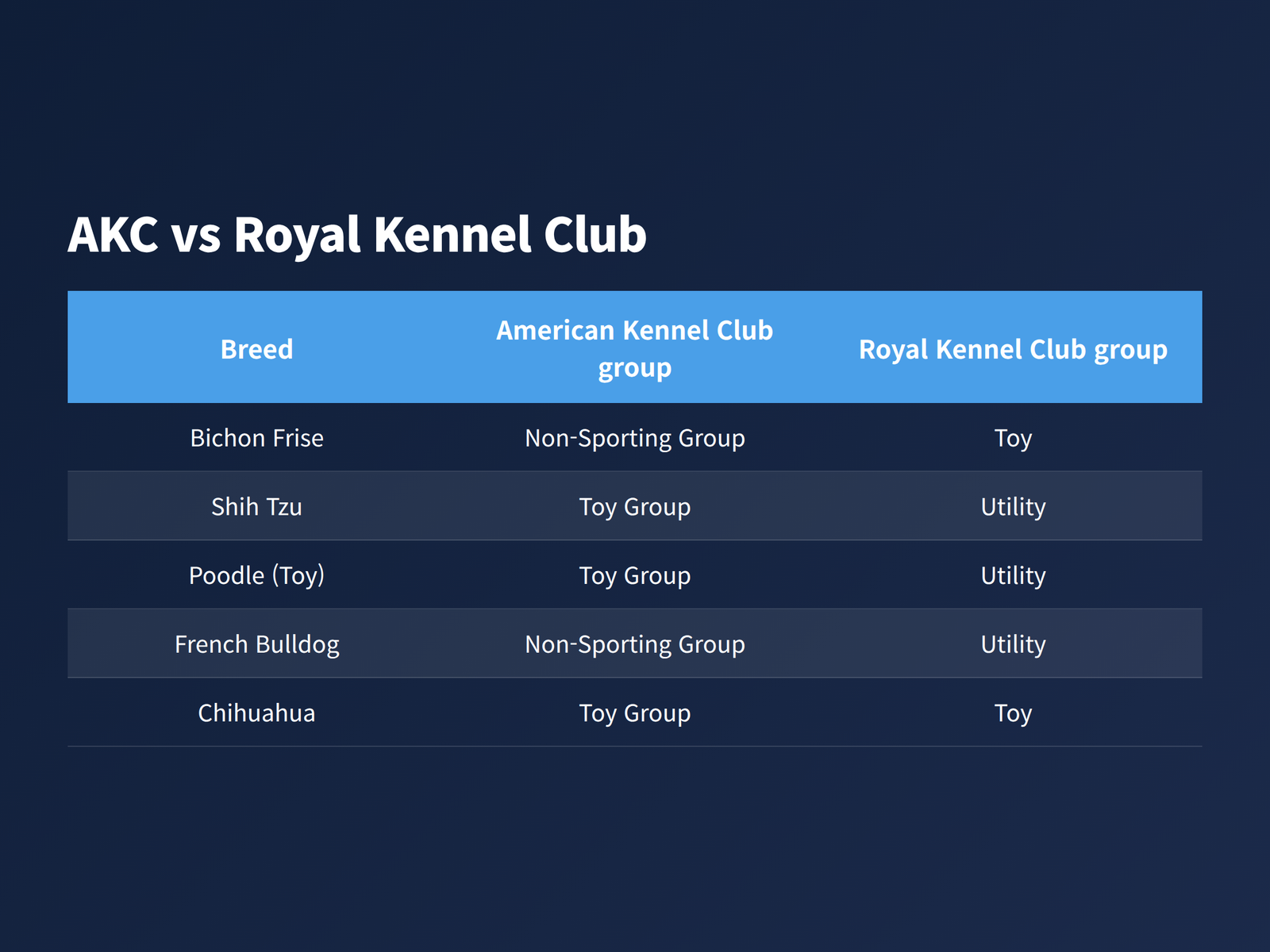
At least five widely kept small breeds sit in different groups on each side of the Atlantic, and two of them swap places exactly. The Bichon Frise is Non-Sporting at the AKC and Toy at the Royal Kennel Club. The Poodle (Toy) runs the other way: Toy Group at the AKC, Utility at the Royal Kennel Club. The Royal Kennel Club describes Utility as covering “miscellaneous breeds of dog mainly of a non-sporting origin,” with the name pointing at fitness for a purpose.
| Breed | American Kennel Club group | Royal Kennel Club group |
|---|---|---|
| Bichon Frise | Non-Sporting Group | Toy |
| Shih Tzu | Toy Group | Utility |
| Poodle (Toy) | Toy Group | Utility |
| French Bulldog | Non-Sporting Group | Utility |
| Chihuahua | Toy Group | Toy |
The FCI flattens much of this by putting the Bichon Frise, Shih Tzu, Poodle, French Bulldog and Chihuahua all inside Group 9, Companion and Toy Dogs, in different sections. The Chihuahua row also hides a split: the AKC treats one breed with two coat varieties, while the Royal Kennel Club publishes Chihuahua (Long Coat) and Chihuahua (Smooth Coat) as separate breed standards, both updated 2025-08-01 and both filed under Toy.
Does a Toy Group listing tell you how small the dog will be?
No, and the breed standards themselves prove it. The Cavalier King Charles Spaniel sits in the AKC Toy Group, and its standard, approved 2023-01-10, sets “Height 12 to 13 inches at the withers; weight proportionate to height, between 13 and 18 pounds.” The Bichon Frise, filed outside the Toy Group by the AKC, carries a standard approved 1988-10-11 that says “Dogs and bitches 9½ to 11½ inches are to be given primary preference” and contains no weight clause at all. The smaller dog is the one outside the Toy Group.
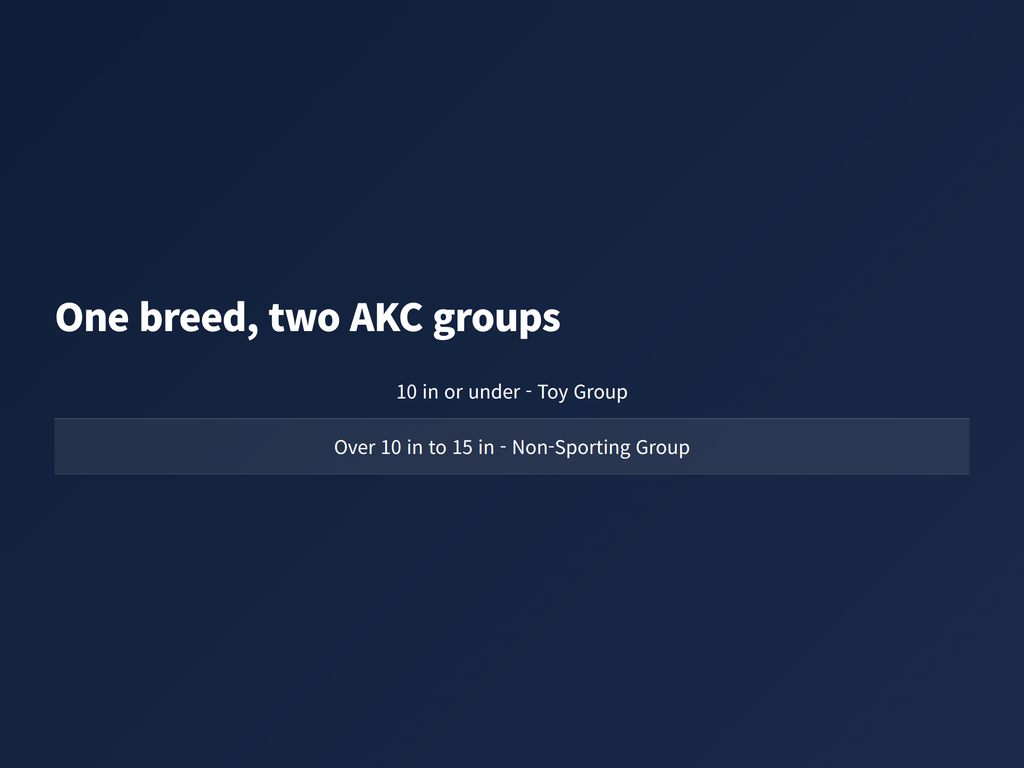
The Poodle makes the point sharper still, because a single AKC standard approved 1984-08-14 splits one breed across two groups by height alone. A Poodle measuring “10 inches or under at the highest point of the shoulders” is a Toy Poodle in the Toy Group. A Poodle “15 inches or under … with a minimum height in excess of 10 inches” is a Miniature Poodle in the Non-Sporting Group. One inch of shoulder height changes the group, and nothing else about the dog changes with it.
[IMAGE 4 — replace this paragraph with the uploaded image]
alt: Table showing how Poodle shoulder height decides whether the AKC files the dog in the Toy Group or the Non-Sporting Group
Is teacup an official size below toy?
No registry recognises teacup as a size class. The Chihuahua Club of America, the AKC parent club for the breed, addresses the marketing vocabulary directly in its Teacup Statement: “Teacup, Pocket Size, Tiny Toy, Miniature or Standard – are just a few of the many tags and labels that have been attached to this breed over the years.” The club then states that it “does not endorse nor condone the use of any of these terms and would caution the perspective puppy buyer not to be misled by them.”
The standards back that up by containing no sub-tier. The AKC Chihuahua standard, approved 2008-08-12, gives one line on size: “Weight – A well balanced little dog not to exceed 6 pounds.” The Royal Kennel Club standard, updated 2025-08-01, allows “up to 2.7 kgs (6 lbs), with 1.8 – 2.7 kgs (4-6 lbs) preferred.” Below toy there is simply nothing written down.
Which measurement should you use instead of the group label?
Use the measured dog, then the standard, then the registry. The Royal Kennel Club is explicit that a standard is not a size guarantee: “the size as described does not imply that a dog will match the measurements given (height or weight). A dog might be larger or smaller than the size measurements stated in the breed standard.” That single sentence rules out using a breed standard as a sizing chart for harnesses, carriers or coats.
Three checks cover most situations. Read the size clause in the standard of the registry you are consulting, since the AKC writes heights in inches while the Royal Kennel Club writes centimetres and often adds a weight range. Measure your own dog’s withers height and chest girth for anything you plan to buy. Note which registry an article follows before trusting its group label: a United States source means AKC, a United Kingdom source means RKC, and a continental European source usually means FCI. If your dog’s weight or build sits outside the range you expected, consult your veterinarian rather than acting on a group label.
Frequently asked questions
Is a Shih Tzu a toy breed?
At the AKC, yes, the Shih Tzu is listed in the Toy Group. At the Royal Kennel Club it is filed under Utility, with a standard updated 2025-04 setting “Height at withers not more than 27 cms (10½ ins)” and a weight of “4.5-8 kgs (10-18 lbs).”
Is the Toy Poodle in the Toy group in the United Kingdom?
No. The Royal Kennel Club lists Poodle (Toy) under Utility and sets the height at shoulder as “under 28 cms (11 ins),” while Poodle (Miniature) is “under 38 cms (15 ins) but not under 28 cms (11 ins).”
Does the FCI have a Non-Sporting group?
No. The FCI uses a numbered system, and the small companion breeds discussed here fall under Group 9, Companion and Toy Dogs, divided into sections such as Section 1 Bichons and Section 5 Tibetan breeds.
Sources
- American Kennel Club, “List of Breeds by Group”, accessed 2026-09-15 — https://www.akc.org/public-education/resources/general-tips-information/dog-breeds-sorted-groups/
- American Kennel Club, “AKC Breed Groups: Understanding Breed Groups at Dog Shows”, updated 2026-03-05 — https://www.akc.org/expert-advice/lifestyle/7-akc-dog-breed-groups-explained/
- American Kennel Club, “AKC Breed Group History: Why are There 7 Groups?”, updated 2025-01-31 — https://www.akc.org/expert-advice/dog-breeds/history-akc-breed-groups/
- American Kennel Club, “Official Standard of the Bichon Frise”, approved 1988-10-11 — https://images.akc.org/pdf/breeds/standards/BichonFrise.pdf
- American Kennel Club, “Official Standard of the Poodle”, approved 1984-08-14 — https://images.akc.org/pdf/breeds/standards/Poodle.pdf
- American Kennel Club, “Official Standard of the Chihuahua”, approved 2008-08-12 — https://images.akc.org/pdf/breeds/standards/Chihuahua.pdf
- The Royal Kennel Club, “Breed standard — Bichon Frise (Toy)”, updated 2025-04 — https://www.royalkennelclub.com/breed-standards/toy/bichon-frise
- The Royal Kennel Club, “About Breed Standards”, accessed 2026-09-15 — https://www.royalkennelclub.com/breed-standards/about-breed-standards/
- Fédération Cynologique Internationale, “Nomenclature — Bichon Frise, standard No.215”, published 2016-04-04 — https://www.fci.be/en/nomenclature/BICHON-FRISE-215.html
- Chihuahua Club of America, “Teacup Statement”, accessed 2026-09-15 — https://www.chihuahuaclubofamerica.org/thechihuahua/teacupstatement