Ask five animal organisations whether a small dog should wear a Halloween costume and the answers split. The American Veterinary Medical Association and the American Kennel Club allow costumes under stated conditions. Blue Cross advises against dressing dogs up for entertainment at all. The Royal Kennel Club gives no costume guidance and warns about the front door instead. What follows sets those five positions side by side.
Is it cruel to dress up a small dog for Halloween?
No single answer exists, because the major animal organisations do not agree. A dog Halloween costume is a non-functional garment worn for entertainment, and the bodies that publish guidance on it take opposite starting points. The American Veterinary Medical Association and the American Kennel Club treat a costume as acceptable if it passes a fit test and the dog is supervised. Blue Cross advises against dressing dogs up for entertainment altogether, accepting only clothing with a function.
So the useful question is not whether costumes are cruel in general, but which conditions a specific small dog and a specific costume can meet. A small dog that already wears a coat in winter starts from a different place than one that has never worn anything.
Do veterinary bodies and animal charities agree about dog costumes?
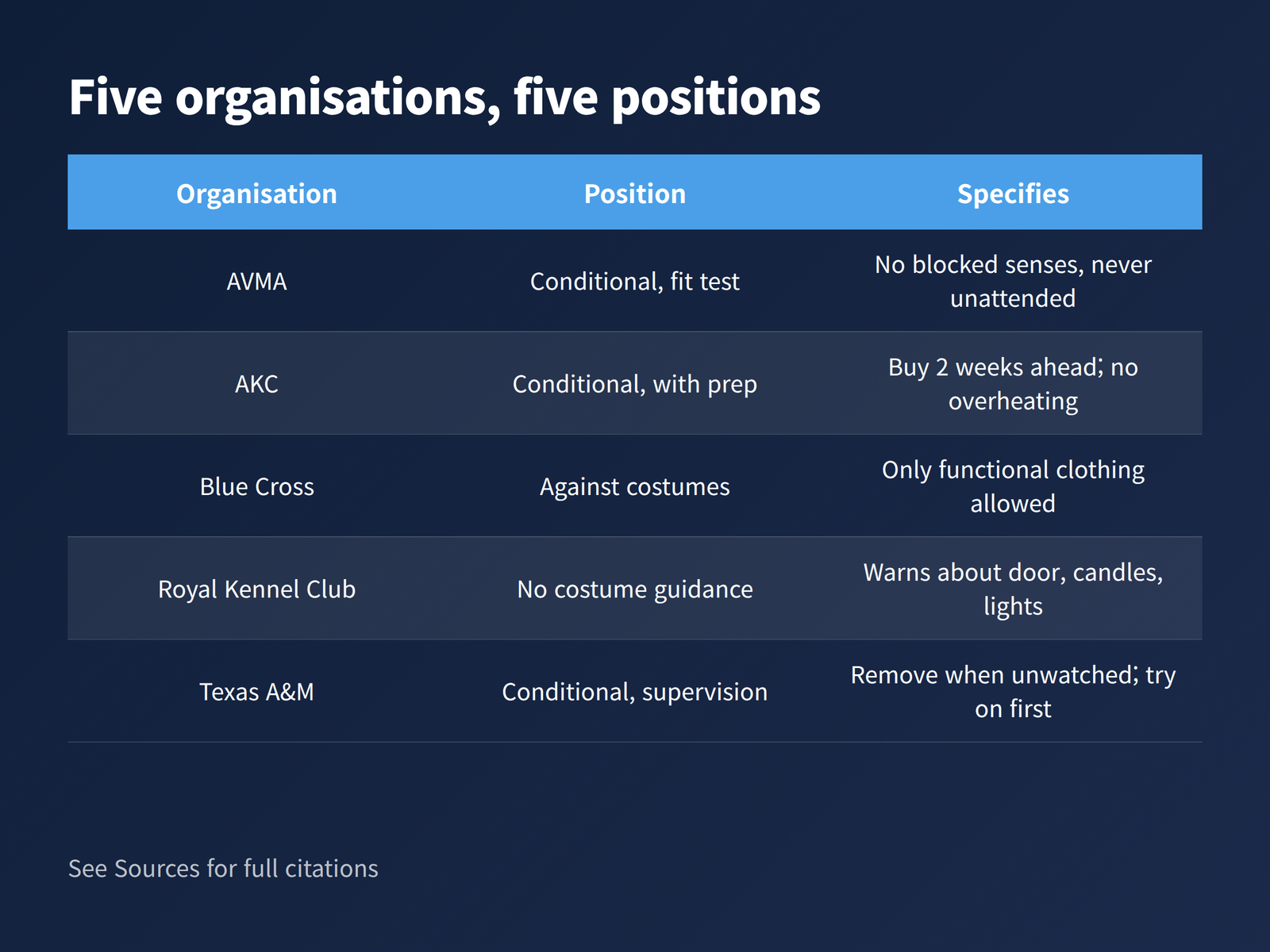
They do not, and the gap runs along national lines. Two American bodies set conditions, one British charity objects to the premise, one British kennel club skips costumes entirely, and one American veterinary school makes supervision the deciding factor. The table below places all five positions together.
| Organisation | Position on costumes | What it specifies |
|---|---|---|
| American Veterinary Medical Association | Conditional, subject to a fit test | No blocking of sight, hearing, breathing, mouth or movement; no chewable or choking parts; never left on unattended |
| American Kennel Club | Conditional, with preparation | Buy at least two weeks ahead; no overheating, restriction or toxic parts; shy dogs stay home without a costume |
| Blue Cross | Advises against costumes for entertainment | Accepts functional clothing only: a winter coat for a short-haired dog, or a post-surgery vest on veterinary advice |
| Royal Kennel Club | No costume guidance at all | Warns that repeated trick-or-treat callers may leave a dog anxious or stressed; keep candles and pumpkin lights out of reach |
| Texas A&M College of Veterinary Medicine | Conditional, supervision is the condition | Remove the costume whenever the dog is unwatched; try the outfit on before buying; retire one that causes a reaction |
What must a Halloween costume never block on a small dog?
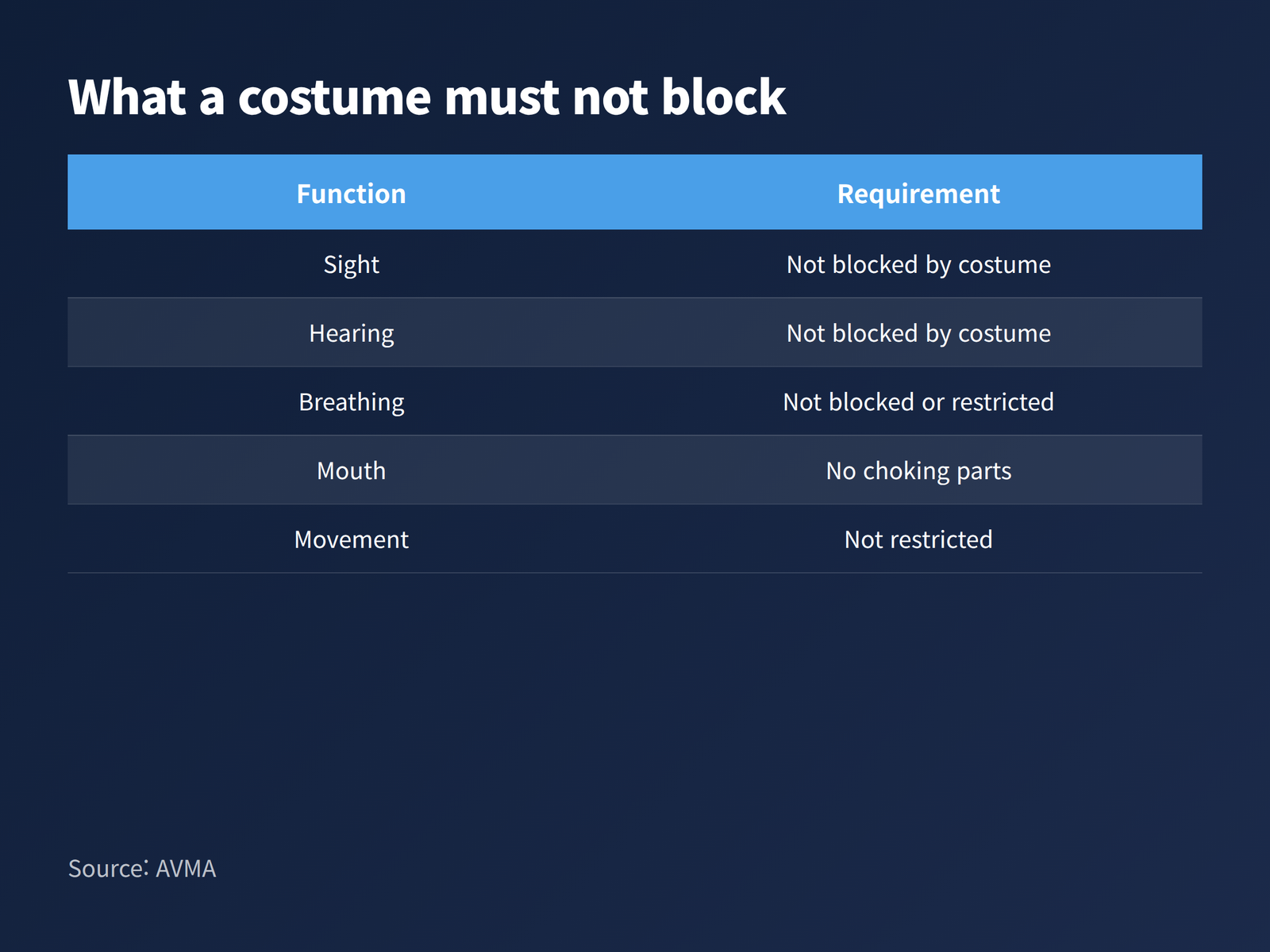
Five body functions, according to the American Veterinary Medical Association. The AVMA states that a costume “doesn’t block your pet’s sight, hearing, breathing, mouth, or movement.” The same guidance adds two more filters: the costume should fit properly and be comfortable, and it should not have “any pieces that easily can be chewed off or cause choking.”
Each of the five is worth checking separately, because on a small dog the margins are narrow. A hood sized for a medium breed sits lower over the eyes, and a cape cut for a longer body drags near the hind legs. The American Kennel Club adds heat to the list, advising against a costume that would make a dog too hot or restrict movement or breathing.
Why does a costume that fits still fail on a small dog?
Because a costume covers the signals a dog uses to communicate. Blue Cross makes this point directly: “As your dog may not be able to communicate very well with clothing on, and other dogs may not be able to read them in return, costume wearing dogs may confuse, alarm or frighten other dogs.” A garment that passes a fit test can still sit over the tail, the ears and the shoulder line.
That matters twice over: the owner loses the body language that would normally signal discomfort, and other dogs on the same street lose it too. Blue Cross also notes that a dog unaccustomed to a coat or jumper “can become very stressed with costumes,” which places habit, not size, at the centre of the question.
How do you measure a small dog before buying a costume?
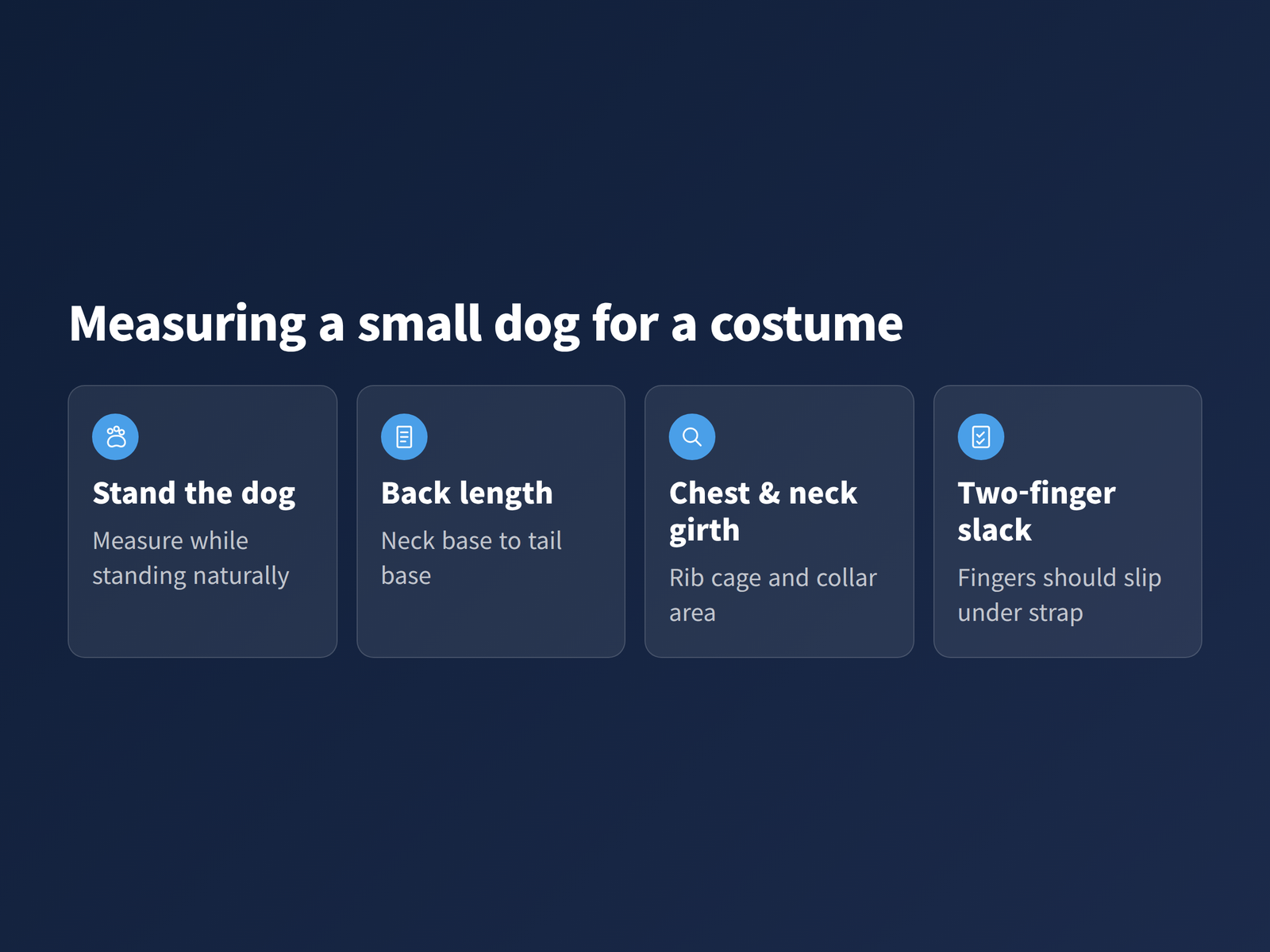
Three measurements, taken while the dog is standing. The American Kennel Club’s clothing and gear guide, updated on 10 August 2026, lists back length along the topline from the base of the neck to the base of the tail, chest girth around the largest part of the rib cage just behind the front legs, and neck girth around the base of the neck where the collar sits.
The AKC adds a slack test for girth measurements: you should be able to “slip two fingers between the measuring tape and your dog,” and the same two-finger gap applies to a collar. A soft tape measure is the only tool required. Note that the AKC guide describes measuring method only and publishes no size chart in inches or centimetres for small breeds.
How can you tell a small dog is stressed in a costume?
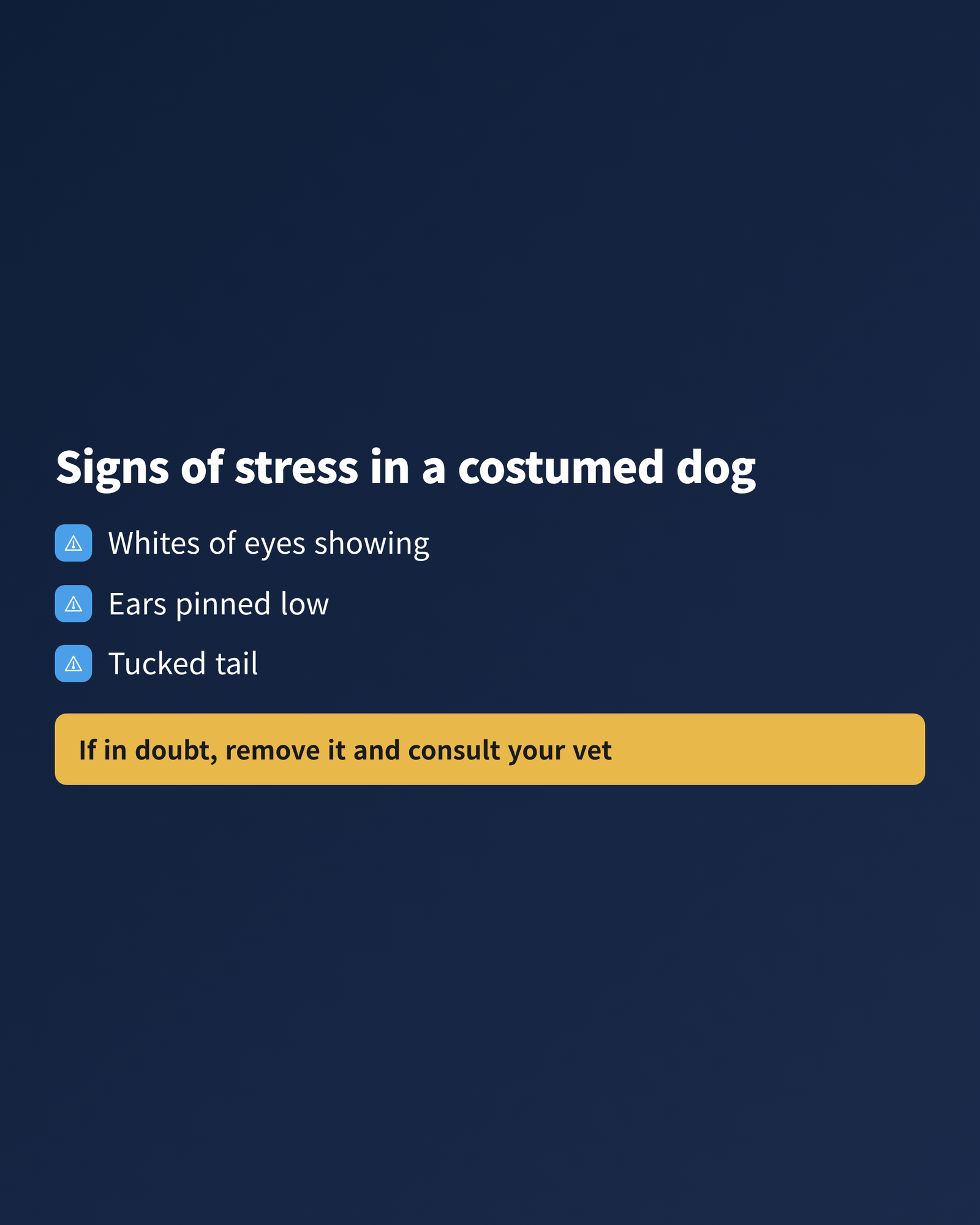
Watch for three signs the American Kennel Club names. The AKC states that “signs of stress in a dog include the whites of the eyes showing more than usual, ears pinned low, or a tucked tail.” On a small dog with a full costume, at least two of those three may be hidden under fabric, which is why the check happens before the outfit goes on as well as after.
The American Kennel Club also draws a line before the costume stage: “If your dog is more shy or reserved, it’s probably a good idea to just let them relax at home without a costume.” Small size is not evidence of tolerance. If a small dog struggles to breathe, overheats, or reacts badly to a costume, remove it and consult your veterinarian.
How long should a small dog stay in a Halloween costume?
No organisation sets a limit in minutes, but two set a limit on supervision. The American Veterinary Medical Association advises against leaving costumed pets unattended at any time. Dr Mark Stickney of Texas A&M University College of Veterinary Medicine and Biomedical Sciences said in 2012 that “cute little costumes are fun to put on your animals while trick-or-treating, but when you are not watching your animals, make sure to take them off.”
Read together, the unsupervised allowance is zero and the supervised allowance is undefined, so leaving a costume on through the evening for photographs meets neither standard. Swallowing risk is part of the reason: Stickney described ribbons and bows becoming a “linear foreign body,” a warning he gave about cats, and small dog costumes carry a similar share of loose trim.
The American Kennel Club also recommends buying a costume “at least two weeks before” Halloween, which assumes short practice sessions rather than a single night of wear.
Is the front door a bigger Halloween risk than the costume?
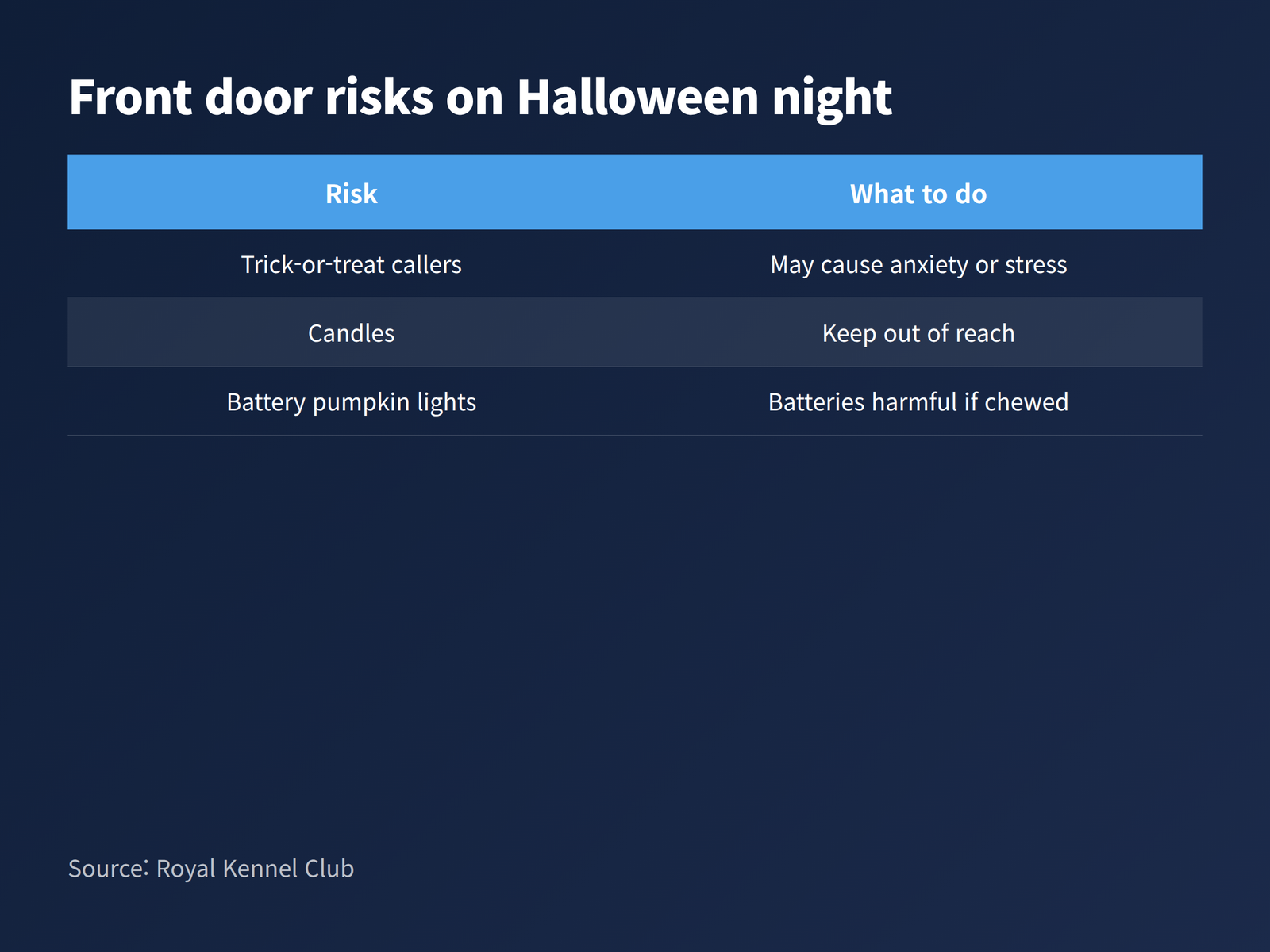
For the Royal Kennel Club, yes. Its Halloween guidance contains no costume instructions at all and warns instead that “frequent calls at the door from costumed trick or treaters may make your dog anxious or stressed.” The same page flags candles and battery-powered pumpkin lights, noting that the batteries inside can be harmful if chewed.
A small dog reaches that hazard more easily than a larger one, since carved pumpkins and light strings usually sit at floor level or on low steps. Whether the door or the costume is the larger issue for a particular small dog depends on how that dog already responds to visitors.
Frequently asked questions
Does a costume count as cruel if the dog does not resist it?
No organisation uses resistance as the test. Blue Cross bases its objection on communication and stress, while the AVMA and AKC use a fit test and supervision.
Is a winter coat treated the same as a costume?
No. Blue Cross accepts two garments only, a winter coat for a short-haired dog and a post-surgery vest advised by a vet, because both have a function.
Can a costume be bought on Halloween week?
Not within the AKC’s guidance, which recommends buying at least two weeks ahead so the dog has time to get used to it.
Is a flat-faced small dog a special case?
No body publishes costume-specific guidance for flat-faced breeds. The general instruction not to block breathing still applies, and a veterinarian can advise on an individual dog.
Sources
- American Veterinary Medical Association, “Halloween pet safety” (no publication date shown, accessed September 2026) — https://www.avma.org/resources-tools/pet-owners/petcare/halloween-pet-safety
- American Kennel Club, “How to Make Halloween Costumes Fun and Safe for Your Dog” (no publication date shown, accessed September 2026) — https://www.akc.org/expert-advice/lifestyle/dog-halloween-costume-safety/
- American Kennel Club, “How to Measure Your Dog for Clothes and Gear” (updated 10 August 2026) — https://www.akc.org/expert-advice/lifestyle/measure-dog-gear/
- Blue Cross, “Dog Halloween costumes” (28 September 2021) — https://www.bluecross.org.uk/advice/dog/wellbeing-and-care/dog-costumes
- Royal Kennel Club, “Halloween dangers” (no publication date shown, accessed September 2026) — https://www.royalkennelclub.com/health-and-dog-care/health-dog-care/health/health-and-care/a-z-of-health-and-care-issues/halloween-dangers
- Texas A&M University College of Veterinary Medicine and Biomedical Sciences, “Dangers of Pet Halloween Costumes”, Pet Talk, Dr Mark Stickney (25 October 2012) — https://vetmed.tamu.edu/news/pet-talk/dangers-of-pet-halloween-costumes/