An undercoat deshedding tool is built to pull loose hair out of a dog’s undercoat, so a dog whose breed standard describes no undercoat has nothing for the tool to remove. That settles the simple half of the question. The harder half is that the manufacturer’s own not-recommended list also includes small breeds that official breed standards call double-coated. Reading the coat, not the breed label, decides whether the tool belongs in your grooming kit.
Does a single-coated small dog have an undercoat to remove?
No. Buying a deshedding tool for a small dog with no undercoat means buying a blade with nothing to grip, because the layer it targets does not exist.
The American Kennel Club Maltese breed standard states it directly: “The coat is single, that is, without undercoat. It hangs long, flat, and silky over the sides of the body almost, if not quite, to the ground.” The Royal Kennel Club Maltese standard asks for a coat “never crimped and without woolly undercoat.” The AKC Papillon standard is shorter still: “There is no undercoat.” Both are toy dogs, the Maltese set under 7 lb and the Papillon at 8–11 in at the withers, but size is not what rules the tool out. Coat construction is.
A single coat does not mean a coat that never sheds, and that misreading is where most shopping mistakes start. FURminator, which makes the undercoat deshedding tool, corrects the idea in its own FAQ: “Breeds that lack an undercoat do shed; however, their shedding is so minimal, that brushing or combing is sufficient.” Hair still comes away from a Maltese. The volume is low enough that a comb handles it.
Which small breeds does the manufacturer say not to use an undercoat deshedding tool on?
FURminator lists the Maltese, Papillon, Shih Tzu, Pomeranian and Long Coat Chihuahua among the breeds it does not recommend for its undercoat deshedding tool.
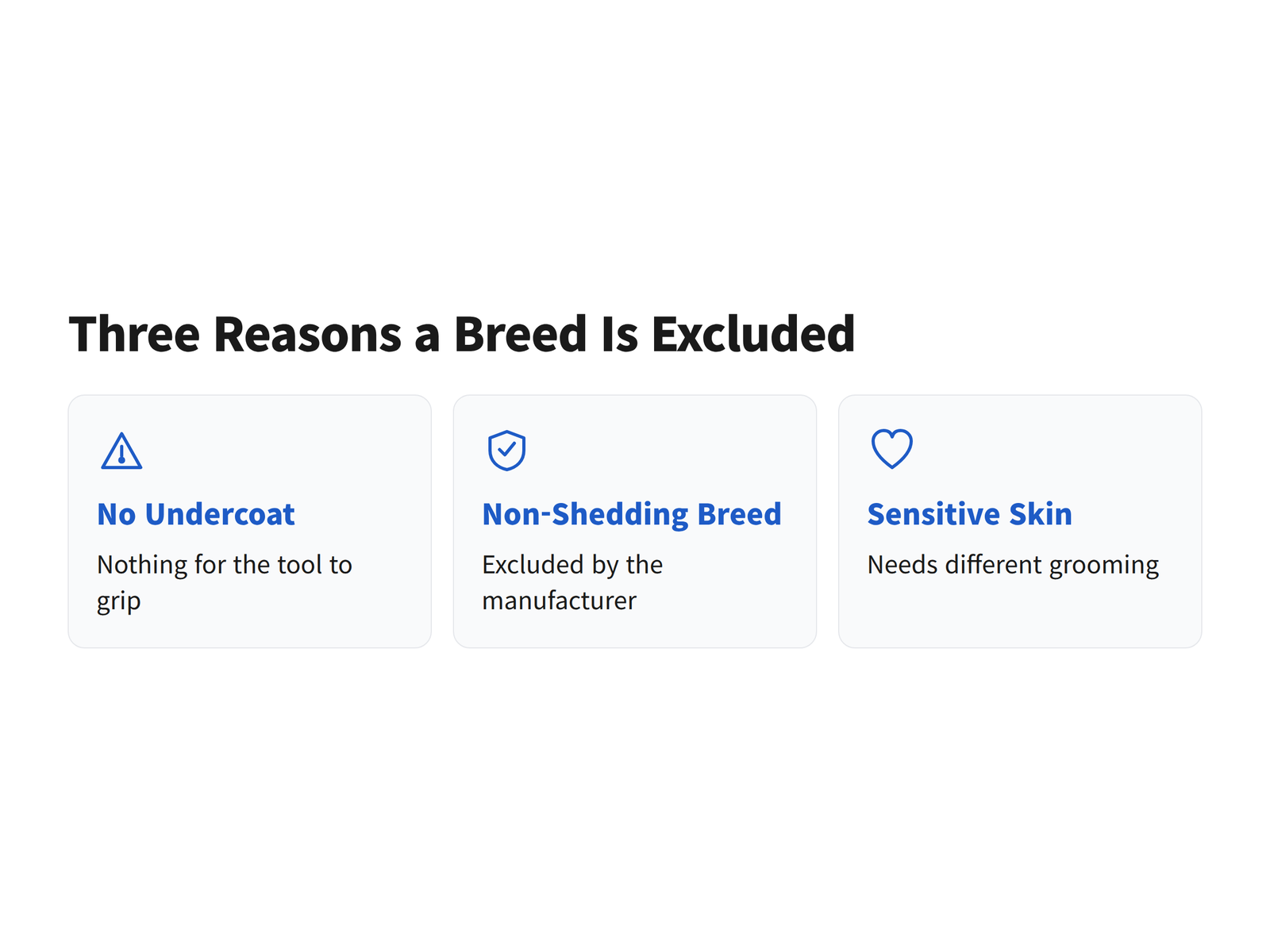
The manufacturer’s guide gives two blanket conditions alongside that list: “The FURminator Undercoat deShedding Tool should not be used on non-shedding breeds or on pets with particularly sensitive skin,” and “Dogs without an undercoat or with particularly sensitive skin require a different type of grooming to keep their coat and skin healthy.” The page carries no visible update date, so treat the list as the manufacturer’s guide as accessed on 2026-09-16 rather than as a fixed specification.
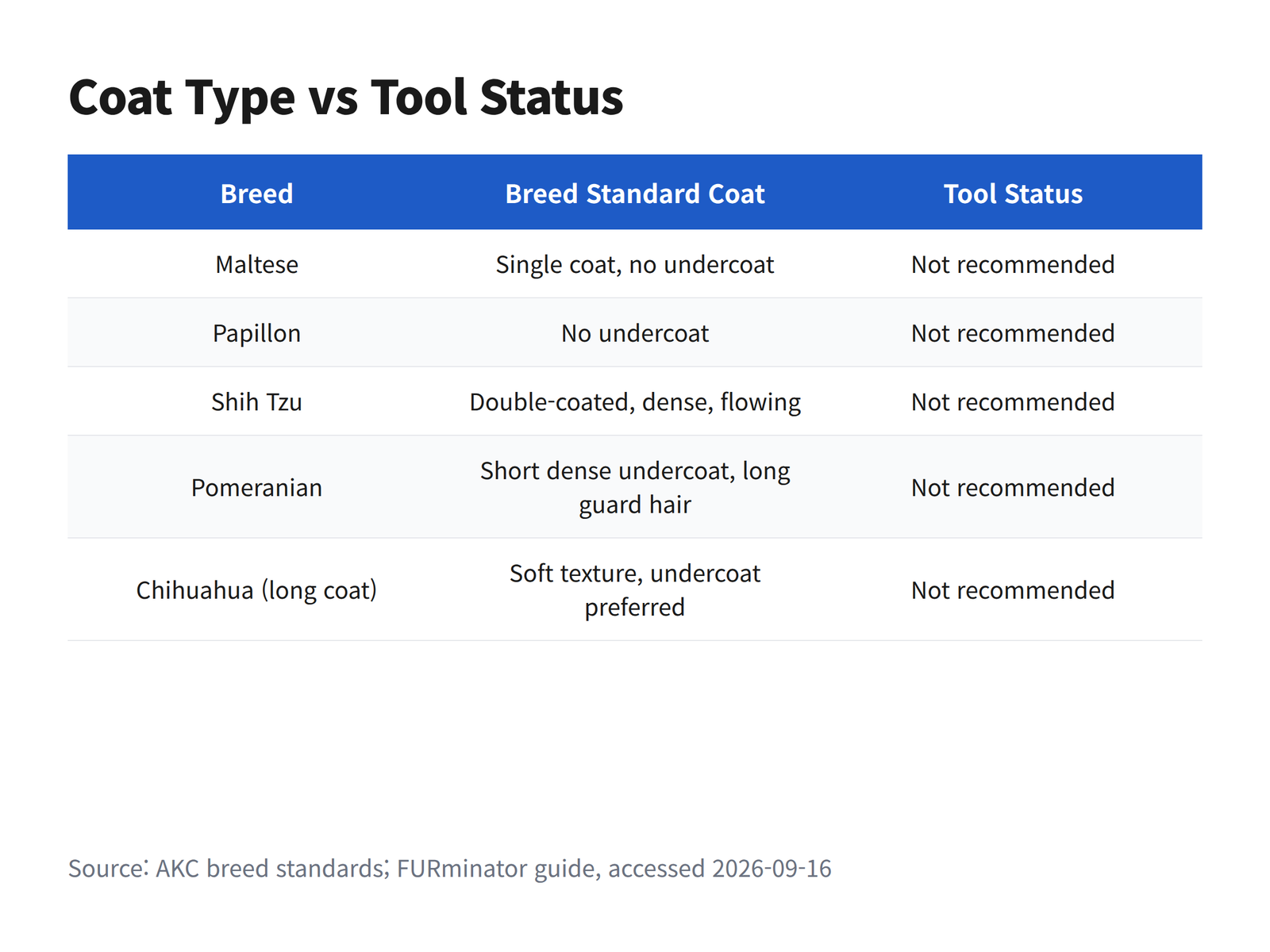
| Small breed | What the official breed standard says about the coat | Manufacturer’s undercoat deshedding tool status |
|---|---|---|
| Maltese | “The coat is single, that is, without undercoat” (AKC) | Not recommended |
| Papillon | “There is no undercoat” (AKC) | Not recommended |
| Shih Tzu | “Luxurious, double-coated, dense, long, and flowing” (AKC) | Not recommended |
| Pomeranian | “a short, dense undercoat with long harsh-textured guard hair growing through” (AKC) | Not recommended |
| Chihuahua, long coat | “soft texture, either flat or slightly wavy, with undercoat preferred” (AKC) | Not recommended |
One more small breed sits on the same list. The AKC Havanese standard describes “a long, untrimmed, double coat” that is “soft and light in texture in both outer and undercoat,” with an ideal height of 9–10½ in. The Yorkshire Terrier makes the opposite point: the AKC standard calls the coat “glossy, fine and silky in texture” without naming an undercoat, and caps weight at 7 lb, recorded by the Royal Kennel Club as 3.2 kg, yet the breed appears on neither manufacturer list. A silky single coat does not guarantee a listing either way.
Why do some double-coated small breeds still appear on the not-recommended list?
Because the manufacturer is not sorting breeds by coat layers alone. The deciding line looks closer to seasonal shedding, continuously growing coat and skin sensitivity.
The Shih Tzu, the Pomeranian, the Havanese and the long coat Chihuahua are the clearest evidence. Each is described by an AKC breed standard as having an undercoat, and each is still excluded by the manufacturer. The AKC Pomeranian standard is explicit: “The Pomeranian is a double-coated breed. The body should be well covered with a short, dense undercoat with long harsh-textured guard hair growing through, forming the longer abundant outer coat which stands off from the body.” A dog built that way, at a standard weight of 3–7 lb, is still not a candidate.
So the shortcut that a double coat means a deshedding tool is the wrong test. The AKC Shih Tzu standard sets 9–10½ in and 9–16 lb for a coat that keeps growing rather than blowing out seasonally. Layer count alone predicts little about whether the tool fits.
How can you tell whether your small dog actually has an undercoat?
Read the official breed standard first, then part the coat down to the skin and look at the layer sitting underneath the outer hair.
Breed standards describe undercoat presence in plain language, which makes them the fastest starting point. Mixed parentage and individual variation are the limit of that method. FURminator flags the same problem for the breeds it marks with an asterisk: “Some breeds have coat textures that vary between individual dogs. Not all dogs in these breeds shed.” The manufacturer splits the Dachshund by coat length, listing the short-haired Dachshund as recommended and the long-haired Dachshund as not recommended, so a breed name alone is not a purchase decision.
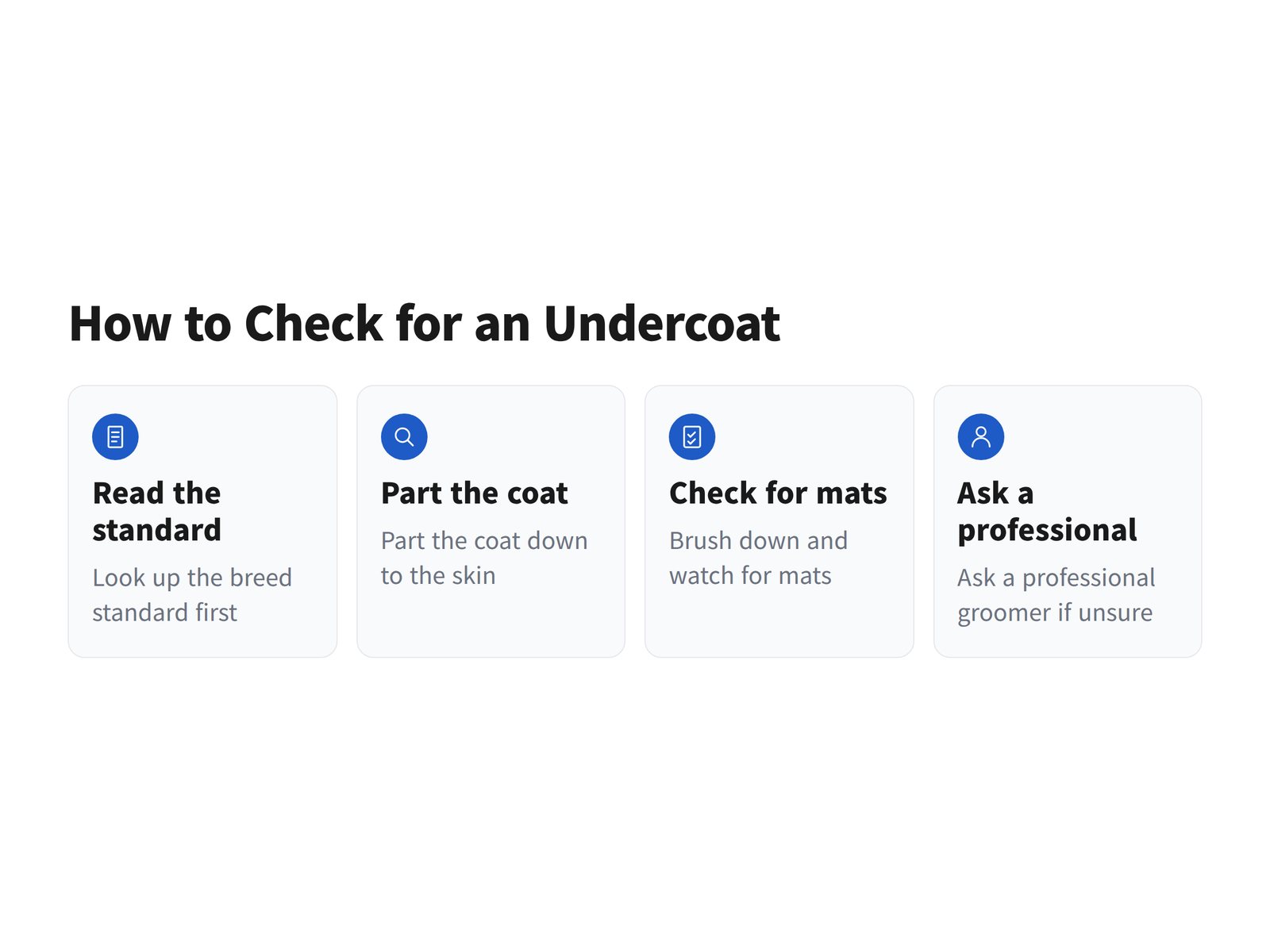
For the physical check, the American Kennel Club advises brushing “all the way down to the skin using gentle strokes” while looking for mats, the same motion that exposes whether a second, softer layer exists. If the answer still looks uncertain, ask a professional rather than guessing with a bladed tool. The RSPCA suggests asking “your vet, friends and family for recommendations about groomers they’ve used.” If the skin looks red, flaky or sore, stop and consult your veterinarian before grooming that area again.
What should you use instead on a silky, single-coated small dog?
Use a comb and a slicker brush worked gently to the skin. The manufacturer itself says brushing or combing is sufficient for breeds that lack an undercoat.
Frequency depends on coat length rather than coat layers. The American Kennel Club notes that long-coated breeds often do best with daily brushing, while Blue Cross advises at least once a week for short, smooth coats. A Maltese or a Yorkshire Terrier in full coat sits at the daily end. Slicker brushes, pin brushes and metal combs make up the usual small-dog kit, and a detangling comb matters more than any deshedding blade.
Gentler tools are not automatically harmless. The AKC warns: “Maintain a light touch when using slicker brushes, as pressing down hard could cause your dog discomfort.” Blue Cross adds that owners should not apply too much pressure and should watch for pins sticking out at the wrong angle. Pressure and pin condition, not brand, decide whether a brushing session leaves the skin comfortable.
Does the manufacturer say a deshedding tool cuts the coat?
No. FURminator states the opposite, describing an edge that “does not cut or damage the dog coat thanks to its carefully-crafted, precise, stainless steel edge.”
The claim that deshedding tools cut guard hair circulates widely in grooming forums and shop blogs. No independent, peer-reviewed source was found to confirm or refute it, and no veterinary or breed-club document reviewed here evaluates deshedding tools at all. The AKC brush guide, updated 2026-03-03, stops at undercoat rakes and limits them to “double-coated breeds of all fur lengths.” Both positions stand here as what each party says, not as a settled finding.
How long should one deshedding session last on a small dog?
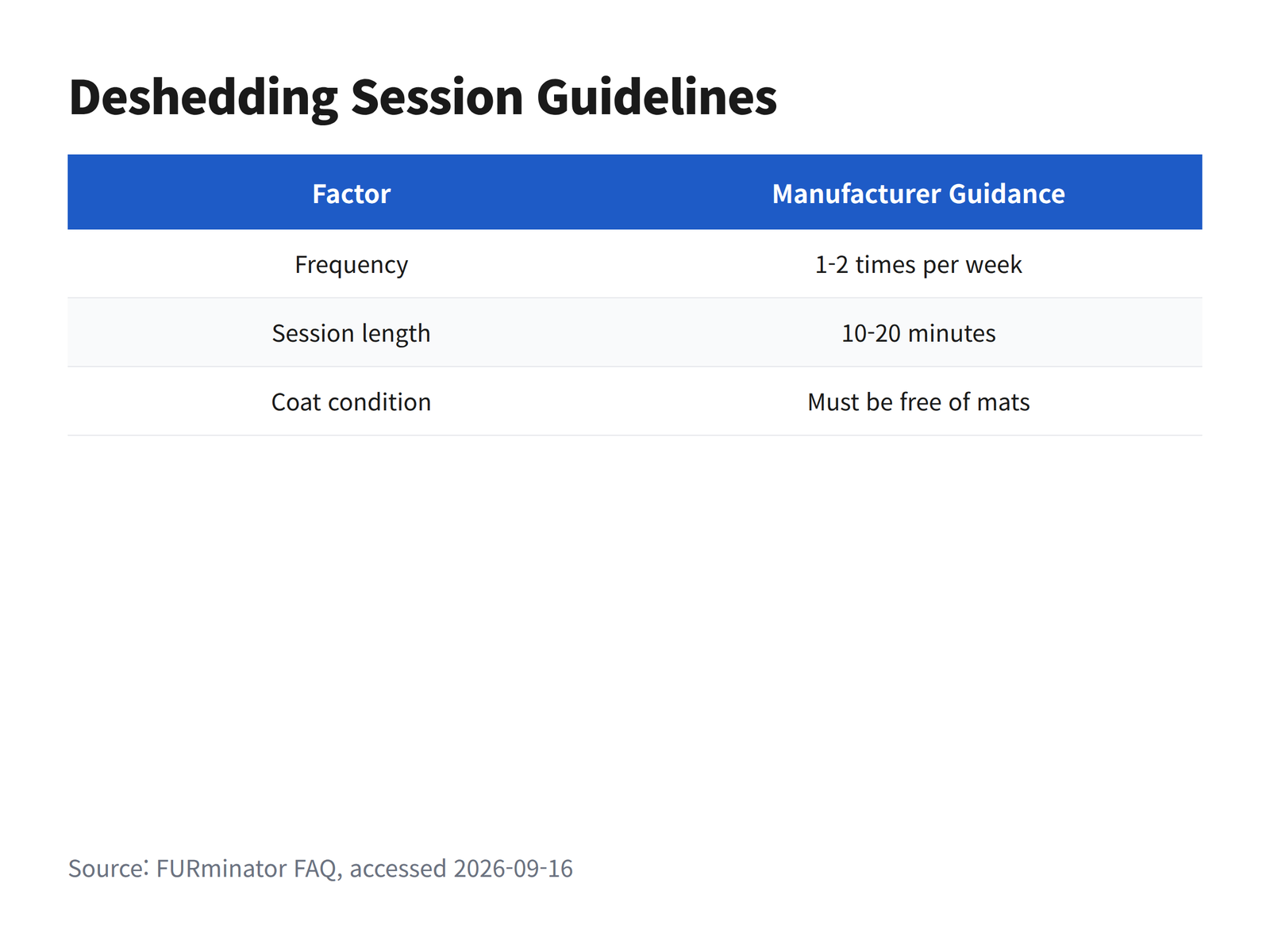
FURminator recommends 1–2 times a week for 10–20 minutes per session, and only on a coat that is already free of mats.
The same FAQ sets the preconditions plainly. Before any session, “your dog should be free of mats and tangles,” which means the tool is not a dematting device, and buying one to break up mats is a misuse of it. The manufacturer also warns against working “one area for an extended period of time,” and singles out two zones: “The ears and tail are typically sensitive areas for most pets, so extra caution will need to be taken when brushing these areas.”
Session limits matter more on a small dog because there is less surface area to spread the work across. A Chihuahua capped at 6 lb by the AKC standard reaches the same 10–20 minutes across a far smaller body, so the risk of overworking one patch of skin rises. Whether any of this applies to your own dog depends on its individual coat and skin condition.
Frequently asked questions
Is the Shih Tzu really excluded even though it is double-coated?
Yes. The AKC Shih Tzu standard calls the coat “Luxurious, double-coated, dense, long, and flowing,” and the manufacturer’s guide, accessed 2026-09-16, still lists the breed as not recommended.
Do single-coated small dogs shed at all?
Yes. FURminator states that “Breeds that lack an undercoat do shed; however, their shedding is so minimal, that brushing or combing is sufficient.”
Is a Dachshund on the recommended or the not-recommended list?
Both, depending on coat length. The manufacturer’s guide, accessed 2026-09-16, lists the short-haired Dachshund as recommended with an asterisk for variable coat texture, and the long-haired Dachshund as not recommended. Check the individual coat rather than the breed name.
What if the skin looks irritated after grooming?
Stop using the tool on that area and consult your veterinarian. This article covers coat type and tool fit, not diagnosis or treatment.
Sources
- American Kennel Club, “Maltese Official Breed Standard” — https://images.akc.org/pdf/breeds/standards/Maltese.pdf
- American Kennel Club, “Papillon Official Breed Standard” — https://images.akc.org/pdf/breeds/standards/Papillon.pdf
- American Kennel Club, “Shih Tzu Official Breed Standard” — https://images.akc.org/pdf/breeds/standards/ShihTzu.pdf
- American Kennel Club, “Pomeranian Official Breed Standard” — https://images.akc.org/pdf/breeds/standards/Pomeranian.pdf
- American Kennel Club, “Havanese Official Breed Standard” — https://images.akc.org/pdf/breeds/standards/Havanese.pdf
- American Kennel Club, “Chihuahua Official Breed Standard” — https://images.akc.org/pdf/breeds/standards/Chihuahua.pdf
- American Kennel Club, “Yorkshire Terrier Official Breed Standard” — https://images.akc.org/pdf/breeds/standards/YorkshireTerrier.pdf
- American Kennel Club, “Dog Brushes: How to Choose the Right Dog Brush for Your Pet”, updated 2026-03-03 — https://www.akc.org/expert-advice/health/types-dog-brushes-shedding/
- American Kennel Club, “Dog Grooming at Home: Brushing, Bathing, and Nail Care”, updated 2026-09-02 — https://www.akc.org/expert-advice/health/how-to-groom-a-dog/
- Royal Kennel Club, “Breed Standard: Maltese” — https://www.royalkennelclub.com/breed-standards/toy/maltese
- Royal Kennel Club, “Breed Standard: Yorkshire Terrier” — https://www.royalkennelclub.com/breed-standards/toy/yorkshire-terrier
- Blue Cross, “How to groom your dog”, published 2017-07-26 — https://www.bluecross.org.uk/advice/dog/how-to-groom-a-dog
- RSPCA, “Choosing the Right Dog Groomer” — https://www.rspca.org.uk/adviceandwelfare/pets/dogs/health/grooming
- FURminator, “Which dog breeds are not recommended for deShedding?”, accessed 2026-09-16 — https://www.furminator.net/guide/deshed/which-dog-breeds-are-not-recommended-for-an-undercoat-deshedding-tool
- FURminator, “Dogs with undercoat: recommended breeds for deshedding”, accessed 2026-09-16 — https://www.furminator.net/guide/deshed/which-dog-breeds-are-recommended-for-an-undercoat-deshedding-tool
- FURminator, “FAQ”, accessed 2026-09-16 — https://www.furminator.net/faq