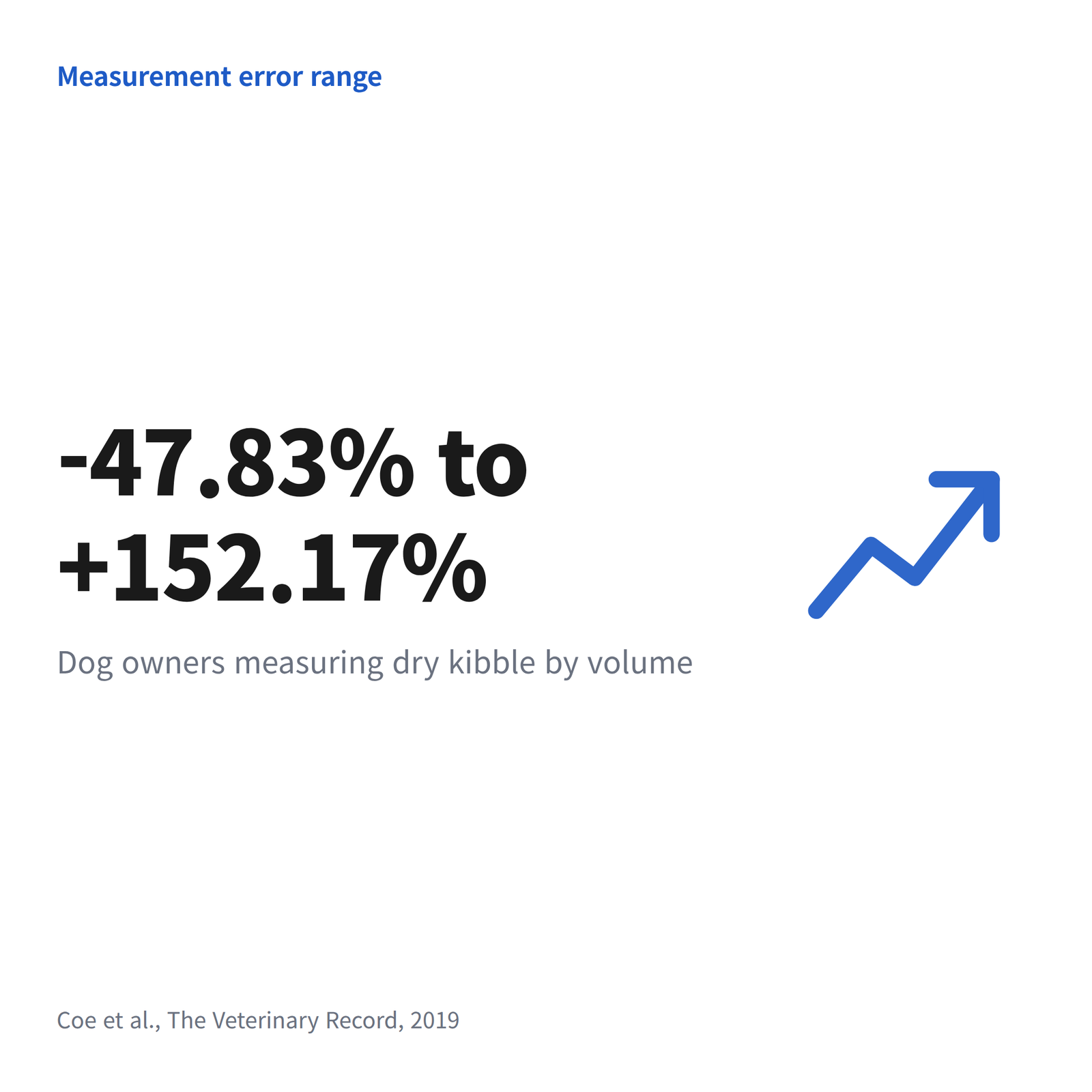
A measuring cup portions dog food by volume, not by weight, so the calories it delivers shift with the kibble’s size, shape and density, and with how the person holding the cup fills it. A 2019 study of 100 dog owners at the Ontario Veterinary College found measurement errors running from −47.83 % to +152.17 %, and accuracy fell as the portion shrank. For a small dog eating a quarter cup a day, that is the whole meal.
Why do measuring cups overfeed small dogs?
Measuring cups misfire on small portions because accuracy depends on both the volume measured and the device doing the measuring. Coe and colleagues, publishing in The Veterinary Record in 2019, asked 100 dog owners to measure quarter-cup, half-cup and one-cup portions with three devices: a 1-cup dry-food measuring cup, a 2-cup graduated liquid measuring cup and a 2-cup commercial food scoop. Accuracy was significantly associated with the volume measured (p<0.001) and with the device used (p<0.001). Smaller portions were the hardest to get right, and small dogs are the ones eating them.
One correction matters here. The cup is not purely an over-measuring device. Errors ran in both directions across that −47.83 % to +152.17 % range, so some owners under-served their dogs. Over-measurement was the more frequent and more consequential direction. “We found it particularly concerning to see how often participants over-measured the assigned portions, particularly given that there is an ongoing problem with pet obesity,” said Prof. Jason Coe of the University of Guelph, the study’s lead author.
How wrong can a measuring cup be on a quarter-cup portion?
The published range for the study as a whole runs from −47.83 % under to +152.17 % over, and no single percentage can be pinned to the quarter-cup portion, because the per-device breakdown was not in the abstract or the university release. What the researchers did report is the direction: accuracy deteriorated as the measured volume fell, which places the quarter cup at the bad end of the scale.
Prof. Coe put the small-dog implication plainly: “That finding has important implications for small dogs, since they typically receive smaller volumes of food.” This is not an isolated news item either. The 2019 study appears as reference 77 in the 2021 AAHA Nutrition and Weight Management Guidelines for Dogs and Cats, which places it inside a profession-level guideline document rather than a press cycle.
Why is the scoop inside the bag the worst tool for a small dog?
The scoop supplied with a bag of kibble is usually far larger than a small dog’s portion, and device-to-portion mismatch is what the 2019 study penalised. One of the three devices tested was a 2-cup commercial food scoop. Asking it to deliver a quarter cup means judging one eighth of its capacity by eye, twice a day.
“The problem with trying to eyeball 1 cup or ½ cup in a 2-cup device is that there is lots of room for error,” Prof. Coe said. His decision rule is short enough to act on: “The closer the measuring cup is to the portion you want to measure, the more accurate you’ll be.” For a household feeding quarter cups, the bag scoop fails that test.
Does the feeding chart on the bag work for a 10 lb dog?
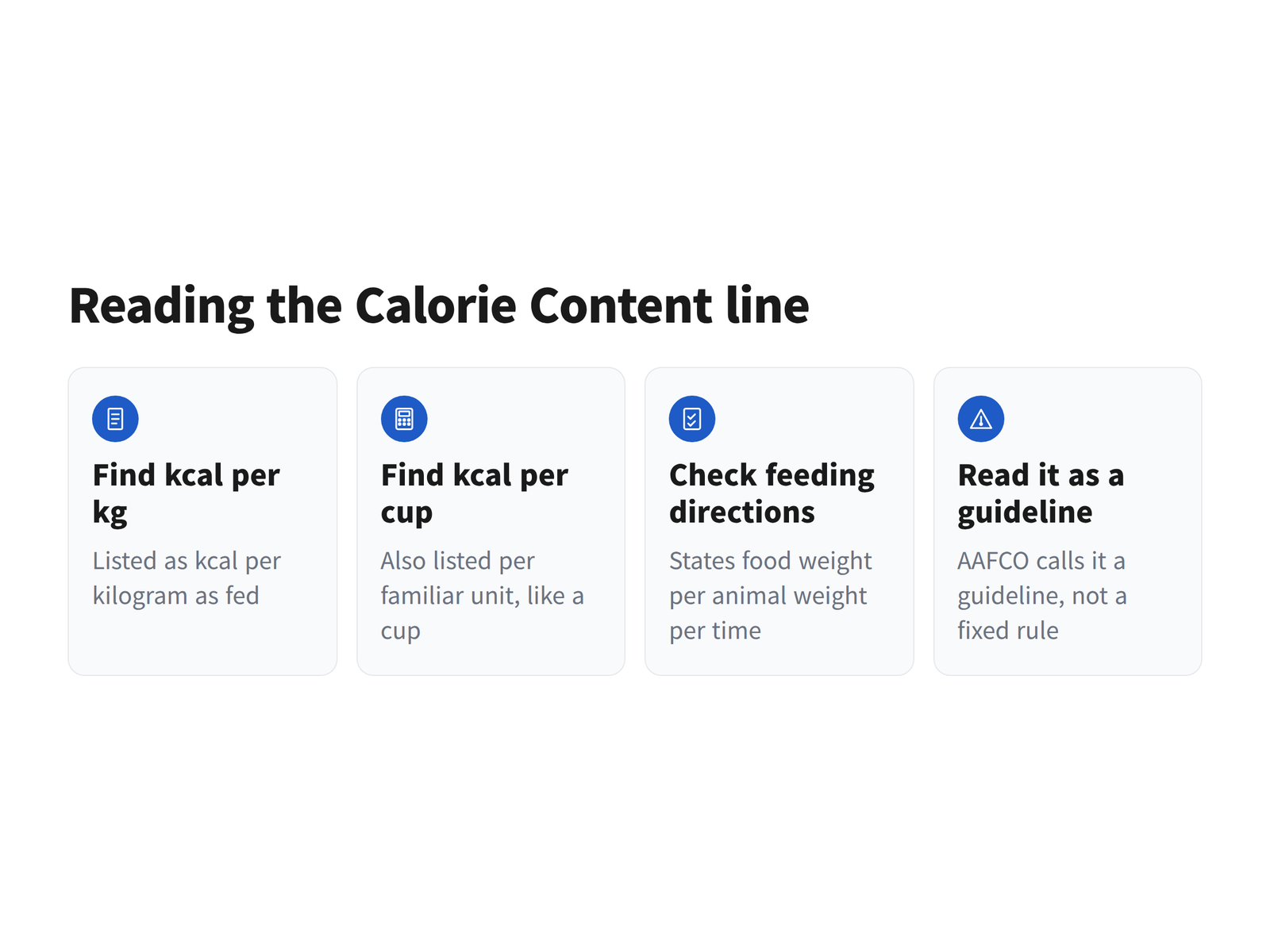
The chart is not wrong, but it is a population starting point rather than an individual prescription. AAFCO, which sets the labelling rules, states that “feeding directions are guidelines that may need modification to meet a particular pet’s needs.” The label must declare Calorie Content as kcal per kilogram as fed and as kcal per familiar unit such as a cup, and feeding directions must specify how much weight of food per weight of animal per unit of time for the life stage.
The room for individual variation is wide. The WSAVA Nutritional Assessment Guidelines put individual energy requirement in dogs at ±30 % in either direction. A chart aimed at the average 10 lb dog can therefore run a third too generous or a third too mean for the specific 10 lb dog in front of you, before any measuring error is added.
Is a gram scale better than a measuring cup for dog food?
Yes, for small portions a gram scale is the more reliable instrument, and the study authors recommended gram scales or volume-calibrated dry-food measuring devices. Weight does not change with how the kibble settles or whether the pieces are large discs or small pellets.
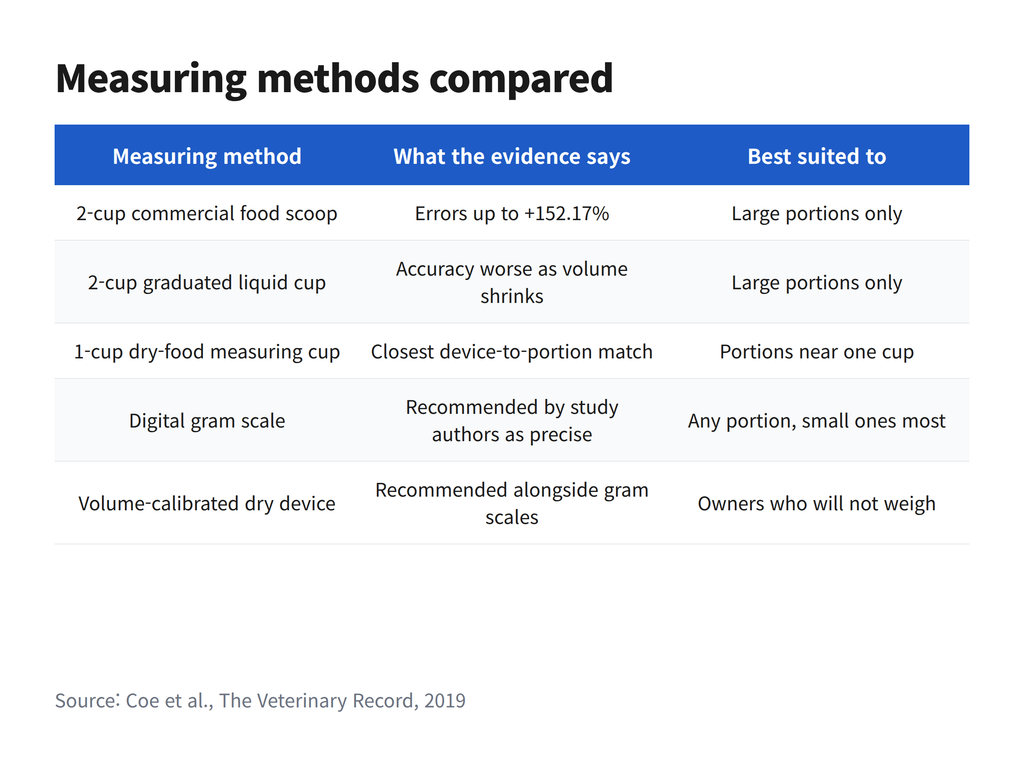
| Measuring method | What the evidence says | Best suited to |
|---|---|---|
| 2-cup commercial food scoop | In the device set producing errors up to +152.17 % | Large portions only |
| 2-cup graduated liquid cup | Accuracy significantly worse as volume shrinks | Large portions only |
| 1-cup dry-food measuring cup | Closest device-to-portion match of the three | Portions near one cup |
| Digital gram scale | Recommended by the study authors as precise | Any portion, small ones most |
| Volume-calibrated dry device | Recommended alongside gram scales | Owners who will not weigh |
One caution before shopping by numbers: grams per cup are not transferable between foods. AAFCO requires Calorie Content per cup precisely because that value differs by product, so a gram figure copied from another brand’s bag means nothing for the bag in your kitchen. WSAVA, for owners who stay with volume, names an 8 oz / 237 mL measuring cup and asks that food be given in measured amounts.
How many calories can a small dog spare for treats?
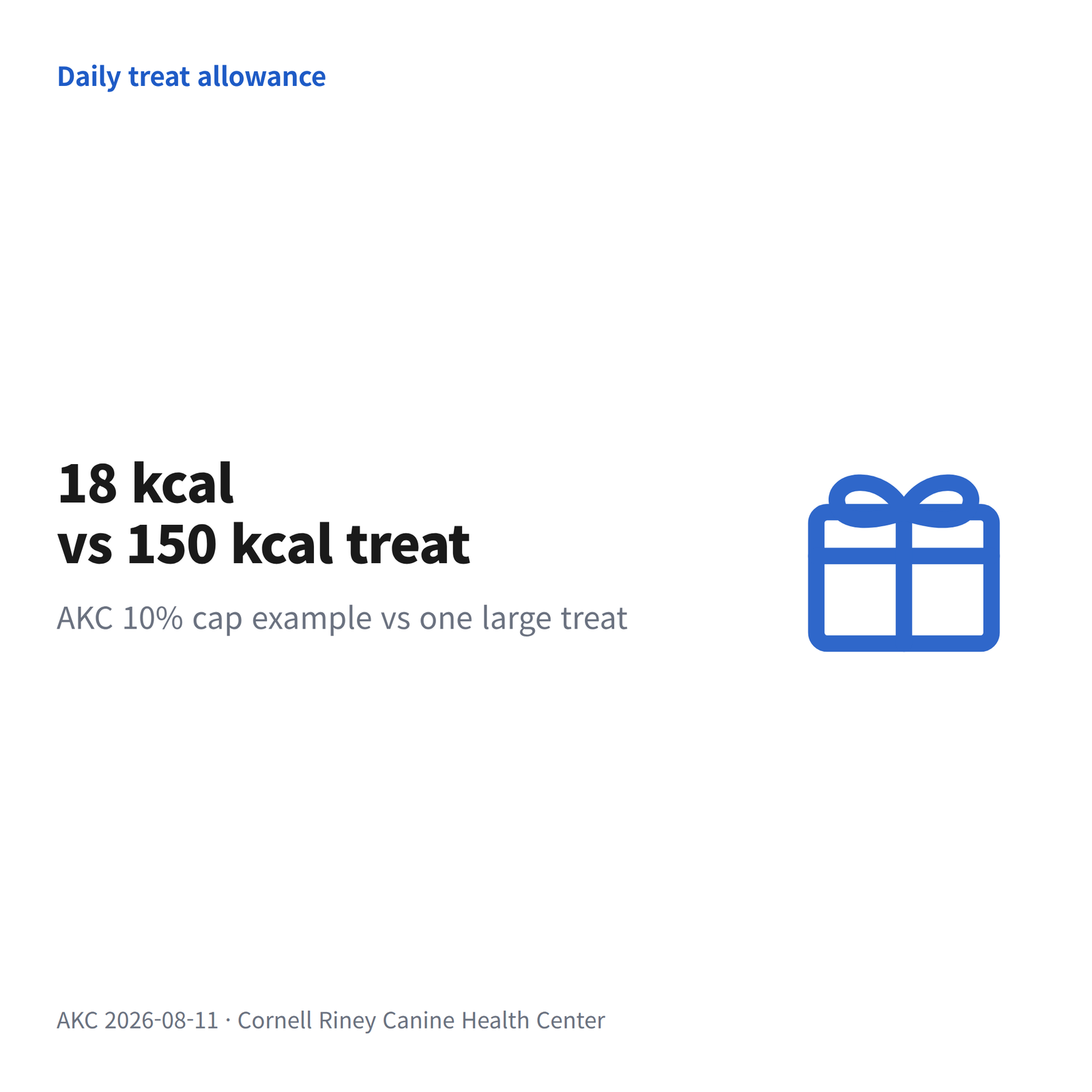
Very few, which is why precision at the bowl is so easily undone at the counter. The American Kennel Club, in guidance updated on 2026-08-11, caps treats at no more than 10 % of daily calories, counting snacks, training treats and table scraps, measured in calories rather than pieces. The AKC’s worked example puts a small dog at roughly 182 kcal a day, leaving about 18 kcal for treats. That figure is an illustration, not a requirement for any particular dog.
Set that allowance against what a treat contains. Cornell University’s Riney Canine Health Center puts individual dog treats at 7 to 150 kcal each, and estimates that treats and table scraps supply about 20 % of a dog’s daily calories. A single 150 kcal treat is more than eight times the 18 kcal allowance in the AKC example, and roughly 82 % of that dog’s entire daily intake. Joseph Wakshlag, D.V.M., Ph.D., DACVIM (Nutrition), of Cornell offers a blunter filter: “If it’s not a veggie, then it shouldn’t cross their lips.”
What does a gram scale not fix?
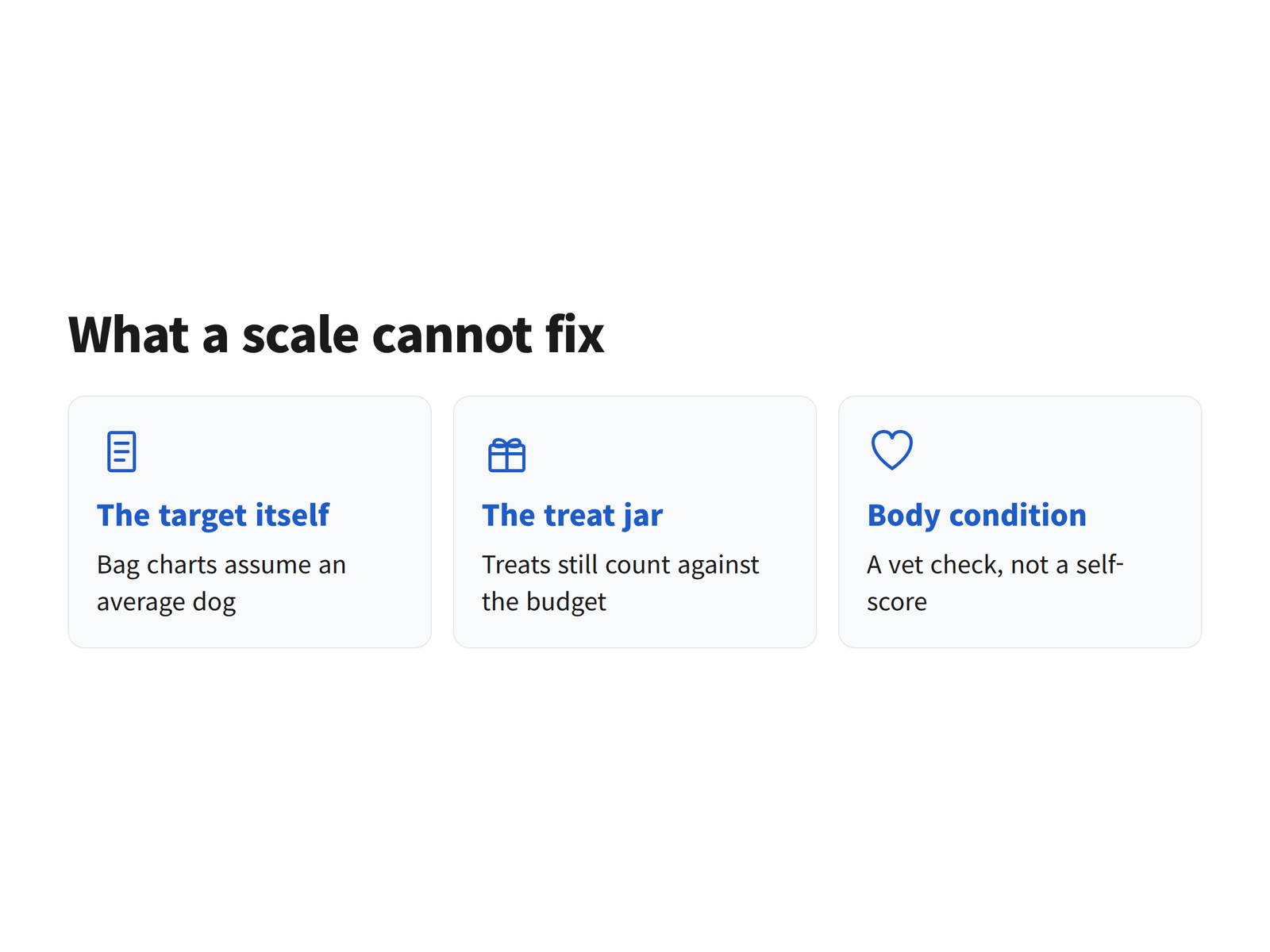
A scale fixes precision, not the target. Weighing to the gram against a number taken from the bag still inherits the bag’s assumption of an average dog, which AAFCO itself calls a guideline needing modification and WSAVA brackets at ±30 %. The scale also does nothing about what leaves the treat jar.
Body condition is the check that matters, and it belongs to your veterinarian. AAHA and WSAVA both use a 9-point body condition score validated against body fat by DEXA, with 4 to 5 out of 9 as the target and rising disease risk above 6 of 9. The 2021 AAHA guidelines state that “each BCS ≥5/9 is equivalent to being 10 % overweight.” Body condition scoring is a veterinary assessment, so ask your veterinarian to score your dog and confirm the target, and treat unexplained weight change as a reason to consult your veterinarian rather than to quietly adjust the portion. Context for that caution: Montoya and colleagues, reviewing about 4.9 million dogs seen at US primary practices between 2020 and 2023, found 44.5 % overweight and 8.4 % obese overall.
Frequently asked questions
Is the amount on the bag per day or per meal? AAFCO requires feeding directions to state how much food per weight of animal per unit of time, so the chart’s figure is a daily total to divide across meals unless the bag says otherwise. For a small dog, reading a daily figure as a per-meal figure doubles intake.
How many grams is a quarter cup of dry dog food? It depends on the food. AAFCO requires Calorie Content per kilogram and per cup precisely because the per-cup value differs by product, so the answer is on your own bag and nowhere else.
Do I have to throw away the scoop from the bag? Not necessarily, but match the device to the portion. A 2-cup scoop suits large portions; a quarter cup needs a scale or a device near that capacity.
Are veterinary diet bags different? Yes. AAFCO allows veterinary medical foods to omit feeding directions when labelled for use only as directed by your veterinarian.
Sources
- Coe JB, Rankovic A, Edwards TR, Parr JM. “Dog owner’s accuracy measuring different volumes of dry dog food using three different measuring devices.” The Veterinary Record, 2019;185(19):599 — https://pubmed.ncbi.nlm.nih.gov/31409751/
- University of Guelph, Ontario Veterinary College. “Dog Owners Often Inaccurately Measure Out Kibble, Study Finds,” 2019-10-07 — https://news.uoguelph.ca/2019/10/dog-owners-often-inaccurately-measure-out-kibble-study-finds/
- American Animal Hospital Association. “2021 AAHA Nutrition and Weight Management Guidelines for Dogs and Cats,” JAAHA, 2021 — https://www.aaha.org/wp-content/uploads/globalassets/02-guidelines/2021-nutrition-and-weight-management/resourcepdfs/new-2021-aaha-nutrition-and-weight-management-guidelines-with-ref.pdf
- World Small Animal Veterinary Association. “WSAVA Nutritional Assessment Guidelines,” Journal of Small Animal Practice, 2011 — https://wsava.org/wp-content/uploads/2020/01/WSAVA-Nutrition-Assessment-Guidelines-2011-JSAP.pdf
- Association of American Feed Control Officials. “Reading Labels” — https://www.aafco.org/consumers/understanding-pet-food/reading-labels/
- American Kennel Club. “How Many Treats Can a Dog Have Per Day?” updated 2026-08-11 — https://www.akc.org/expert-advice/nutrition/how-many-treats-can-dog-have/
- Cornell University College of Veterinary Medicine, Riney Canine Health Center. “The biggest health problem in canine medicine: Obesity” — https://www.vet.cornell.edu/departments-centers-and-institutes/riney-canine-health-center/canine-health-topics/biggest-health-problem-canine-medicine-obesity
- Montoya M, Péron F, Hookey T, Morrison J, German AJ, Gaillard V, Flanagan J. “Overweight and obese body condition in ~4.9 million dogs and ~1.3 million cats seen at primary practices across the USA.” Preventive Veterinary Medicine, 2025;235:106398 — https://www.sciencedirect.com/science/article/pii/S0167587724002848