No veterinary or kennel authority publishes a binding outdoor temperature limit for dogs. The only fixed cold-weather figures that carry legal force sit inside individual US state animal-care statutes, and those statutes govern tethering and shelter rather than walking. The temperature charts that fill winter pet articles are guidance at best, and most of them name no source at all. This page separates the numbers that are legally binding from the numbers that are simply repeated, and explains why body size shifts the picture for small dogs.
Is there an official temperature limit for walking a small dog?
No organization with veterinary or regulatory authority publishes one. The American Veterinary Medical Association’s cold weather animal safety page, read on 2026-09-19, gives no numeric threshold at all. The AVMA states only that no pet should be left outside for long periods in below-freezing weather, and leaves the judgment with the owner. The United Kingdom’s Department for Environment, Food and Rural Affairs takes the same approach in its Code of Practice for the Welfare of Dogs (December 2017), which names no temperature figure in degrees anywhere in the document.
That absence matters because the widely copied charts pairing a dog’s weight with a “danger” temperature do not trace back to either body. Treat any single figure presented as the safe limit for small dogs as unsourced until the publisher names the study or statute behind it.
Which bodies actually publish a cold weather figure?
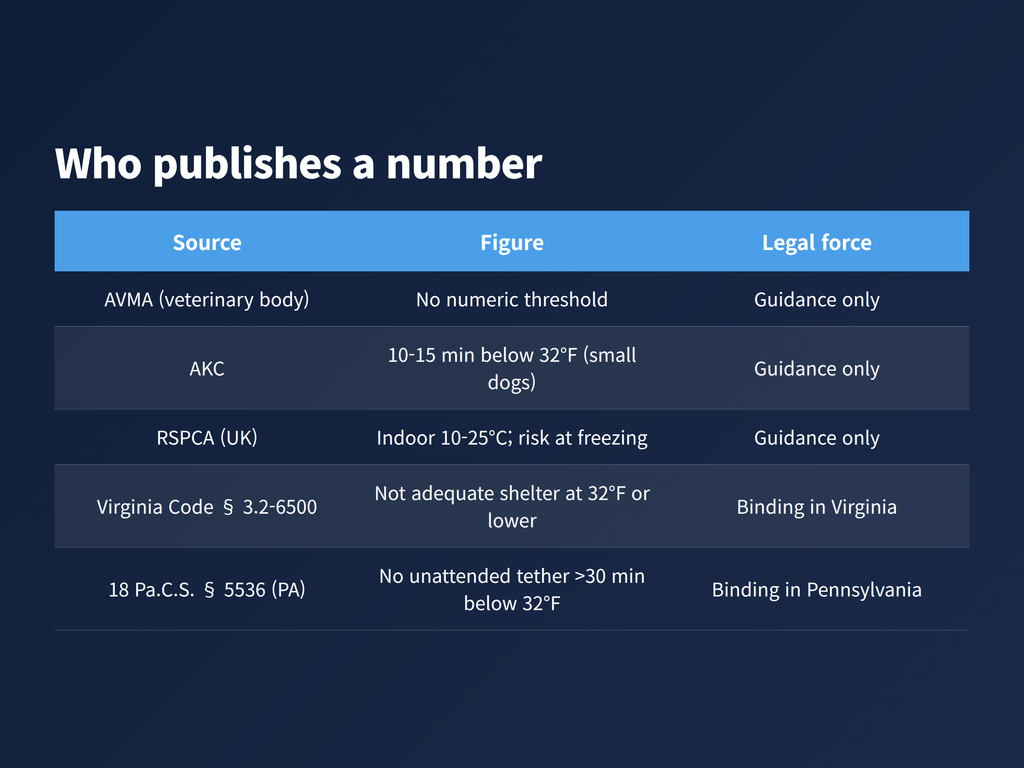
Only a few, and almost all publish guidance rather than rules. The table below separates advice from law.
| Source | Cold-weather figure | Legal force |
|---|---|---|
| AVMA (veterinary body) | No numeric threshold; “below-freezing” wording only | Guidance only |
| AKC | 10-15 minutes outdoors below 32°F for small dogs | Guidance only |
| RSPCA (UK) | Indoor range 10-25°C; all dogs at risk at freezing | Guidance only |
| Virginia Code § 3.2-6500 | Tethering is not adequate shelter at 32°F or lower | Binding in Virginia |
| 18 Pa.C.S. § 5536 (PA) | No unattended tethering over 30 minutes below 32°F | Binding in Pennsylvania |
Why do small dogs lose body heat faster than large dogs?
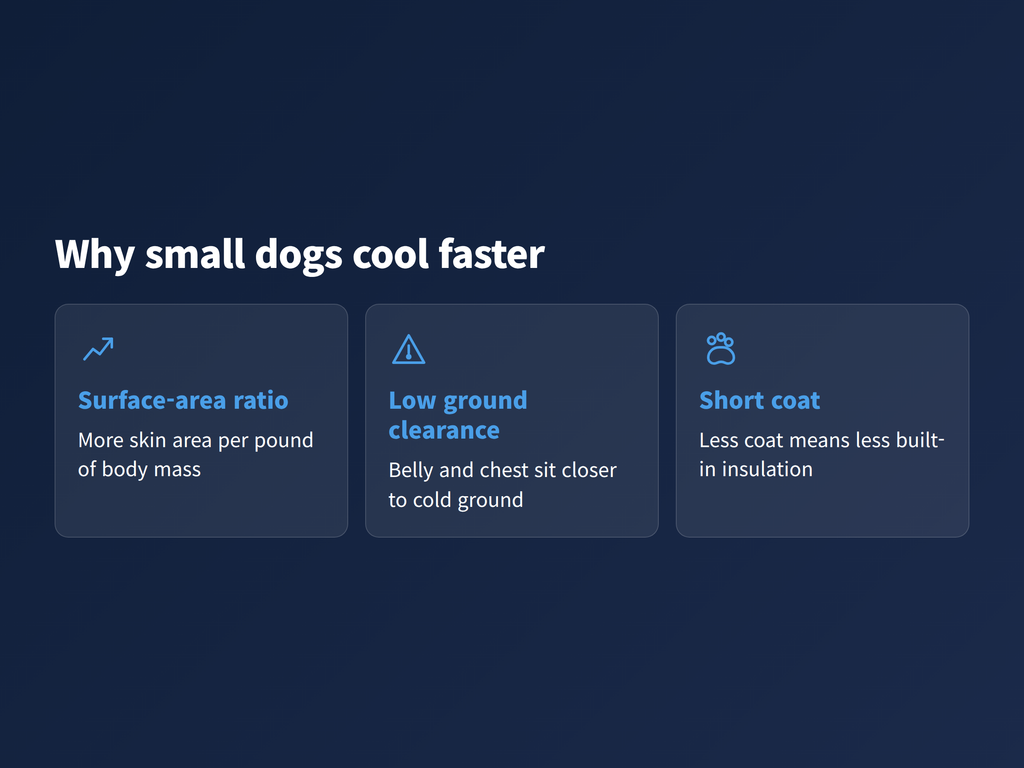
Small dogs lose heat faster because surface area rises relative to body mass as body size falls. The RSPCA puts the mechanism plainly: “Smaller dogs lose body heat faster than larger dogs – bigger breeds are more insulated and higher above the ground, so they stay warmer for longer.” A 2022 study of 380 dogs published in Veterinary World describes the same physiology, noting that “small animals contain a larger body surface area-to-body mass ratio, with higher metabolic heat production and faster heat loss.”
Ground clearance compounds the effect for short-legged builds such as a dachshund or a corgi. The AVMA notes that “short-haired pets feel the cold faster because they have less protection, and short-legged pets may become cold faster because their bellies and bodies are more likely to come into contact with snow-covered ground.” Whether that applies to your dog depends on coat type, age and body condition.
What temperature do US state laws actually name for dogs left outside?
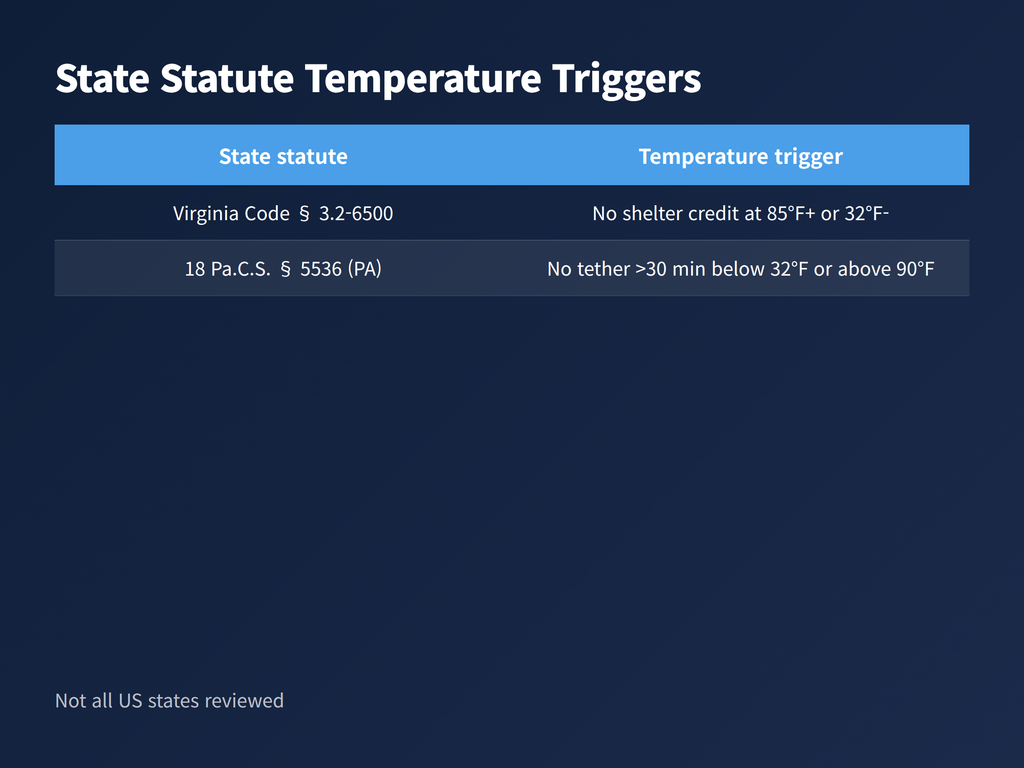
Two states checked for this article name specific temperatures, and both attach them to tethering rather than walking. Virginia Code § 3.2-6500, as amended in 2022, provides that tethering does not count as adequate shelter when the temperature is 85°F (about 29°C) or higher, or 32°F (0°C) or lower, and also during heat advisories, winter storm, tornado and thunderstorm warnings, and hurricane or tropical storm warnings. The same section sets a minimum tether length of 15 feet, or four times the length of the animal.
Pennsylvania uses a clock as well as a thermometer. Under 18 Pa.C.S. § 5536, enacted as Act 10 of 2017, a presumption against neglect applies only where “the dog has not been tethered for longer than 30 minutes in temperatures above 90 or below 32 degrees Fahrenheit,” and where unattended tethering stays under nine hours in a 24-hour period.
Read those figures carefully before repeating them. Neither statute makes it unlawful to walk a dog at 31°F (about -1°C). Both regulate unattended tethering and the shelter provided to an animal kept outdoors, and only within their own state. Texas, New Jersey, Delaware and Illinois were not examined here, so their numbers and conditions should not be assumed to match.
Does the wind chill number on a weather app apply to a small dog?
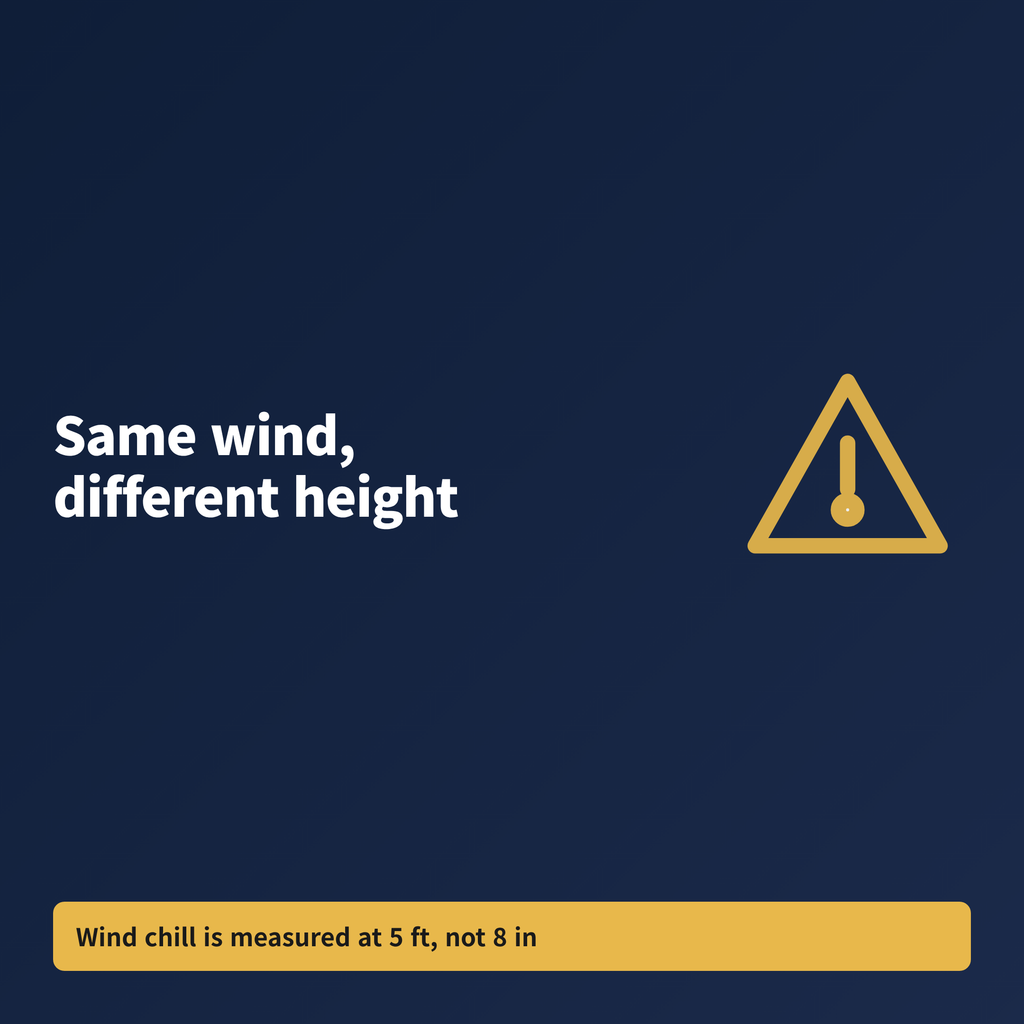
Not directly, because the wind chill formula was never written for dogs. The National Weather Service explains that its chart “calculates wind speed at an average height of 5 feet, the typical height of an adult human face.” A small dog carries its chest roughly 8 to 10 inches (20 to 25 cm) off the ground, inside a different wind profile and in contact with cold surfaces the model ignores.
The NWS figures still describe how quickly wind strips heat. At 0°F (about -18°C) with a 15 mph wind, the chart gives a wind chill of -19°F (about -28°C) and warns that exposed human skin can freeze within 30 minutes. No published correction factor converts that scale to a dog, and inventing one is not a safe substitute for cutting the outing short.
How long can a small dog stay outside below freezing?
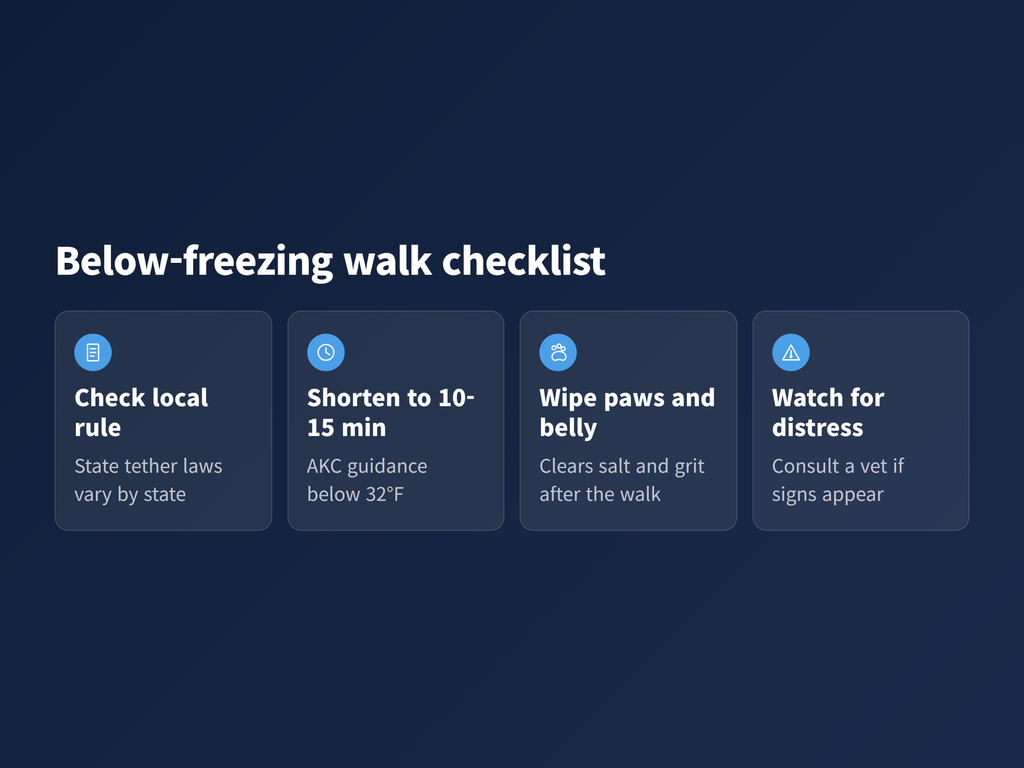
The American Kennel Club, in guidance updated on 2026-03-24, suggests capping outdoor time at 10 to 15 minutes below 32°F (0°C) or above 90°F (about 32°C). The same page describes 60°F to 90°F (about 16°C to 32°C) as a range in which many small dogs can stay outside for a few hours. Those are recommendations, not thresholds with evidence of a fixed danger point.
Weight alone is a weaker predictor than the charts imply. A 2023 study in Veterinary Research Communications measuring dogs before and after exercise across seasons found body mass among the leading variables in spring and summer trials but not in the winter trials. If your dog shows signs of distress in the cold, consult your veterinarian rather than relying on a temperature chart.
Do UK rules give a temperature figure for dogs in cold weather?
No, the UK framework is written as a duty rather than a number. The DEFRA Code of Practice for the Welfare of Dogs (December 2017), issued under section 15 of the Animal Welfare Act 2006, describes a cold or damp place as a source of suffering but never states degrees. Breaching the code is not an offence in itself, though it can be used as evidence where the section 9 duty of care is in question.
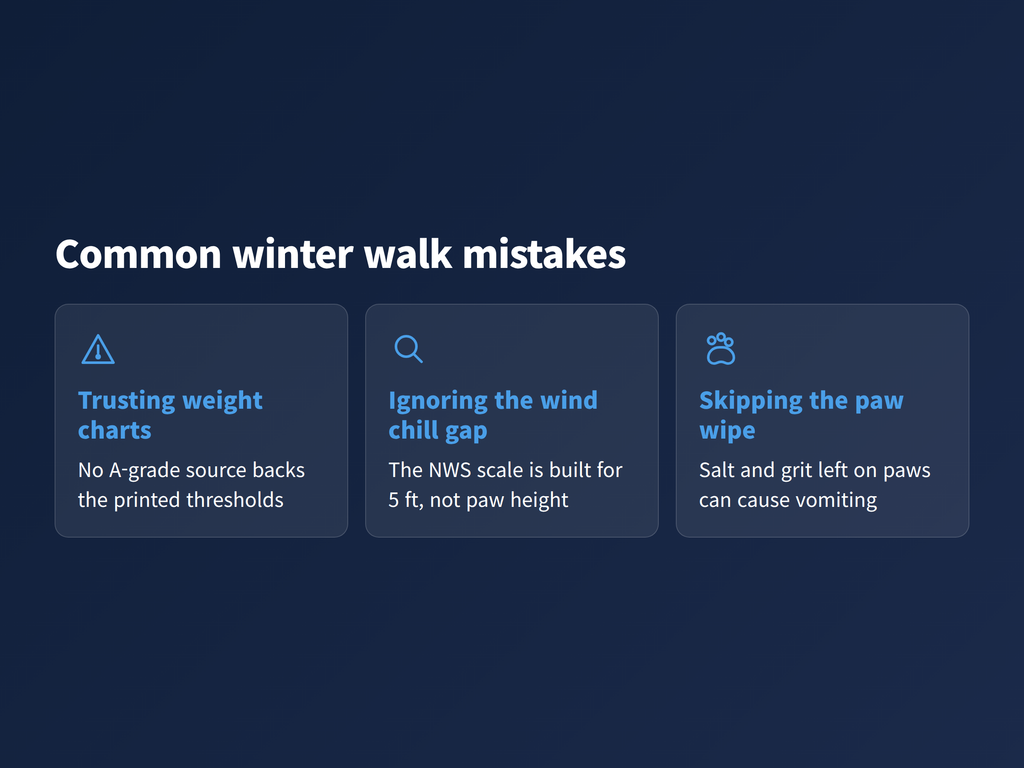
British charities fill the gap with indoor guidance instead. The RSPCA recommends keeping the home between 10°C and 25°C (50°F to 77°F) and warns that “when the temperature reaches freezing, all dogs are at risk of hypothermia and frostbite – especially small, slim, young and old dogs, and those with little or no fur.” The RSPCA and Blue Cross, whose winter page was reviewed in January 2023 and read on 2026-09-19, both advise wiping paws and the belly after a walk, because rock salt and grit swallowed during grooming can cause thirst, vomiting and lethargy.
Frequently asked questions
Is it illegal to walk a small dog below freezing in Virginia or Pennsylvania? No. Virginia Code § 3.2-6500 and 18 Pa.C.S. § 5536 regulate unattended tethering and the adequacy of shelter. Neither statute addresses walking, and neither applies outside its own state.
Should a weight-based cold weather chart decide the walk? A chart can be a rough prompt, but no A-grade source stands behind the thresholds most charts print. Coat, age and body condition change the answer for an individual dog.
Does a winter coat raise the temperature a small dog can handle? No published figure quantifies that. A coat reduces heat loss from the back and flanks, yet leaves the legs, paws and belly exposed, which are the areas closest to frozen ground.
Sources
- American Veterinary Medical Association, “Cold weather animal safety”, accessed 2026-09-19 — https://www.avma.org/resources-tools/pet-owners/petcare/cold-weather-animal-safety
- American Kennel Club, “How Long Can Dogs Be Outside?”, updated 2026-03-24 — https://www.akc.org/expert-advice/health/how-long-can-dogs-be-outside/
- RSPCA, “Winter and Cold Weather Care for Dogs”, accessed 2026-09-19 — https://www.rspca.org.uk/adviceandwelfare/seasonal/winter/pets/dogs
- Blue Cross, “Advice for Dogs and Puppies in Winter”, reviewed 2023-01-20, accessed 2026-09-19 — https://www.bluecross.org.uk/advice/dog/dogs-in-winter
- Commonwealth of Virginia, “Code of Virginia § 3.2-6500 Definitions”, amended 2022 c. 92 — https://law.lis.virginia.gov/vacode/title3.2/chapter65/section3.2-6500/
- Animal Legal and Historical Center, Michigan State University College of Law, “PA – Cruelty – Consolidated Cruelty Statutes, 18 Pa.C.S. § 5536”, Act 10 of 2017 — https://www.animallaw.info/statute/pa-cruelty-consolidated-cruelty-statutes
- NOAA National Weather Service, “Wind Chill Chart”, accessed 2026-09-19 — https://www.weather.gov/safety/cold-wind-chill-chart
- Department for Environment, Food and Rural Affairs, “Code of Practice for the Welfare of Dogs”, December 2017 — https://assets.publishing.service.gov.uk/government/uploads/system/uploads/attachment_data/file/697953/pb13333-cop-dogs-091204.pdf
- Lukkanawaraporn et al., “Effects of environmental condition, size, coat type, and body condition score on rectal temperature prediction in dogs”, Veterinary World, 2022, n=380 — https://pmc.ncbi.nlm.nih.gov/articles/PMC9210846/
- Jimenez, Paul, Zafar and Ay, “Effect of different masses, ages, and coats on the thermoregulation of dogs before and after exercise across different seasons”, Veterinary Research Communications, 2023, Springer