Harness mats on a longhaired small dog follow strap lines, not brushing schedules. USDA APHIS Animal Care names the armpits, behind the ears and under the collar as rubbing zones, and harness straps sit across all three. That overlap explains why a Maltese, a Havanese or a longhaired dachshund can be brushed every day and still turn up felted under the chest strap. The answer is coverage, not frequency: comb the friction zones down to the skin, then check the fit of the straps.
Where do mats actually form on a small dog that wears a harness?
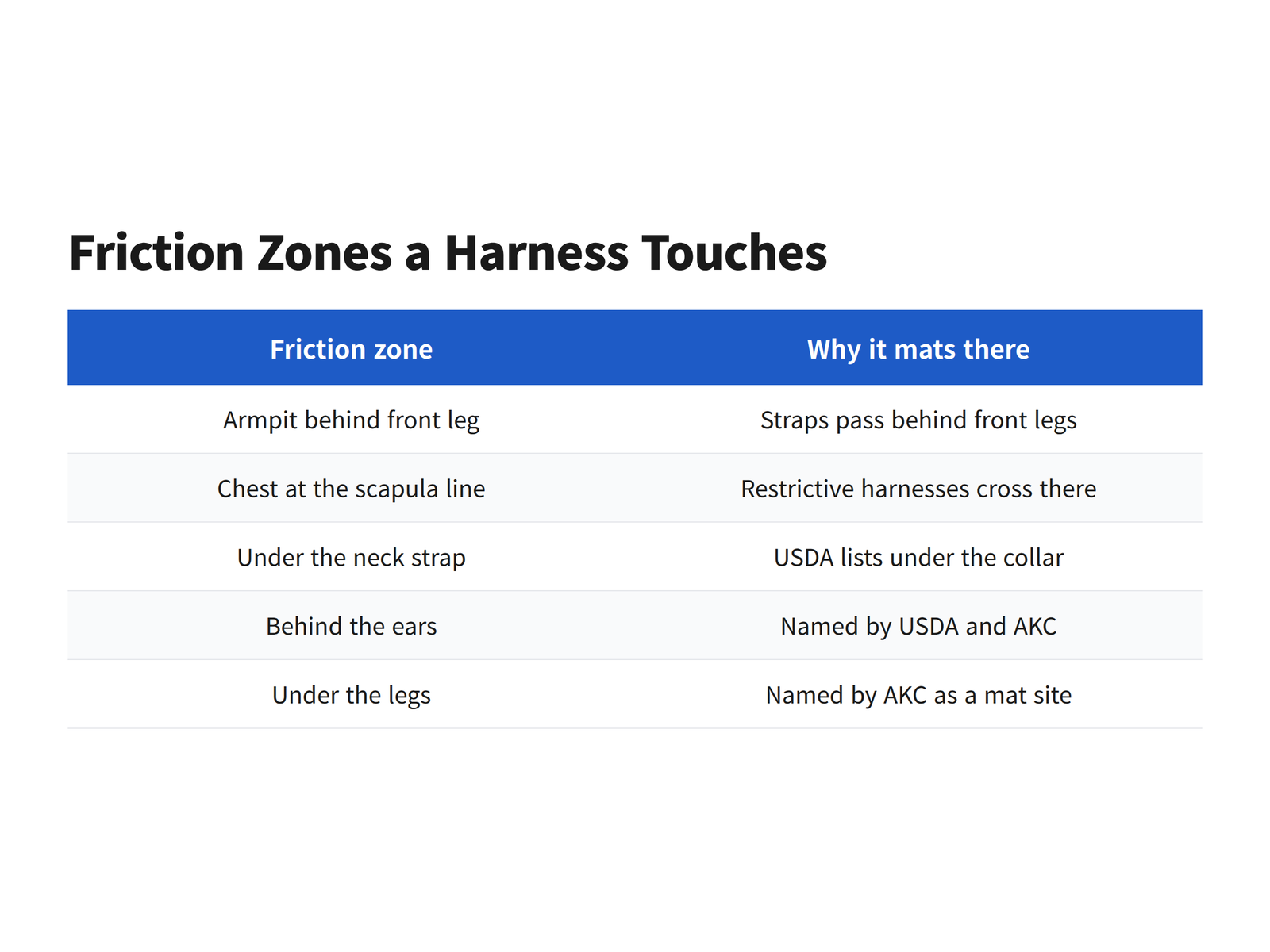
Mats form where the coat is rubbed and compressed, and those spots are already documented. USDA APHIS Animal Care states that “Mats are commonly found under the collar, behind the ears, and in the armpits—areas where there is rubbing.” The American Kennel Club adds a second list in its 2026-09-02 home grooming guide: “Mats commonly develop behind the ears and under the legs.” Neither organisation blames a harness. Both describe friction, and a harness supplies it.
Strap geometry decides which of those zones a harness touches. A peer-reviewed gait study published in PLOS ONE on 2022-03-09 separates non-restrictive designs, where a Y-shaped chest strap passes above the shoulder blade, from restrictive designs, where the strap crosses at or below the scapula. A horizontal strap therefore lies along the scapula line and holds the same band of coat for the whole walk.
Why does daily brushing still miss the mats under a harness?
Daily brushing fails on these spots because it is a coverage problem, not a frequency problem. The American Kennel Club notes that long-coated breeds “often do best with daily brushing,” and The Kennel Club puts longhaired grooming at as much as once a day against two or three times a week for smooth coats. Owners of a Shih Tzu or a Yorkshire terrier are usually already doing that. A fast daily pass covers the back, flanks and tail, because that is where a brush glides.
The armpit and the inner thigh resist a glide. The leg has to be lifted, the coat parted, and the tool has to reach skin rather than skim the surface. A coat can look finished from above while a felted pad sits in the axilla.
Does a comb find mats that a slicker brush leaves behind?
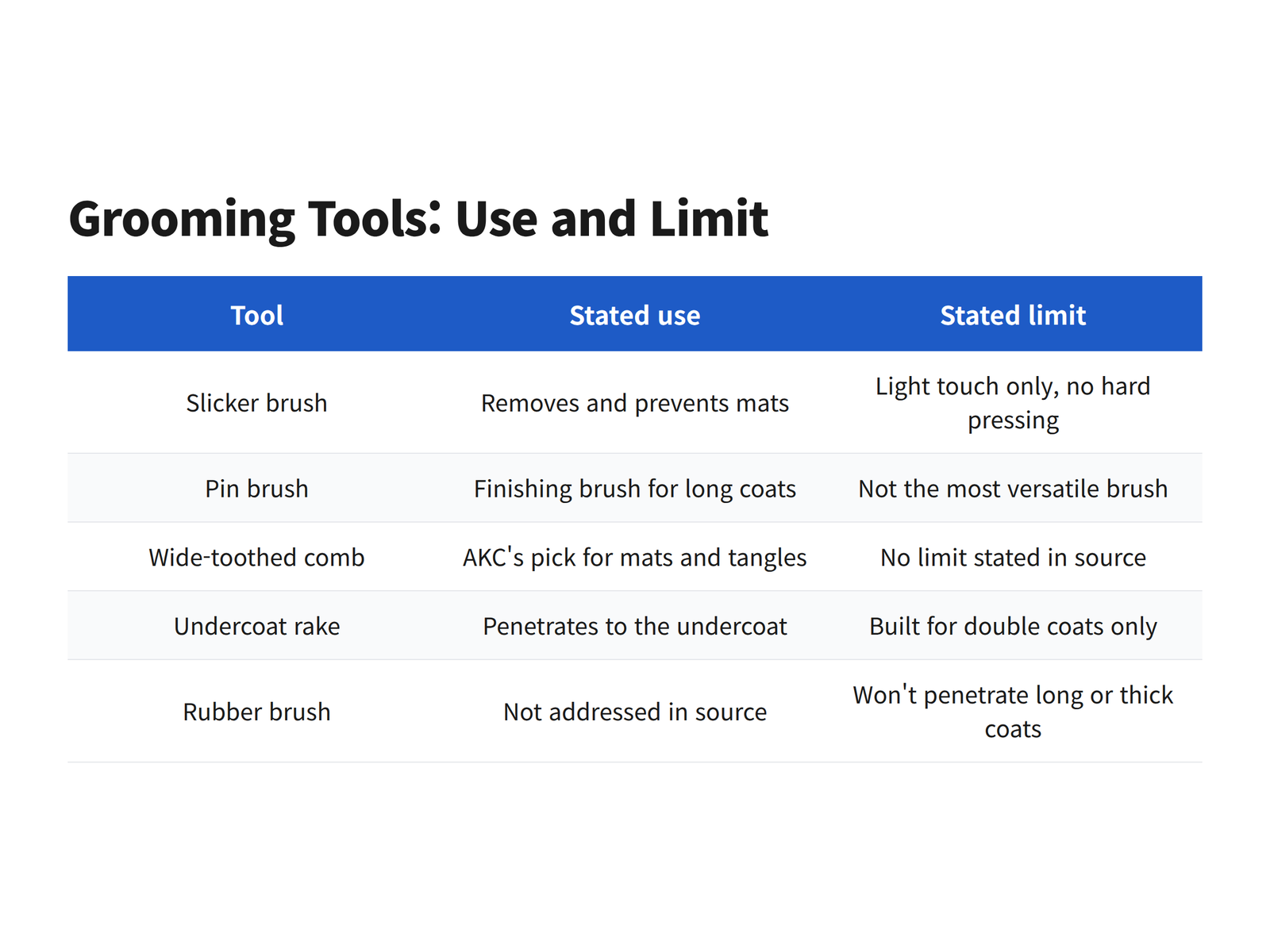
A wide-toothed comb is the tool the American Kennel Club names for mats and tangles, and a comb is the honest test. In its 2026-03-03 brush guide, the AKC describes the slicker brush as removing mats and preventing them by lifting loose hair, while warning owners to “Maintain a light touch … pressing down hard could cause your dog discomfort.” A slicker that skates over a pad has not removed it.
The other tools have stated limits worth respecting. A pin brush is a finishing brush for long coats, and the AKC says pin brushes “aren’t the most versatile of brushes.” An undercoat rake is built to “penetrate through to the undercoat” on double coats. A rubber brush “won’t penetrate through long or thick coats,” which rules it out for a Pomeranian or a longhaired dachshund.
Which friction zone needs which check?
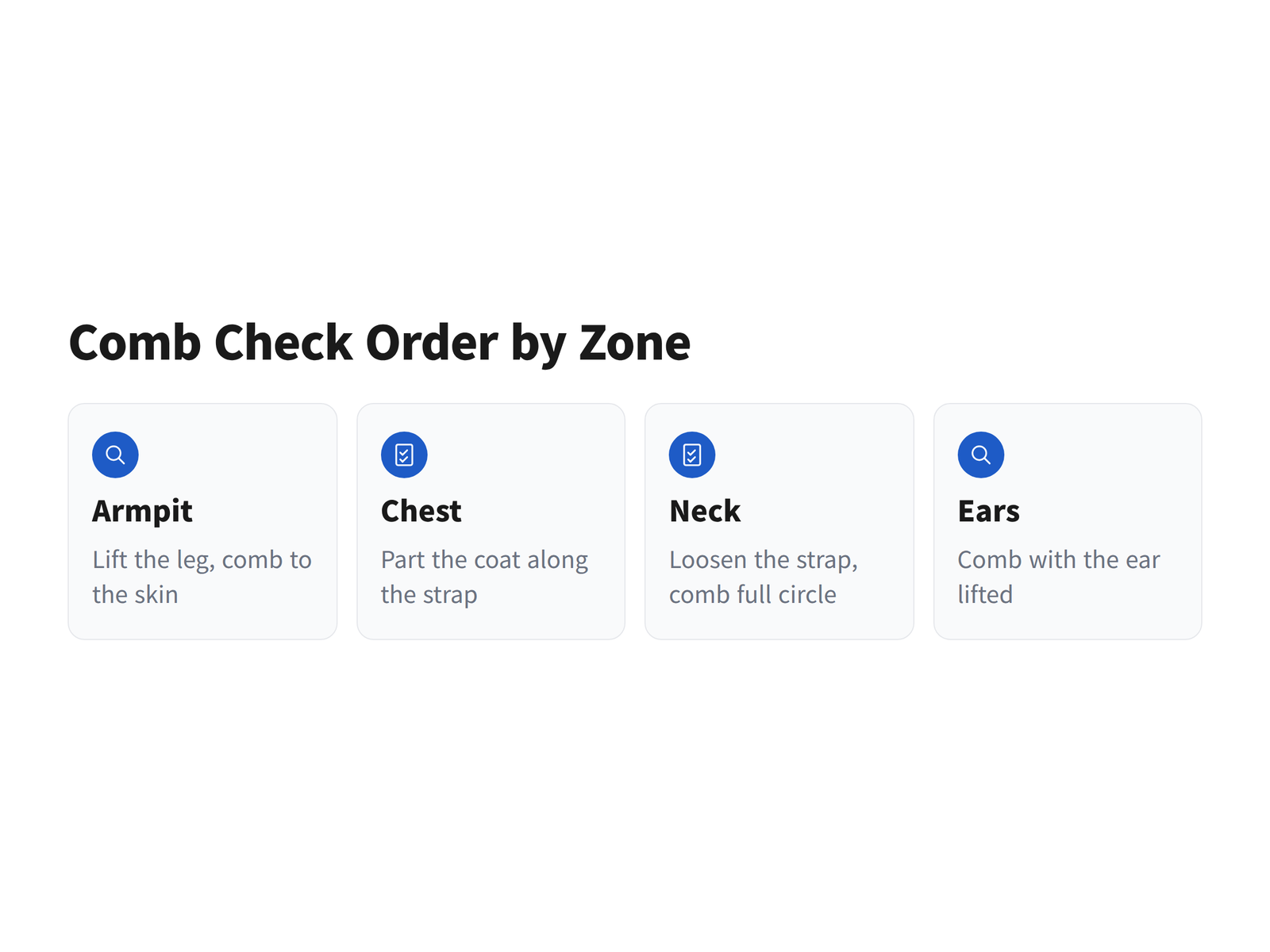
Each zone needs a different check because each one hides the coat differently. The armpit hides behind a leg, the scapula line hides under a strap, and the area behind the ears hides under the ear leather itself. The table below pairs the five rubbing spots named by USDA APHIS Animal Care and the American Kennel Club with the movement that exposes each one.
| Friction zone | Why the coat mats there | What actually checks it |
|---|---|---|
| Armpit behind front leg | USDA APHIS names it a rubbing zone; straps pass behind the front legs | Lift the leg and comb to the skin |
| Chest at the scapula line | Restrictive harnesses cross at or below the scapula | Part the coat along the strap line |
| Under the neck strap | USDA APHIS lists “under the collar” | Loosen the strap and comb the full circle |
| Behind the ears | Named by both USDA APHIS and the AKC | Wide-toothed comb with the ear lifted |
| Under the legs | Named by the AKC as a common mat site | Comb the inner thigh and groin edge |
How tight should a harness be on a longhaired small dog?
The American Kennel Club gives a two-finger rule: “you should be able to fit two fingers under the straps.” That 2022-02-16 guidance is the one measurable standard in this topic. Lori Stevens, a professional dog trainer and certified animal behaviour consultant, told the AKC that “an incorrectly fit harness can do a lot of damage both physically and behaviorally.” Dr Chris Zink, a canine sports medicine veterinarian, described “overuse soft tissue injuries due to abnormal pressures or compensatory muscle overuse” in the same article.
No harness style wins outright. The PLOS ONE pilot study concluded there is “no absolute superior harness,” while confirming that harness design significantly affects gait parameters. Padded panels and Y-front chest straps are both worth looking at, but no peer-reviewed source ranks harness materials by matting. Whether a padded panel helps or simply widens the contact band depends on chest depth and coat density.
Why is a damp coat under a harness worse than a dry one?
Moisture makes an existing tangle tighter, so the order of operations matters. Blue Cross is direct about it: “Detangle any matts before washing as they will only get worse during shampooing.” A harness buckled over a coat still damp from a bath or from rain compresses hair that is already clumping.
Washing more often is not a workaround either. The American Kennel Club warns that bathing too frequently strips the natural oils from skin and coat, which leaves a long coat drier and readier to catch on itself. Dry the coat, comb the friction zones, and fit the harness last.
What can a mat hide underneath it?
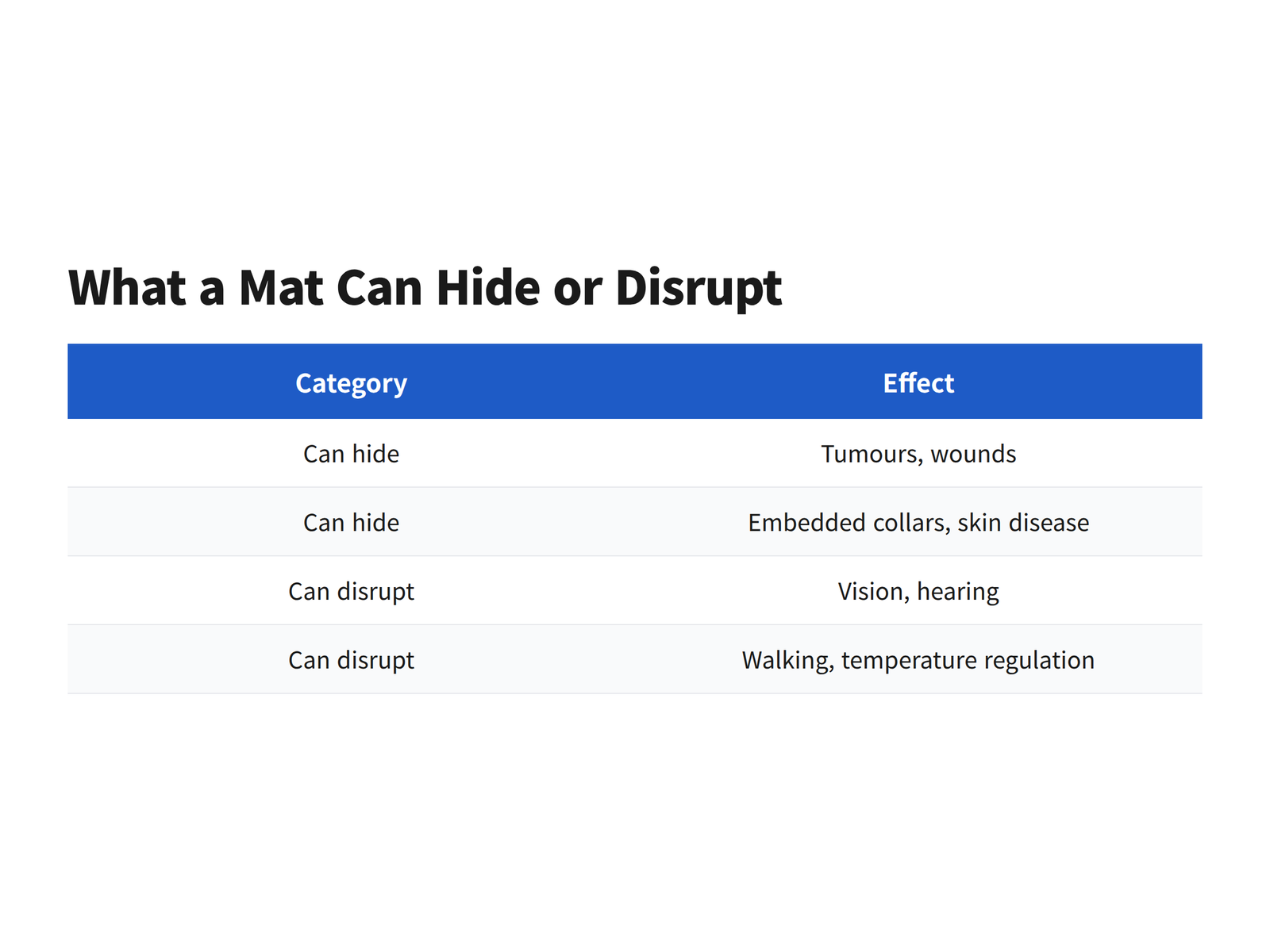
A tight mat is not only a grooming issue, and USDA APHIS Animal Care spells out why. The agency lists pain and skin irritation, and notes that matted hair conceals tumours, wounds, embedded collars and skin disease. It also lists interference with vision, hearing, walking and body temperature regulation.
That is where grooming stops and veterinary judgement starts. If the skin under a mat is red, raw, weeping or sore to touch, or if a dog flinches when the area is handled, consult your veterinarian rather than working on it at home. This article covers coat care and harness fit and is not a substitute for veterinary diagnosis.
When should a matted coat go to a groomer instead of being brushed out?
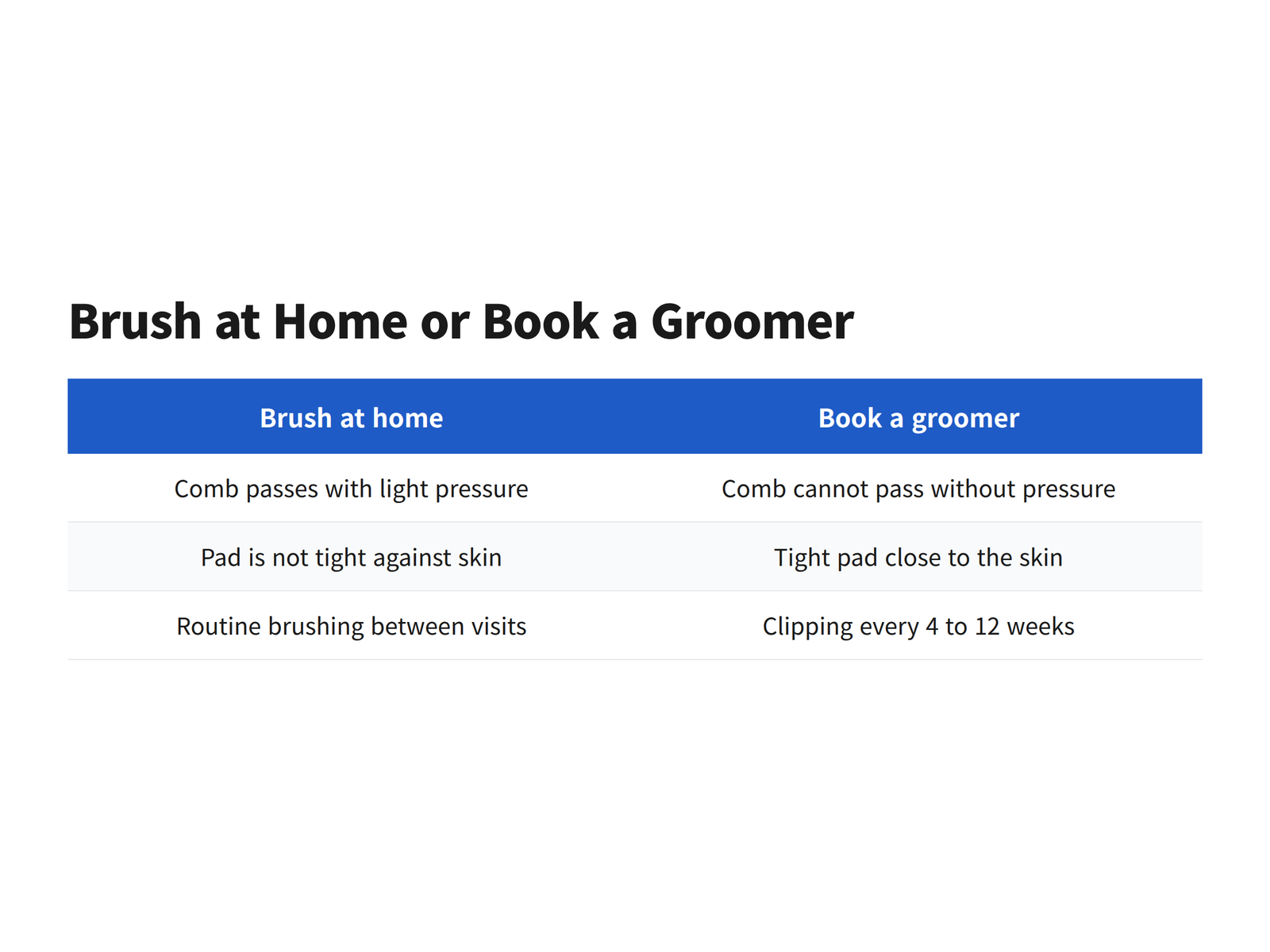
Hand the coat over once a comb cannot pass under the mat without pressure. The American Kennel Club’s instruction to keep a light touch is the practical threshold, because force is where a grooming session turns into a pain problem. Tight pads close to the skin on a Maltese or a Havanese come off with clippers, not with a brush and persistence.
Blue Cross describes clipped coats being maintained every 4 to 12 weeks, with routine brushing between appointments. For a longhaired small dog that wears a harness most days, booking inside that window is easier than rescuing a coat afterwards. A groomer working on the chest and armpits can also see skin changes along a strap line that stay invisible from above.
Frequently asked questions
Does a harness cause matting? No authoritative source says so. USDA APHIS Animal Care identifies rubbing zones, and harness straps run across them. The AKC’s 2026-03-04 harness and collar comparison does not mention matting.
Should the harness come off indoors? No organisation cited here publishes a recommended off-time, so treat any fixed number as unverified. Combing the strap zones after each walk is the documented part.
Is a padded harness better for a long coat? No peer-reviewed source compares harness materials by matting rate. The PLOS ONE study found no absolute superior harness, so fit and post-walk combing matter more than the panel.
How tight is too tight? Two fingers should slide under the straps, per the American Kennel Club. Straps that flatten a parted line in the coat or rub hair thin are too tight.
Sources
- USDA APHIS Animal Care, “Coat Care: Preventing Matted Hair” (Animal Care Aid AC-18-001), published 2018-10, reviewed 2024-02 — https://aphis.prod.usda.gov/sites/default/files/AC-Aids-for-Dogs_Coat-Care-Preventing-Matted-Hair_0.pdf
- American Kennel Club, “Dog Grooming at Home: Brushing, Bathing, and Nail Care,” updated 2026-09-02 — https://www.akc.org/expert-advice/health/how-to-groom-a-dog/
- American Kennel Club, “Dog Brushes: How to Choose the Right Dog Brush for Your Pet,” 2026-03-03 — https://www.akc.org/expert-advice/health/types-dog-brushes-shedding/
- American Kennel Club, “Dog Harness Sizes: The Importance of a Well-Fitting Dog Harness,” 2022-02-16 — https://www.akc.org/expert-advice/lifestyle/the-importance-of-a-well-fitting-harness/
- American Kennel Club, “Dog Harnesses and Dog Collars: Which Is Right For Your Dog?,” 2026-03-04 — https://www.akc.org/expert-advice/training/dog-harness-vs-collar/
- Blue Cross, “How to groom a dog,” 2017-07-26 — https://www.bluecross.org.uk/advice/dog/how-to-groom-a-dog
- The Kennel Club (Royal Kennel Club), “How to groom my dog?,” accessed 2026-09-19 — https://www.royalkennelclub.com/health-and-dog-care/health-dog-care/health/health-and-care/a-z-of-health-and-care-issues/dog-grooming
- Pálya Z., Rácz K., Nagymáté G., Kiss R., “Development of a detailed canine gait analysis method for evaluating harnesses: A pilot study,” PLOS ONE, 2022-03-09, DOI 10.1371/journal.pone.0264299 — https://journals.plos.org/plosone/article?id=10.1371/journal.pone.0264299