Firework season and dark autumn evenings are when a startled small dog slips a gate and disappears. The microchip between that dog’s shoulder blades is supposed to solve that, and frequently it does not. Shelter research points at the same culprit every time: the implant works, and the record attached to the number does not. What follows is the documented breakdown of those failures, the separate legal duty that survives microchipping in Great Britain, and a check that fits into one evening.

Why is a microchipped dog still not returned to its owner?
Because the contact record behind the chip number is wrong, not because the implant failed. A pet microchip is a passive radio-frequency identification implant that returns a number only, and everything after that number depends on a database entry a human has to keep current. Shelters log the outcome plainly: a microchipped dog not returned to owner.
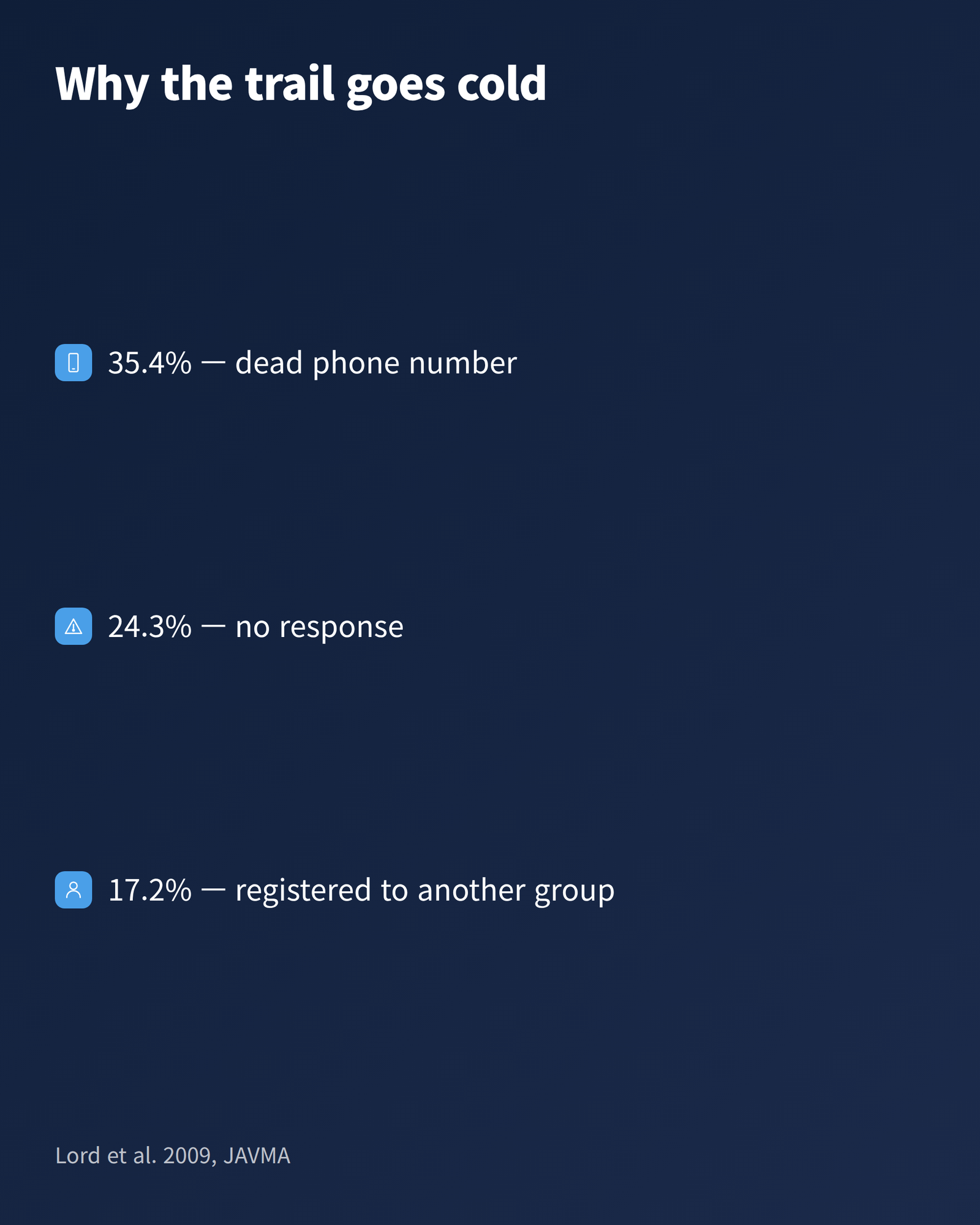
Lord et al., in the Journal of the American Veterinary Medical Association in 2009, examined stray animals entering United States shelters. Microchipped stray dogs were reclaimed at 74.1 percent, or 2,191 of 2,956 animals, yet 876 microchipped animals had no findable owner. An incorrect or disconnected telephone number explained 35.4 percent of those cases, 310 animals. Another 24.3 percent, 213 animals, involved an owner who never answered calls or a letter, and 17.2 percent, 151 animals, were registered to a different group.
What is the difference between implanting a microchip and registering it?
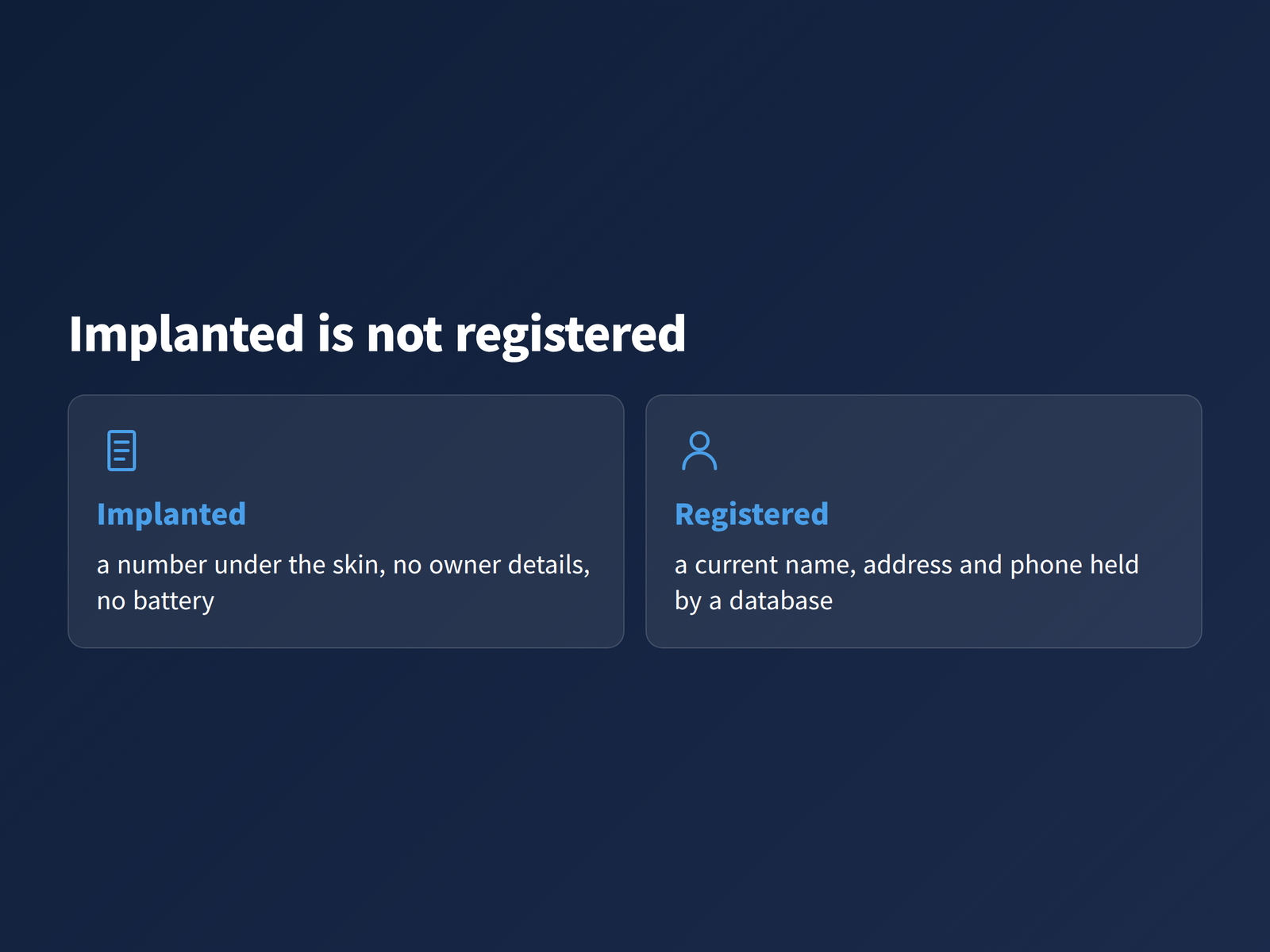
Implantation places the number under the skin; registration links that number to a current keeper record, and only registration sends a dog home. The American Veterinary Medical Association states that “the U.S. is the only country in which microchip implantation and microchip registration are often separate processes.” Linda Lord, then assistant professor of veterinary preventive medicine at The Ohio State University, named the consequence: “We really need to focus on not separating the microchip implantation process from registration.”
The two published figures for that gap do not measure the same thing. The American Veterinary Medical Association, citing Lord et al., reports that 58.1 percent of microchipped animals were actually registered when shelters searched. The Ohio State University news release for the same study reports that 9.8 percent of the chips were unregistered. Those percentages use different denominators and belong side by side, not added or averaged.
Is your small dog’s microchip still registered to the breeder?
Very possibly, because the breeder is normally the first registered keeper and the record changes only when the new keeper changes it. The Microchipping of Cats and Dogs (England) Regulations 2023, SI 2023/468, require a dog to be microchipped and registered on a compliant database by 8 weeks of age. The same regulations require the database record to show “if the keeper is also the breeder of that dog, that fact.”
That is why a Yorkshire Terrier or Maltese puppy bought from a breeder usually arrives with a database entry naming the breeder rather than the buyer. SI 2023/468 puts the correction on the new keeper, who must record “their full name, address and contact telephone number (if any) and any changes” with the database operator. Lancaster et al., in Animals in 2015, found 47 percent of problem chips at RSPCA Queensland shelters registered to a previous owner or an organisation. In England an enforcement notice gives 21 days to comply, and failure carries a fine of up to £500 at level 2 on the standard scale.
Does a microchip replace a collar and tag?
In Great Britain, no. The Control of Dogs Order 1992 sets a duty that survives microchipping entirely: “Every dog while in a highway or in a place of public resort shall wear a collar with the name and address of the owner inscribed on the collar or on a plate or badge attached to it.” Article 2 then lists a closed set of exemptions covering working packs, sporting and vermin-control dogs, livestock work, Armed Forces, Customs and police duty, emergency rescue and Guide Dogs for the Blind Association registered dogs. Being microchipped is not on that list.
Two duties therefore run in parallel in England: the SI 2023/468 registration duty and the 1992 collar duty. The Control of Dogs Order 1992 applies in Great Britain only, and the United States has no single national equivalent, so readers elsewhere should confirm the local rule.
Can a scanner miss your dog’s microchip?
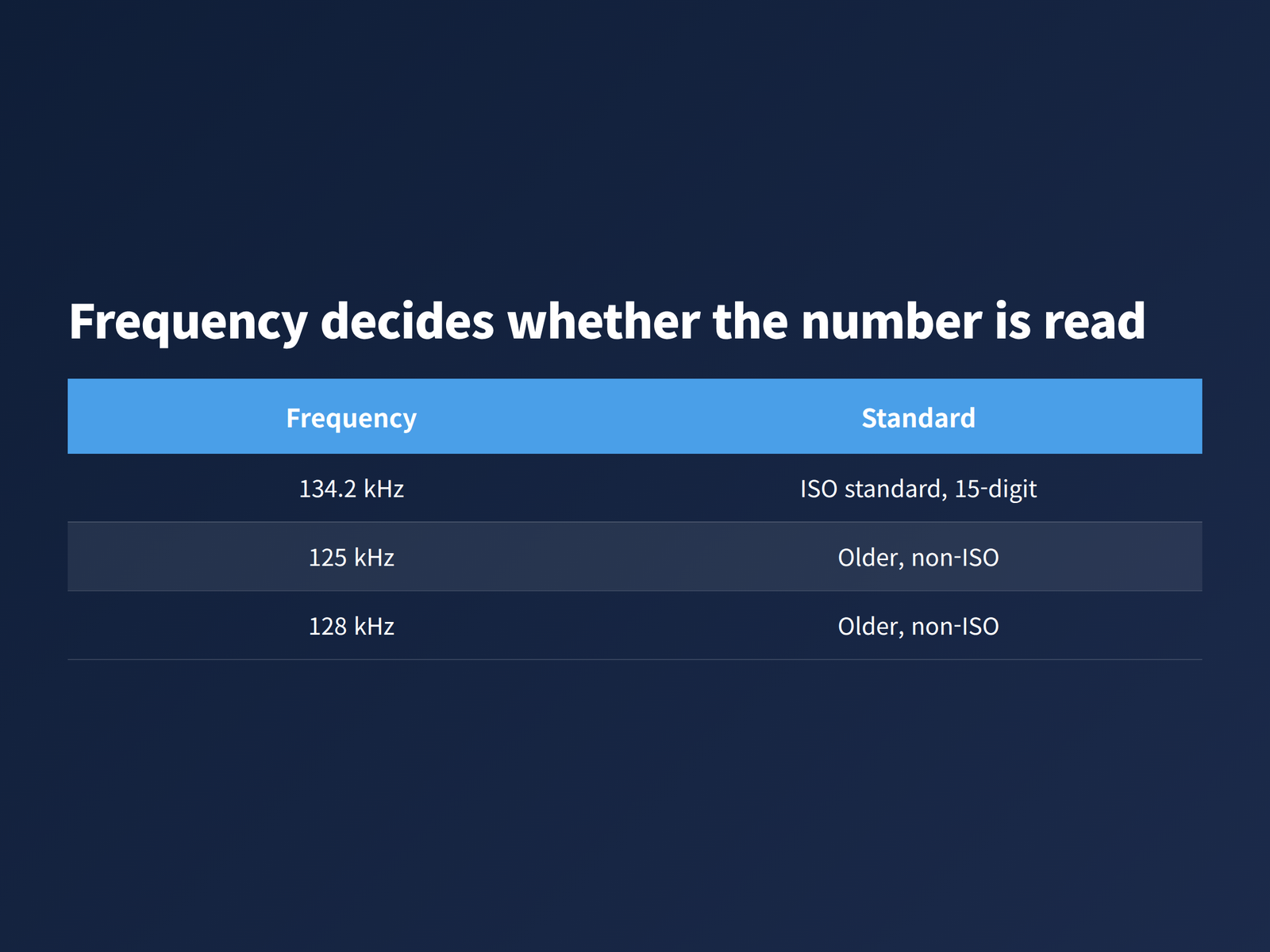
Yes, and the cause is hardware. The American Veterinary Medical Association states that “scanners manufactured to detect only 125-kHz microchips cannot read or determine the presence of ISO microchips.” ISO 11784 and ISO 11785, implemented in 1996, define the 134.2 kHz standard and its 15-digit code, while 125 kHz and 128 kHz chips remain in circulation in the United States. A USDA-APHIS figure cited by the American Veterinary Medical Association for 2007 put United States pet microchipping at 3 to 5 percent of pets, with 98 percent of those on 125 kHz.
Placement is the second hardware problem. The American Veterinary Medical Association describes migration as the most commonly reported complication and notes that “it can make the chip more difficult to find if a complete scan is not performed.” Consult your veterinarian, who can scan your dog and check the implant site; the American Veterinary Medical Association recommends an annual scan.
How often does each identification status actually get a dog home?
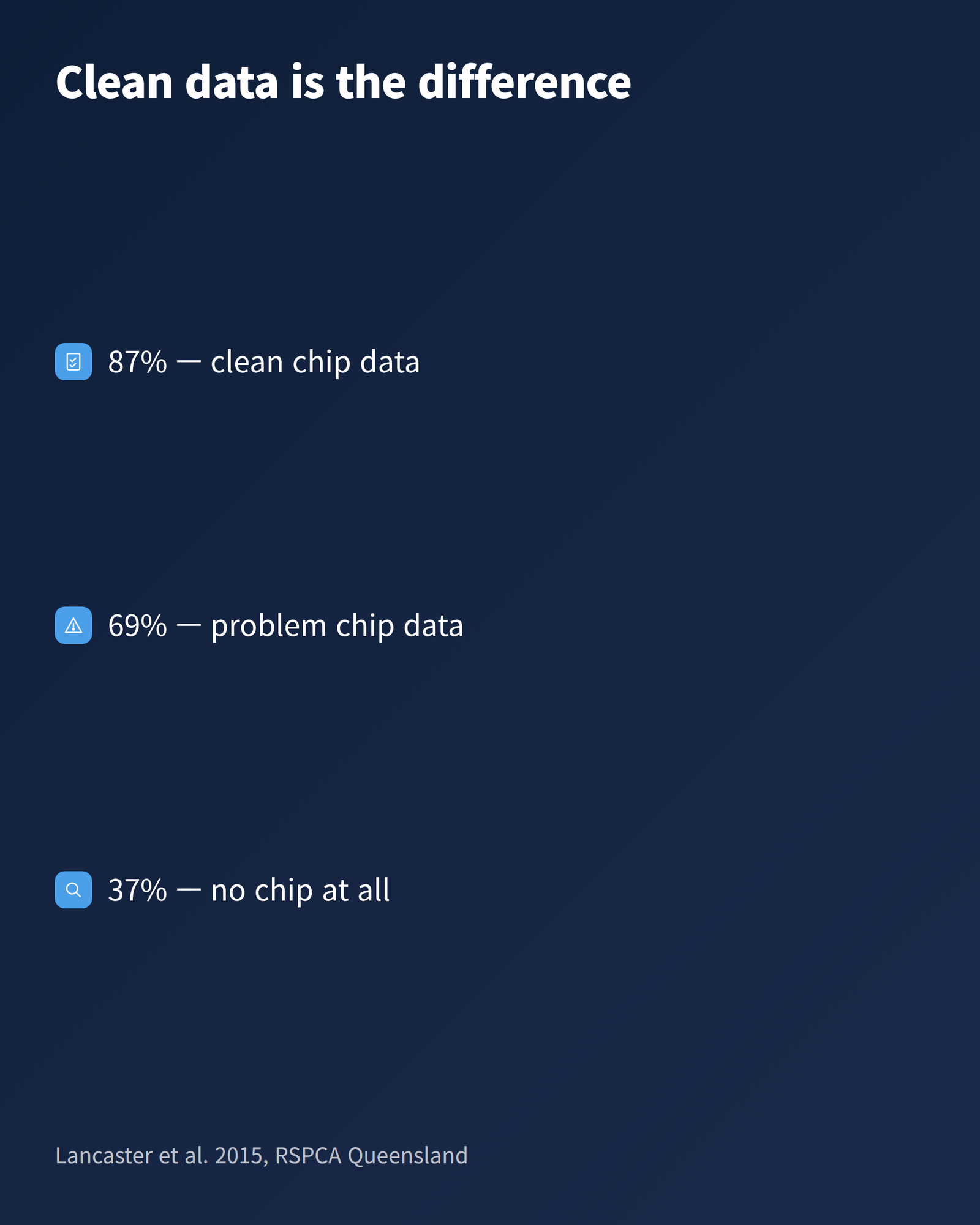
Reclaim rates rise sharply once the chip data is clean, and two separate studies show it. Read the table as two blocks, because the rows come from different countries, years and study designs.
| Identification status | Dogs reclaimed by owner | Source |
|---|---|---|
| Microchip, no data problems | 87% | Lancaster et al. 2015 |
| Microchip with data problems | 69% | Lancaster et al. 2015 |
| No microchip at all | 37% | Lancaster et al. 2015 |
| Microchipped strays, US shelters | 74.1% | Lord et al. 2009 |
| Microchipped animals actually registered | 58.1% | AVMA, citing Lord et al. |
Rows one to three come from RSPCA Queensland shelters, where Lancaster et al. recorded 28 percent of the 7,258 arriving stray dogs as microchipped and 37 percent of those as carrying a data problem. Rows four and five come from the United States shelter study, and no combined figure should be calculated across the two blocks.
What should you check before firework season starts?
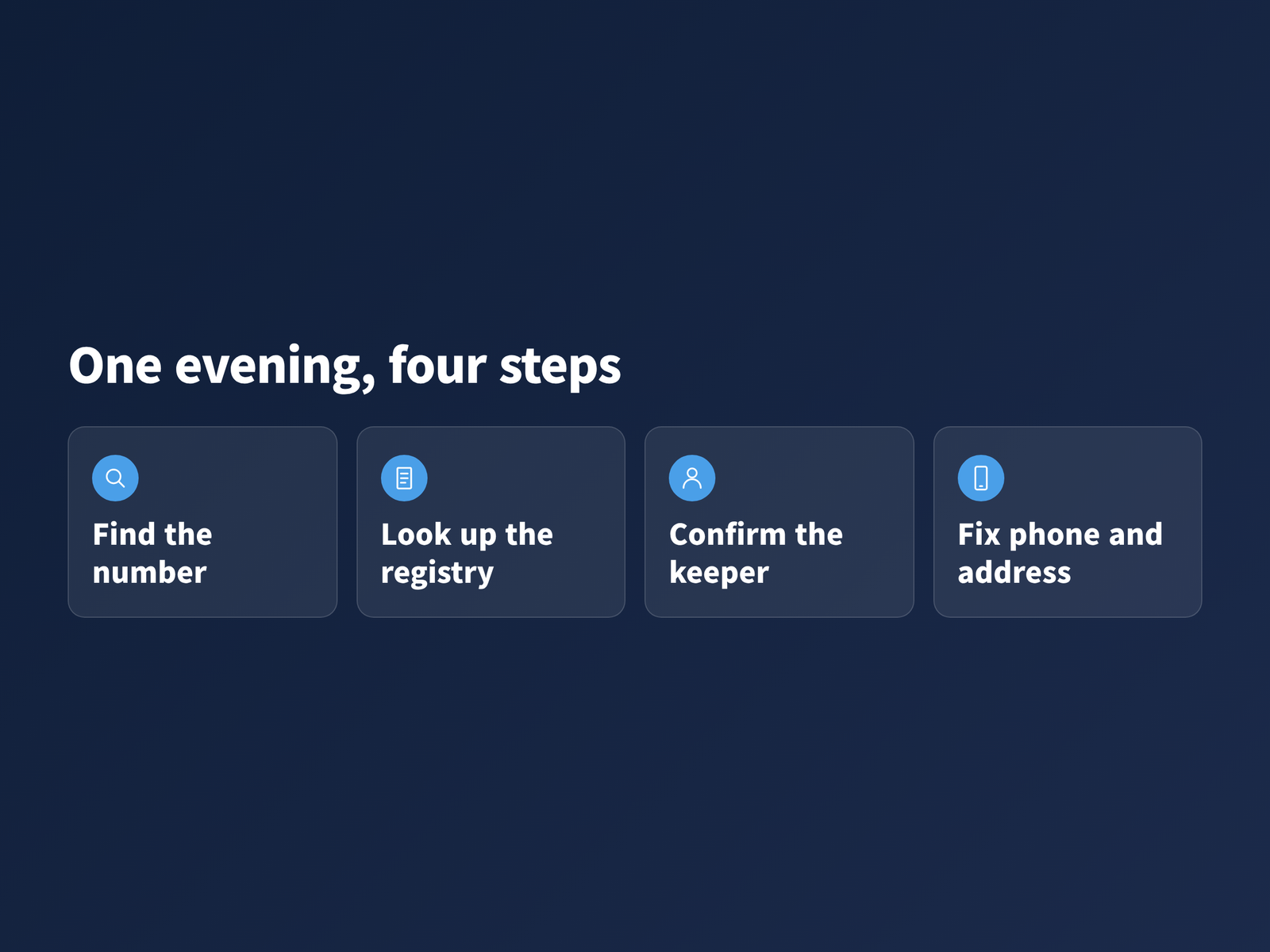
Four steps, and only the first may need a veterinary appointment. Blue Cross states the task plainly: “make sure your dog is microchipped and your information is up to date so your dog can be returned to you if they are spooked by fireworks and run off.” The RSPCA cites a 2025 Savanta poll in which nearly two-thirds of responding dog owners said fireworks affected their dog negatively, from a survey programme with more than 14,000 responses collected between 2021 and 2024.
- Find the 9, 10 or 15-digit number on your paperwork, or have a veterinary practice scan your dog.
- Enter that number in the AAHA Microchip Registry Lookup Tool, which directs users to participating microchip registries.
- Contact the registry the lookup names and confirm the record shows you, not the breeder, rescue or previous owner.
- Correct the telephone number and address held by that registry, and check the collar tag carries what local law requires.
The American Animal Hospital Association is direct about where the duty sits: “It’s the owner’s responsibility to make sure that information is up to date.”
What does a dog microchip not do?
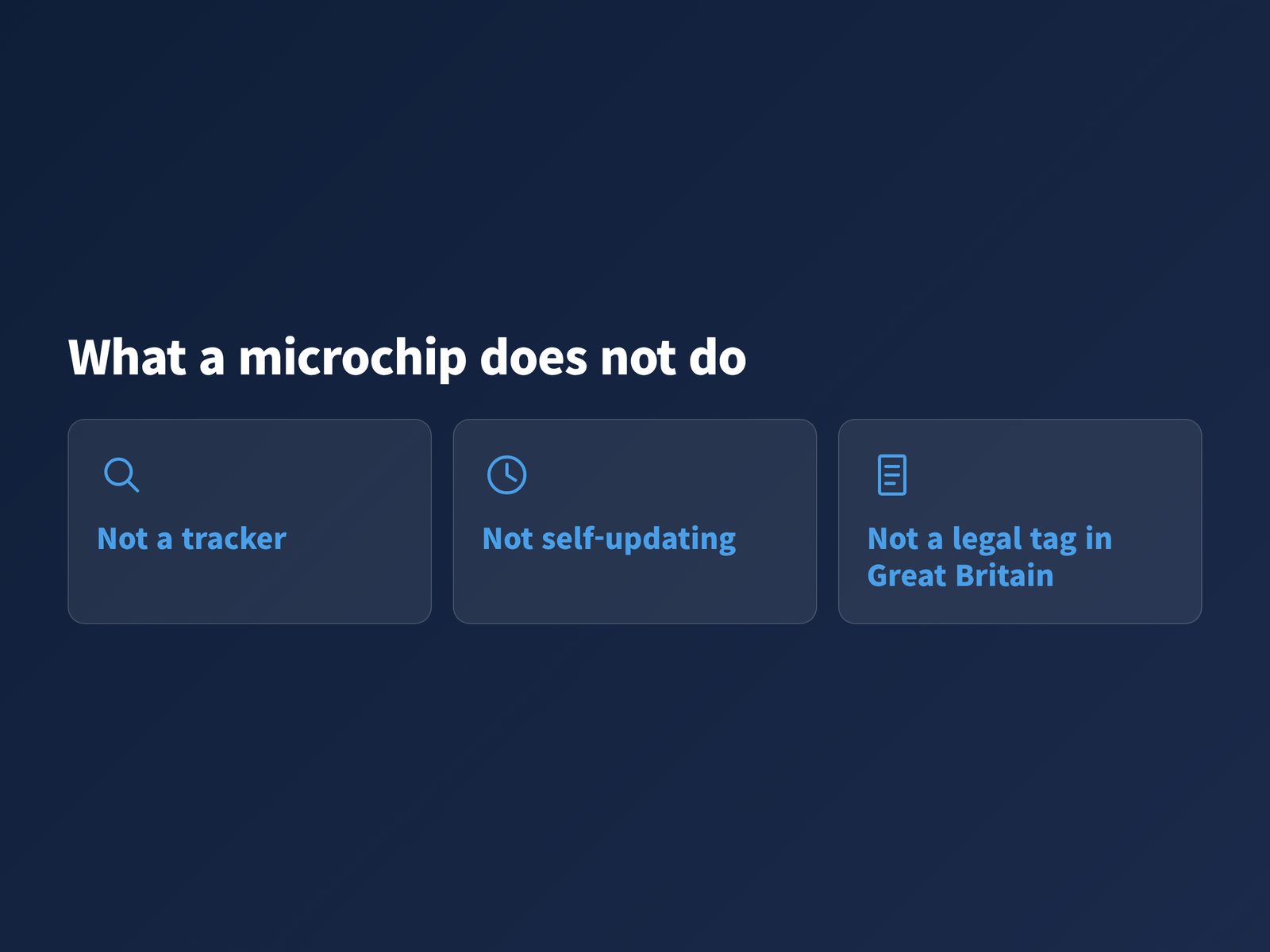
A pet microchip stores no owner details, carries no battery and cannot report a location. That boundary is where most pages on the subject stop short.
- A microchip is not a tracker; it is passive and returns a number when a scanner powers it.
- An unregistered microchip returns a number that leads nowhere.
- A microchip does not update itself when you move house or change your phone.
- A microchip does not discharge the Control of Dogs Order 1992 collar duty in Great Britain.
- A microchip does not guarantee a read by whatever scanner reaches your dog first.
Frequently asked questions
Can a veterinary practice change the microchip details?
The record belongs to the database operator, not the practice. SI 2023/468 places the duty on the keeper to record their full name, address and telephone number with that operator. A practice can scan your dog and read the number back, but the entry is yours to correct.
The chip is registered to a previous owner who cannot be reached. Is that common?
It is the commonest failure of all. Lancaster et al. 2015 found 47 percent of problem chips registered to a previous owner or an organisation, and Lord et al. 2009 recorded 17.2 percent of unreunited United States animals as registered to another group. Use the AAHA lookup tool to find which registry holds the number.
Is an unregistered microchip worth anything?
Very little on its own. Lancaster et al. 2015 found 14 percent of problem chips had never been registered, and the American Veterinary Medical Association reports that only 58.1 percent of microchipped animals were registered when shelters searched.
How often should a microchip be scanned?
The American Veterinary Medical Association recommends an annual scan. Any concern about the implant site is a question for your veterinarian.
Sources
- American Veterinary Medical Association, “Microchipping of animals”, read 2026-09-21 — https://www.avma.org/resources-tools/animal-health-and-welfare/microchipping-animals
- American Veterinary Medical Association, “Microchipping: FAQs for pet owners”, read 2026-09-21 — https://www.avma.org/resources-tools/pet-owners/petcare/microchips-reunite-pets-families/microchipping-faq
- American Animal Hospital Association, “How to Update Microchip Details: The First Step in Lost Pet Prevention”, read 2026-09-21 — https://www.aaha.org/resources/how-to-update-microchip-details-the-first-step-in-lost-pet-prevention/
- GOV.UK, “Get your dog or cat microchipped”, read 2026-09-21 — https://www.gov.uk/get-your-dog-microchipped
- The Microchipping of Cats and Dogs (England) Regulations 2023, SI 2023/468, in force 2023-04-25 — https://www.legislation.gov.uk/uksi/2023/468/body/made
- Control of Dogs Order 1992, article 2 — https://www.legislation.gov.uk/uksi/1992/901/article/2/made
- RSPCA, “Keeping dogs, cats and other small pets safe during fireworks”, read 2026-09-21 — https://www.rspca.org.uk/adviceandwelfare/fireworks/pets
- Blue Cross, “Dogs and fireworks”, read 2026-09-21 — https://www.bluecross.org.uk/pet-advice/dogs-and-fireworks-how-keep-your-dog-happy-during-fireworks-season
- Lord LK, Ingwersen W, Gray JL, Wintz DJ, “Characterization of animals with microchips entering animal shelters”, JAVMA 2009;235(2):160-167 — https://pubmed.ncbi.nlm.nih.gov/19601734/
- Lancaster E, Rand J, Collecott S, Paterson M, “Problems Associated with the Microchip Data of Stray Dogs and Cats Entering RSPCA Queensland Shelters”, Animals 2015;5(2):332-348 — https://www.mdpi.com/2076-2615/5/2/332
- The Ohio State University, “Microchips Result In Higher Rate Of Return Of Shelter Animals To Owners” — https://news.osu.edu/microchips-result-in-higher-rate-of-return-of-shelter-animals-to-owners/