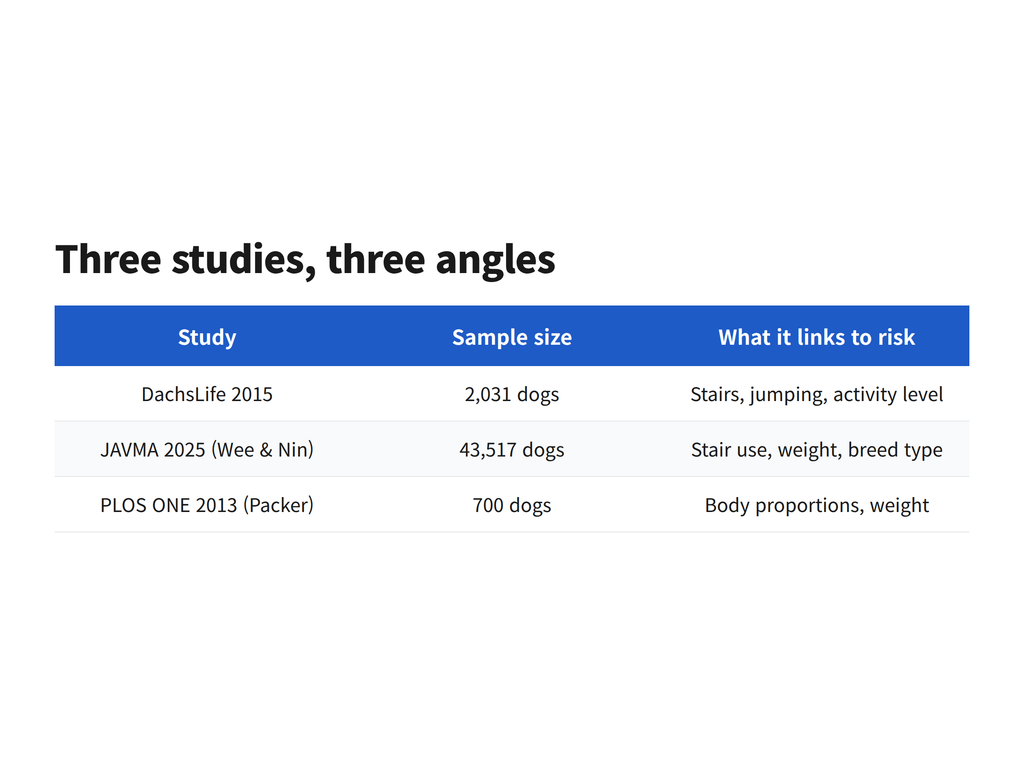
Most dachshund advice opens with a ban: no stairs, no sofa. The largest published data sets point the other way. In DachsLife 2015, a survey of 2,031 dachshunds, dogs over the age of 3 allowed to jump on and off furniture daily had lower odds of intervertebral disc disease than dogs not allowed to. A 2025 analysis of 43,517 US dogs listed regular staircase use among protective factors. None of that proves the habits are the reason.

Is jumping off the couch bad for a dachshund?
The published evidence does not support a blanket ban for a healthy adult dachshund, and cannot declare jumping harmless either. Packer and colleagues, reporting DachsLife 2015 in Canine Genetics and Epidemiology on 2016-11-05, wrote that “dogs who were not allowed to jump on and off furniture were at an increased odds of IVDD”. Dachshund Health UK reports the same result for dachshunds over the age of 3.
Two limits travel with that finding. It was measured at one moment in time, so owners restricting a dog that was already affected would produce the same numbers. Dachshund Health UK also states that a dachshund already diagnosed with disc degeneration faces elevated re-injury risk if allowed to jump. Before changing the routine of a dachshund with any history of back trouble, consult your veterinarian rather than a survey average.
Do dachshunds really need to avoid stairs?
Published guidance and published survey data disagree, and one organisation carries both sides. The Dachshund Health UK information library advises owners to “avoid the sudden compressive forces on the spine that result from going down stairs wherever possible”. Its own DachsLife 2015 survey found dachshunds not using stairs daily trending toward higher odds of intervertebral disc disease.
That trend did not reach the study’s own significance threshold of P < 0.001, so it is a signal rather than a result. The wider picture is similar. Wee and Nin, publishing 43,517 owner-reported records in the Journal of the American Veterinary Medical Association on 2025-01-15, listed regular staircase use among protective factors for the whole cohort. Whether the same holds inside the dachshund subgroup was not reported.
What did the largest dachshund lifestyle study actually find?
DachsLife 2015 surveyed 2,031 dachshunds and identified 310 with intervertebral disc disease, a prevalence of 15.7%. The strongest patterns were not about furniture. Entire dogs had lower odds than neutered dogs, at an odds ratio of 0.6 with a 95% confidence interval of 0.5 to 0.9. The highest-odds age band was 8 to 10 years against 0 to 2 years, and living with two or more other dachshunds halved the odds against a single-dog household.
Packer and colleagues concluded that the results “can inform an evidence-based approach to advising Dachshund owners as to which activities to avoid or promote”. Associated, not caused, is the operative word.
Does being overweight raise the risk for a long-backed dog?
The three data sets disagree, so the answer is a range rather than a verdict. Wee and Nin reported an odds ratio of 1.67, with a 95% confidence interval of 1.38 to 2.01, for overweight dogs across 43,517 records. Packer and colleagues, writing in PLOS ONE on 2013-07-24 about 700 dogs of which 79 had thoracolumbar disc extrusion, stated that “IVDE risk is increased in obese dogs, but in high-risk breeds (as exemplified here by the Miniature Dachshund), even being moderately overweight increases the risk”. DachsLife 2015 could not replicate that association.
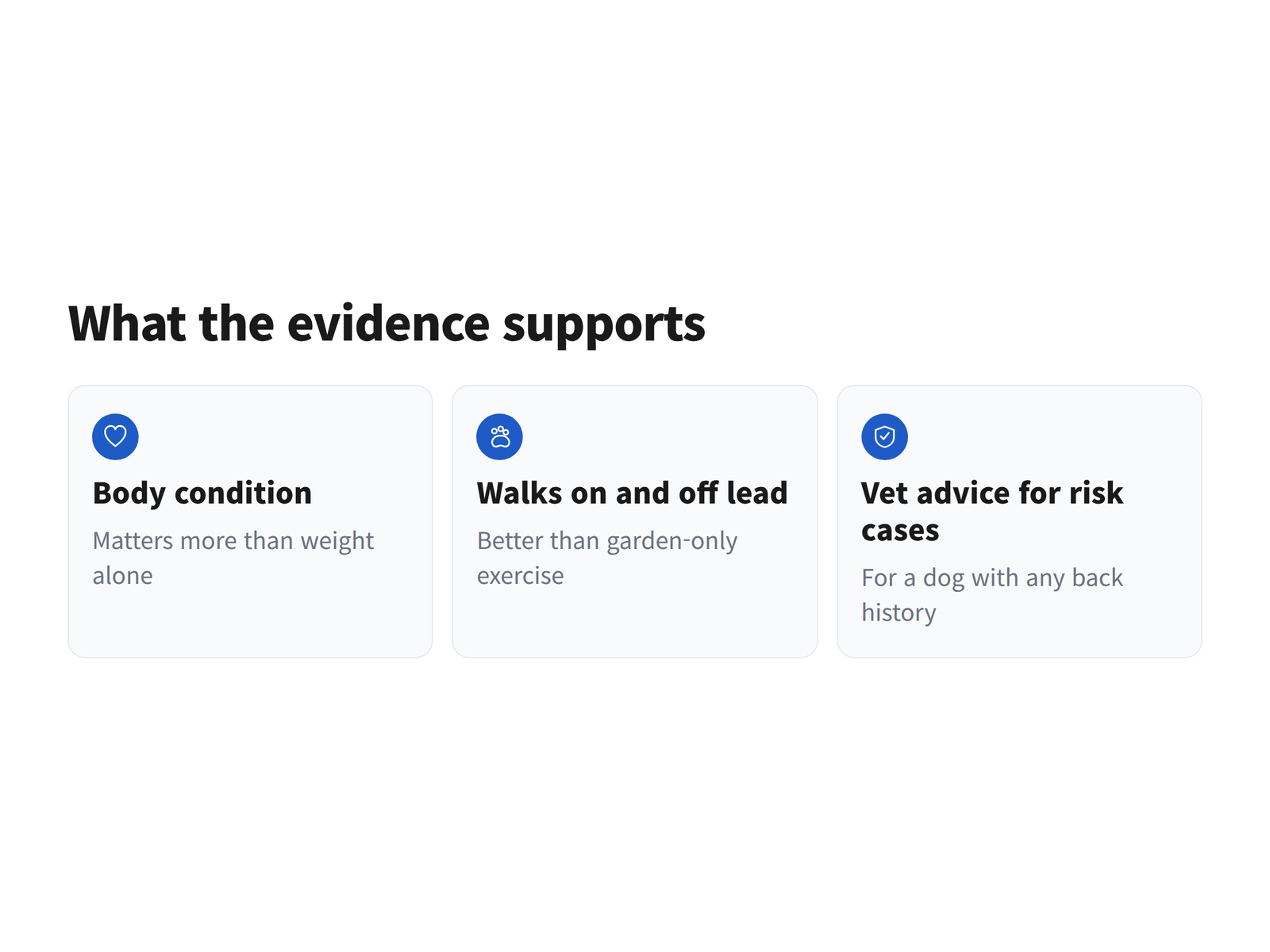
Body proportions split the same way. The 2013 conformation study put the predicted probability of disc extrusion at 0.30 for a back-length to height ratio of 1.1, rising to 0.68 at a ratio of 1.5 in Miniature Dachshunds, with smaller skeletal size also associated with higher risk at p = 0.002. DachsLife 2015 found no such association. Dachshund Health UK keeps the practical line short: “your dog’s Body Condition Score is more important than what it weighs”.
How much daily exercise do the data actually support?
DachsLife 2015 associated more movement with lower odds, not more. Among dachshunds over the age of 3, dogs described as highly or moderately active “were half as likely to have suffered an IVDD incident”. Dogs exercised only in the garden were 1.8 times more likely to have suffered intervertebral disc disease than dogs given both on-lead and off-lead walks, and under 30 minutes a day tracked with increased odds.
For puppies, Dachshund Health UK repeats the convention of 5 minutes of formal on-lead exercise per day for each month of age, plus free play. The same organisation states why the adult figures stay ambiguous: the pattern “could either be a genuine effect of fitter dogs being less prone to IVDD, or affected dogs are now leading less active lives”.
Do ramps and pet stairs have published evidence behind them?
No study showing that ramps or pet steps reduce disc disease was found. The American Kennel Club, in guidance updated on 2026-03-02, quotes Dr. Amanda Steffen saying “we often recommend dog stairs or ramps to clients with pets who are prone to back issues such as intervertebral disc disease”. That is clinical preference, not outcome data.
The same American Kennel Club page offers selection criteria only: a slip-resistant surface, adequate width, a height matching the furniture, and a stated weight limit. It publishes no angle, length or height specification, and no breed or veterinary authority found for this article publishes one. Degree figures on retailer pages carry no primary source, so treat any claimed ideal angle as unverified.
Why can none of these findings prove cause and effect?
Every figure above comes from a cross-sectional, owner-reported design, recording habits and disease history at the same moment. Dachshund Health UK frames the problem directly: a pattern may reflect fitter dogs being less prone to disc disease, or affected dogs now living quieter lives. The 43,517-dog analysis carries the same limit.
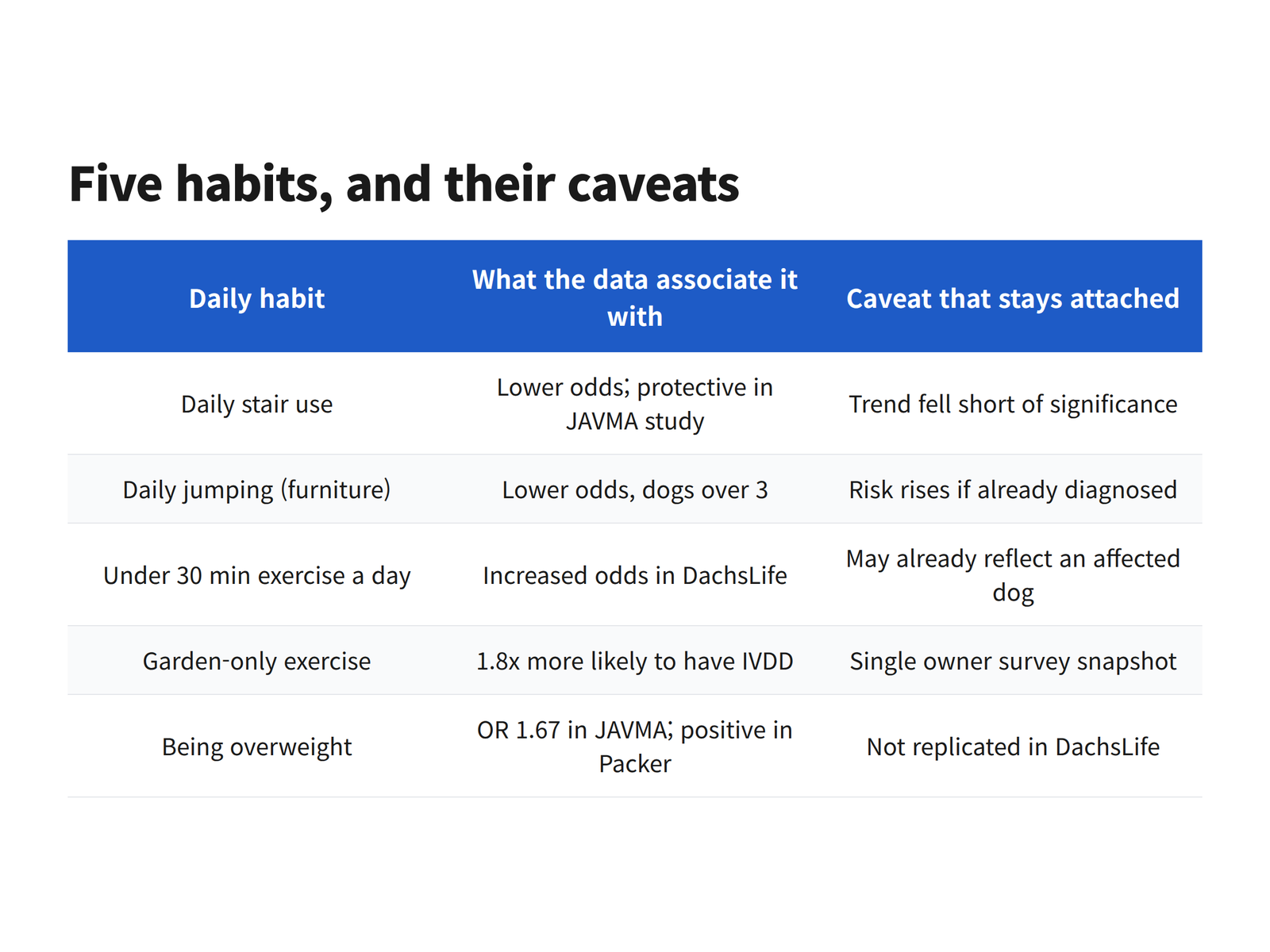
| Daily habit | What the published data associate it with | The caveat that stays attached |
|---|---|---|
| Daily stair use (adult, healthy) | Lower odds in DachsLife; protective in the 43,517-dog JAVMA study | Non-significant in DachsLife; direction of cause unproven |
| Daily jumping on and off furniture (adult, healthy) | Lower odds in DachsLife for dogs over 3 | Dogs already diagnosed face elevated re-injury risk |
| Under 30 minutes of exercise a day | Increased odds in DachsLife | Less active dogs may already be affected |
| Garden-only exercise, no walks | 1.8 times more likely to have suffered IVDD | Owner-reported, cross-sectional |
| Being overweight | OR 1.67 in the JAVMA cohort; positive association in Packer 2013 | DachsLife could not replicate it |
An older Danish population study warns against treating any single activity as settled. Jensen and Arnbjerg, publishing in 2000 on 48 standard wirehaired dachshunds, found 77% carried disc calcifications, at a mean of 4.5 per dog, and linked running alongside a bicycle to more of them. Only 4 dogs did that, far too few to generalise.
When should you speak to a veterinarian instead?
Speak to a veterinarian before changing routine for a dachshund with a diagnosis, a past episode or a visible change in movement. Dachshund Health UK places puppies under 12 months and dogs over 7 years in a higher injury-risk group, and notes that stairs stay a risk for dogs with strongly calcified discs. The same organisation holds that a healthy adult dachshund “should be capable of tolerating the normal activities of day-to-day living”.
Breed prevalence is also not individual risk. Wee and Nin reported dachshund prevalence of 15.3%, the highest of any breed in that cohort, alongside odds ratios of 1.85 for toy and small breeds, 1.66 for purebred dogs and 1.36 for male dogs. Most dachshunds in that cohort were never reported as affected.

Frequently asked questions
Should a dachshund puppy be allowed on the stairs? The favourable DachsLife finding covered dachshunds over the age of 3 only, and Dachshund Health UK places puppies under 12 months in a higher injury-risk group.
Does a ramp prevent disc disease? No published study measuring that was found. The American Kennel Club reports clinical preference for ramps in dogs prone to back issues, plus selection criteria, but no outcome figures.
Why do two pages from one organisation disagree? Dachshund Health UK publishes both its DachsLife 2015 survey result and its older advice to avoid stair descent. The survey trend was non-significant, so the cautious advice still stands.

The workable reading is narrow. For a healthy adult dachshund, the published data give no support for a strict ban on stairs and sofas, and clearer support for body condition and for walks on and off lead. For a dachshund with a back history, that average does not apply.
Sources
- Packer RMA, Seath IJ, O’Neill DG, De Decker S, Volk HA, “DachsLife 2015: an investigation of lifestyle associations with the risk of intervertebral disc disease in Dachshunds”, Canine Genetics and Epidemiology 3:8, 2016-11-05 (open access, publisher record)
- Packer RMA, Hendricks A, Volk HA, Shihab NK, Burn CC, “How Long and Low Can You Go? Effect of Conformation on the Risk of Thoracolumbar Intervertebral Disc Extrusion in Domestic Dogs”, PLOS ONE, 2013-07-24 – https://journals.plos.org/plosone/article?id=10.1371%2Fjournal.pone.0069650
- Wee C, Nin DZ, “Demographic and lifestyle characteristics impact lifetime prevalence of owner-reported intervertebral disc disease: 43,517 companion dogs in the United States”, Journal of the American Veterinary Medical Association 263(5), 2025-01-15 – https://pubmed.ncbi.nlm.nih.gov/39813820/
- American Kennel Club, “Dog Stairs vs. Ramps: Choosing the Right Option for Your Dog”, updated 2026-03-02 – https://www.akc.org/expert-advice/health/dog-stairs-and-ramps/
- Dachshund Health UK, “Jumping & Stairs” – https://www.dachshund-ivdd.uk/lifestyle-advice/jumping-stairs/
- Dachshund Health UK, “Exercise” – https://www.dachshund-ivdd.uk/lifestyle-advice/exercise/
- Dachshund Health UK, “Body condition” – https://www.dachshund-ivdd.uk/lifestyle-advice/body-condition/
- Dachshund Health UK information library, “Should my Dachshund avoid stairs?” – https://sites.google.com/site/ukdachshundhealthreport/dachshund-health-information-library/welfare/should-my-dachshund-avoid-stairs
- Jensen VF, Arnbjerg J, “Mechanical Factors affecting the Occurrence of Intervertebral Disc Calcification in the Dachshund – a Population Study”, Journal of Veterinary Medicine Series A 47(5):283-296, 2000 – https://onlinelibrary.wiley.com/doi/10.1046/j.1439-0442.2000.00296.x