Cavalier puppy health tests are mostly tests of the parents, not the puppy. The main screening schemes for Cavalier King Charles Spaniels have minimum ages of 12 to 18 months, so an eight-week-old puppy cannot hold a heart or MRI clearance of its own. What a buyer can check is whether the mother and father were screened, whether their certificates are current, and which national scheme those certificates belong to.

Which health tests should a Cavalier King Charles Spaniel breeder show you?
A Cavalier King Charles Spaniel breeder should be able to show heart, eye and DNA results for both parents, and in the US also hip and patella results. The Royal Kennel Club groups its Cavalier tests into “Good Practice” (the Kennel Club Heart Scheme plus DNA tests for Curly coat/dry eye and Episodic falling) and “Best Practice” (eye testing through the BVA/KC/ISDS Eye Scheme). The Royal Kennel Club says responsible breeders should complete all tests in both categories.
In the US, the American Cavalier King Charles Spaniel Club (ACKCSC) lists cardiac, eye, hip (OFA or PennHIP) and patellar luxation exams as required for its CHIC health program, together with permanent identification such as a microchip or tattoo. The Royal Kennel Club puts the buyer’s job plainly: “It’s important to find out what health tests are relevant for your chosen breed and whether your puppy’s parents have been screened.” Asking to see the paper certificates for both the mother and the father, rather than accepting a verbal “all tested”, is the practical version of that advice.
Why can’t a Cavalier puppy have its own heart clearance yet?
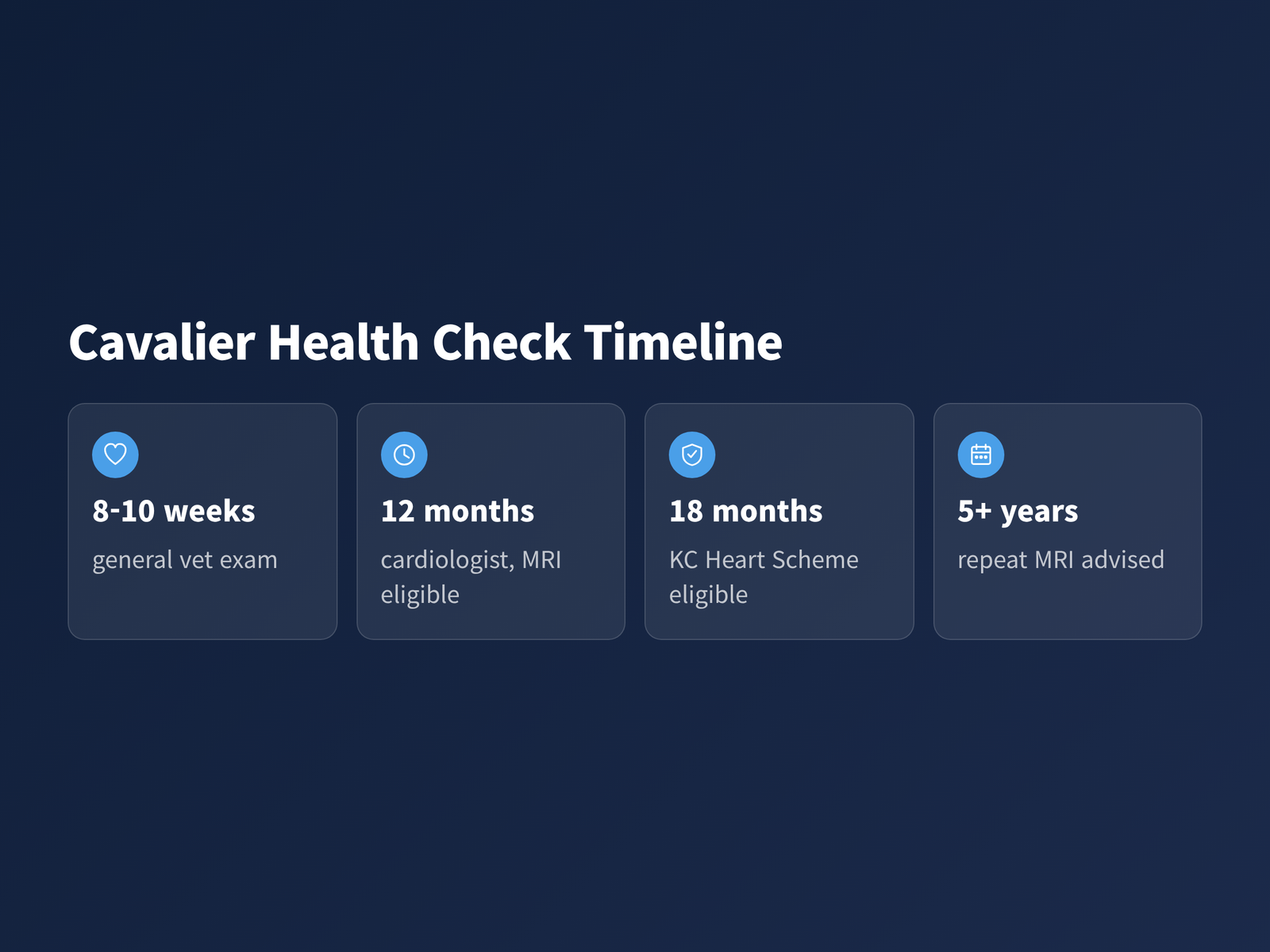
A Cavalier puppy cannot have its own heart clearance because the formal heart schemes do not assess dogs that young. The Kennel Club Heart Scheme, which checks Cavalier King Charles Spaniels for mitral valve disease using a stethoscope and an echocardiogram performed by approved cardiologists, has a minimum age of 18 months. The ACKCSC sets the first board-certified cardiologist exam at 12 months, followed by annual checks.
Brain and neck screening follows the same pattern. The BVA/KC Chiari Malformation/Syringomyelia (CM/SM) Scheme screens dogs by MRI of the brain and upper neck, with a minimum age of one calendar year. Its stated aim is “to reduce or eliminate the incidence of inherited CM and SM in dogs.” Because every one of these schemes starts at 12 months or later, any heart or MRI clearance shown at the time of purchase belongs to the Cavalier puppy’s parents, never to the puppy itself.
What does a puppy vet check not prove for a Cavalier?
A puppy vet check at 8 to 10 weeks does not prove that a Cavalier is free of inherited heart disease. The ACKCSC lists the 8-to-10-week heart exam by a general veterinarian as a separate step from the 12-month exam by a board-certified cardiologist, which shows the two are not interchangeable. A puppy vet check is a general health exam at homing age, not a clearance under any breed scheme.
The same logic applies to the brain and neck. A puppy vet check cannot stand in for the MRI used by the BVA/KC CM/SM Scheme, because that scheme does not scan dogs under one year. Clear parental results also reduce risk rather than remove it. In a study of 126 Cavalier King Charles Spaniels aged eight or older, published in Animals, echocardiographic mitral valve disease was found in 100% of the dogs. No breeder certificate turns a Cavalier puppy into a guaranteed-healthy puppy.
Does a heart certificate expire, and how recent should the parents’ be?
Yes, a Kennel Club heart certificate for a Cavalier expires, and the expiry date depends on the dog’s age at testing. A certificate for a dog tested under four years old expires at its 4th birthday; tested between four and six, at its 6th; tested between six and eight, at its 8th. A Cavalier tested after age eight receives a certificate with no expiry.
The Royal Kennel Club also advises regular retesting: “Your dog should have an assessment every two years to monitor any change, particularly if they are being used for breeding.” Results are reported as a murmur grade (0, 1, 2 or 3+) and a mitral valve prolapse grade, summarised in a green, amber or red traffic-light rating. In the US, the ACKCSC parent club statement notes that “The ACVIM is recommending Cavaliers be screened annually by an Echocardiogram and owners will receive an Advance Cardiac Certification.” A buyer can compare the date on each parent’s heart certificate against these rules.
Are MRI scans for Cavalier parents required or optional?
MRI scans for Cavalier parents are optional on the US list and offered through a dedicated scheme in the UK. The ACKCSC places SM/COM screening among its optional tests, alongside BAER, DM, Episodic falling, Dry eye and Curly coat, MCADD and an MMVD entry. In the UK, the BVA/KC CM/SM Scheme accepts dogs from one calendar year, ideally scanned before breeding and again at five years or older, with no upper age limit.
Screening data show why the question matters. A Dutch study of 1,020 Cavalier King Charles Spaniels screened by MRI, published in PLOS ONE, recorded syringomyelia in 39% of dogs overall, with the more advanced SM2 grade rising from 11% in dogs under three to 32% in dogs over five.
How do UK and US Cavalier health-testing schemes differ?
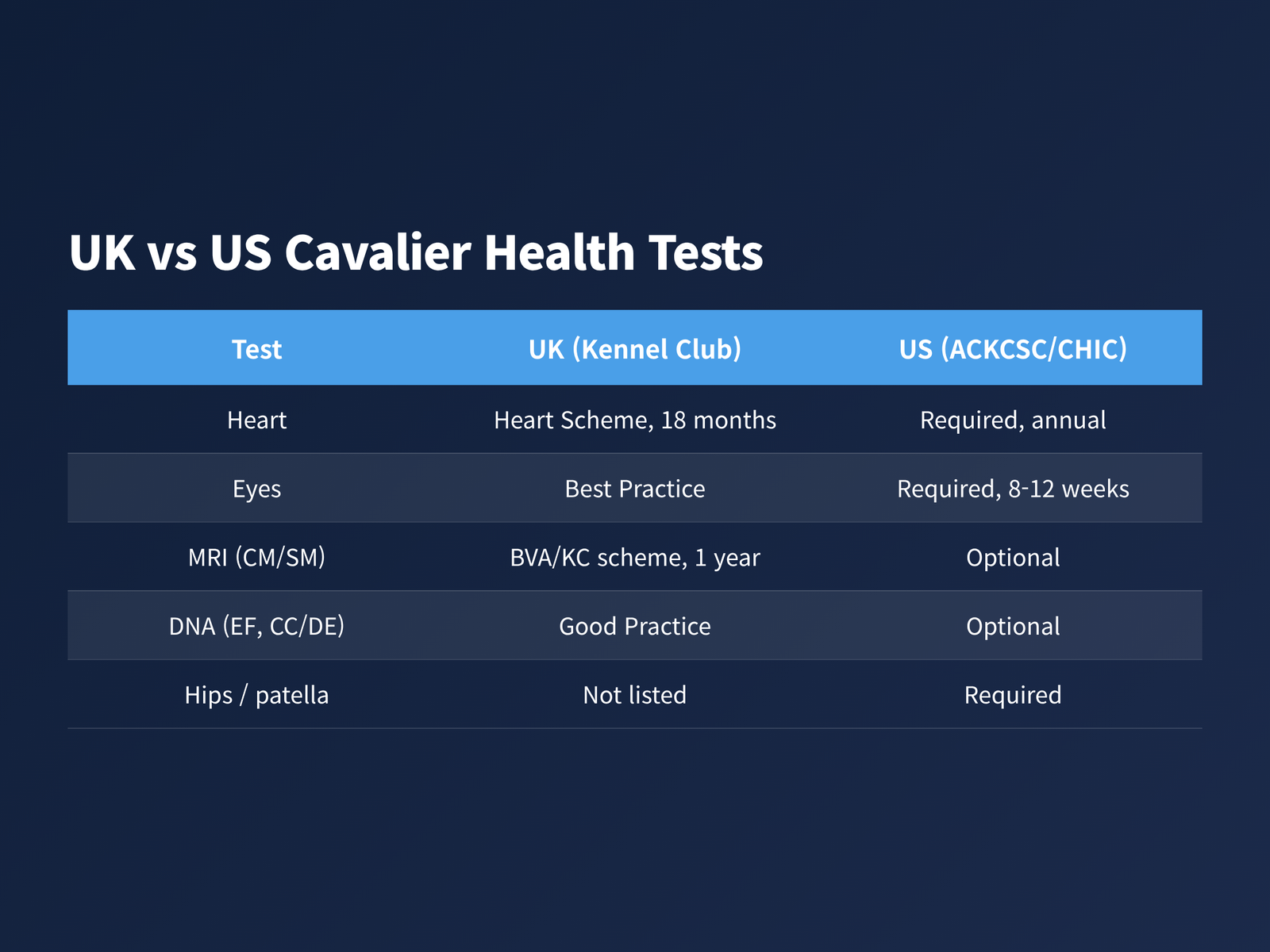
UK and US Cavalier health-testing schemes overlap on heart and eye testing but differ on DNA, hips and the patella. A Cavalier buyer should check the scheme that applies in the country where the puppy is registered, because a certificate from one scheme may not cover the other list.
| Test | UK (Kennel Club) | US (ACKCSC/CHIC) |
|---|---|---|
| Heart | Heart Scheme, 18 months | Required, annual |
| Eyes | Best Practice | Required, 8-12 weeks |
| MRI (CM/SM) | BVA/KC scheme, 1 year | Optional |
| DNA (EF, CC/DE) | Good Practice | Optional |
| Hips / patella | Not listed | Required |
The Royal Kennel Club breed page does not list hip or patella testing for the Cavalier, while the ACKCSC requires both for CHIC. Episodic falling and Curly coat/dry eye DNA tests sit in the Kennel Club “Good Practice” group but are optional in the ACKCSC statement. The ACKCSC eye schedule starts at 8 to 12 weeks, repeats at 12 months, then annually to age five and every two years to age nine.
What should you ask a Cavalier breeder, step by step?
The safest order is to confirm parental screening first, then certificate dates, then the puppy’s own homing paperwork. The five steps below follow buyer guidance from the Royal Kennel Club and the British Veterinary Association (BVA), and each one can be checked on paper.
- Ask whether both parents were screened for the inherited conditions relevant to the Cavalier King Charles Spaniel.
- Ask to see the health certificates for both the mother and the father.
- Check each heart certificate date against the Kennel Club expiry rule or the ACKCSC annual recheck.
- Ask whether the parents had MRI scans under the CM/SM scheme.
- Confirm the puppy is microchipped and has had its first vaccinations before homing.
The Royal Kennel Club advises homing a puppy no younger than 8 weeks, and microchipping before homing is a legal requirement in the UK. In a BVA survey, 55% of vets in clinical practice named irresponsible breeding or sourcing as the most pressing welfare concern. Dr Elizabeth Mullineaux, BVA Junior Vice President at the time, said: “While there are lots of responsible breeders, there are many unscrupulous individuals cashing in and not prioritising the welfare of the animals above making money.”
Before bringing a Cavalier puppy home, consult your veterinarian about when the puppy’s own first heart and eye exams should be booked. Ask your breeder and vet to talk through any parental heart, eye or MRI result that is unclear, since this checklist covers paperwork rather than medical advice.
Does breeding from screened Cavaliers actually lower heart disease risk?
Yes, published evidence shows that breeding from screened Cavalier parents lowers the odds of mitral valve disease murmurs in their offspring. A Danish study of 997 Cavalier King Charles Spaniels, published in the Journal of Veterinary Internal Medicine, found that offspring of approved parents had 73% lower odds of a mitral regurgitation murmur (odds ratio 0.27). The authors concluded: “A mandatory breeding scheme based on auscultation and echocardiography significantly decreased the prevalence of MMVD over the 8- to 10-year time period.” Lower odds are not zero odds, so screened parents improve a Cavalier puppy’s starting point rather than settle its future. A buyer can also ask which published breed-club breeding protocol the breeder follows.
Frequently asked questions
Can a breeder give me a heart certificate for the Cavalier puppy itself?
No. The Kennel Club Heart Scheme starts at 18 months and the ACKCSC cardiologist exam at 12 months, so certificates at purchase belong to the parents.
Are the UK Kennel Club tests compulsory for every Cavalier breeder?
The Royal Kennel Club describes its Cavalier tests as “Good Practice” and “Best Practice” and says responsible breeders should complete both groups.
Do clear parent results mean the puppy will stay healthy?
No. Screening lowers risk but does not remove it, and a study of Cavaliers aged eight or older found mitral valve disease on echocardiography in all 126 dogs examined.
Sources
- The Royal Kennel Club, “Heart scheme for Cavalier King Charles Spaniels” (accessed 2026-10-02) — https://www.royalkennelclub.com/health-and-dog-care/health-dog-care/health/getting-started-with-health-testing-and-screening/heart-scheme-for-cavalier-king-charles-spaniels/
- The Royal Kennel Club, “Cavalier King Charles Spaniel” breed page, health testing section (accessed 2026-10-02) — https://www.royalkennelclub.com/search/breeds-a-to-z/breeds/toy/cavalier-king-charles-spaniel/
- The Royal Kennel Club, “Questions to ask the breeder” (accessed 2026-10-02) — https://www.royalkennelclub.com/your-dog/getting-a-dog/buying-a-dog/questions-for-the-breeder/
- American Cavalier King Charles Spaniel Club, “Parent Club Health Statement for AKC” (2023-11-01) — https://s3.amazonaws.com/cdn-origin-etr.akc.org/wp-content/uploads/2024/07/03143814/ACKCSC-Parent-Club-Health-Statment-for-AKC-2023.pdf
- American Cavalier King Charles Spaniel Club, Health Statement (2015-12-02) — https://cdn.akc.org/Marketplace/Health-Statement/Cavalier-King-Charles-Spaniel.pdf
- British Veterinary Association / The Kennel Club, “Chiari Malformation / Syringomyelia Scheme” leaflet (2019-07) — https://www.bva.co.uk/media/2800/20190710-chs-cmsm-leaflet-0719-v1-web.pdf
- British Veterinary Association, “Crufts 2024: Vets reveal top questions to ask when buying a puppy” (2024-03-01) — https://www.bva.co.uk/news-and-blog/news-article/crufts-2024-vets-reveal-top-questions-to-ask-when-buying-a-puppy-to-avoid-unwanted-health-issues/
- Birkegård AC et al., “Breeding Restrictions Decrease the Prevalence of Myxomatous Mitral Valve Disease in Cavalier King Charles Spaniels over an 8- to 10-Year Period”, Journal of Veterinary Internal Medicine (2016) — https://academic.oup.com/jvim/article/30/1/63/8452806
- Wijnrocx K et al., “Twelve years of chiari-like malformation and syringomyelia scanning in Cavalier King Charles Spaniels in the Netherlands”, PLOS ONE (2017) — https://journals.plos.org/plosone/article?id=10.1371%2Fjournal.pone.0184893
- “Clinical and Echocardiographic Findings in an Aged Population of Cavalier King Charles Spaniels”, Animals (MDPI) (2021) — https://www.mdpi.com/2076-2615/11/4/949