The safest Halloween costume for a flat-faced small dog covers the body, leaves the head, neck and muzzle completely free, and comes off in seconds. Flat-faced breeds such as the Boston Terrier start with less breathing and cooling margin than longer-nosed dogs, so hoods, masks, chin straps and snug collars carry more risk for them. This guide maps advice from the American Veterinary Medical Association (AVMA), the American Kennel Club (AKC), Blue Cross and the RSPCA onto each costume type.

Which Halloween costumes are safe for a flat-faced small dog?
A safe costume for a flat-faced small dog fits properly, has no chewable pieces, and does not block sight, hearing, breathing, the mouth or movement. That five-part rule comes straight from the AVMA’s Halloween pet safety guidance, and the AKC puts it the same way: “A safe costume should never interfere with your dog’s ability to see, hear, breathe, walk, or rest comfortably.” For a Boston Terrier or similar breed, the practical result is a short list of shapes that pass: a bandana, a decorative collar, or a light body-only outfit without a head piece.
The AVMA and the AKC both warn against buttons, gems and detachable decorations that a dog can chew off and choke on. The AKC also flags glitter, dyes and decorative materials that can be swallowed or irritate skin. Any costume should pass these checks before the head and neck question comes up.
Why do hoods, masks and chin straps cause problems for flat-faced dogs?
Hoods, masks and chin straps sit exactly where a flat-faced dog has the least room to spare: around the eyes, ears, nose and mouth. The AVMA rule says a costume must not block sight, hearing, breathing or the mouth, and a head piece is the one part of a costume that can interfere with all four at once. A strap under the jaw can also limit how wide a dog opens its mouth.
Muzzle length explains why flat-faced breeds are more sensitive here. A 2015 study in PLOS ONE by Packer and colleagues found that brachycephalic obstructive airway syndrome (BOAS) risk “increases sharply in a non-linear manner as relative muzzle length shortens.” In that study, over 80% of dogs with a craniofacial ratio below 0.1 were affected. A costume that adds fabric or elastic over an already short face works against an airway with little reserve, so a hood-free design is the sensible default for a flat-faced small dog.
Why does a thicker neck matter when a Boston Terrier wears a costume?
Neck girth matters because a thicker neck was linked to greater breathing risk in brachycephalic dogs, independent of muzzle length. Packer et al. reported that increased neck girth predicted higher BOAS risk in both of their study populations. A later Boston Terrier study by Tomlinson and colleagues, published in PLOS ONE, listed the neck-to-chest girth ratio among the breed’s risk factors, alongside nostril narrowing (odds ratio 2.51), facial foreshortening and skull index.
Collars, ruffs, capes tied at the throat and elastic neck openings should sit loose on a Boston Terrier, never snug. The veterinary and kennel-club sources reviewed for this guide do not give a fixed finger-width rule for costume necklines, so the fit check is visual and practical: the dog should swallow, pant and turn its head without the fabric pulling. If a neckline tightens when the dog lowers its head to sniff, that costume is the wrong cut for a flat-faced small dog.
Does every Boston Terrier have breathing problems in a costume?
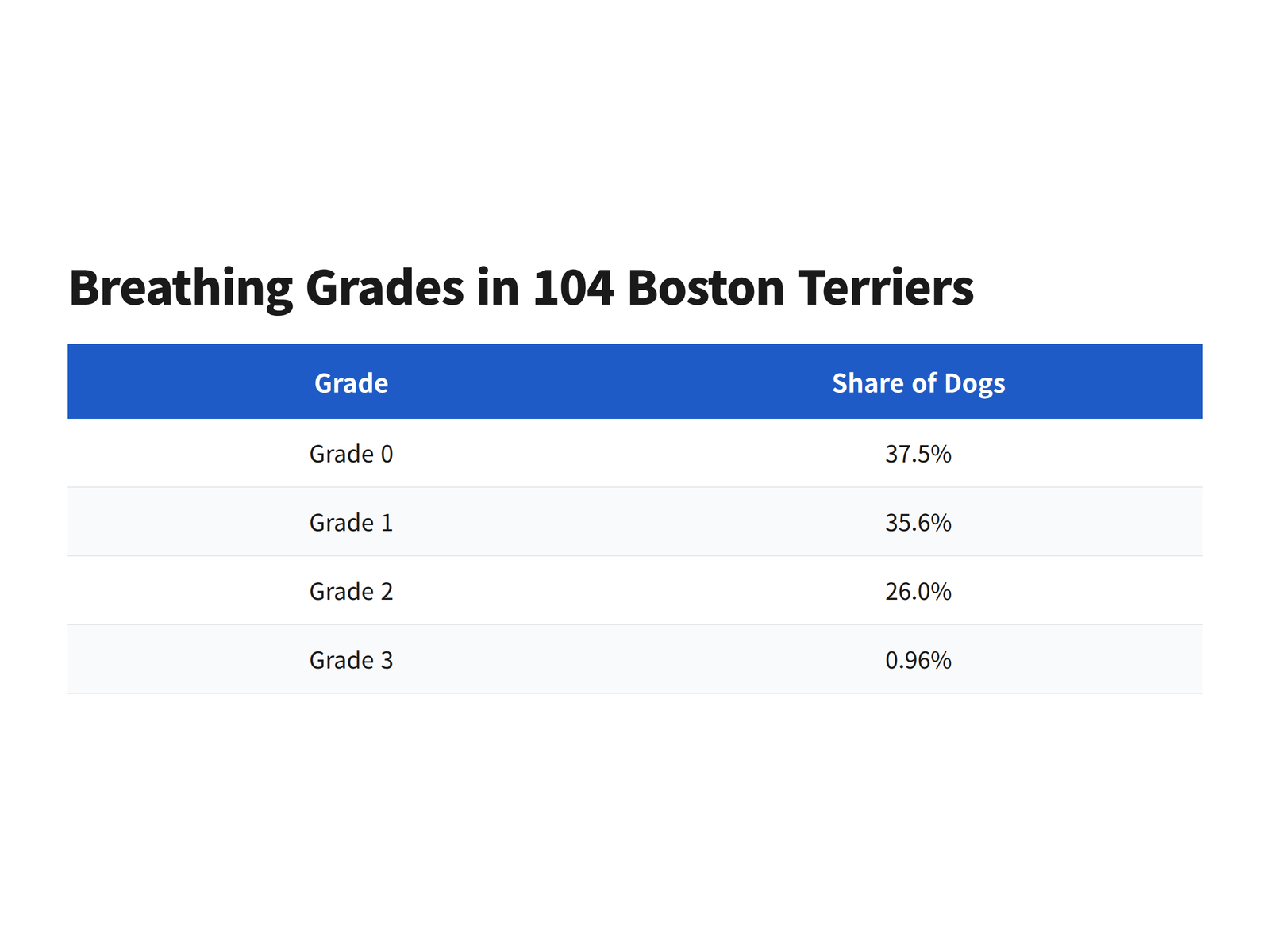
No, not every Boston Terrier has a breathing problem, and a costume decision should not assume one. The Tomlinson study assessed 107 Boston Terriers and fully graded 104. Of those, 37.5% were Grade 0, 35.6% were Grade 1, 26.0% were Grade 2 and 0.96% were Grade 3. The study’s own title asks whether the Boston Terrier is a healthier screw-tailed breed.
Those numbers still mean that roughly a quarter of the dogs in the study were graded 2. A Boston Terrier owner usually cannot tell from appearance alone which group a particular dog falls into. That uncertainty is the reason to choose open-faced, loose-necked costumes as the starting point rather than testing limits. Whether stricter limits apply to your dog depends on that dog’s own airway, which only a veterinary assessment can confirm.
How warm is too warm under a costume for a flat-faced breed?
The sources reviewed for this guide do not give a temperature threshold for costume wear, so the safe answer is to treat any extra layer as added heat load for a flat-faced breed. The RSPCA states that “dogs with brachycephaly are less able to regulate their temperature, so they’re up to 16 times more likely to suffer from heat-related illnesses.” A full-body costume traps warmth against the coat, and a crowded indoor party or a long trick-or-treat walk adds more.
Blue Cross adds a second concern: “Elaborate costumes will restrict the movement of your dog and stop them being able to show natural behaviours.” A flat-faced small dog that cannot stretch, lie flat or move to a cooler spot has fewer ways to shed heat. Thin, breathable body-only pieces worn for short periods are the lower-risk option. Heavy plush, padded or fully enclosed costumes are the higher-risk option for any flat-faced small dog.
What signs mean a costume should come off right away?
A costume should come off immediately if a flat-faced dog shows noisy breathing, keeps the tongue out, breathes with an open mouth while resting, or stops wanting to move. The RSPCA lists these signs in its guidance on caring for brachycephalic pets. They are not a diagnosis, and this article does not attempt one; they are a signal to remove every layer, let the dog rest somewhere cool, and consult your veterinarian if the signs do not settle quickly.
Stress counts as well. Blue Cross notes that dogs not used to wearing coats or jumpers can become very stressed in costumes. The AVMA advises owners to “take time before Halloween to get your pet accustomed to the costume, and never leave a costumed pet unsupervised.” The AVMA also recommends keeping identification on, through a microchip, collar or tag, in case a frightened dog slips out the door when costumed visitors arrive.
Is a bandana or decorative collar a better choice than a full costume?
For many flat-faced small dogs, yes: a bandana or decorative collar is the lowest-coverage option and the easiest to remove. The AKC suggests considering simple accessories such as a bandana or decorative collar instead of a full outfit. A loosely tied bandana leaves the face open, adds little heat and avoids the tight neck openings that matter for a Boston Terrier.
A bandana still needs the same checks as any costume. The knot should sit loose at the side, not under the throat, and there should be no beads, glitter or dangling decorations to chew. Blue Cross also points out that “costume wearing dogs may confuse, alarm or frighten other dogs,” so a minimal accessory has a social benefit at busy Halloween events too. For a flat-faced small dog meeting other dogs on the street, less costume often means fewer problems.
How do common costume types compare for a flat-faced dog?
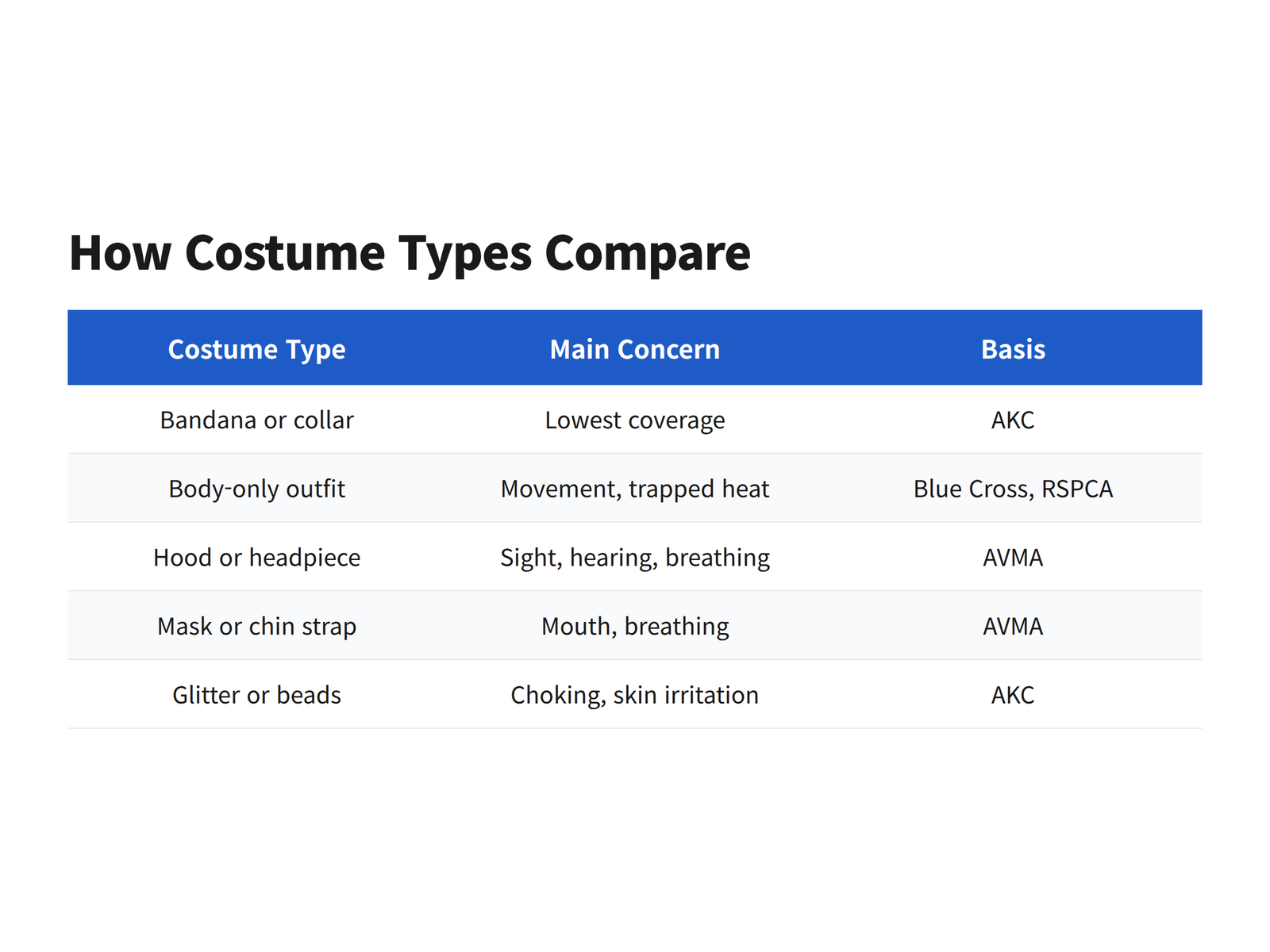
The table below matches each common costume type to the main concern for a flat-faced dog, based on the AVMA, AKC, Blue Cross and RSPCA guidance.
| Costume type | Main concern | Basis |
|---|---|---|
| Bandana or collar | Lowest coverage | AKC |
| Body-only outfit | Movement, trapped heat | Blue Cross, RSPCA |
| Hood or headpiece | Sight, hearing, breathing | AVMA |
| Mask or chin strap | Mouth, breathing | AVMA |
| Glitter or beads | Choking, skin irritation | AKC |
Frequently asked questions
Can a Boston Terrier wear a hoodie-style costume?
A hood is the costume part most likely to block sight, hearing and breathing, which the AVMA says a costume must never do. A body-only version with the hood removed is the lower-risk choice for a Boston Terrier.
How long can a flat-faced dog wear a costume?
The AVMA’s Halloween pet safety guidance focuses on preparation and supervision: get the pet accustomed to the costume before Halloween, and never leave a costumed pet unsupervised. Short, watched sessions follow from that advice.
Is a costume a problem for a flat-faced dog that breathes normally?
Even a dog graded 0 carries the higher heat risk the RSPCA describes for brachycephalic breeds. An open face, loose neck and light fabric keep that risk lower.
Sources
- American Veterinary Medical Association, “Halloween pet safety” — https://www.avma.org/resources-tools/pet-owners/petcare/halloween-pet-safety
- American Kennel Club, “How to Choose a Halloween Costume for Your Dog”, updated 2026-09-15 — https://www.akc.org/expert-advice/advice/costumes-for-dogs-dressed-up/
- Blue Cross, “Dog Halloween costumes”, 2021-09-28 — https://www.bluecross.org.uk/advice/dog/wellbeing-and-care/dog-costumes
- Blue Cross, “How to keep your dog safe at Halloween”, reviewed 2025-12-10 — https://www.bluecross.org.uk/advice/dog/wellbeing-and-care/how-to-keep-your-dog-safe-this-halloween
- RSPCA, “Caring for brachycephalic pets” — https://www.rspca.org.uk/adviceandwelfare/pets/brachycephalic/caring
- Packer RMA, Hendricks A, Tivers MS, Burn CC, “Impact of Facial Conformation on Canine Health: Brachycephalic Obstructive Airway Syndrome”, PLOS ONE, 2015-10-28 — https://journals.plos.org/plosone/article?id=10.1371%2Fjournal.pone.0137496
- Tomlinson F, O’Neill E, Liu N-C, Sargan DR, Ladlow JF, “BOAS in the Boston Terrier: A healthier screw-tailed breed?”, PLOS ONE, 2024-12-31 — https://journals.plos.org/plosone/article?id=10.1371%2Fjournal.pone.0315411