A Havanese usually still mats when brushed daily because the brush skims the top layer while tangles form at the skin. Daily brushing is the right habit: the American Kennel Club says Havanese owners must brush “daily to prevent mats and tangles.” The gap lies in how the brushing is done, meaning which tool does the work, whether the coat is split into sections, and whether friction points and damp patches get checked first.

Why does a Havanese still mat when you brush every day?
A Havanese still mats despite daily brushing because surface strokes never reach the hair near the skin. The Royal Kennel Club lists the Havanese grooming need as “every day,” and that schedule only prevents mats if each session reaches the base of the coat. RSPCA Australia explains that daily grooming prevents “the build up of dead but not shed hair, the development of matts, and the associated problems like discomfort and inflammation.” Shed hair trapped in a Havanese coat becomes the core of a knot. A quick pass over the top smooths the outer layer and hides that knot while it keeps growing underneath.
What makes the Havanese coat so prone to tangles?
The Havanese coat tangles easily because both layers are soft and the coat is long. The AKC Official Standard of the Havanese describes a coat that is “Silky to the touch, the coat is soft and light in texture in both outer and undercoat,” and calls it “long, abundant and wavy.” A soft undercoat holds shed hair instead of dropping it, and wavy strands twist around each other. The standard sets an ideal height of 9 to 10.5 inches, so a Havanese carries a lot of hair close to the ground, the furniture and its own moving legs.
Where do mats form first on a Havanese?
Mats on a Havanese form first at friction points. The American Kennel Club notes that mats “often form in places of friction, like where your dog’s front legs and chest meet.” AKC grooming guidance adds a second trigger: “Sometimes, mats start as an area of dampness or even a little debris picked up while playing outside.” A Havanese that comes in from wet grass or carries a leaf fragment has a mat starting point even after a morning brush. Checking the legs-and-chest junction and any damp or dirty patch before the easy areas catches the knots a top-down routine misses.
Should a pin brush or a slicker brush do the main work on a Havanese coat?
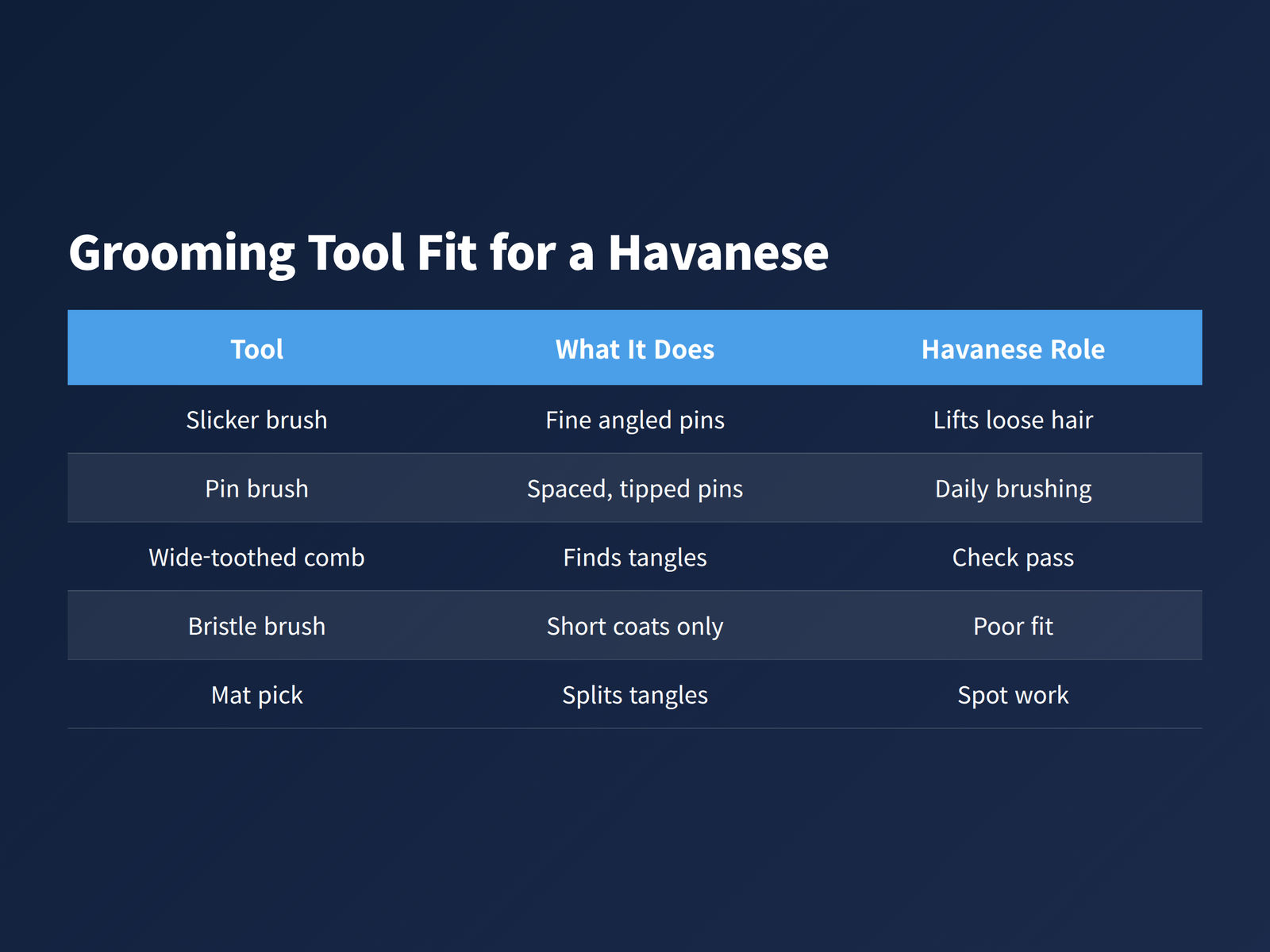
A pin brush or a comb should do the main daily work on a Havanese, since that is the pairing the AKC names for the breed. AKC guidance describes pin brush pins as medium-spaced and often rubber-tipped. A slicker brush, with short, tightly packed pins angled to avoid the skin, is useful for lifting loose hair before it seeds a mat. A wide-toothed comb then serves as a check pass; the AKC notes it “can also help remove mats and tangles.” A bristle brush is a poor fit for a Havanese, because the AKC limits bristle brushes to short-coated dogs.
| Tool | What it does | Havanese role |
|---|---|---|
| Slicker brush | Fine angled pins | Lifts loose hair |
| Pin brush | Spaced, tipped pins | Daily brushing |
| Wide-toothed comb | Finds tangles | Check pass |
| Bristle brush | Short coats only | Poor fit |
| Mat pick | Splits tangles | Spot work |
How do you brush a Havanese in sections?
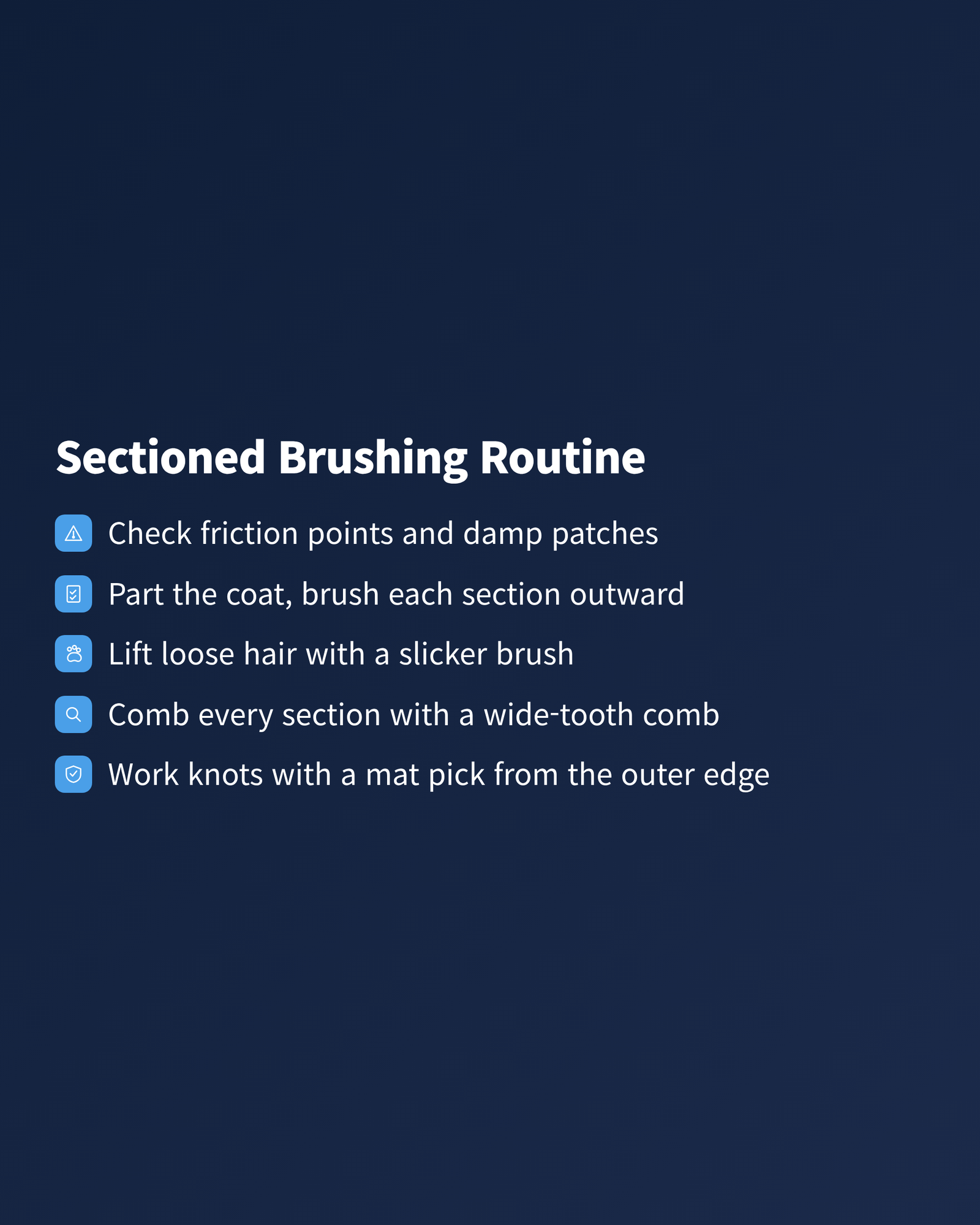
Brushing a Havanese in sections means parting the coat and working one small area at a time down to the skin. RSPCA Australia advises dividing a long coat into sections and brushing each one in turn. Combined with AKC tool guidance, a sectioned routine looks like this:
- Check friction points and damp or dirty patches first.
- Part the coat and brush each section from the skin outward.
- Use a slicker brush where loose hair has built up.
- Run a wide-toothed comb through every section.
- Work any knot with a mat pick from the outer edge.
The AKC advises holding a mat near the skin so the skin is not pulled. A stubborn Havanese mat may take several short sessions over a few days. Short sessions keep the routine tolerable for the dog and leave the surrounding coat intact.
Why does matting get worse when a Havanese coat is changing?
Matting tends to get worse during a coat change because more Havanese hair is loose at once. Young Havanese go through a coat change, and any shed hair left in the coat is the “dead but not shed hair” that RSPCA Australia links to mats. The timing and intensity vary from dog to dog. During that stretch, shorter and more frequent sectioned sessions with a slicker brush and a comb check pass keep loose hair from piling up at the friction points. If the coat becomes unmanageable, a professional groomer can help reset it.
Should you bathe a Havanese that already has mats?
For a Havanese that already has mats, the main point is that the coat should dry fully after any bath. The AKC notes that dampness can start a mat, so a coat left wet around a tangle gives that tangle a head start. The AKC also says “Only occasional baths are necessary for this breed,” which means bathing is not the main tool against Havanese matting. After a bath or a wet walk, drying completely and combing through removes those damp starting points. For a heavy or tight mat, a professional groomer can advise on the next step based on the mat’s condition.
Is a short clip a reasonable answer to constant matting?
A short clip is a reasonable choice for owners who want less grooming time, though it changes the look rather than the technique. The AKC notes: “Some owners choose to keep a Havanese’s coat clipped short to help reduce grooming time.” A short-clipped Havanese still needs regular brushing, just with less time per session. Corded Havanese are the exception to all brushing advice. The AKC explains that “cording requires little to no brushing or combing,” and quotes an expert who says “Cords are a system of controlled mats.” Owners of a corded Havanese should not brush the cords out.
When is a mat no longer a home-grooming job?
A mat is no longer a home job when it sits tight against the skin or the skin underneath looks red, sore or broken. RSPCA Australia notes that untreated matting may need professional or veterinary help to remove without injuring the skin. If the skin under a Havanese mat looks irritated, consult your veterinarian before trying to remove it.
A 2022 Frontiers in Veterinary Science study by McDonald and colleagues found that grooming issues made up 4 to 6 percent of appointments in ASPCA veterinary programs in New York City. Matting or strangulating wounds featured in 13 percent of cruelty cases, and most matting-related cases in that data involved long-haired dogs. The authors write that chronically matted hair “can contribute to and cause medical conditions such as skin irritation and infection.”
Frequently asked questions
How often should a Havanese be brushed?
Every day. The Royal Kennel Club lists daily grooming for the Havanese, and the AKC names a comb or pin brush for the job.
Is a slicker brush bad for a Havanese?
No. AKC guidance describes slicker pins as angled to avoid the skin, which suits lifting loose hair before the pin brush and comb.
Can a matted Havanese be brushed out in one session?
Often not. The AKC suggests several short sessions, working from the outer edge of the mat toward the body.
Does a corded Havanese need daily brushing?
No. The AKC explains that cording requires little to no brushing or combing.
Sources
- American Kennel Club, “Official Standard of the Havanese,” approved 2011-08-09 — https://images.akc.org/pdf/breeds/standards/Havanese.pdf
- American Kennel Club, “Is the Havanese a Good Fit for Your Lifestyle?”, updated 2026-08-11 — https://www.akc.org/expert-advice/dog-breeds/havanese-right-for-you/
- American Kennel Club, “How to Overcome the 4 Biggest Dog Grooming Challenges,” updated 2026-08-05 — https://www.akc.org/expert-advice/health/how-to-overcome-the-4-biggest-dog-grooming-challenges/
- American Kennel Club, “Dog Brushes: How to Choose the Right Dog Brush,” 2026-03-03 — https://www.akc.org/expert-advice/health/types-dog-brushes-shedding/
- American Kennel Club, “Dog Breeds With Corded Coats,” updated 2026-08-11 — https://www.akc.org/expert-advice/dog-breeds/meet-the-corded-breeds/
- The Royal Kennel Club, “Havanese” breed page — https://www.royalkennelclub.com/search/breeds-a-to-z/breeds/toy/havanese
- McDonald SE et al., “Grooming-Related Concerns Among Companion Animals,” Frontiers in Veterinary Science, 2022 — https://www.frontiersin.org/journals/veterinary-science/articles/10.3389/fvets.2022.827348/full
- RSPCA Australia Knowledgebase, “Why and how should I groom my dog?”, 2022-01-19 — https://kb.rspca.org.au/categories/companion-animals/dogs/caring-for-my-dog/why-and-how-should-i-groom-my-dog