A winter coat that gapes at the belly or pinches behind the front legs is usually a measuring problem, not a bad coat. The short answer to why dog coats don’t fit a deep-chested small dog is body shape: breeds such as the Toy Fox Terrier and the Miniature Pinscher are deep at the ribs and narrower at the belly. Measuring the chest and the stomach separately, then checking both against the brand’s own chart, prevents most fit problems before the coat arrives.

Why don’t standard dog coats fit a deep-chested small dog?
Standard dog coats often miss on a deep-chested small dog because the coat’s shape and the dog’s shape do not match. The breed standards for the Toy Fox Terrier and the Miniature Pinscher describe a body that is deep through the rib cage, narrower at the loin, and short from front to back. A coat sized by back length alone, or cut as a straight tube, can therefore end up tight at the chest and loose at the belly. That is a reasonable reading of the breed standards, not the result of a published fit study.
The American Kennel Club sets the priority plainly: “Chest girth is often the most important measurement when sizing clothing and harnesses.” Whether a particular coat fits your dog still depends on the brand’s cut, so comparing several body measurements with the size chart is safer than picking a size by breed or by length.
What do “deep chest” and “tuck-up” mean on a Toy Fox Terrier or Miniature Pinscher?
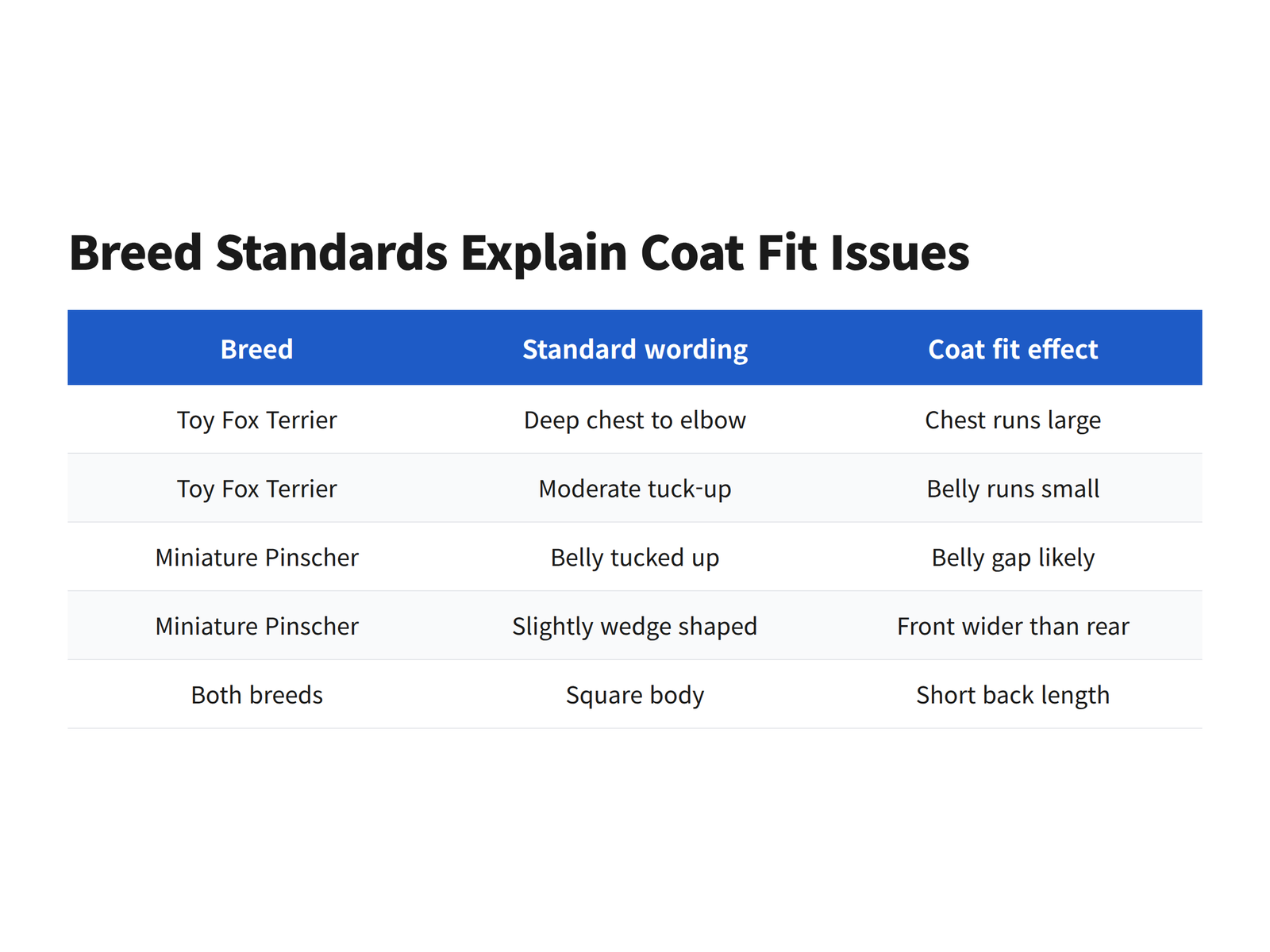
A deep chest means the rib cage reaches down toward the elbow, and a tuck-up means the belly rises noticeably behind the ribs. The AKC standard for the Toy Fox Terrier states: “The chest is deep and muscular with well sprung ribs. Depth of chest extends to the point of elbow.” The same standard asks for a body “Short and strong in loin with moderate tuck-up to denote grace and elegance,” and describes the Toy Fox Terrier as square, with height roughly equal to length.
The Miniature Pinscher follows a similar outline. The Royal Kennel Club standard reads: “Belly moderately tucked up. Ribs well sprung, deep rather than barrelled. Viewed from top slightly wedge shaped.” The AKC standard adds “Forechest well developed” and gives a height of 10 to 12.5 inches. Because the breed standard describes a Miniature Pinscher as wider in front and slimmer toward the rear, a coat cut in a straight line from chest to belly can sit snugly at the ribs while leaving a gap under the stomach.
| Breed | Standard wording | Coat fit effect |
|---|---|---|
| Toy Fox Terrier | Deep chest to elbow | Chest runs large |
| Toy Fox Terrier | Moderate tuck-up | Belly runs small |
| Miniature Pinscher | Belly tucked up | Belly gap likely |
| Miniature Pinscher | Slightly wedge shaped | Front wider than rear |
| Both breeds | Square body | Short back length |
Which measurements matter when sizing a coat for a small dog?
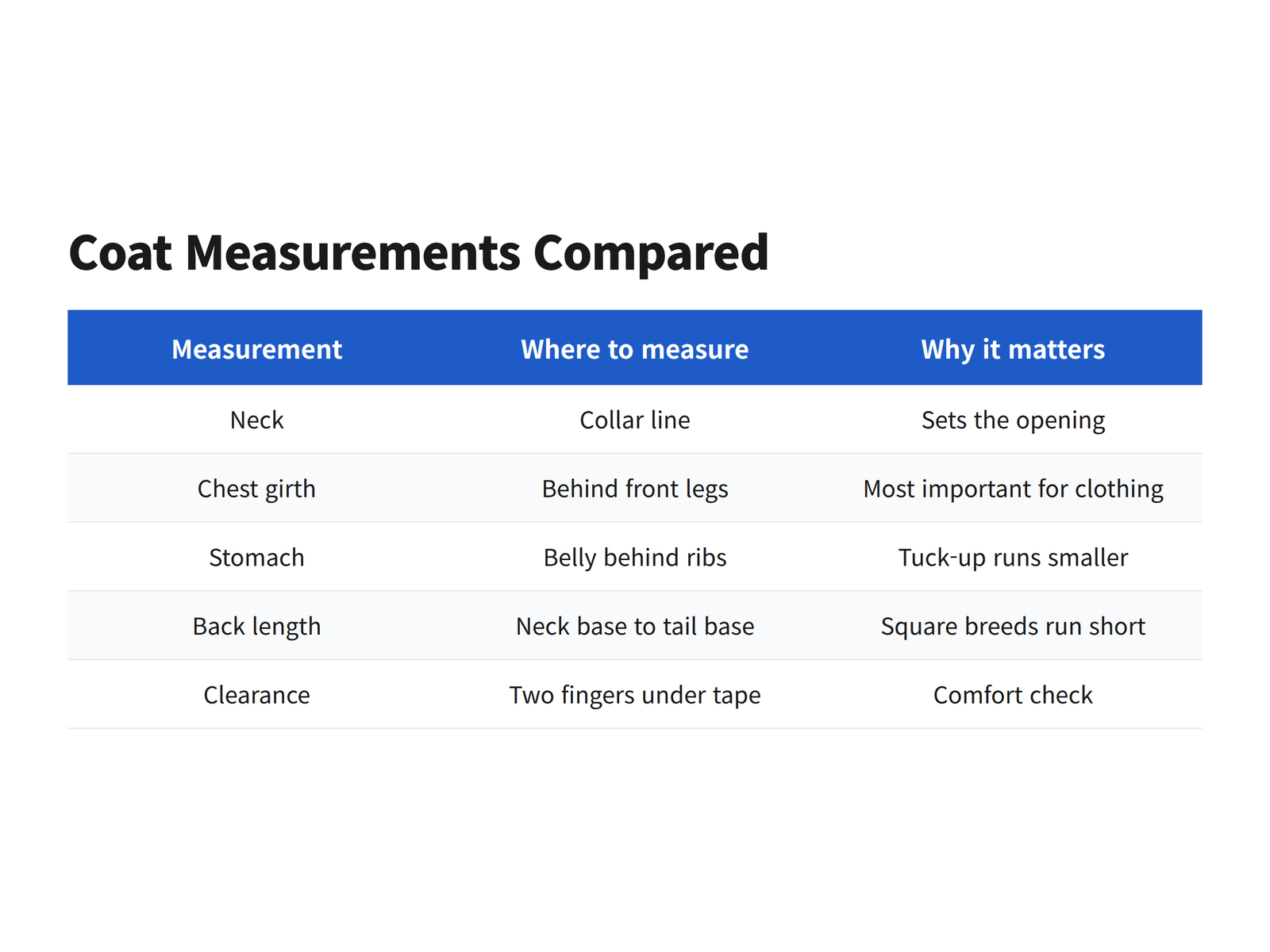
Chest girth matters most, but a deep-chested small dog needs four measurements: neck, chest, stomach, and back length. The AKC’s raincoat article lists “the circumference of your dog’s neck, chest, and stomach” plus “the length from your dog’s neck to the base of their tail.” The stomach reading is the one that matters for a tucked-up breed, because the Toy Fox Terrier and Miniature Pinscher standards both describe a belly that sits higher and narrower than the ribs.
- Neck: “Measure around the base of your dog’s neck where the collar sits.”
- Chest: “Wrap the measuring tape around the largest part of the rib cage, usually just behind the front legs.”
- Stomach: measure around the belly behind the ribs, where the tuck-up is visible.
- Back length: “Measure along the top of their spine from the base of the neck where it joins the body—usually where their collar sits—to the base of their tail.”
For each circumference, the AKC measuring guide advises: “Keep the tape snug but not tight, and follow the two-finger rule to ensure a comfortable fit.” On a smooth-coated breed such as the Miniature Pinscher, whose coat the Royal Kennel Club describes as “Closely adhering to and uniformly covering body,” there is little fur to compress, so the tape reading sits close to the actual body size.
Coat measurements compared for a deep-chested small dog
Each measurement answers a different fit question, and the AKC’s two-finger clearance check applies to all three circumferences on a deep-chested small dog. Writing the four numbers down before shopping makes it easier to compare a Toy Fox Terrier or Miniature Pinscher against each brand’s chart.
| Measurement | Where to measure | Why it matters |
|---|---|---|
| Neck | Collar line | Sets the opening |
| Chest girth | Behind front legs | Most important for clothing |
| Stomach | Belly behind ribs | Tuck-up runs smaller |
| Back length | Neck base to tail base | Square breeds run short |
| Clearance | Two fingers under tape | Comfort check |
Should you size up when a small dog falls between coat sizes?
Yes, the AKC advises choosing the larger size when a small dog falls between coat sizes. The AKC measuring guide states: “When in doubt, always opt for the larger size, especially if your dog is between sizes. It’s better to have a slightly looser fit rather than something that is constricting your pet.” The AKC’s sweater article also notes that sizing varies by brand, so each brand’s chart should be checked rather than assuming a size from a previous coat.
Sizing up has a limit on a deep-chested small dog. The AKC’s winter coat article warns that a coat should not be “so loose as to present a hazard where a dog could become entangled in the coat while playing or walking.” On a Miniature Pinscher or Toy Fox Terrier, the larger size may fit the chest yet hang loosely under the tucked-up belly. A coat with an adjustable belly closure lets the chest fit while taking in slack at the stomach.
What are the signs a dog coat doesn’t fit?
A dog coat doesn’t fit if it limits normal movement or gets in the way of toileting, and the PDSA adds biting or rubbing at the coat as a sign. The RSPCA says a winter dog coat “should be snug, but not restrict their movement,” and advises making sure “your dog can still behave normally (for example, that they can go to the toilet easily).” The PDSA, a UK veterinary charity, frames the same test: “Your dog should be able to move freely in their coat and do everything they usually do without the coat on (running, jumping, and, of course, pooping and weeing, to name a few!)”
According to the PDSA, “If they bite or scratch at the coat or rub themselves on the floor or furniture, that’s a sign it doesn’t fit right and is irritating them.” Tightness brings its own problems: the AKC notes that “A sweater that is too tight can restrict movement, which is uncomfortable and can also lead to injuries.” For straps, the AKC’s check is to “see if you can slide two fingers under the straps. If you can’t, the raincoat is too tight.” If your dog still seems to struggle with the cold in a well-fitted coat, consult your veterinarian.
Frequently asked questions
Does a short-coated small dog need a coat?
The AKC notes that “Smaller breeds of dogs often benefit from wearing coats in cold weather.” The AKC standard describes the Toy Fox Terrier coat as “shiny, satiny, fine in texture and smooth to the touch,” so a coat or sweater can be worth considering for outdoor walks, sized with the same four measurements.
Should a small dog wear a coat indoors?
Usually not. The PDSA states: “Most dogs won’t need to wear a coat indoors as they can quickly overheat in modern, centrally heated homes.” The RSPCA gives an indoor temperature range for dogs of 10°C to 25°C.
Why does a coat slip sideways on a deep-chested small dog?
A coat that is loose at the belly has little to hold it in place, so it can shift as the dog moves. Measuring the stomach separately and snugging the belly closure usually keeps the coat centered.
Sources
- American Kennel Club, “How to Measure Your Dog for Clothes and Gear”, Courtney Campbell, updated 2026-08-10 — https://www.akc.org/expert-advice/lifestyle/measure-dog-gear/
- American Kennel Club, “Does My Dog Need a Winter Coat? Choosing the Best Winter Coat for Your Dog”, Sassafras Patterdale, updated 2025-11-14 — https://www.akc.org/expert-advice/lifestyle/dog-winter-coat/
- American Kennel Club, “Does Your Dog Need a Sweater?”, Sassafras Patterdale, updated 2026-03-03 — https://www.akc.org/expert-advice/lifestyle/sweaters-for-dogs/
- American Kennel Club, “Does Your Dog Need a Raincoat?”, Colt Dodd, updated 2026-03-03 — https://www.akc.org/expert-advice/lifestyle/dog-raincoats/
- American Kennel Club, “Official Standard of the Miniature Pinscher”, approved 1980-07-08 — https://images.akc.org/pdf/breeds/standards/MiniaturePinscher.pdf
- American Kennel Club, “Official Standard of the Toy Fox Terrier”, effective 2003-08-27 — https://images.akc.org/pdf/breeds/standards/ToyFoxTerrier.pdf
- Royal Kennel Club, “Miniature Pinscher Breed Standard”, last updated 2025-08-01 — https://www.royalkennelclub.com/breed-standards/toy/miniature-pinscher/
- RSPCA, “Winter & cold weather care for dogs” (no date shown) — https://www.rspca.org.uk/adviceandwelfare/seasonal/winter/pets/dogs
- PDSA, “Q&A: Does my dog need to wear a coat on winter walks?”, 2019-10-28 — https://www.pdsa.org.uk/what-we-do/blog/vet-qa-does-my-dog-need-to-wear-a-coat-on-winter-walks