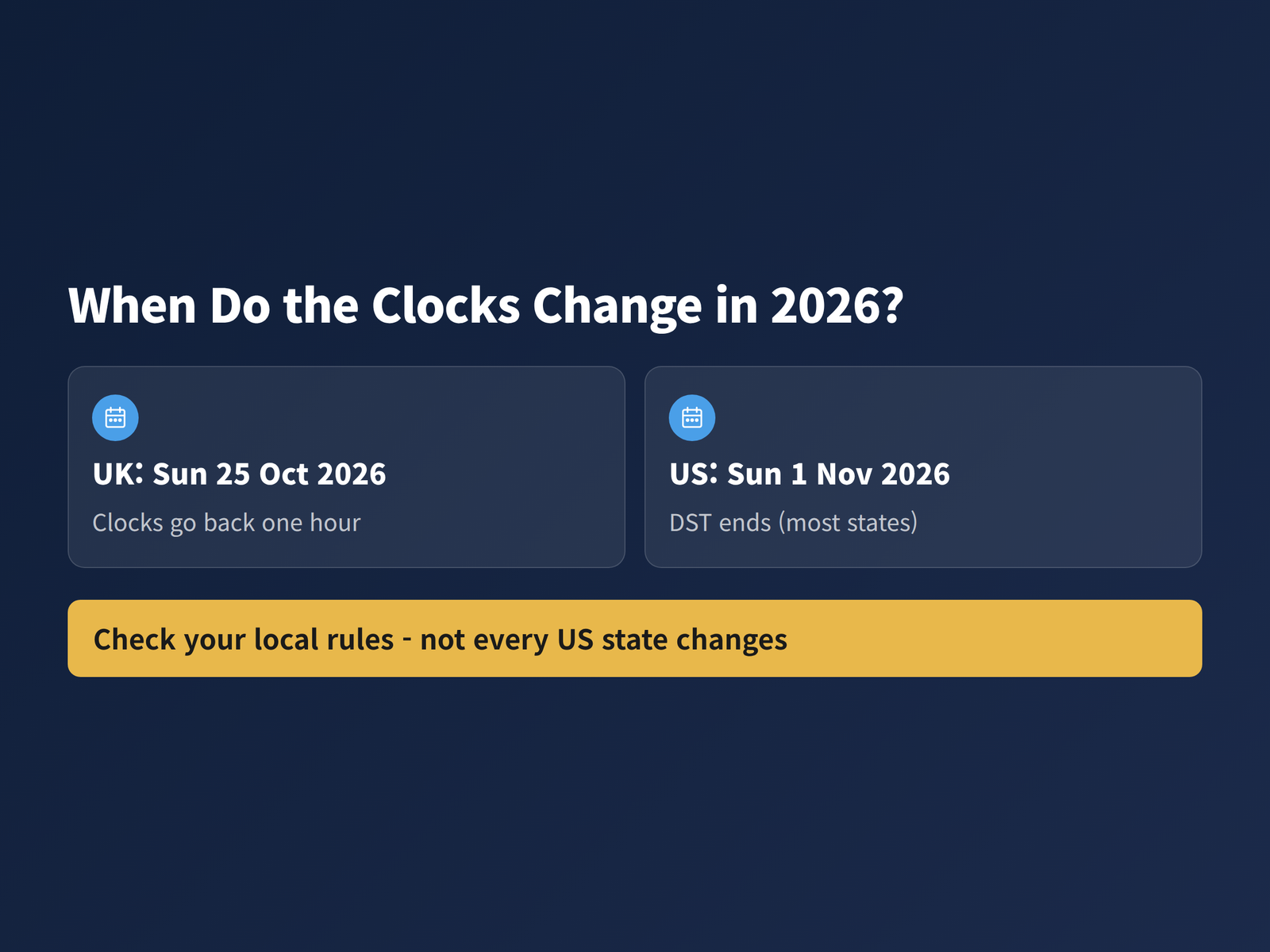
Walking a small dog in the dark after the clocks change comes down to four things: knowing the date, staying visible, keeping a short lead near traffic, and shifting the routine gradually. In the UK the clocks go back on Sunday 25 October 2026, and in most of the US daylight saving time ends on Sunday 1 November 2026. Evening walks that were in daylight will now start at dusk or after dark.

When do the clocks change in 2026, and what does that mean for small dog walks?
The UK clocks go back on Sunday 25 October 2026, and US daylight saving time ends at 2:00 a.m. on Sunday 1 November 2026. Under 15 U.S. Code 260a, US daylight saving time ends on the first Sunday of November, but states may exempt themselves and stay on standard time, so the 1 November date does not apply across every part of the US. For a dog walker, the practical effect is simple: a walk at the same clock time now starts about an hour closer to darkness.
The American Kennel Club explains why a dog’s body notices the shift before the calendar does. Dr. Jerry Klein, AKC Chief Veterinary Officer, puts it plainly: “Dogs respond to daylight, and they wake when the sun rises and sleep when it’s dark.” A small dog that expects an evening walk at a set hour will still ask for it, even when that hour is now dark outside.
Why is a small dog harder for drivers to see after dark?
Darkness is where most pedestrian road deaths happen, and a dog walker is a pedestrian. NHTSA data show that 76% of US pedestrian fatalities in 2024 occurred in the dark, compared with 20% in daylight, 2% at dusk and 2% at dawn. Those numbers describe people, not dogs, and no primary source found for this article measures how visible a small dog itself is to drivers.
Visibility research on people still points to a useful lesson for the walker at the other end of the lead. A study by Wood, Tyrrell, Lacherez and Black in Ophthalmic and Physiological Optics found that drivers recognised pedestrians wearing a reflective vest with biomotion markings at 319.1 m, compared with 184.5 m for a vest without them. The authors wrote that “adding biomotion reflectors to the vest facilitated earlier recognition of pedestrians.” Biomotion markings are reflectors placed on moving joints. The study tested human pedestrians, so the result applies to the walker, not directly to the dog.
What does the UK Highway Code say about walking a dog on the road?
The UK Highway Code says a dog should be kept on a short lead on a pavement, road or path shared with cyclists or horse riders. Rule 56 reads: “Do not let a dog out on the road on its own. Keep it on a short lead when walking on the pavement, road or path shared with cyclists or horse riders.” Rule 2 adds that where there is no pavement, walkers should “keep to the right-hand side of the road so that you can see oncoming traffic.” These rules apply in Great Britain and are not US law.
Two more Highway Code rules speak directly to dark evenings. Rule 3 advises walkers to “wear or carry something light-coloured, bright or fluorescent in poor daylight conditions.” Rule 17 covers night-time and says to “wear something reflective to make it easier for others to see you” and to “cross the road near a street light.” Blue Cross, the UK pet charity, adds a detail the Highway Code does not state: on country roads, walk against the traffic and keep your dog on your right, away from the traffic.
UK law goes further on certain roads. Section 27(1) of the Road Traffic Act 1988 states that “a person who causes or permits a dog to be on a designated road without the dog being held on a lead is guilty of an offence.” Local authorities decide which roads are designated, so a UK walker who is unsure about a particular route should check with the local council.
Why is a retractable leash a poor choice on dark evening walks?
A retractable leash puts distance between walker and dog, and distance removes supervision exactly when visibility is lowest. The American Kennel Club advises against retractable leashes on sidewalks and in crowds. Retractable leashes typically extend 10 to 30 ft, 16 ft is the most common length, and the AKC calls 26 ft “likely too long for most dogs.” The AKC warns: “At that distance, you’re unable to supervise your dog’s behavior. Your dog could eat something dangerous, get into a fight with a wild animal, or run into traffic.”
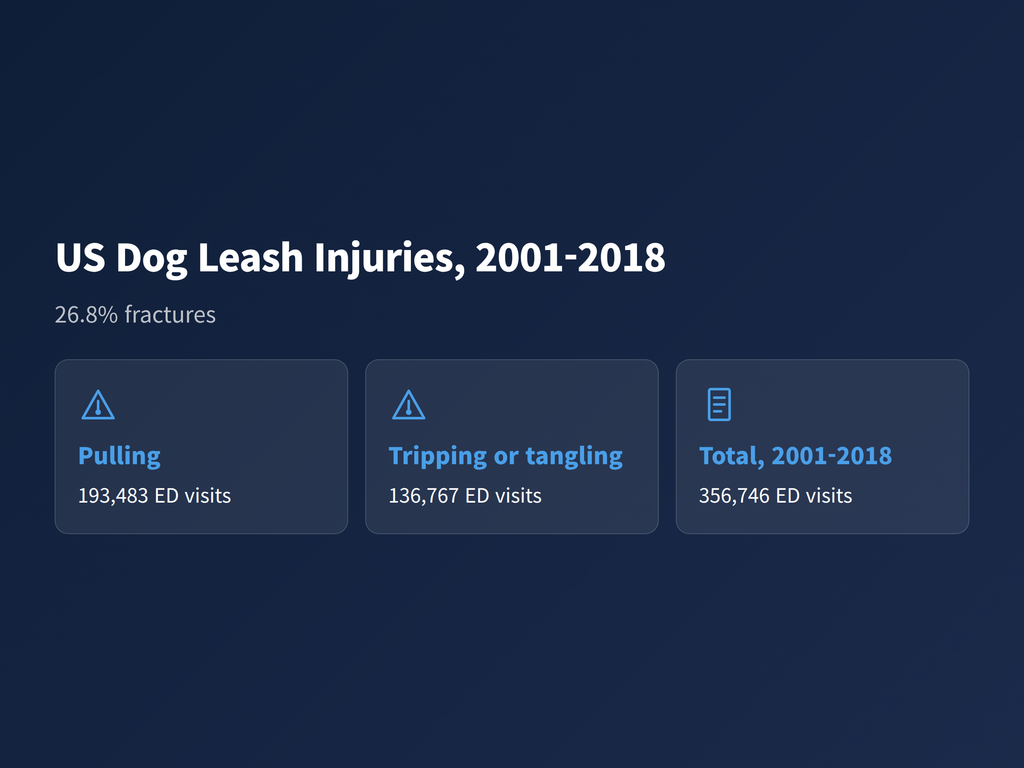
The cord itself is another concern, since the AKC notes that “the thinner cord can more easily burn, cut, or worse as it pulls across the skin.” A study in the American Journal of Emergency Medicine estimated 356,746 US emergency department visits for dog leash injuries between 2001 and 2018. Of those, 193,483 came from pulling and 136,767 from tripping or tangling, and 26.8% were fractures. The rate rose from 25.4 to 105.5 per 1,000,000 people over the same period. The study did not measure lighting, so it does not show that darkness causes these injuries.
How should you shift a small dog’s walk and meal times when the clocks change?
A gradual shift is easier on a small dog than an overnight one-hour jump. PDSA, the UK vet charity, suggests moving the routine by 10 minutes a day until the full hour is made up. The American Kennel Club gives similar advice: “Gradually adjust your dog’s schedule for eating, walking, and bedtime.”
Moving the main walk earlier can also keep it in daylight for longer. If that is not possible, a small dog walk after dark works better on familiar, lit routes. Blue Cross recommends that walkers “try to stick to lighted areas, such as paths that are lit in the park.” Every dog adjusts at its own pace. If your dog still seems unsettled by the new schedule after several days, consult your veterinarian.
Does a small dog legally need a collar tag on a night walk in the UK?
Yes, in the UK a dog in a public place must wear a collar with the owner’s name and address, day or night. The Control of Dogs Order 1992 says every dog “while in a highway or in a place of public resort shall wear a collar with the name and address of the owner inscribed on the collar or on a plate or badge attached to it.” Exemptions cover groups such as some working, sporting, police and guide dogs.
The RSPCA confirms that a collar with an ID tag in public is a legal requirement and that dogs over eight weeks old must be microchipped. A tag and a microchip matter more after dark, when a small dog that slips a lead is harder to spot. US readers should check local rules, because this article does not cover US state or city leash and tag laws.
Night walk situations compared
The table below summarises five common evening walk situations for a small dog.
| Situation | Guidance | Source |
|---|---|---|
| Road, no pavement (UK) | Face traffic, dog away from traffic | Highway Code, Blue Cross |
| Pavement beside traffic | Short lead | Highway Code, RSPCA |
| Designated road (UK) | Lead required by law | Road Traffic Act 1988 |
| Sidewalk or crowds | Avoid retractable leash | AKC |
| Off lead after dark | Enclosed area only | Blue Cross |
For UK walkers, the first three rows come from law or official guidance. The last two rows are welfare advice from the AKC and Blue Cross. Blue Cross advises letting a dog off lead after dark “only … in an enclosed area, away from the road,” ideally one the dog already knows.
Frequently asked questions
Do the clocks change on the same day in the UK and the US?
No. The UK clocks go back on Sunday 25 October 2026, while US daylight saving time ends on Sunday 1 November 2026. Some US states are exempt and do not change their clocks at all.
What should a walker wear for an evening dog walk?
The UK Highway Code advises light-coloured, bright or fluorescent clothing in poor daylight and something reflective at night. Blue Cross also suggests a flashing or reflective collar or harness for the dog and a torch or head lamp for the walker.
Is it safe to let a small dog off lead after dark?
Blue Cross advises off-lead time after dark only in an enclosed, familiar area away from the road. On a pavement, road or path shared with cyclists or horse riders, the UK Highway Code calls for a short lead.
Sources
- GOV.UK, “The Highway Code – Rules about animals (47 to 58)”, updated 22 October 2025 – https://www.gov.uk/guidance/the-highway-code/rules-about-animals-47-to-58
- GOV.UK, “The Highway Code – Rules for pedestrians (1 to 35)”, updated 22 October 2025 – https://www.gov.uk/guidance/the-highway-code/rules-for-pedestrians-1-to-35
- GOV.UK, “When do the clocks change?” – https://www.gov.uk/when-do-the-clocks-change
- legislation.gov.uk, Road Traffic Act 1988, section 27 – https://www.legislation.gov.uk/ukpga/1988/52/section/27
- legislation.gov.uk, The Control of Dogs Order 1992, article 2 – https://www.legislation.gov.uk/uksi/1992/901/article/2
- Cornell Legal Information Institute, 15 U.S. Code 260a – https://www.law.cornell.edu/uscode/text/15/260a
- NHTSA / Traffic Safety Marketing, “Pedestrian Safety”, 2024 data – https://www.trafficsafetymarketing.gov/safety-topics/pedestrian-safety
- Forrester MB, “Dog leash-related injuries treated at emergency departments”, American Journal of Emergency Medicine, 2020 – https://www.sciencedirect.com/science/article/abs/pii/S0735675720304460
- Wood JM, Tyrrell RA, Lacherez P, Black AA, “Night-time pedestrian conspicuity: effects of clothing on drivers’ eye movements”, Ophthalmic and Physiological Optics, 2017 – https://link.springer.com/article/10.1111/opo.12351
- American Kennel Club, “Retractable Dog Leashes: When and How to Use Them Safely”, Stephanie Gibeault, updated 10 March 2026 – https://www.akc.org/expert-advice/training/retractable-dog-leashes-use-safely/
- American Kennel Club, “How Does Daylight Saving Time Affect Dogs?”, Harriet Meyers, updated 30 October 2025 – https://www.akc.org/expert-advice/home-living/daylight-savings-time-affect-dogs/
- Blue Cross, “Advice for dogs and puppies in winter”, last reviewed 20 January 2023 – https://www.bluecross.org.uk/advice/dog/dogs-in-winter
- RSPCA, “Walking your dog” – https://www.rspca.org.uk/adviceandwelfare/pets/dogs/walking
- RSPCA, “Keep pets safe in cold weather” – https://www.rspca.org.uk/adviceandwelfare/seasonal/winter/pets
- PDSA, “Getting pets ready for when the clocks change” – https://www.pdsa.org.uk/pet-help-and-advice/looking-after-your-pet/all-pets/pets-and-daylight-savings