Xylitol hides in four places on US labels: the food ingredient list, the optional “Sugar Alcohol” line on Nutrition Facts, the “Inactive ingredients” heading on Drug Facts, and the “Other ingredients” line under Supplement Facts. Knowing where xylitol hides on product labels matters because the front of a package rarely says so. This guide covers US label rules only; other countries differ.
Xylitol is a sugar alcohol used as a sugar substitute, and the U.S. Food and Drug Administration (FDA) states that xylitol is dangerous to dogs.
Why doesn’t xylitol always appear as “xylitol” on a label?
Xylitol can appear under other names, because the FDA notes that xylitol may also be called “birch sugar” or “wood sugar.” A shopper scanning only for the word “xylitol” can miss a package that lists birch sugar instead. The FDA also groups xylitol with seven other sugar alcohols: erythritol, hydrogenated starch hydrolysates, isomalt, lactitol, maltitol, mannitol and sorbitol. The FDA describes sugar alcohols as “carbohydrates that chemically have characteristics of both sugars and alcohols.” For label reading, the practical takeaway is simple: search every ingredient list for three words, not one – xylitol, birch sugar and wood sugar.
Can the Sugar Alcohol line on a Nutrition Facts label hide xylitol?
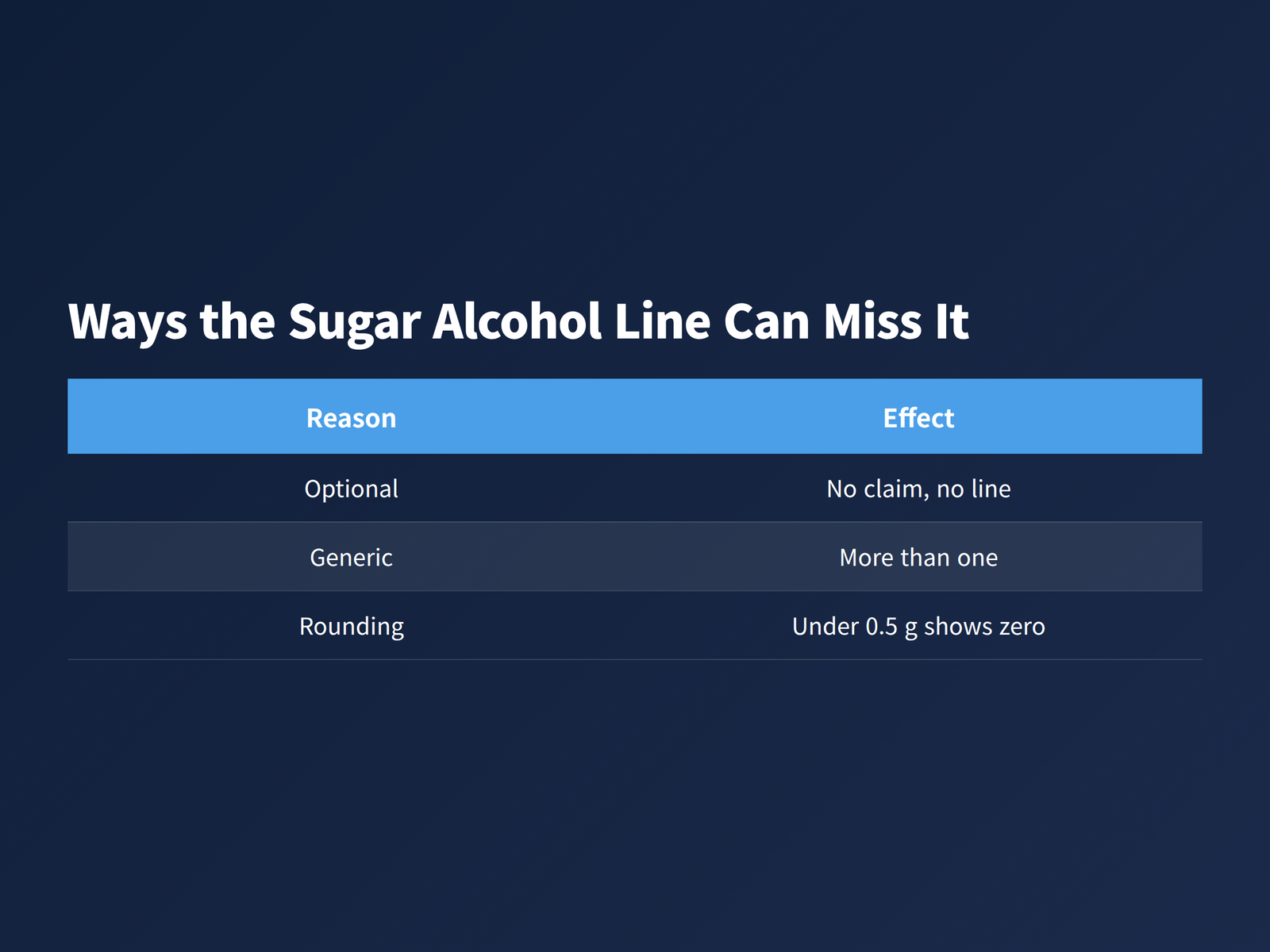
Yes, the Sugar Alcohol line on a Nutrition Facts label can fail to show xylitol, so the ingredient list is the place to check. Under 21 CFR 101.9, the Sugar Alcohol line is voluntary unless the maker makes a claim about sugar alcohol, total sugars or added sugars when sugar alcohols are present. Many products therefore carry no Sugar Alcohol line at all.
The Nutrition Facts panel allows the specific name only in a narrow case. Federal text reads: “In lieu of the term ‘sugar alcohol,’ the name of the specific sugar alcohol (e.g., ‘xylitol’) present in the food may be used in the nutrition label provided that only one sugar alcohol is present in the food.” When a product contains more than one sugar alcohol, the Nutrition Facts line says only “Sugar Alcohol.” Rounding adds a third gap: under 21 CFR 101.9, less than 1 gram may read “Contains less than 1 gram,” and less than 0.5 grams may be expressed as zero.
None of these Nutrition Facts rules removes xylitol from the ingredient list. Under 21 CFR 101.4, food ingredients must be “listed by common or usual name in descending order of predominance by weight.” The FDA says sugar alcohol names appear both under Total Carbohydrate on the Nutrition Facts panel and in the ingredient list. So a missing, generic or zero Sugar Alcohol line is not evidence that a food is free of xylitol – the ingredient list is where the answer sits.
Where does xylitol show up on a Drug Facts label for medicines?
On over-the-counter medicines, xylitol shows up under the “Inactive ingredients” heading inside the Drug Facts box. Under 21 CFR 201.66(c)(8), that heading lists the established name of each inactive ingredient. The regulation adds: “If the product is an OTC drug product that is not also a cosmetic product, then the inactive ingredients shall be listed in alphabetical order.” Alphabetical order gives a useful shortcut for the Drug Facts box: xylitol sits near the very end of the Inactive ingredients list, so scan the “W” and “X” entries first. The ASPCA also lists liquid prescription medications as a xylitol source.
Where should you look on a vitamin or supplement label?
On a vitamin or supplement, look at the “Ingredients” or “Other ingredients” line printed directly below, or to the right of, the Supplement Facts panel. Under 21 CFR 101.4(g), that ingredient list sits immediately next to the Supplement Facts panel and uses the “Other ingredients” heading when some sources are already named inside the panel. The FDA, the ASPCA and Cornell University College of Veterinary Medicine all name vitamins, supplements or medications as xylitol sources, so the Other ingredients line deserves the same attention as a food ingredient list.
Which everyday products besides gum can contain xylitol?
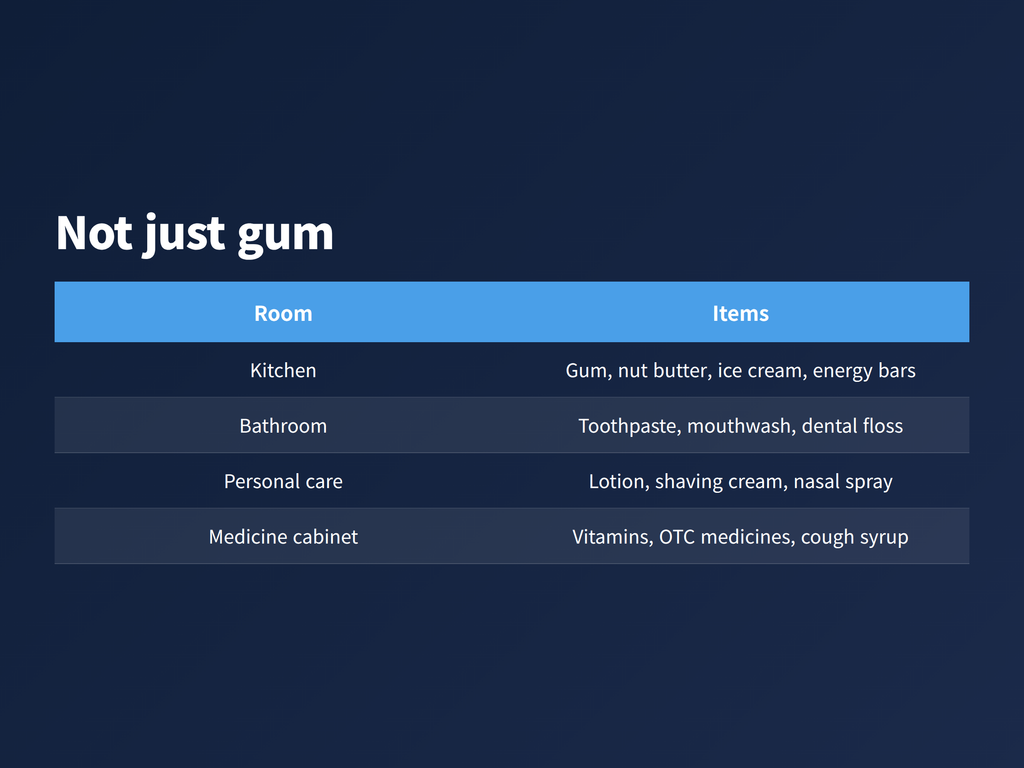
Beyond sugarless gum, xylitol can appear in nut butters, sugar-free desserts, vitamins, medicines and several non-food personal care products. Between them, the FDA, the ASPCA and Cornell University College of Veterinary Medicine name the following categories:
- Sugarless gum, sugar-free candy and mints
- Peanut and nut butters
- Chewable or gummy vitamins, OTC medicines and supplements
- Toothpaste and mouthwash, plus dental floss per the ASPCA
- Cough syrup, nasal sprays and skin care
- Lotions and shaving cream, per Cornell
- Sugar-free ice cream, pudding, baked goods, energy bars and protein powder
Toothpaste, lotion and nasal spray are the easiest xylitol sources to overlook. The scale of accidental exposure is not small: the ASPCA reports that its Animal Poison Control Center received more than 6,100 xylitol-related calls in 2021 and saw a 39% increase in xylitol-related calls between 2007 and 2020. Cornell advises storing products that contain xylitol out of reach and using only dog-safe toothpaste.
How do you check a peanut butter jar before sharing it with a small dog?
To check a peanut butter jar, turn it around and read the full ingredient list for xylitol, birch sugar or wood sugar. The FDA advises: “Check the label for xylitol in the ingredients of products, especially ones that advertise as sugar-free or low sugar.” A peanut butter jar marketed as sugar-free or low sugar deserves the closest look. Cornell University College of Veterinary Medicine warns: “The exact amount of xylitol in products varies wildly and can even vary between flavors of the same brand.” Read the ingredient list on every new jar and every new flavor, even from a familiar peanut butter brand.
What does a 5-step label check look like?
A reliable label check takes five steps and starts with the ingredient list, not the front of the package:
- Food: read the ingredient list for xylitol, birch sugar and wood sugar.
- Ignore a missing, generic or zero Sugar Alcohol line and still read the ingredient list.
- Medicines: read Inactive ingredients in the Drug Facts box, starting near the end.
- Vitamins and supplements: read the Other ingredients line below the Supplement Facts panel.
- Treat “sugar-free” and “low sugar” claims as a reason to look harder, then store any xylitol product out of reach.
Which label panel should you check for each product type?
Each US label type puts xylitol in a different panel, and the table below summarizes where to look.
| Label type | Where to look | Catch |
|---|---|---|
| Packaged food | Ingredient list | Ordered by weight |
| Nutrition Facts | Sugar Alcohol line | Optional, may be generic |
| OTC medicine | Inactive ingredients | Alphabetical, near end |
| Supplement | Other ingredients | Below the facts panel |
| Any product | Front of pack | Sugar-free is a cue |
A US package also carries no required pet warning about xylitol. The ASPCA is asking the FDA to “require manufacturers … to label them with a warning about the danger this ingredient poses to pets,” which means reading the back panel is still the owner’s job.
What should you do if a small dog gets into a xylitol product?
Contact a professional immediately rather than waiting to see what happens. The FDA states: “If you think your dog may have eaten a product containing xylitol, call your vet, emergency clinic, or animal poison control center right away.” For any question about your own dog’s health or a possible exposure, consult your veterinarian, an emergency clinic or the ASPCA Animal Poison Control Center.
Frequently asked questions
Is birch sugar the same as xylitol?
The FDA states that xylitol may also be called “birch sugar” or “wood sugar,” so a label listing birch sugar should be treated as a xylitol label.
Does “Sugar Alcohol” on a Nutrition Facts label mean xylitol?
Not necessarily. Under 21 CFR 101.9, the Nutrition Facts line reads “Sugar Alcohol” whenever more than one sugar alcohol is present, so only the ingredient list confirms whether xylitol is one of them.
If the Sugar Alcohol line says 0 g, is the product xylitol-free?
No. Under 21 CFR 101.9, less than 0.5 grams per serving may be expressed as zero, so the ingredient list is the only reliable check.
Sources
- U.S. Food and Drug Administration, “Paws Off Xylitol; It’s Dangerous for Dogs”, updated 2025-12-17 — https://www.fda.gov/consumers/consumer-updates/paws-xylitol-its-dangerous-dogs
- U.S. Food and Drug Administration, Interactive Nutrition Facts Label, “Sugar Alcohols”, 2021-10 — https://www.accessdata.fda.gov/scripts/InteractiveNutritionFactsLabel/assets/InteractiveNFL_SugarAlcohols_October2021.pdf
- Electronic Code of Federal Regulations, 21 CFR 101.9, “Nutrition labeling of food”, current edition accessed 2026-09-29 — https://www.ecfr.gov/current/title-21/chapter-I/subchapter-B/part-101/subpart-A/section-101.9
- Electronic Code of Federal Regulations, 21 CFR 101.4, “Food; designation of ingredients”, current edition accessed 2026-09-29 — https://www.ecfr.gov/current/title-21/chapter-I/subchapter-B/part-101/subpart-A/section-101.4
- Electronic Code of Federal Regulations, 21 CFR 201.66, OTC Drug Facts format, current edition accessed 2026-09-29 — https://www.ecfr.gov/current/title-21/chapter-I/subchapter-C/part-201/subpart-C/section-201.66
- ASPCA, “Updated Safety Warning on Xylitol: How to Protect Your Pets”, 2019-05-23 — https://www.aspca.org/news/updated-safety-warning-xylitol-how-protect-your-pets
- ASPCA, “USA: The FDA Must Protect Pets From Accidental Poisoning”, campaign page citing 2021 data — https://secure.aspca.org/action/usa-paws-off
- Cornell University College of Veterinary Medicine, Riney Canine Health Center, “Xylitol toxicities”, no date shown — https://www.vet.cornell.edu/departments-centers-and-institutes/riney-canine-health-center/canine-health-topics/xylitol-toxicities