A small dog can’t fly in the cabin to the UK on a commercial airline because the official GOV.UK list of approved routes only allows commercial airlines to carry pets in the hold. Cabin travel into Great Britain is limited to approved charter operators and recognised assistance dogs. This guide covers the approved route rule, the assistance dog exception, US paperwork, and which workarounds through France hold up.

Why can’t a small dog fly in the cabin into the UK?
A pet dog cannot enter Great Britain in the cabin of a commercial flight because the approved route list puts commercial airline pets in the hold. The GOV.UK publication on approved routes states: “You can only use these carriers and routes approved by the Animal and Plant Health Agency to bring your pet to England or Scotland.” The companion list of airlines and airports says of commercial carriers: “These airlines transport pets in the hold of the plane”. The size of the dog does not change that outcome.
British Airways states the policy in plain terms on its pet travel page: “We don’t carry pets in the cabin on any route.” British Airways routes pet imports to the UK through IAG Cargo instead. The official government reason for the hold-only rule has not been published in response to the public petitions, so this guide describes only what the approved route list says. Checking the current GOV.UK list before booking is the safest first step.
Which airlines and airports are approved to bring a dog into Great Britain?
The approved airlines and airports are named on the GOV.UK page “Pet travel: airlines and airports you can use,” which lists 26 airports. The airport list includes London Heathrow, where pets are handled at the Heathrow Animal Reception Centre (HARC), London Gatwick, Manchester, Edinburgh, Glasgow, Birmingham, London Stansted and London Luton. The page separates commercial airlines, which carry pets in the hold, from charter airlines, which are listed as carrying pets in the aircraft cabin.
Approval is not automatic. GOV.UK guidance for air carriers says carriers “…must agree a required method of operation (RMOP) with APHA for each airport you travel to.” The charter listing does not mean a specific operator offers cabin travel for a given trip or price, so availability has to be confirmed with the operator. Travel within the UK or from Ireland does not require an approved route, according to the GOV.UK guide to bringing a pet to Great Britain.
Why can an assistance dog fly in the cabin when a pet dog can’t?
An assistance dog can fly in the cabin because GOV.UK treats recognised assistance dogs as a separate category from pets. The GOV.UK assistance dogs guidance tells owners “…you can bring your dog into the aircraft cabin…” and that assistance dogs can “…travel on more routes than people with pets.” The key word is recognised: only a recognised assistance dog receives the wider route and cabin access.
Emotional support dogs do not fall into that category. British Airways states that it is “…unable to accept emotional support dogs for travel in the cabin on any British Airways operated flights.” An owner with an emotional support dog therefore faces the same hold-only rule as any other pet owner on a commercial route into Great Britain.
What paperwork does a dog from the US need before landing in Great Britain?
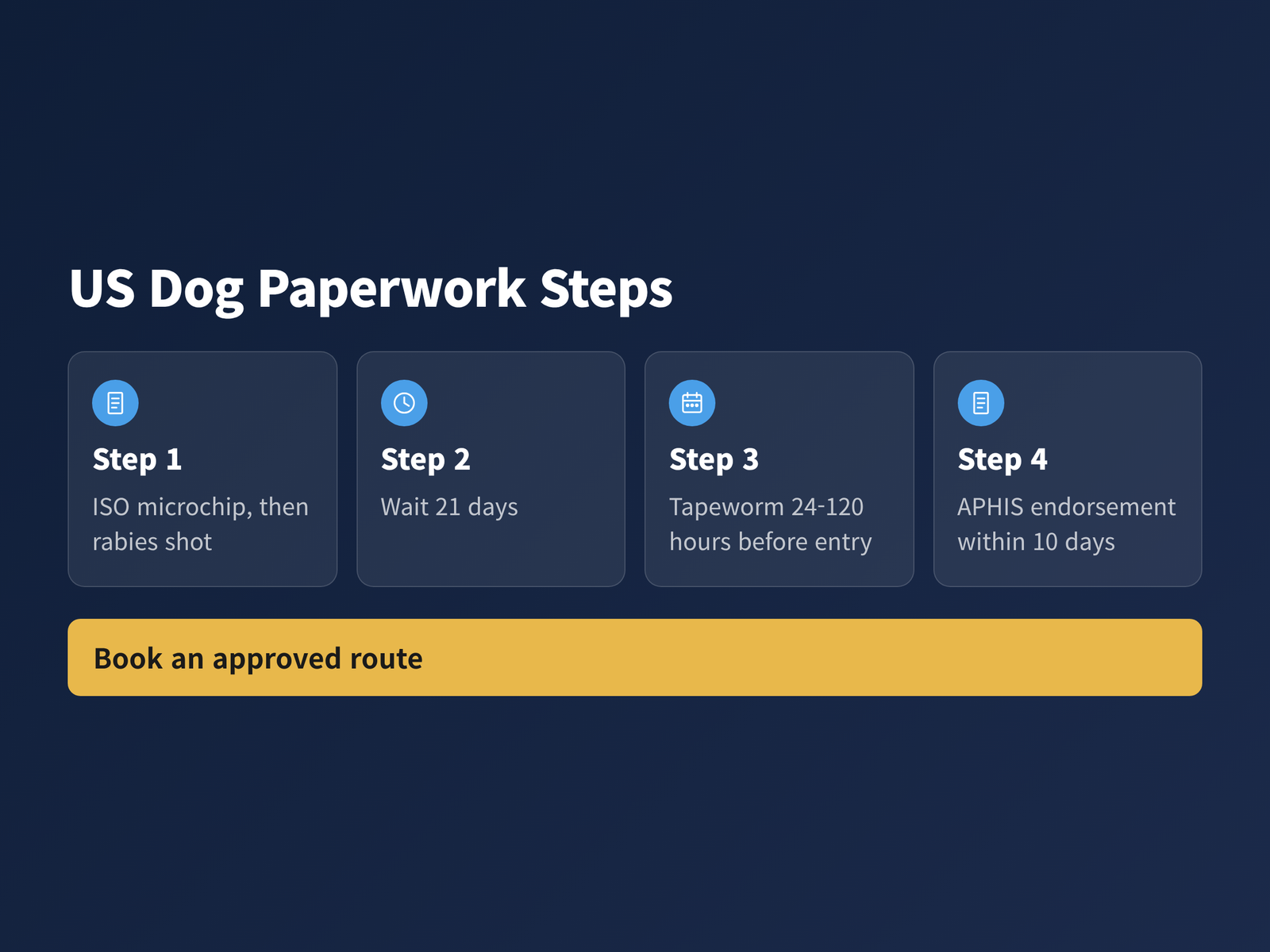
A dog travelling from the US to Great Britain needs a microchip, a rabies vaccination, a tapeworm treatment and an APHIS-endorsed health certificate. The timing windows matter as much as the documents. The microchip must meet ISO 11784/11785 and must be implanted before the rabies vaccination, or the vaccination does not count.
USDA APHIS states: “After a primary rabies vaccination, the pet must wait at least 21 days to be eligible to enter the UK.” The tapeworm treatment must be given by a USDA Accredited Veterinarian between 24 hours and 5 days (120 hours) before arrival. The non-commercial health certificate is valid for 30 days after the veterinarian signs, but APHIS endorsement must fall within 10 days of arriving in the UK. Because each step depends on the one before it, consult your veterinarian early to plan the dates, and ask your veterinarian whether the journey suits your dog’s health.
- Microchip (ISO), then rabies vaccination; wait 21 days after the primary vaccination
- Tapeworm treatment by a USDA Accredited Veterinarian, 24 to 120 hours before entry
- Health certificate from an accredited veterinarian, endorsed by APHIS; arrive within 10 days of endorsement
- Book an approved carrier and route from the GOV.UK list
Is flying into France in the cabin and driving through the Channel Tunnel a real workaround?
Flying into France in the cabin and then driving through the Channel Tunnel can work, but only with a vehicle and only if the dog fits the airline’s cabin limit. Air France accepts cats and dogs in the cabin when the animal weighs under 8 kg (17.64 lb) including the carrier. A small dog plus a sturdy carrier can pass that limit.
The second leg uses LeShuttle from Calais. LeShuttle Pet Reception at Calais is a drive-thru, the limit is 5 pets per vehicle, and travellers are asked to arrive at least 90 minutes before departure. LeShuttle describes the crossing itself this way: “Enjoy the 35-minute journey with your pet by your side”. Whether LeShuttle or the ferries accept foot passengers with pets has not been confirmed, so the route should be planned around a car. The APHIS 10-day endorsement window also keeps running during the French stopover, so a long stay in France can break the timeline.
Why won’t Eurostar take a small dog to London?
Eurostar does not allow pets on routes to or from London, regardless of the dog’s size. The Eurostar pet travel page explains that small dogs under 6 kg can travel free in a 45 x 30 x 25 cm carrier, and larger dogs can travel with a EUR 30 dog fare, but only on routes between Belgium, France, Germany and the Netherlands. London is excluded from both options.
The Eurostar carrier allowance looks like a cabin-style option, yet it never reaches Great Britain. The cross-Channel rail option that does carry a dog is the vehicle crossing on LeShuttle from Calais, where the dog stays in the owner’s car. Checking the current Eurostar page before travel remains sensible, because carrier policies can change.
Cabin, hold, charter or LeShuttle: how do the routes into Great Britain compare?
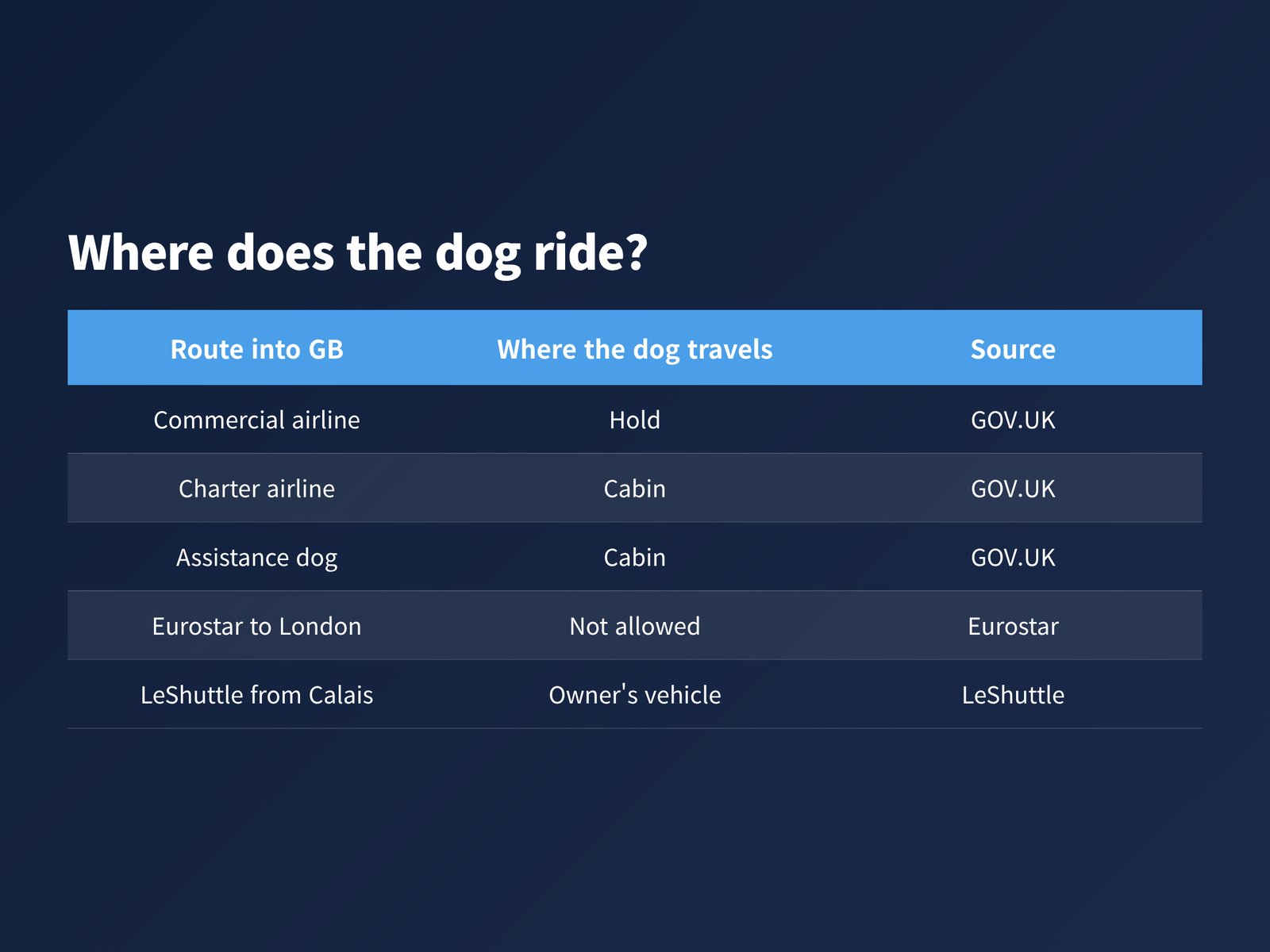
The routes into Great Britain differ mainly in where the dog travels, and only the charter and assistance dog routes keep a dog in the cabin. The table below summarises each option using the GOV.UK approved route list, the GOV.UK assistance dogs guidance and the carriers’ own pages. Each row reflects the published rule, not a guaranteed booking.
| Route into GB | Where the dog travels | Source |
|---|---|---|
| Commercial airline | Hold | GOV.UK |
| Charter airline | Cabin | GOV.UK |
| Assistance dog | Cabin | GOV.UK |
| Eurostar to London | Not allowed | Eurostar |
| LeShuttle from Calais | Owner’s vehicle | LeShuttle |
Frequently asked questions
Does a dog under 8 kg get an exception for the cabin into the UK?
No. The GOV.UK approved route list puts pets on commercial airlines in the hold regardless of weight. The 8 kg cabin limit belongs to Air France routes, not to flights into Great Britain.
How early should a driver with a dog arrive for LeShuttle at Calais?
LeShuttle asks travellers with pets to arrive at least 90 minutes before departure. Pet Reception at Calais is a drive-thru.
Did the UK Parliament consider allowing pets in the cabin?
A petition titled “Change rules to allow pets in airplane cabins going to and from the UK” ran from 2025-06-04 to 2025-12-04 and closed with 2,254 signatures, below the 10,000 needed for a government response.
Do the rules change if a family brings more than five pets? Yes. GOV.UK states that different rules, known as the Balai rules, apply when more than five pets travel.
Sources
- GOV.UK (DEFRA/APHA), “Pet travel: approved air, sea, rail and charter routes,” 2026-09-25 – https://www.gov.uk/government/publications/pet-travel-approved-air-sea-rail-and-charter-routes-for-the-movement-of-pets
- GOV.UK, “Pet travel: airlines and airports you can use,” 2026-09-25 – https://www.gov.uk/government/publications/pet-travel-approved-air-sea-rail-and-charter-routes-for-the-movement-of-pets/approved-air-routes-for-pet-travel
- GOV.UK, “Bringing your pet dog, cat or ferret to Great Britain,” 2024-10-24 – https://www.gov.uk/bring-pet-to-great-britain
- GOV.UK, “Assistance dogs,” 2024-10-24 – https://www.gov.uk/bring-pet-to-uk/guide-dogs
- GOV.UK, “Air carriers: transport pets and assistance dogs,” 2025-08-12 – https://www.gov.uk/guidance/air-carriers-transport-pets-and-assistance-dogs
- USDA APHIS, “Pet Travel From the United States to the United Kingdom/Great Britain,” 2026-01-25 – https://www.aphis.usda.gov/pet-travel/us-to-another-country-export/pet-travel-us-united-kingdom-great-britain-england-scotland
- British Airways, “Travelling with pets,” accessed 2026-10-03 – https://www.britishairways.com/content/information/travel-assistance/travelling-with-pets
- Air France, “Travel with your pet,” accessed 2026-10-03 – https://wwws.airfrance.us/information/passagers/voyager-avec-son-animal-chien-chat
- Eurostar, “Pet travel,” accessed 2026-10-03 – https://www.eurostar.com/uk-en/pet-travel
- LeShuttle, “Travelling with pets,” accessed 2026-10-03 – https://www.leshuttle.com/uk-en/travelling-with-us/travelling-with-pets
- UK Parliament Petitions, “Change rules to allow pets in airplane cabins going to and from the UK” (petition 727223), closed 2025-12-04