Clipping does not permanently ruin a Border Terrier coat, but clipping does change it. According to the Border Terrier Club of America, a clipped Border loses the texture and color of the natural wire coat, and some clipped coats can be restored with two or three hand strippings. Below: what clipping does, why stripping differs, how often to strip, and when clipping is fine.
Does clipping really ruin a Border Terrier coat?
No, clipping changes a Border Terrier coat rather than ruining it for good, and the change can often be reversed. The Border Terrier Club of America, the AKC parent club for the breed, states that “the coats of some Borders who have been clipped can be restored in two or three hand strippings but it is very hard work.” So the popular claim that one clip destroys a Border Terrier coat forever is an overstatement. The accurate version is narrower: clipping costs the wire coat its texture and color, and getting that wire texture back takes repeated, skilled stripping.
What does clipping actually do to a Border Terrier’s wire coat?
Clipping cuts the Border Terrier’s harsh outer hairs short, and the coat that results loses its natural texture and color. The Border Terrier Club of America puts it directly: “A Border who has been clipped will lose the texture and color of his natural protective coat.” The American Kennel Club makes the same point about wire coats in general, noting that hand stripping is what keeps the coarse texture. Texture is the whole point of a Border Terrier coat.
The breed standards describe that texture precisely. The AKC Official Standard of the Border Terrier calls for “a short and dense undercoat covered with a very wiry and somewhat broken topcoat which should lie closely, but it must not show any tendency to curl or wave.” The Royal Kennel Club breed standard is shorter: “Harsh and dense; with close undercoat. Skin must be thick.” A softer, duller Border Terrier coat after clipping is a coat drifting away from that written description.
Why doesn’t clipping remove the dead hair the way stripping does?
Clipping only shortens dead hair, while stripping pulls dead hair out at the root. The Border Terrier Club of America explains that “clipping is not a recommended method of grooming since it does not remove the dead hair but merely shortens it.” Hand stripping, by contrast, is defined by the club as “pulling out the dead outer hair by hand, or with the help of a stripping tool.” The AKC describes stripping as plucking dead strands to retain the coarse texture of the coat.
That difference explains the change owners notice. With hand stripping, the dead outer hair of a Border Terrier comes out and leaves room for a fresh wire coat to grow. With clipping, the dead outer hair stays in the follicle, now trimmed to a stub. The exact follicle-level reason clipped wire coats turn soft has not been confirmed by a primary study, so the safe takeaway is the practical one: stripping removes, clipping shortens.
Can a Border Terrier coat that went soft after clipping be brought back?
Yes, in many cases a soft clipped Border Terrier coat can be brought back with two or three hand strippings, according to the Border Terrier Club of America. The same club adds that the restoration is “very hard work,” so owners should expect a gradual process rather than a single appointment. No primary source gives a timeline in months, so be wary of any promised recovery date.
Skill matters during restoration. Kim Kier, a groomer quoted by the AKC, warns: “An untrained pet strip can be painful for the dog and may not produce the results the owner seeks. Knowledge and skill are key.” For general context only, a 2004 study in Labrador Retrievers found clipped hair took 13.6 to 15.4 weeks to regrow, a figure that says nothing about Border Terrier texture or restoration time.
How often does a Border Terrier need hand stripping or rolling?
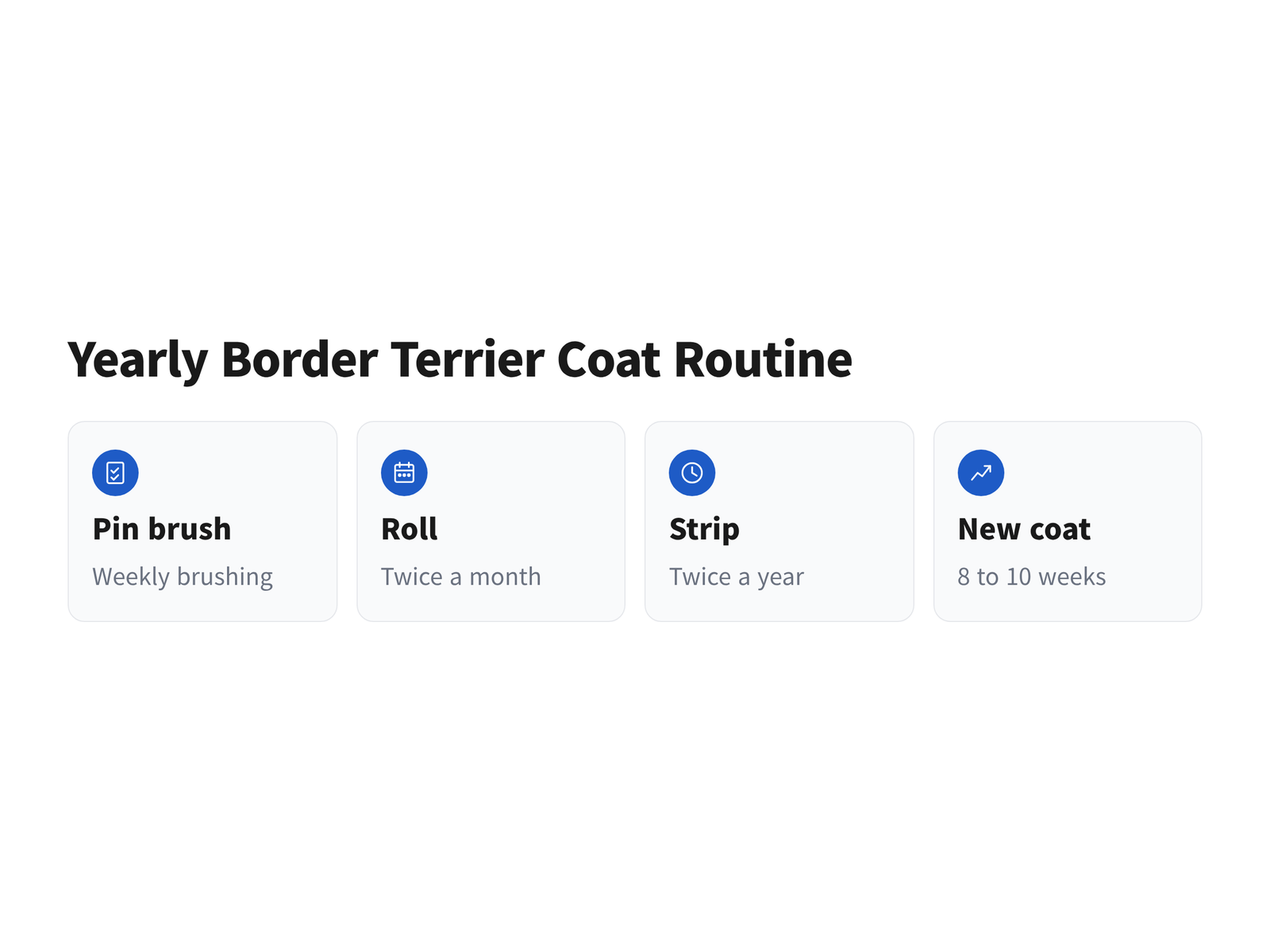
A Border Terrier is usually hand stripped twice a year, according to the Border Terrier Club of America, with a new coat growing in over 8 to 10 weeks. Between full strips, the club suggests “rolling” the coat, tidying it by hand or with a stripping tool twice a month. Rolling is the between-strip upkeep that the Border Terrier Club of America pairs with the twice-yearly strip.
A simple routine looks like this:
- Brush the wire coat with a pin brush once a week (AKC)
- Roll the coat twice a month, gripping hair near the root and pulling in the direction of growth; a rubber finger cot or grooming chalk can help grip (AKC, Border Terrier Club of America)
- Fully hand strip twice a year (Border Terrier Club of America)
- Towel a wet, dirty coat, then slicker-brush it once dry; frequent baths are not needed (Border Terrier Club of America)
Skipping coat work has a cost too. The Border Terrier Club of America notes that a Border that is only brushed can take on a “cocoa-mat” look, with more shedding and odor. The Royal Kennel Club lists Border Terrier grooming as “more than once a week.”
When is clipping a reasonable choice for a Border Terrier?
Clipping is a reasonable choice for some older Border Terriers and for sensitive areas such as the face and belly. The Border Terrier Club of America states: “For their comfort, some older Borders are maintained by clipping.” For a senior Border Terrier, comfort can outweigh a show-correct wire texture.
The AKC also notes that clippers are fine on sensitive areas like the face and lower belly, even on dogs whose body coat is stripped. Kim Kier, quoted by the AKC, says “most pet dogs can maintain a healthy coat that looks fabulous with what most would call a ‘pet strip,’ which is a clipper trim with carding.” Carding removes loose undercoat, so a pet strip combines some of the convenience of clipping with part of the effect of stripping.
The AKC also writes that long-term clipping of a wire coat may raise the risk of skin conditions and affect temperature regulation. If a Border Terrier shows skin changes, itching, or patchy regrowth after clipping, consult your veterinarian rather than changing grooming methods on your own.
Hand stripping vs clipping for a Border Terrier: how do they compare?
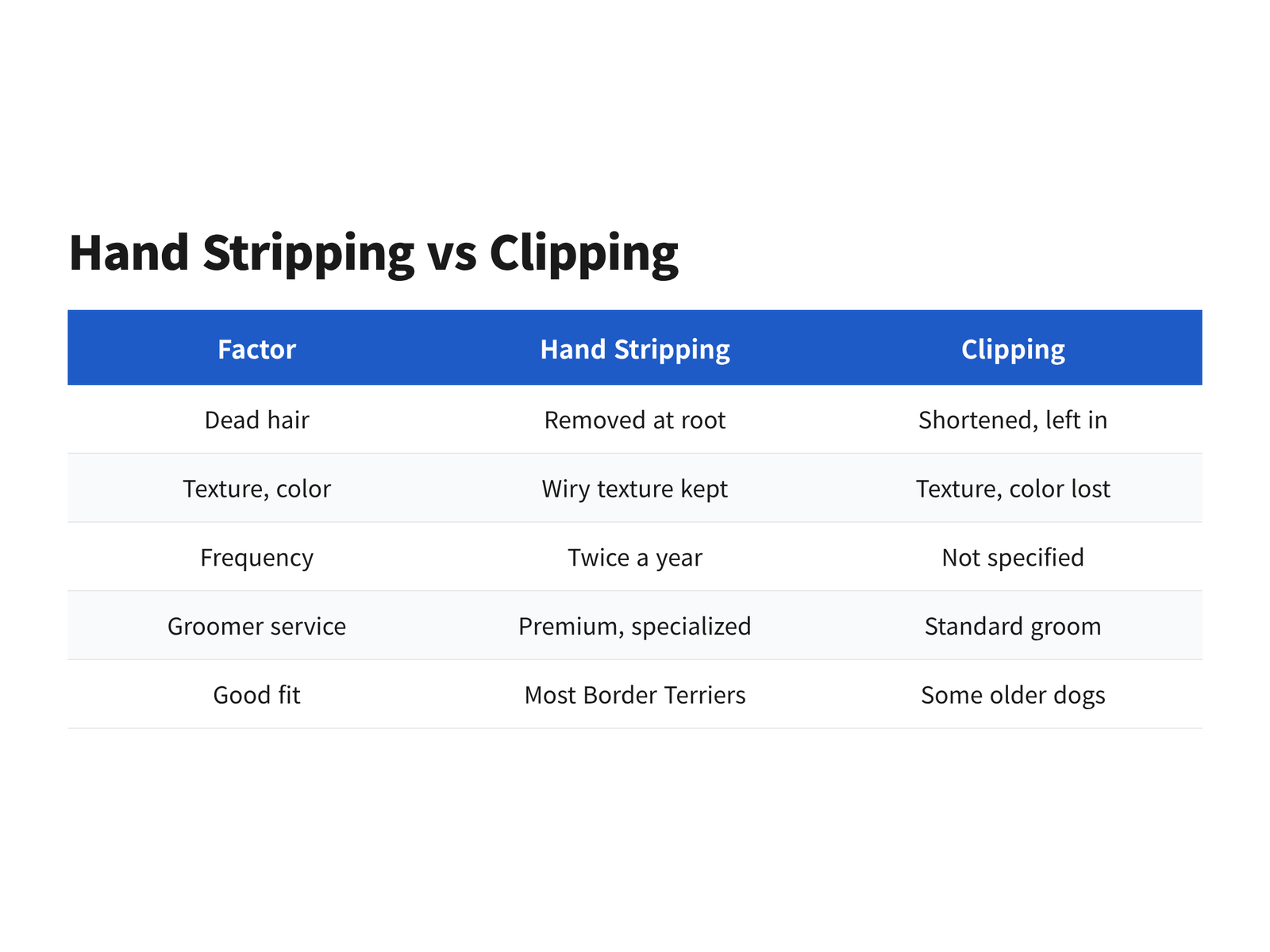
Hand stripping keeps the Border Terrier’s wire texture, while clipping is quicker but changes texture and color. The table below summarizes the differences drawn from Border Terrier Club of America and AKC guidance, so owners can weigh texture, upkeep, and groomer service side by side.
| Factor | Hand stripping | Clipping |
|---|---|---|
| Dead hair | Removed at root | Shortened, left in |
| Texture and color | Wiry texture kept | Texture, color lost |
| Frequency | Twice a year | Not specified |
| Groomer service | Premium, specialized | Standard groom |
| Good fit | Most Border Terriers | Some older dogs |
Cost is the trade-off most owners weigh. Kim Kier notes in the AKC article that hand stripping is a specialized, premium service compared with a standard groom, though no reliable price range is available to cite here. The right choice for a given Border Terrier depends on age, grooming tolerance, and how much the original wire coat matters.
Frequently asked questions
Will one clip permanently ruin a Border Terrier coat?
No. The Border Terrier Club of America says some clipped Border coats can be restored in two or three hand strippings, although the work is hard and texture and color are lost in the meantime.
Is hand stripping painful for a Border Terrier?
That depends on skill. Kim Kier, quoted by the AKC, warns that an untrained pet strip can be painful and may not give the result an owner wants, which is why experience with terrier coats matters.
At what age should a Border Terrier puppy have a first strip?
No breed club or kennel club source reviewed for this guide gives a specific age, so ask a groomer experienced with terriers, or your breeder, about your puppy’s coat.
Can the face and belly be clipped on their own?
Yes. The AKC notes that clippers are fine on sensitive areas such as the face and lower belly, even when the body coat is stripped.
Sources
- Border Terrier Club of America, “Grooming” (accessed 2026-10-04) – https://www.btcoa.org/grooming
- American Kennel Club, “Official Standard of the Border Terrier” (approved 1950-03-14, reformatted 1990-07-13) – https://images.akc.org/pdf/breeds/standards/BorderTerrier.pdf
- American Kennel Club, Colt Dodd, “Everything You Need to Know About Hand-Stripping Dog Coats” (updated 2025-11-10) – https://www.akc.org/expert-advice/health/hand-stripping-dog-coats/
- American Kennel Club, Steve Pessah, “Wired Coat Care: Stripping” (2019-12-06) – https://www.akc.org/expert-advice/grooming/wired-coat-care-stripping/
- The Royal Kennel Club, “Border Terrier” breed page (accessed 2026-10-04) – https://www.royalkennelclub.com/search/breeds-a-to-z/breeds/terrier/border-terrier
- The Royal Kennel Club, “Border Terrier Breed Standard” (accessed 2026-10-04) – https://www.royalkennelclub.com/breed-standards/terrier/border-terrier/
- Diaz SF, Torres SMF, Dunstan RW, Lekcharoensuk C., “An analysis of canine hair re-growth after clipping for a surgical procedure,” Veterinary Dermatology 15(1):25-30 (2004) – https://experts.umn.edu/en/publications/an-analysis-of-canine-hair-re-growth-after-clipping-for-a-surgica/