The bathroom scale method works by subtraction, and subtraction is exactly where a small dog’s weight change disappears. Weighing yourself with the dog, then without the dog, gives a number built from two large readings, so a shift that matters for a small dog can sit inside the scale’s own wobble. A kitchen scale or baby scale, a body condition score, and a written log give a far clearer picture.

Why does the bathroom scale method fail small dogs?
The bathroom scale method fails small dogs because the dog’s weight is only the difference between two large readings, and small changes get lost in that gap. Maddie’s Fund describes the method plainly: weigh yourself while holding the dog, weigh yourself alone, and subtract the second number from the first. The trouble is resolution. A bathroom scale is designed to read an adult human, and any rounding or drift in either reading lands directly on the small dog’s result.
For very small animals, Maddie’s Fund says “a postage scale or a kitchen scale is an excellent choice,” because “a weight change of a fraction of an ounce is significant.” Maddie’s Fund still lists the bathroom scale method for animals of 2 lb and up, so the method is not useless. Using the same scale on the same hard floor removes some noise, but consistency cannot add precision the bathroom scale does not have. For a small dog, though, the hold-and-subtract number is best treated as a ballpark, not as a trend line.
Is a kitchen scale or a baby scale better for weighing a small dog?
A kitchen scale or a baby scale is better for a small dog because either one reads the dog directly in grams or ounces instead of by subtraction. Maddie’s Fund outlines the routine: turn the scale on, choose grams or ounces, press tare to zero out any bowl or basket, and make sure the whole body, tail included, rests on the scale.
A baby scale has a wider platform and offers the same gram or ounce choice, so a small dog can lie or sit on it without a container. The trade-off is that a baby scale is extra equipment many households do not already own. PDSA, the UK veterinary charity, notes that many veterinary practices let owners use the clinic scale without an appointment. The clinic scale suits an owner who wants an occasional precise reading rather than a home routine.
Why isn’t the number on the scale enough without a body condition score?
The number on the scale is not enough because weight alone cannot show how much of a small dog’s body is fat and how much is muscle. The American Animal Hospital Association (AAHA) Nutrition and Weight Management Guidelines ask veterinary teams to assess body weight, body condition score (BCS), and muscle condition score (MCS) together. AAHA states that “BCS and MCS are not causally related and should be assessed separately.” Two small dogs with the same scale reading can still differ in body condition, and the number alone would not reveal that difference.
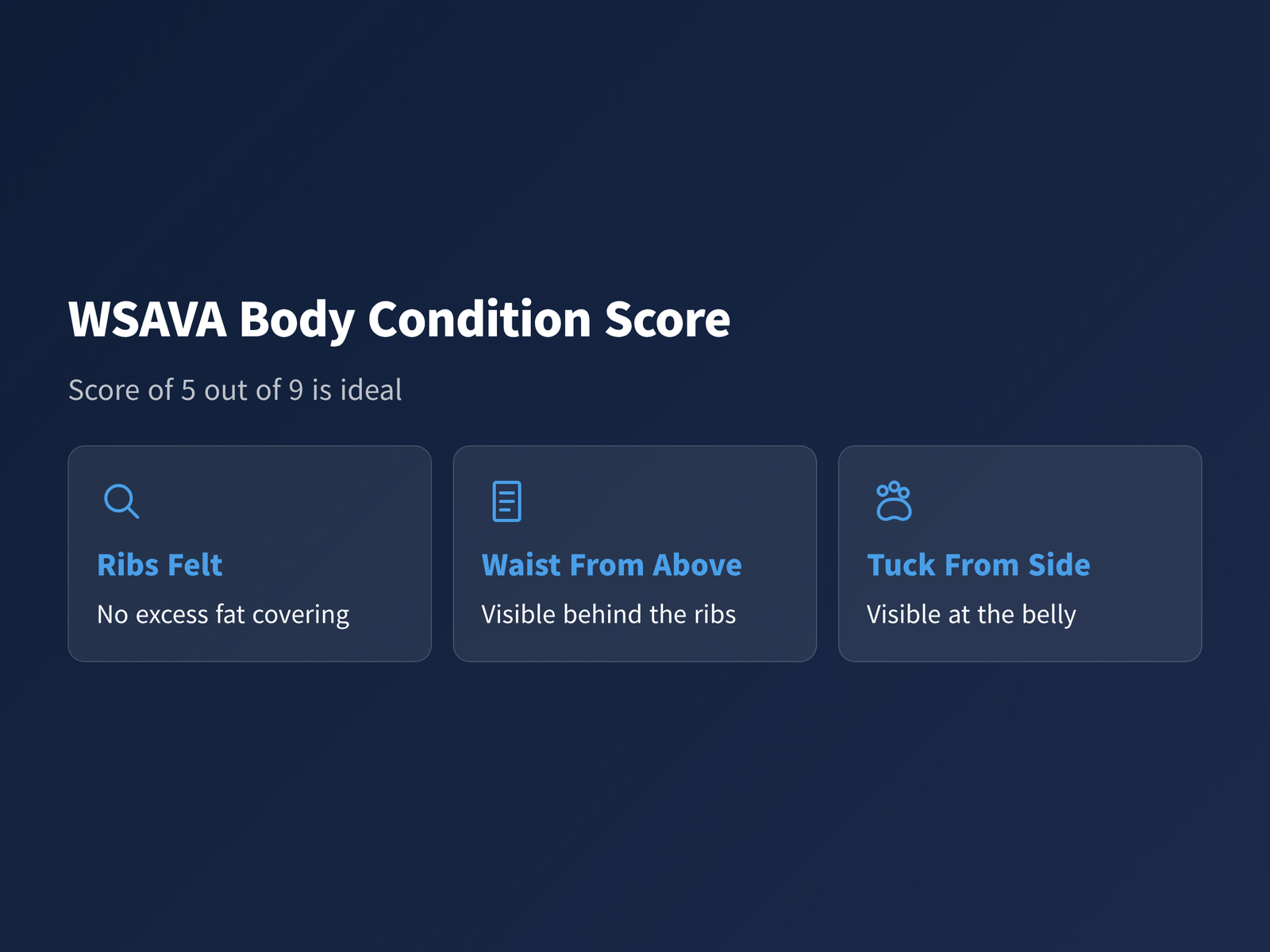
The World Small Animal Veterinary Association (WSAVA) body condition score uses a 9-point scale on which 5 is ideal. At a score of 5, the ribs can be felt without excess fat covering them, a waist is visible behind the ribs from above, and an abdominal tuck shows from the side. Writing down the WSAVA score next to each weight entry turns a list of numbers into a record a veterinary team can read. A BCS entry is an observation for the log, not a home diagnosis, and any concern about the score is a question for a veterinarian.
How many treat calories does a small dog actually get per day?
A small dog gets very few treat calories per day, because the common 10% limit applies to a very small total. AAHA guidance keeps treats and other extras at or below 10% of total daily calories, and the WSAVA Nutritional Assessment Guidelines list “snacks, table food > 10% of total calories” as a nutritional risk factor. The 10% rule is sound, but the catch is arithmetic: 10% of a small dog’s daily budget is a very small number.
The American Kennel Club (AKC) gives a worked example. A small dog eating about 182 calories a day has room for roughly 18 calories of treats. Eighteen calories disappears quickly once training rewards, a bite of a chew, and a scrap from the table are added together. Treat calories belong in the same log as the scale reading and the WSAVA score. Your dog’s actual calorie needs depend on the individual dog, so the 182-calorie figure is an illustration rather than a target, and a veterinarian can set a daily number that fits.
Why do measuring cups overfeed small dogs?
Measuring cups can overfeed small dogs because scooping kibble by volume is inaccurate, and the error grows as the portion shrinks. Research summarized by the Ontario Veterinary College (OVC) Pet Nutrition team found that owners using measuring cups were off by anywhere from 48% under to 152% over the intended amount. An earlier study cited by OVC reported errors from 18% under to more than 80% over. OVC also notes that a quarter cup was measured less accurately than a full cup.
That last finding matters most for small dogs, since small dogs are fed small volumes. OVC puts the fix directly: “Pet owners should be encouraged to measure their pet’s food by weight, not by volume, through the use of an electronic gram scale.” The kitchen scale that weighs the dog can weigh the food too.
When should a weight change send a small dog to the vet?
A weight change should send a small dog to the vet whenever the change worries you, and especially when a lot of weight seems to go in a short time. PDSA advises owners to “always contact your vet if you think your dog is losing weight, especially if they seem to have lost a lot in a short space of time.” No home rule replaces a professional look at the dog.
PDSA also suggests a practical step before the appointment: weigh the dog every few days for a couple of weeks and take that record to the visit. A log that pairs each kitchen-scale reading with a WSAVA body condition score and a note on treats gives the veterinary team useful context. Consult your veterinarian before changing a small dog’s food amount or starting a weight plan, since the right target depends on the individual dog.
How do the home weighing methods compare for a small dog?
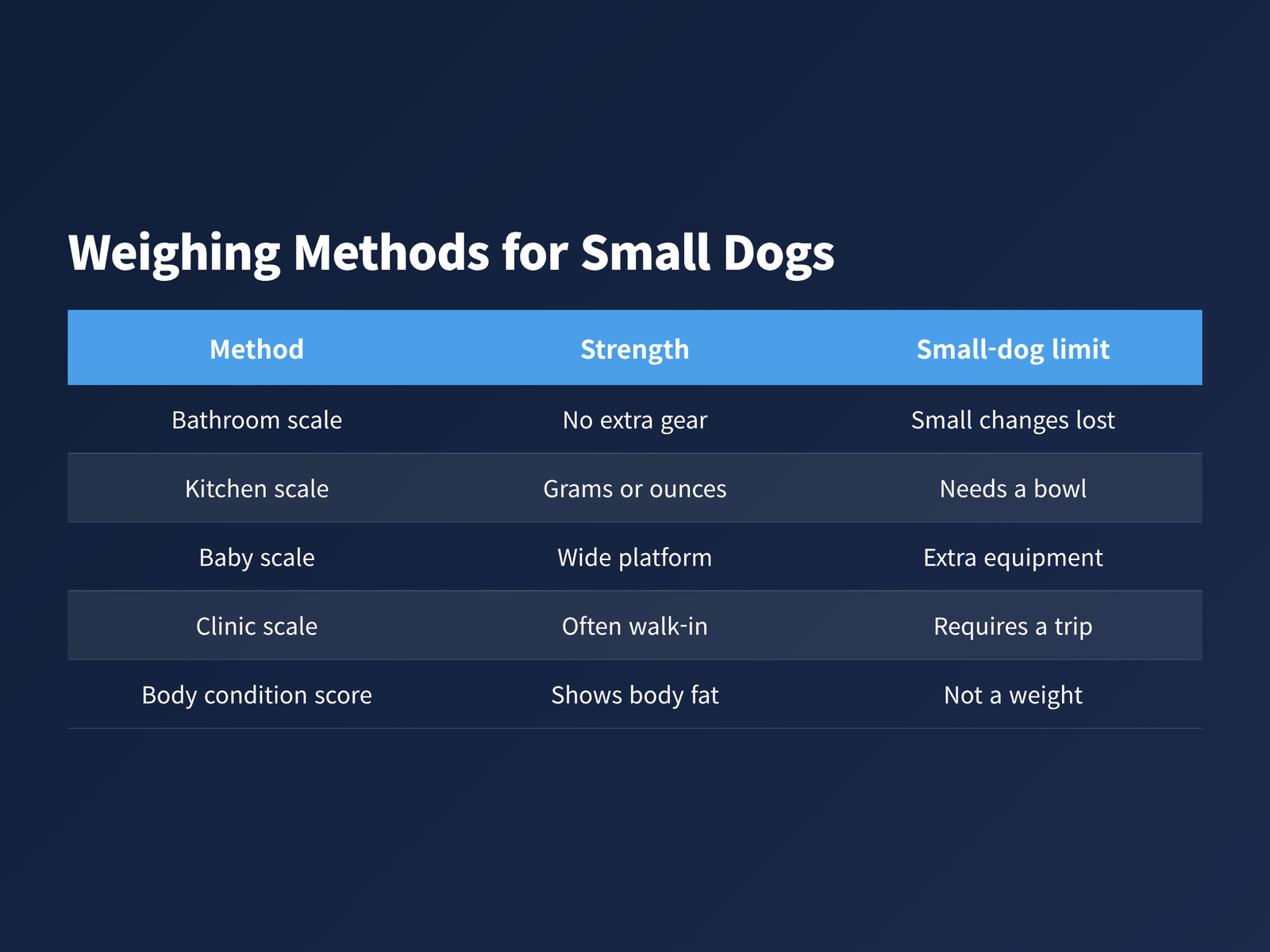
The home weighing methods differ mainly in precision and in what they can show for a small dog. The table below sets the bathroom scale, kitchen scale, baby scale, clinic scale, and WSAVA body condition score side by side, using only the sources cited in this article.
| Method | Strength | Small-dog limit |
|---|---|---|
| Bathroom scale | No extra gear | Small changes lost |
| Kitchen scale | Grams or ounces | Needs a bowl |
| Baby scale | Wide platform | Extra equipment |
| Clinic scale | Often walk-in | Requires a trip |
| Body condition score | Shows body fat | Not a weight |
The bathroom scale is the easiest starting point, while the kitchen scale and baby scale suit regular tracking at home. The clinic scale works well for occasional checks between visits. The WSAVA body condition score complements every scale option rather than replacing any of them, because the WSAVA score describes body fat while the scale describes total weight.
Frequently asked questions
Can a bathroom scale ever be accurate enough for a small dog?
A bathroom scale can give a rough figure for a small dog, and Maddie’s Fund lists the hold-and-subtract method for animals of 2 lb and up. For tracking small changes over time, a kitchen scale or baby scale that reads the dog directly is the more precise choice.
How often should a small dog be weighed at home?
There is no single weighing schedule that fits every small dog. When weight is a concern, PDSA suggests weighing the dog every few days for a couple of weeks and bringing that record to the veterinary appointment, ideally on the same kitchen scale each time.
Is the 10% treat rule wrong for small dogs?
The 10% treat rule is not wrong for small dogs. AAHA and WSAVA both use the 10% line, and the AKC example shows that it leaves about 18 calories of treats for a dog eating about 182 calories a day. The rule simply produces a very small number.
Sources
- American Animal Hospital Association, “2021 AAHA Nutrition and Weight Management Guidelines for Dogs and Cats,” 2021 — http://www.aaha.org/wp-content/uploads/globalassets/02-guidelines/2021-nutrition-and-weight-management/resourcepdfs/new-2021-aaha-nutrition-and-weight-management-guidelines-with-ref.pdf
- AVMA JAVMA News, “New AAHA nutrition, weight management guidelines published,” 2021-08-11 — https://www.avma.org/javma-news/2021-09-01/new-aaha-nutrition-weight-management-guidelines-published
- World Small Animal Veterinary Association, “Body Condition Score chart — dogs” (hosted by The Ohio State University Veterinary Medical Center), undated — https://vmc.vet.osu.edu/sites/default/files/documents/wsava-bcs-chart-dogs-cats.pdf
- World Small Animal Veterinary Association, “Nutritional Assessment Guidelines,” 2011 — https://www.ddd.dk/media/1954/pna-guidelines_wsava.pdf
- American Kennel Club, “How Many Treats Can a Dog Have,” updated 2026-08-11 — https://www.akc.org/expert-advice/nutrition/how-many-treats-can-dog-have/
- Ontario Veterinary College, Pet Nutrition at OVC, “National Pet Obesity Awareness Day #BanTheCup,” 2020-10-01 — https://ovcpetnutrition.uoguelph.ca/2020/10/01/national-pet-obesity-awareness-day-banthecup
- Ontario Veterinary College, Pet Nutrition at OVC, “My cup runneth over,” 2019-11-27 (updated 2025-08-13) — https://ovcpetnutrition.uoguelph.ca/2019/11/27/my-cup-runneth-over
- Coe J., Rankovic A., Parr J., “Dog owner’s accuracy measuring different volumes of dry dog food using three different measuring devices,” Veterinary Record 185(19):599, 2019 (cited via OVC)
- PDSA, “Weight loss in dogs,” 2020-09 — https://pdsa.org.uk/pet-help-and-advice/pet-health-hub/symptoms/weight-loss-in-dogs
- PDSA, “Obesity in dogs,” 2023-08 — https://pdsa.org.uk/pet-help-and-advice/pet-health-hub/conditions/obesity-in-dogs
- Maddie’s Fund, “How to Weigh Foster Pets — Script,” undated — https://www.maddiesfund.org/how-to-weigh-your-foster-pet/presentation_content/external_files/How%20to%20Weigh%20Foster%20Pets-%20Script.pdf