Treat package feeding guidelines often give a small dog more treat calories than the 10% rule allows. A peer-reviewed study of commercial dog treats found that small dogs receive the highest share of their daily energy needs when producers’ feeding instructions are followed. This guide explains why treat package feeding guidelines overfeed small dogs, shows the daily treat ceiling for dogs from 2 to 10 kg, and walks through reading the calorie line on a treat label.

Why do treat package feeding guidelines overfeed small dogs?
Treat package feeding guidelines overfeed small dogs because the suggested amounts usually exceed 10% of a dog’s maintenance energy requirement, and small dogs feel that gap most. Morelli and colleagues analysed 32 commercial treats in The Veterinary Record and concluded: “Small dogs receive the highest percentage of maintenance energy requirement when producers’ feeding instructions are followed.” The study authors added that treat producers “should reconsider the feeding instructions provided on labels as we demonstrated that usually they exceed the 10 percent maintenance energy requirements.”
The treats in that study averaged 332.0 kcal of metabolisable energy per 100 g, and the most energy-dense treat reached 475.0 kcal per 100 g. A small dog’s total daily calorie need is low, so a label serving built for an average dog takes a much larger bite out of a small dog’s day. The 10% rule itself is sound. The mismatch comes from label serving sizes and calorie-dense treats.
How many treat calories does a 2 kg, 4 kg or 6 kg dog actually get per day?
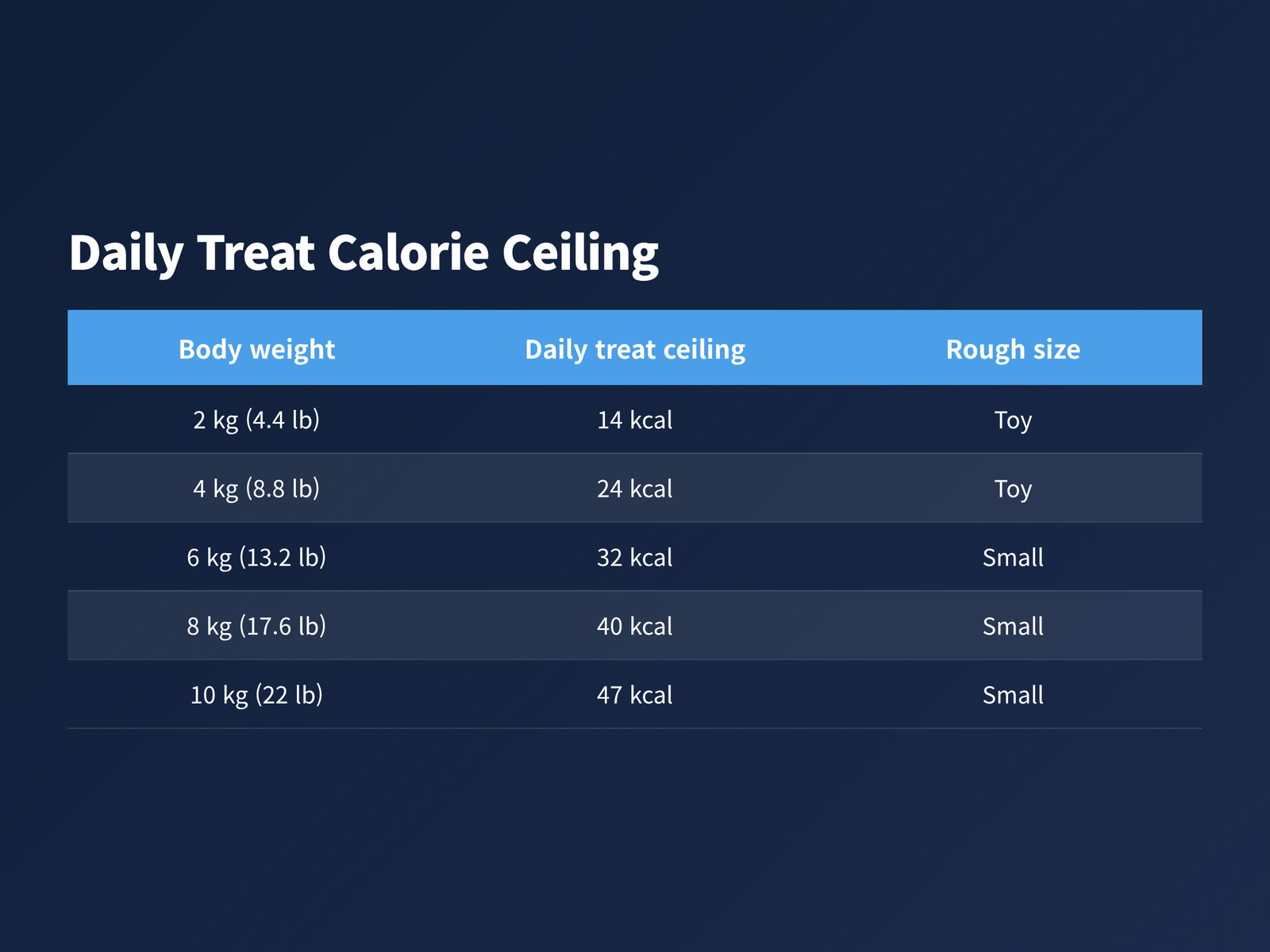
A 2 kg dog has a treat ceiling of about 14 kcal per day, a 4 kg dog about 24 kcal, and a 6 kg dog about 32 kcal. Those figures come from the World Small Animal Veterinary Association (WSAVA) guide “Feeding treats to your dog,” which applies the 10% rule by body weight. WSAVA defines the rule plainly: treats should make up no more than 10% of a dog’s daily calorie intake.
| Body weight | Daily treat ceiling | Rough size |
|---|---|---|
| 2 kg (4.4 lb) | 14 kcal | Toy |
| 4 kg (8.8 lb) | 24 kcal | Toy |
| 6 kg (13.2 lb) | 32 kcal | Small |
| 8 kg (17.6 lb) | 40 kcal | Small |
| 10 kg (22 lb) | 47 kcal | Small |
The American Kennel Club gives a matching example. A small dog needing about 182 kcal per day has roughly 18 kcal left for treats, and the AKC notes that one high-calorie snack can exceed that allowance on its own. Whether those numbers fit your dog exactly depends on activity level and body condition.
Which treat types use up a small dog’s daily allowance fastest?
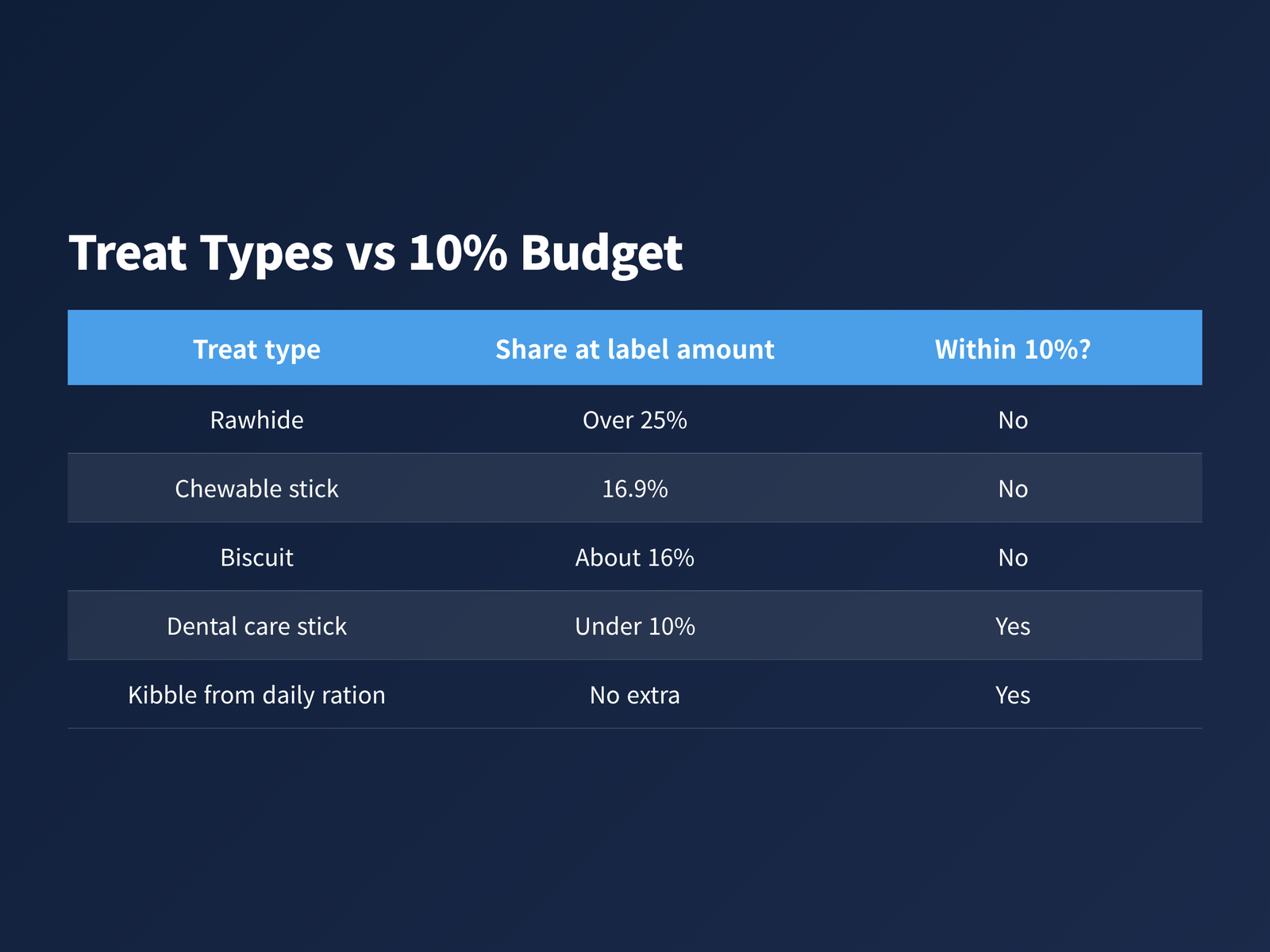
Rawhides, chewable sticks and biscuits use up a small dog’s treat allowance fastest when fed at label instructions. Trade reports on the Morelli study (dvm360 and Petfood Industry) put rawhides at over 25% of a small dog’s maintenance energy requirement, chewable sticks at 16.9%, and biscuits at about 16%. Dental care sticks stayed below 10% across all dog sizes.
| Treat type | Share of daily energy at label amount | Within 10%? |
|---|---|---|
| Rawhide | Over 25% | No |
| Chewable stick | 16.9% | No |
| Biscuit | About 16% | No |
| Dental care stick | Under 10% | Yes |
| Kibble from daily ration | No extra | Yes |
Kibble taken from the measured daily ration adds no extra calories, because the kibble is already counted in the meal. The U.S. Food and Drug Administration, Center for Veterinary Medicine, also points out that treats and snacks are usually not complete and balanced, so treats are not meant to replace a dog’s regular diet.
Why is the 10% treat rule hard to follow for a toy breed dog?
The 10% treat rule is hard to follow for a toy breed dog because the allowance is tiny compared with common treat and food portions. A 2 kg dog’s 14 kcal ceiling is smaller than many single treats. The WSAVA guide lists 1 oz (28 g) of cheddar cheese at 120 kcal, which is more than eight times that 2 kg dog’s daily treat ceiling.
The 10% rule is the shared standard of WSAVA, the American Veterinary Medical Association (AVMA) and the AKC, and the rule itself does not change for toy breeds. What changes is the margin for error. A medium dog can absorb one oversized biscuit; a toy breed dog’s whole treat budget can disappear in one piece. The AVMA puts the risk simply: “the extra calories from treats and other food sources outside your pet’s regular diet quickly can add up.”
How can training rewards fit inside a small dog’s 10% treat budget?
Training rewards fit inside a small dog’s 10% treat budget only when every reward is counted, because the AKC states that all treats, including training rewards, count toward the daily allowance. A training session is not a free pass for extra calories.
Ontario Veterinary College Pet Nutrition at the University of Guelph offers two practical methods. Commercial training morsels run about 3 to 5 kcal each and can be broken into thirds, which stretches a small dog’s allowance across more repetitions. The second method uses the regular meal: “Simply measure out the amount of food you would feed normally and use this as your training reward!”
Why do “just a bite” human foods add up so fast for a small dog?
“Just a bite” human foods add up fast for a small dog because common table foods are calorie-dense compared with a small dog’s treat ceiling. WSAVA lists peanut butter at 81 kcal per tablespoon, lean chicken breast at 47 kcal per ounce (28 g) and ham at 46 kcal per ounce. One ounce of chicken alone is more than three times a 2 kg dog’s 14 kcal treat ceiling.
Owners also tend to skip the meal adjustment. A regional survey of dog owners in Western Romania, published in Frontiers in Animal Science, found that 84% did not account for treat calories and only 16% adjusted main meals. That survey covers one region, so the figures should not be generalised, but the pattern shows how easily shared bites slip outside the daily count. The AVMA advises reducing regular food by roughly the calories given as treats.
Where do you find the calories per treat on a package?
The calories per treat appear in the calorie statement on the package, which lists kcal per kg and kcal per familiar unit such as a treat. According to JAVMA News from the AVMA, AAFCO model regulations require calorie statements on dog and cat foods, and treats were included rather than exempted. Dr. David A. Dzanis of the American College of Veterinary Nutrition explained the reasoning: “We felt it was very important information for the label, similar to calorie statements on human food labels.”
An owner-level method, built from WSAVA, AKC, OVC and AVMA guidance, follows four steps:
- Read the kcal per treat on the calorie statement.
- Check your dog’s treat ceiling in the WSAVA body-weight table.
- Count every training reward inside that ceiling.
- Reduce the meal by roughly the treat calories given.
Some dogs need a different approach. Dogs with medical conditions or dietary sensitivities need professional guidance on treat type and amount. WSAVA advises: “Chat with your dog’s veterinary health care team to determine a suitable quantity and type of treat.” Consult your veterinarian before changing your dog’s treat routine or meal size, especially if your dog has any health condition.
Frequently asked questions
Are treat bag feeding guidelines wrong for every dog?
Treat bag feeding guidelines are not wrong for every dog, but research found they usually exceed 10% of maintenance energy needs, with small dogs most affected. Comparing the label amount with your dog’s WSAVA ceiling shows whether the gap applies to your dog.
Do dental care sticks count toward the 10% treat budget?
Dental care sticks do count toward the 10% treat budget, like every treat. Reports on the Morelli study found dental care sticks stayed under 10% of daily energy for all dog sizes at label amounts.
How much daily activity does the AVMA suggest for dogs?
The AVMA suggests at least 30 minutes of daily activity for dogs. Activity needs vary by age and health, so your veterinarian can advise on the right amount for your dog.
Sources
- World Small Animal Veterinary Association, “Feeding treats to your dog” v2 (PDF), 2024-06 — https://wsava.org/wp-content/uploads/2024/06/Feeding-treats-to-your-dog-v2.pdf
- American Veterinary Medical Association, “Your pet’s healthy weight” — https://www.avma.org/resources-tools/pet-owners/petcare/your-pets-healthy-weight
- American Veterinary Medical Association, JAVMA News, “Calories to appear on pet food labels,” 2013-08-01 — https://www.avma.org/javma-news/2013-08-01/calories-appear-pet-food-labels
- American Kennel Club, “How Many Treats Can a Dog Have?” (Anna Burke), 2026-08-11 — https://www.akc.org/expert-advice/nutrition/how-many-treats-can-dog-have/
- U.S. Food and Drug Administration, Center for Veterinary Medicine, “Complete and Balanced Pet Food,” 2020-02-28 — https://www.fda.gov/animal-veterinary/animal-health-literacy/complete-and-balanced-pet-food
- Morelli G. et al., “Study of ingredients and nutrient composition of commercially available treats for dogs,” The Veterinary Record 182(12), 2018 — https://air.unimi.it/handle/2434/549367
- Daina S. et al., “Owners’ perceptions of dog treat management in Western Romania,” Frontiers in Animal Science, 2025 — https://www.frontiersin.org/journals/animal-science/articles/10.3389/fanim.2025.1502724/pdf
- dvm360, “Dog Treats: Packing Too Much Punch?,” 2017-12 — https://dvm360.com/view/dog-treats-packing-too-much-punch
- Petfood Industry, “Dog treats feeding guidelines may exceed healthy amounts,” 2017-12 — https://www.petfoodindustry.com/news-newsletters/pet-food-news/article/15464458/dog-treats-feeding-guidelines-may-exceed-healthy-amounts
- Ontario Veterinary College Pet Nutrition, University of Guelph, “Nutrition in training,” 2022-06-09 (updated 2025-08-13) — https://ovcpetnutrition.uoguelph.ca/2022/06/09/nutrition-in-training