Clipping softens a Border Terrier coat because clippers cut every hair at the same length, live and dead, instead of pulling out the dead wiry hairs the way hand stripping does. The cut hairs stay in the follicle, and the coat that grows through them tends to be softer, fluffier, and duller in color. Owners who searched “Border Terrier coat gone soft and fluffy after clipping” are seeing exactly this effect. This guide covers what the breed standards ask for, which areas the breed club says never to cut, and when clipping is still a fair trade-off.
Why does clipping make a Border Terrier coat soft?
Clipping makes a Border Terrier coat soft because it removes the length of the hair without removing the dead hair itself. The American Kennel Club describes hand stripping as “a specialized grooming procedure for wiry-coated dogs. It involves plucking dead strands of hair to retain the coat’s coarse texture.” The AKC also explains that stripping removes hairs in the telogen, or resting, phase, which simulates natural shedding. Clippers skip that step entirely, so a Border Terrier coat that is clipped keeps its dead hairs as short stubs.
The American Kennel Club states that clipping a wire coat negatively affects “its color, sheen, and texture” and disrupts the natural growth cycle. The Southern Border Terrier Club reaches the same conclusion from the breed side: “Clipping will change your Border’s coat making it softer and less waterproof.” The breed club adds that a clipped example coat “is no longer harsh and wiry and has lost its colour.” Two independent bodies, one general and one breed-specific, describe the same change in texture and color, which is why clipping softens a Border Terrier coat so reliably.
What does the Border Terrier breed standard say about the coat?
The Border Terrier breed standard calls for a harsh, wiry, weather-resistant topcoat over a dense undercoat, not a soft one. The AKC standard describes “a short and dense undercoat covered with a very wiry and somewhat broken topcoat which should lie closely, but it must not show any tendency to curl or wave.” The Royal Kennel Club standard is shorter and just as clear: “Harsh and dense; with close undercoat. Skin must be thick.”
The AKC Border Terrier standard also limits how much grooming a show dog should need. In its words, “With such a coat a Border should be able to be exhibited almost in his natural state, nothing more in the way of trimming being needed than a tidying up of the head, neck and feet.” That sentence explains why clippers and the Border Terrier sit uneasily together. A coat that the standard wants close to natural, harsh, and lying flat is the opposite of the soft, less waterproof coat that often follows a full clip.
Which parts of a Border Terrier should never be clipped?
The Southern Border Terrier Club says no area with a harsh, dense double coat should be cut. The club’s grooming guidance spells this out: “No area with harsh dense double coat should be cut. This includes under the neck, on the chest, bottom, tail, legs and on top of the feet.” For a pet Border Terrier, that list covers almost every visible part of the dog.
- Under the neck
- The chest
- The bottom
- The tail
- The legs
- The top of the feet
The never-cut list from the Southern Border Terrier Club lines up with the AKC standard, which only allows “a tidying up of the head, neck and feet.” Tidying is not the same as clipping. A groomer can neaten the outline of a Border Terrier with careful hand work while still leaving the harsh coat in place. Owners who want to keep the wiry texture can show this list to a groomer before the first appointment.
Can a clipped Border Terrier coat go back to wiry?
A clipped Border Terrier coat can sometimes return toward its wiry texture, but recovery is slow and not guaranteed. The Southern Border Terrier Club notes that “it may require several strips to get the coat growing properly again.” That wording matters. The breed club does not promise a full return, and no source gives a Border Terrier-specific timeline for how long the coat takes to recover.
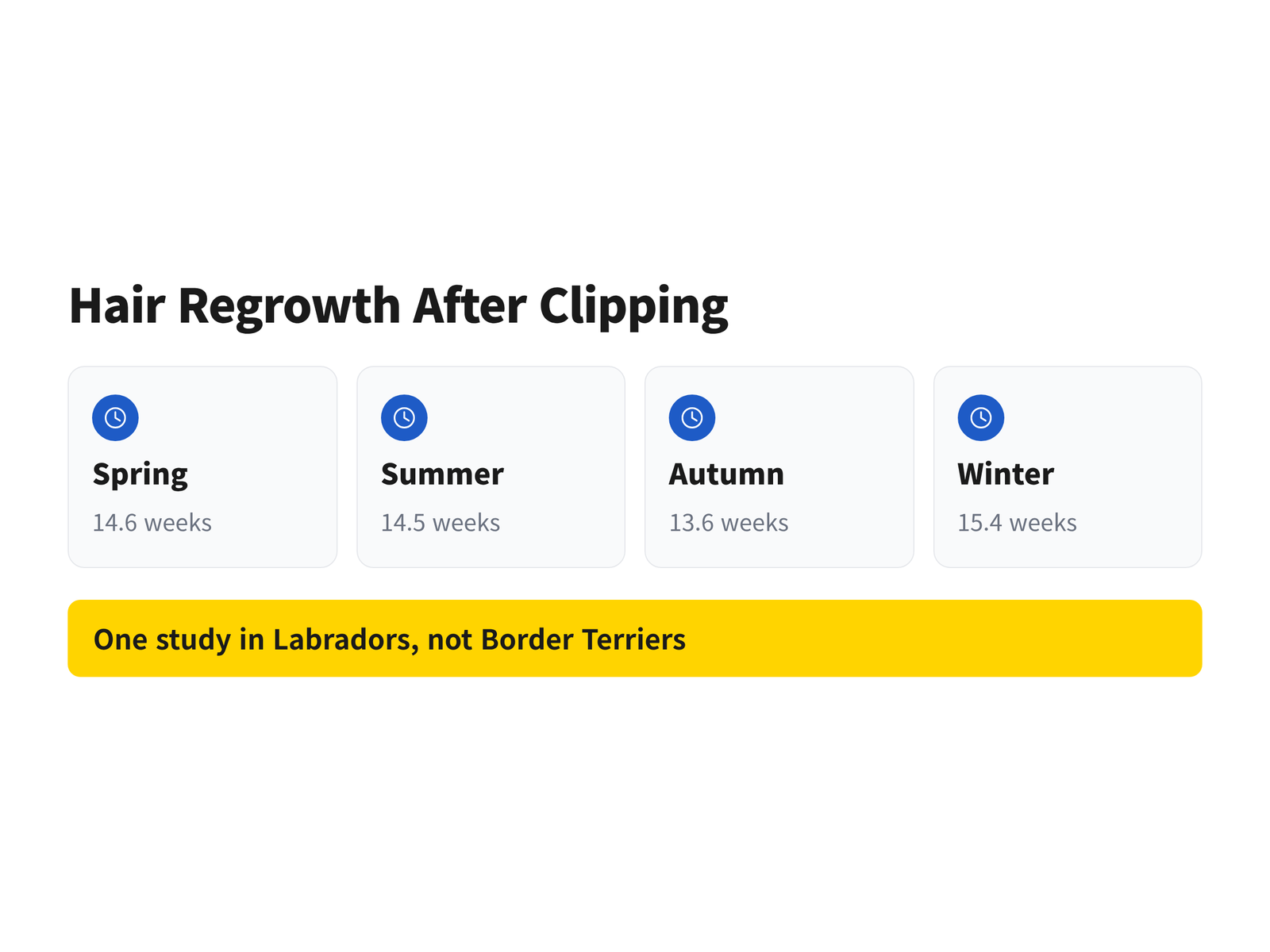
The closest published figure comes from one study in Labrador Retrievers, a large breed, clipped for surgery and published in Veterinary Dermatology. In that study, hair took 13.6 to 15.4 weeks to regrow to its pre-clip length depending on season, and the season effect was not statistically significant. More than 80% of hairs were in the telogen phase at the time of clipping in all four seasons. Those numbers describe Labradors, not Border Terriers, so treat them as a rough reference only.
If a clipped Border Terrier coat does not grow back at all, or regrowth is far slower than expected, that is a question for a veterinarian rather than a groomer. Consult your veterinarian about any patch of hair that fails to regrow after a clip, because a groomer cannot assess what is happening at the skin level.
Is hand stripping painful for a Border Terrier?
Hand stripping done properly is not meant to hurt a Border Terrier, but an untrained attempt can. Groomer Kim Kier, quoted by the American Kennel Club, says, “Proper hand-stripping should be a gentle rhythm to remove the hair, and never forceful.” Kier also notes that “most pets do not mind hand-stripping on the body.” The technique pulls hairs that are already in the resting phase, which is why it can be gentle when done well.
The American Kennel Club is direct about the risk on the other side: “An untrained pet strip can be painful for the dog and may not produce the results the owner seeks.” For a first-time owner, this is a reason to watch a trained groomer before trying hand stripping at home. Tools such as a stripping knife or a carding tool exist, yet the tool matters less than the gentle, rhythmic technique the AKC describes.
Hand stripping vs clipping a Border Terrier: how do they compare?
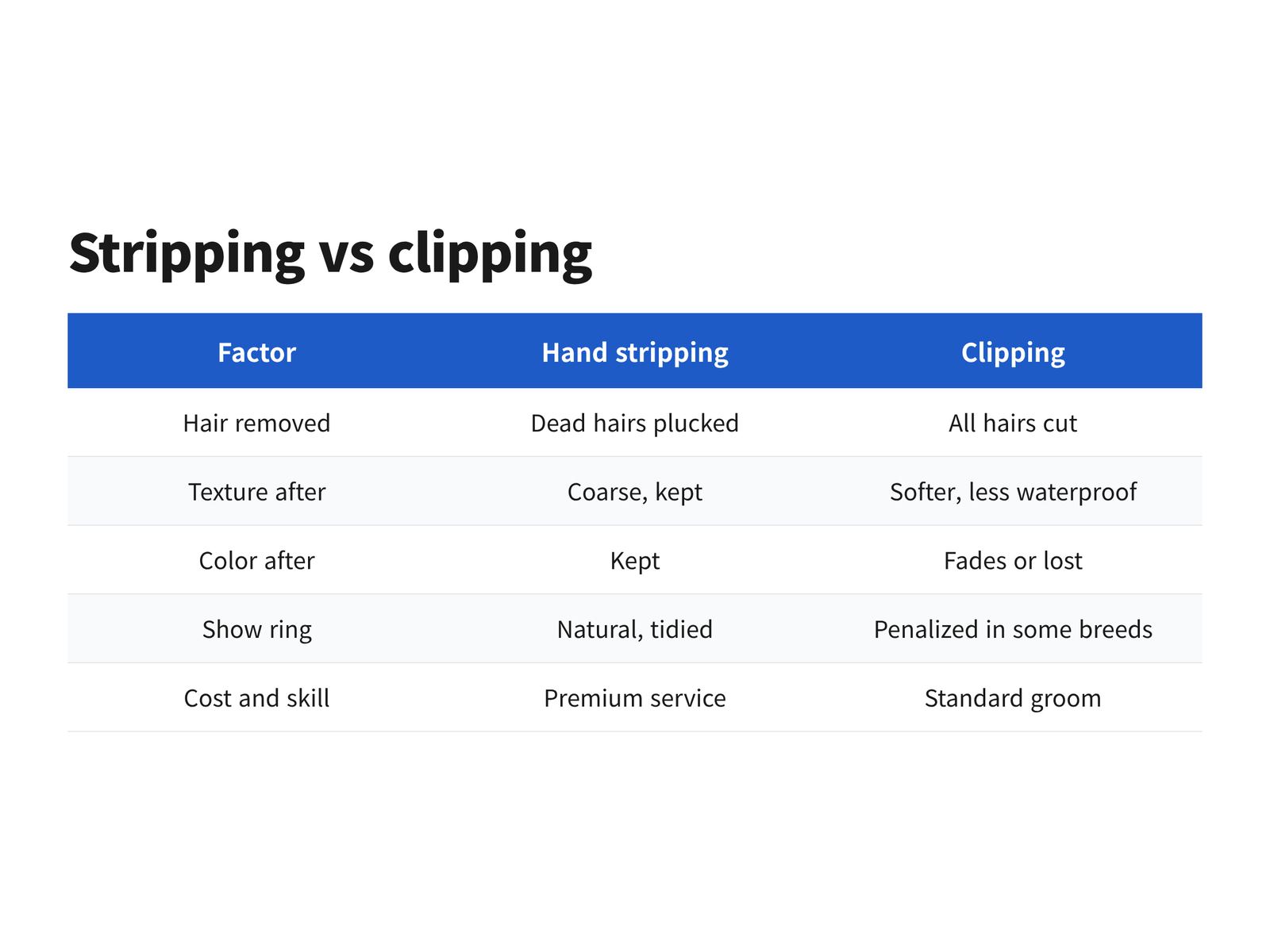
Hand stripping keeps the Border Terrier coat harsh and colored, while clipping trades texture and color for speed and lower cost. The table below brings together the AKC, the breed standards, and the Southern Border Terrier Club.
| Factor | Hand stripping | Clipping |
|---|---|---|
| Hair removed | Dead hairs plucked | All hairs cut |
| Texture after | Coarse, kept | Softer, less waterproof |
| Color after | Kept | Fades or lost |
| Show ring | Natural, tidied | Penalized in some breeds |
| Cost and skill | Premium service | Standard groom |
The show ring row deserves context. The AKC Border Terrier standard expects a dog shown “almost in his natural state,” and the AKC Brussels Griffon standard goes further, stating that “coats prepared with scissors and/or clippers should be severely penalized.” A pet Border Terrier never needs to meet show rules, but the standards explain why breeders and breed clubs push so hard for stripping.
When is clipping a reasonable choice for a pet Border Terrier?
Clipping is a reasonable choice for a pet Border Terrier when the owner knowingly accepts a softer, duller coat in exchange for a faster and cheaper groom. Kim Kier, quoted by the American Kennel Club, puts the cost side plainly: “Hand-stripping is a premium service and will (and should) be more expensive than a traditional groom.” Not every area has a groomer trained in stripping, and not every budget stretches to it.
A clipped Border Terrier is not a neglected dog. The trade-off is the coat’s natural texture, color, and some of its water resistance, as the Southern Border Terrier Club describes. Owners who later want the wiry coat back can switch to stripping, keeping in mind the breed club’s caution that it may take several strips. The Royal Kennel Club breed profile lists grooming “more than once a week” for the Border Terrier, so regular brushing matters whichever method is chosen.
Frequently asked questions
How often does a Border Terrier need hand stripping?
The Southern Border Terrier Club suggests stripping a couple of times a year for a pet Border Terrier. That figure comes from the breed club alone, and the right schedule depends on how fast an individual coat grows. A groomer trained in stripping can judge when the coat is ready.
What is the difference between carding and using a stripping knife?
Both tools work on a wire coat, but the American Kennel Club stresses technique over tools. Stripping should be a gentle rhythm, never forceful, whichever tool is used. Owners new to the process benefit from watching a trained groomer first.
Why does a Border Terrier coat lose its color after clipping?
Clipping cuts the harsh outer hairs instead of plucking the dead ones out. The AKC says clipping affects a wire coat’s “color, sheen, and texture,” and the Southern Border Terrier Club describes a clipped coat that “has lost its colour.”
Will one clip ruin a Border Terrier coat permanently?
No source says a single clip causes permanent damage, and none promises a full recovery either. The Southern Border Terrier Club says it may take several strips to get the coat growing properly again.
Sources
- American Kennel Club, “Hand-Stripping Dog Coats” by Colt Dodd, updated 2025-11-10 – https://www.akc.org/expert-advice/health/hand-stripping-dog-coats/
- American Kennel Club, “Official Standard of the Border Terrier,” approved 1950-03-14, reformatted 1990-07-13 – https://images.akc.org/pdf/breeds/standards/BorderTerrier.pdf
- American Kennel Club, “Official Standard of the Brussels Griffon,” approved 2022-11-08, effective 2023-02-01 – https://images.akc.org/pdf/breeds/standards/BrusselsGriffon.pdf
- The Royal Kennel Club, “Border Terrier breed standard,” last updated 2026-04-01 – https://www.royalkennelclub.com/breed-standards/terrier/border-terrier/
- The Royal Kennel Club, “Border Terrier breed profile,” accessed 2026-10-05 – https://www.royalkennelclub.com/search/breeds-a-to-z/breeds/terrier/border-terrier
- Diaz SF, Torres SMF, Dunstan RW, Lekcharoensuk C., “An analysis of canine hair re-growth after clipping for a surgical procedure,” Veterinary Dermatology 15(1):25-30, 2004 – https://experts.umn.edu/en/publications/an-analysis-of-canine-hair-re-growth-after-clipping-for-a-surgica/
- Southern Border Terrier Club, “Grooming,” accessed 2026-10-05 – https://www.thesouthernborderterrierclub.com/grooming