For small dog food, a kitchen scale is more accurate than a measuring cup. A measuring cup portions kibble by volume, but calories depend on weight, so the same “cup” can deliver a different number of grams and calories depending on the food and how the cup is filled. Research shows the measuring error grows as the portion shrinks, which puts small dogs in the least accurate range. Weighing in grams removes that error, though the daily amount itself should still come from your veterinarian.
Text graphic reading “A cup is volume. Calories are weight.” beside a calculator icon
A measuring cup is less accurate for a small dog because cup errors get proportionally larger as the portion gets smaller. A 2011 review by German and colleagues in the Journal of Animal Physiology and Animal Nutrition found that measuring cup inaccuracy was negatively associated with portion size. A small dog’s ration sits in exactly that range, so a slight over-scoop is a bigger share of the meal.
Deborah E. Linder, DVM, a board-certified veterinary nutritionist at Tufts Petfoodology, describes the owner’s side of the problem: “For cats and smaller dogs, the amount needed may be a small volume which also makes rounding to the nearest volume measurement challenging.” Linder adds, “It is nearly impossible to measure 2/5 of a cup accurately!” A measuring cup has no clean markings for many fractions a small dog’s ration calls for.
Jason Coe of the Ontario Veterinary College, University of Guelph, put the stakes plainly: “Even a small amount of over-measuring for a small dog can be a considerable increase in their daily caloric intake.” For a small dog, a measuring cup error is a meaningful slice of the day’s calories, not a rounding detail.
How far off can a scoop of kibble be?
A scoop of kibble can be off by a wide margin in either direction, according to two peer-reviewed studies. German and colleagues (2011) reported that cup-portioned dry kibble ranged from an 18% underestimate to an 80% overestimate across 12 studies. The within-subject coefficient of variation ran from 2% to 13%, and the between-subject figure from 2% to 28%. As reproduced by Petfood Industry, the authors noted that “Poor precision was noted in all studies.”
A 2019 Veterinary Record study by Coe and colleagues at the Ontario Veterinary College tested 100 dog owners with three devices: a two-cup graduated scoop, a two-cup liquid measuring cup, and a one-cup dry-food measuring cup. Owners’ errors ranged from 48% under to 152% over the target. According to Veterinary Practice News’ report on the study, owners measured 1/4 cup, 1/2 cup, and 1 cup portions, and error was largest at the smallest volume.
These figures are individual extremes, not averages, but both studies point the same way: the smaller the scoop, the less a measuring cup can be trusted.
Why doesn’t a cups-to-grams chart work for every dog food?
A cups-to-grams chart fails across dog foods because kibble density varies, so one food’s gram weight per cup does not transfer to another. Tufts Petfoodology explains that calorie labels assume an 8 fluid ounce standard cup, and fluid ounces measure volume, not weight. In Linder’s words, “a cup of feathers and a cup of rocks would both be the same volume.”
The household scoop adds a second layer of variation. The Coe study found that three device types gave different results, and Tufts Petfoodology notes that some households scoop with unmarked containers, even “64 oz big plastic cups.” A gram scale skips the conversion problem, and calorie differences between foods show up clearly through each food’s kcal per gram.
How do you turn the calories on the bag into grams for a small dog?
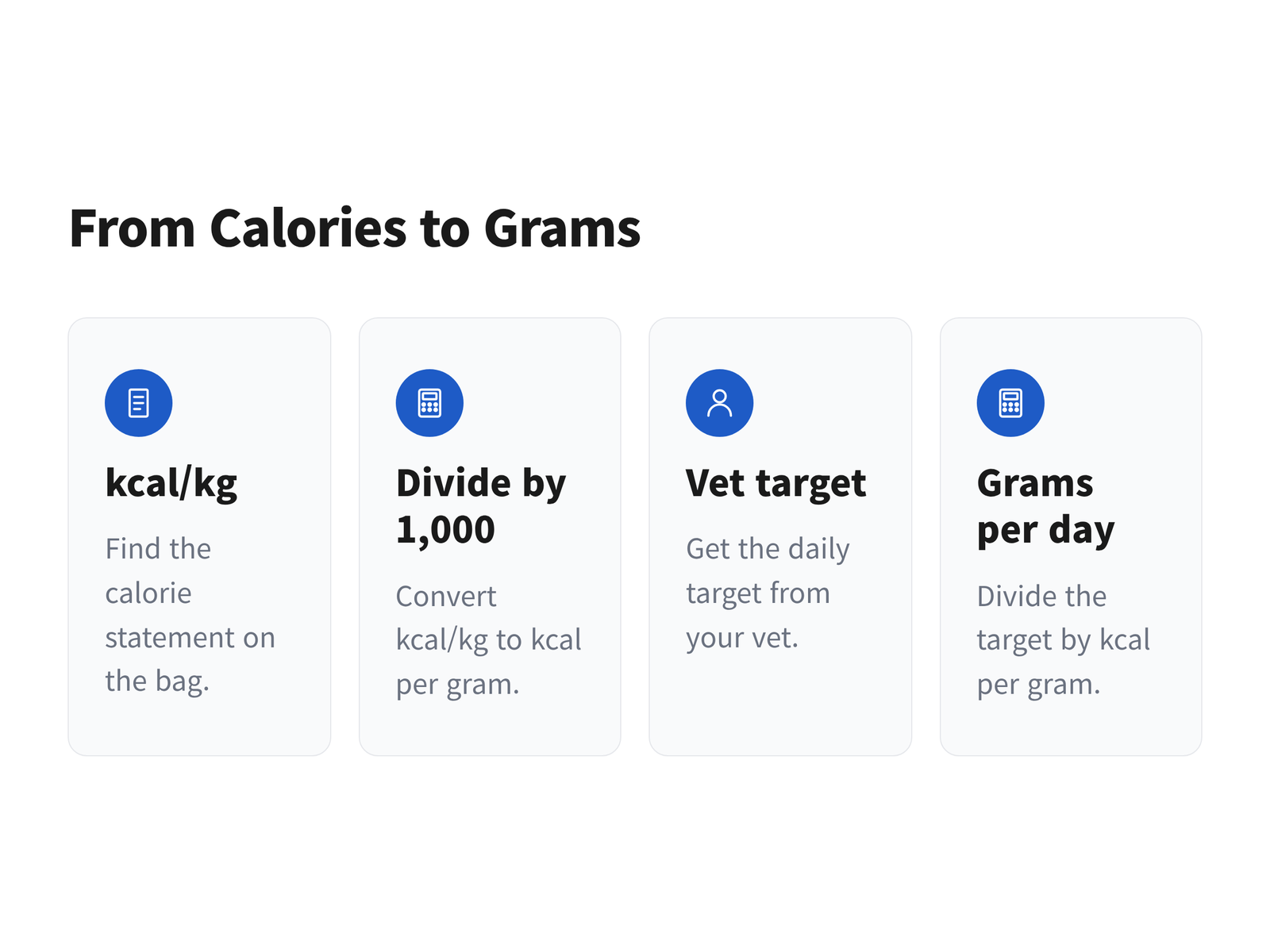
You turn the calories on the bag into grams by converting kcal per kilogram to kcal per gram, then dividing your veterinarian’s daily calorie target by that number. The 2021 AAHA Nutrition and Weight Management Guidelines note that “AAFCO requires calorie content on dog and cat food labels, including snacks and treats,” so the starting figure is already on the bag.
- Find the calorie statement on the bag (kcal/kg, or kcal per household unit plus its gram weight on new labels).
- Divide kcal/kg by 1,000 to get kcal per gram. Tufts Petfoodology uses 3,570 kcal/kg, which equals 3.57 kcal per gram.
- Get the daily calorie target from your veterinarian.
- Divide the daily target by kcal per gram to get grams per day.
- Weigh the whole day’s portion once, then split it into meals and treats.
Tufts Petfoodology’s own worked example is for a cat, not a dog: 250 kcal per day divided by 3.57 kcal per gram equals 70 grams per day, split into two 35 gram meals. The University of Guelph’s advice applies: “If unsure how many grams to feed, speak with a veterinarian.” Step 5 comes from Coe’s own practice, as described by the OVC Pet Trust.
What will the new AAFCO Pet Nutrition Facts box show about cups and grams?
The new AAFCO Pet Nutrition Facts box will show a familiar household unit, such as a measuring cup, together with that unit’s weight in grams. The AAFCO Pet Food Label Modernization document requires “The unit of familiar household unit (e.g., can, measuring cup, treat or piece) and its weight in grams.” AAFCO’s sample line reads “1 cup (8 oz standard measuring cup) = 32 g,” but that 32 g figure is an illustration, not a value for any real product.
Hill and Dzanis, writing in Today’s Veterinary Practice, note that on the new box “Calories per kilogram of the diet is no longer provided.” Dividing calories per household unit by that unit’s gram weight gives calories per gram instead. The rollout will be gradual: AAFCO approved the model regulations in 2023 with a 6-year recommended transition, and states must adopt them, so many bags will keep the older format for some time.
Is a kitchen scale worth it for a dog that eats under a cup a day?
A kitchen scale is usually worth it for a dog that eats under a cup a day, because that is the portion range where measuring cup errors are largest. University of Guelph researchers recommend a gram scale as the most accurate way to measure pet food.
A kitchen scale fixes measurement error only; it does not decide how much a small dog should eat. The AAHA guidelines note that “Commercial pet foods are required to contain feeding recommendations,” but those recommendations are general. Please consult your veterinarian to set the daily calorie target. AAHA also describes weigh-in rechecks 4 to 8 weeks apart as reasonable, so accurate portions work alongside regular weight checks, not in place of them. As Coe put it, “a small change made by the caregiver can have a significant impact on a dog’s quality of life.”
How do a measuring cup and a kitchen scale compare side by side?
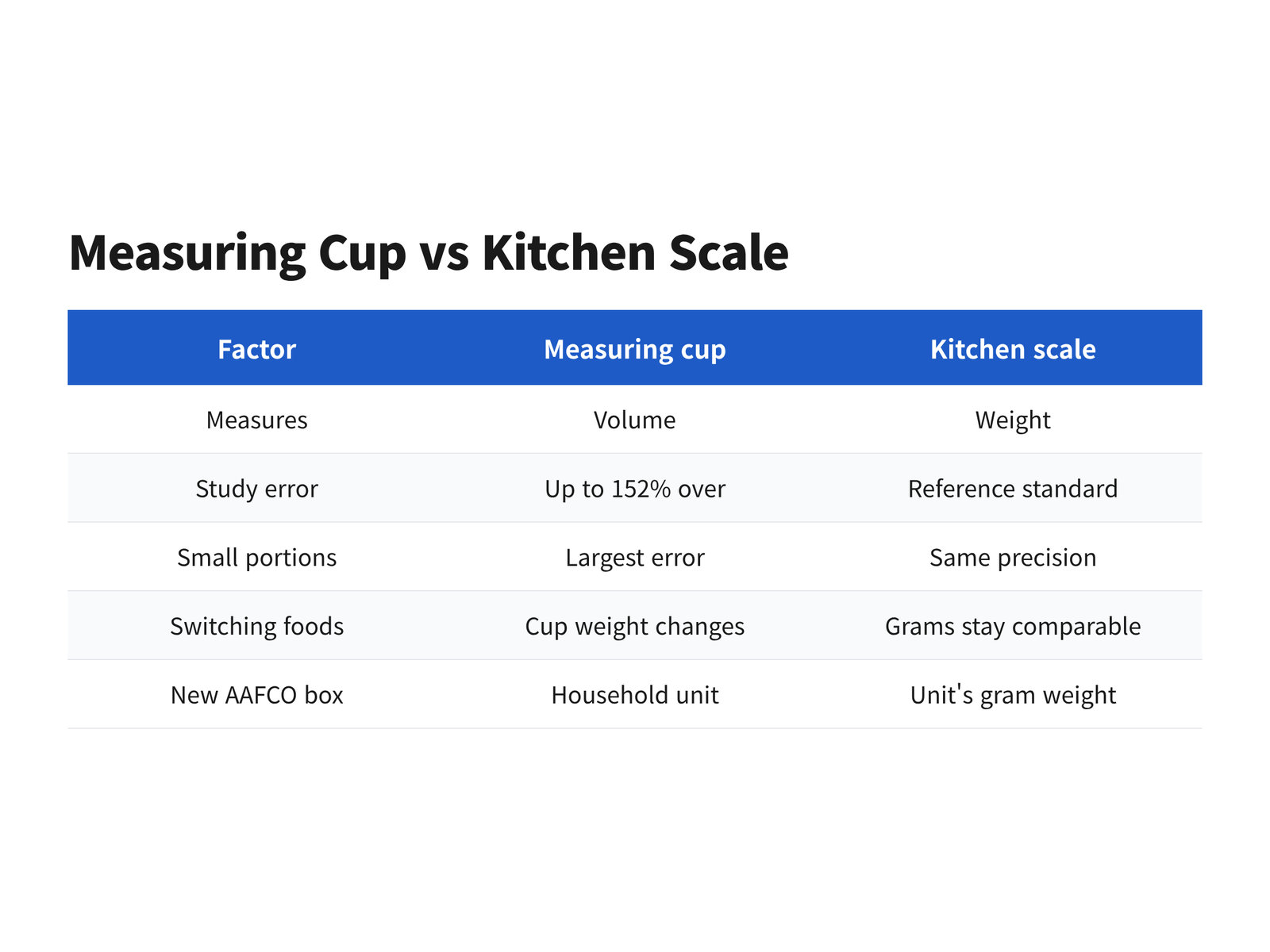
A kitchen scale measures weight with the same precision at any portion size, while a measuring cup measures volume and loses accuracy as portions shrink. In the Coe 2019 study, the gram scale served as the reference standard for checking owners’ scoops.
| Factor | Measuring cup | Kitchen scale |
|---|---|---|
| Measures | Volume | Weight |
| Study error | Up to 152% over | Reference standard |
| Small portions | Largest error | Same precision |
| Switching foods | Cup weight changes | Grams stay comparable |
| New AAFCO box | Household unit | Unit’s gram weight |
Frequently asked questions
Does a measuring cup overfeed or underfeed a small dog?
A measuring cup can do either. German and colleagues (2011) found errors from 18% under to 80% over, and the Coe 2019 study found 48% under to 152% over, with the largest error at the smallest volume.
Can a cups-to-grams chart replace a kitchen scale?
A cups-to-grams chart cannot reliably replace a kitchen scale, because kibble density differs between foods and household scoops differ in size.
Does weighing food mean a small dog will lose weight?
Weighing food does not guarantee weight change. A kitchen scale only makes the portion accurate; the right daily amount should come from your veterinarian.
When will every dog food bag show grams per cup?
No single date applies. AAFCO approved the new label rules in 2023 with a 6-year recommended transition, and each state must adopt them.
Sources
- German AJ, Holden SL, Mason SL, et al., “Imprecision when using measuring cups to weigh out extruded dry kibbled food,” Journal of Animal Physiology and Animal Nutrition, 2011;95(3):368-373 — https://agris.fao.org/search/en/providers/122535/records/65df2829b766d82b18006a62
- Coe JB et al., “Dog owner’s accuracy measuring different volumes of dry dog food using three different measuring devices,” Veterinary Record, 2019;185(19):599 — https://pmc.ncbi.nlm.nih.gov/articles/PMC6902066
- University of Guelph, OVC Pet Trust, “How Measuring That Kibble Can Help Your Dog Live a Longer, Healthier Life” — https://pettrust.uoguelph.ca/node/240
- Tufts Cummings School of Veterinary Medicine, Petfoodology, Linder DE, “Should You Be Weighing Your Pet’s Food?” 2021-08-16 — https://sites.tufts.edu/petfoodology/2021/08/16/should-you-be-weighing-your-pets-food/
- American Animal Hospital Association, “2021 AAHA Nutrition and Weight Management Guidelines for Dogs and Cats,” 2021-06-21 — https://www.aaha.org/resources/2021-aaha-nutrition-and-weight-management-guidelines/
- AAFCO, “Pet Food Label Modernization – Pet Nutrition Facts,” 2023-07-31 — https://www.aafco.org/wp-content/uploads/2023/10/AAFCO-PFLM-Nutrition-Facts-Final-July-2023.pdf
- Hill RC, Dzanis DA, “AAFCO pet food label updates,” Today’s Veterinary Practice, 2024-04-05 — https://todaysveterinarypractice.com/nutrition/aafco-pet-food-label-updates/
- Veterinary Practice News Canada, “Dog owners often mismeasure kibble,” 2019-10-10 — https://www.veterinarypracticenews.ca/?p=29249
- Petfood Industry, “Measuring cups for dry food not precise,” 2011 — https://www.petfoodindustry.com/articles/2011-measuring-cups-for-dry-food-not-precise
- Feedstuffs, “AAFCO approves new model pet food and specialty pet food regulations,” 2023-08-01 — https://www.feedstuffs.com/news/aafco-approves-new-model-pet-food-and-specialty-pet-food-regulations