If you plan to drive a dog from Canada to the US for winter, the U.S. Centers for Disease Control and Prevention (CDC) asks for three things at the land border: a dog at least 6 months old, a microchip readable by a universal scanner, and a CDC Dog Import Form receipt. The drive home is a separate matter, because Canada applies its own rabies certificate rule. This guide covers both legs and the cases where a dog does not get through.

What does a dog need to cross from Canada into the US by car?
A dog crossing from Canada into the US by car needs to be at least 6 months old, carry a microchip, appear healthy, and have a CDC Dog Import Form receipt. Canada is not on the CDC high-risk list, so a dog that has spent the previous 6 months only in Canada follows the simpler low-risk route. On that route, the CDC describes the form receipt as “the only required documentation for dogs entering or returning to the United States.”
The CDC media statement that announced the current process put the core rule in one line: “All dogs entering the United States must have a microchip and be over six months of age.” The CDC also states that the microchip “can be any brand,” as long as a universal scanner can detect it. The rule has been in force since August 1, 2024, at 12:00 a.m. Eastern Time.
How do you prepare the CDC Dog Import Form before the drive?
The CDC Dog Import Form is submitted online, one form per dog, before you reach the border. The CDC instructions page states: “A CDC Dog Import Form is required for each dog you are bringing into the U.S.” A household driving south with two small dogs therefore files two separate forms and carries two receipts.
The CDC FAQ says submitting the form in advance is “highly recommended.” The 2024 CDC statement noted that the form can be completed on the day of travel, but a snowbird drive leaves little room for a weak cell signal at a rural crossing. Carry each receipt printed or saved on a phone so you can show the receipt to U.S. Customs and Border Protection officers.
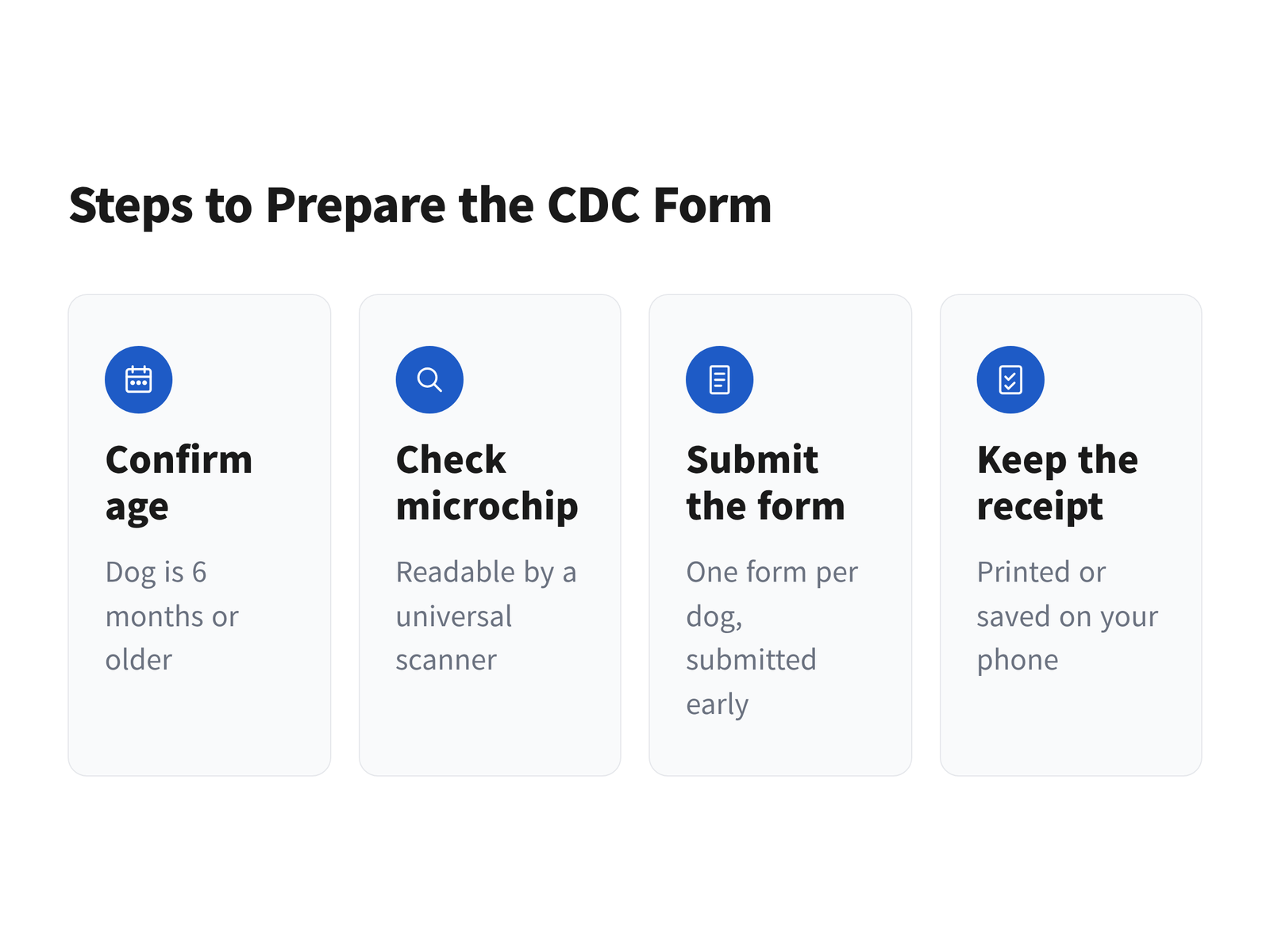
A simple order of steps for the outbound trip:
- Confirm the dog is at least 6 months old on the day of entry.
- Confirm the dog’s microchip is readable by a universal scanner.
- Submit one CDC Dog Import Form per dog, ideally in advance.
- Keep each receipt printed or on a phone for the border officer.
Why can’t a puppy under 6 months cross into the US from Canada?
A puppy under 6 months cannot cross because the CDC lists no exception to the 6-month minimum age for dogs entering the United States. The age floor applies on the day of entry, not on the day you book a rental or plan the route.
The 6-month rule catches families who add a puppy in late summer and expect the puppy to ride south in the autumn. A puppy that turns 6 months in January cannot join a November departure. In that case, the realistic options are a later departure date or arranging care in Canada until the puppy reaches the minimum age.
Does a dog need the CDC form if it never leaves the car?
Yes, a dog needs the CDC form even if the dog never leaves the car. The CDC FAQ says dogs crossing at a land border must meet the entry requirements even when they stay in the vehicle and do not stay overnight.
This answer matters for short trips as well as long winters. Border-area day trips, a quick shopping run, or a drive that cuts through a US state on the way to another part of Canada all count as entering the United States. The CDC lists the receipt as required for all dogs entering the U.S., so a short stay or a closed car door does not change the paperwork.
How long is one CDC Dog Import Form receipt good for?
One CDC Dog Import Form receipt for a dog from a low-risk country such as Canada is valid for 6 months from the date of issuance, including multiple entries. The CDC media statement put it directly: “The receipt will be good for travel into the U.S. for six months from the date of issuance, including multiple entries.”
The multi-entry window has one condition. The CDC FAQ and form instructions say the receipt stays valid only while the country of departure does not change. A dog that crosses from Canada several times during the winter can reuse the same receipt within the 6-month window. A dog that later enters the United States from a different country needs a new CDC Dog Import Form. For a long snowbird season, compare the receipt’s issue date with the full length of your stay. A receipt issued in early October will not cover a re-entry the following spring if that re-entry falls outside the 6-month window.
What does Canada require when you drive the dog back home?
Canada requires a rabies vaccination certificate for dogs over 3 months old on the return leg, according to the USDA APHIS summary of Canada’s rules. The vaccination must have been given within 3 years of import, and the certificate must come from a licensed veterinarian.
The CDC receipt does not cover Canada. The USDA APHIS page also notes that “Pet dogs OLDER than 8 months do NOT require any health certificate” for entry into Canada. Dogs under 3 months are exempt from rabies proof under that summary, although proof of age is needed. Because the rabies certificate is a veterinary document, consult your veterinarian well before the spring drive home to confirm the dog’s vaccination record and certificate are current.
How do the outbound and return rules compare?
The outbound and return rules differ on age, documents and rabies proof, so one set of paperwork does not cover both directions. The table below lines up the CDC rule for entering the United States against the USDA APHIS summary of Canada’s rule for the trip home.
| Item | Entering the US (CDC) | Returning to Canada (USDA APHIS) |
|---|---|---|
| Age rule | 6 months minimum | Under 3 months: proof of age |
| Key document | CDC form receipt | Rabies certificate |
| Rabies certificate | Not required | Required over 3 months |
| Health certificate | Not required | Not required over 8 months |
| Microchip | Required | Not mentioned |
The microchip row deserves a note. The USDA APHIS page for Canada does not mention a microchip, but the dog still needs a readable microchip to enter the United States in the first place.
Which dogs get turned back at the land border?
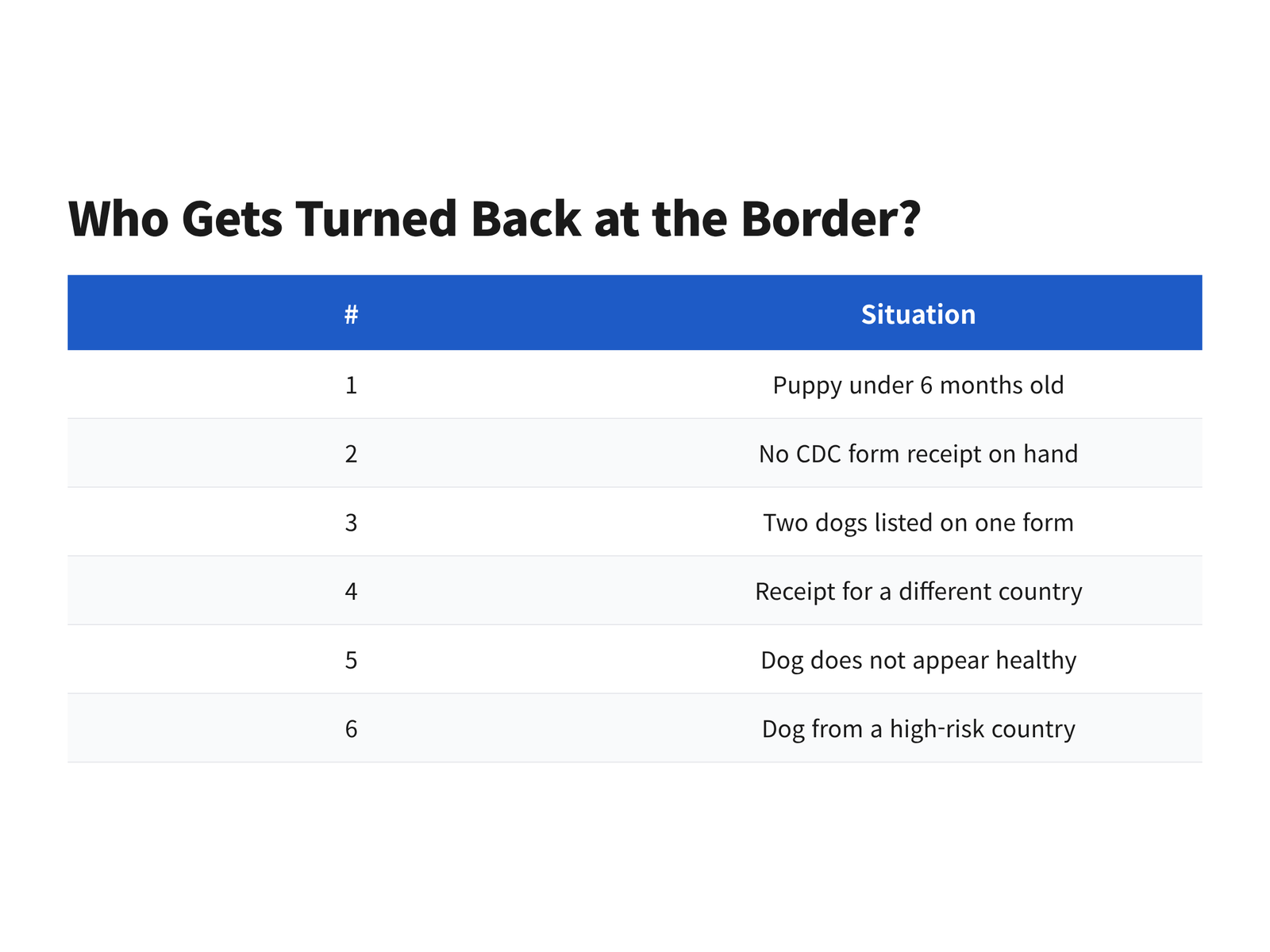
Dogs that do not meet the CDC entry conditions are the ones at risk at the land border. Based on the CDC pages, six situations stand out for drivers heading south.
- A puppy under 6 months old, since the CDC lists no age exception.
- A dog without a CDC Dog Import Form receipt, even if the dog stays in the car.
- Two dogs on one form, since the CDC requires one form per dog.
- A dog whose earlier receipt was issued for a different country of departure.
- A dog that does not appear healthy on arrival.
- A dog that was in a high-risk country in the past 6 months.
The last case moves a dog off the simple low-risk route entirely. The CDC FAQ states that foreign-vaccinated dogs from high-risk countries “are not allowed to enter the U.S. at a land border crossing.” Dogs with that travel history need to follow the separate CDC requirements for high-risk countries.
Frequently asked questions
Does the CDC require a rabies certificate for a dog driving in from Canada?
No, the CDC does not require a rabies certificate on the low-risk route. For a dog that has been only in low-risk countries such as Canada in the past 6 months, the CDC describes the form receipt as the only required documentation.
Does the microchip have to be a specific brand?
No, the CDC states the microchip can be any brand. The requirement is that a universal scanner can detect the microchip.
Can one receipt cover several crossings during one winter?
Yes, one receipt covers multiple entries within 6 months of issuance. The country of departure has to stay the same for the receipt to remain valid.
Do the rules change often?
The CDC updates these pages several times a year. Check the current CDC dog importation pages before each departure.
Sources
- Centers for Disease Control and Prevention, “Frequently Asked Questions on Dog Importations,” updated 2026-08-27 – https://www.cdc.gov/importation/dogs/faqs.html
- Centers for Disease Control and Prevention, “Entry Requirements for Dogs from Dog-Rabies Free or Low-Risk Countries,” 2024-07-22, last published 2026-02-05 – https://www.cdc.gov/importation/dogs/rabies-free-low-risk-countries.html
- Centers for Disease Control and Prevention, “High-Risk Countries for Dog Rabies,” 2026-04-15 – https://www.cdc.gov/importation/dogs/high-risk-countries.html
- Centers for Disease Control and Prevention, “CDC Dog Import Form and Instructions,” 2026-04-28 – https://www.cdc.gov/importation/dogs/dog-import-form-instructions.html
- Centers for Disease Control and Prevention, “CDC Updates Dog Importation Process,” media statement, 2024-07-22 – https://www.cdc.gov/media/releases/2024/s0722-dog-importation.html
- USDA Animal and Plant Health Inspection Service, “Pet Travel From the United States to Canada,” modified 2025-07-30 – https://www.aphis.usda.gov/pet-travel/us-to-another-country-export/pet-travel-us-canada