A reflective collar fails on a small dog at night mainly because it is passive and tiny: it only shows up when a headlight beam lands on it, and it sits on a dog that is already low, small and hard for drivers to pick out. Reflective material does help, but on its own it rarely makes a small dog visible early enough. With the clocks going back and evening walks moving into darkness, the gap between how visible owners think a dog is and how visible the dog really is matters more every week.

Why does a reflective collar often fail on a small dog at night?
A reflective collar often fails because retroreflection only works when light from a vehicle hits it and bounces back toward the driver. The Federal Highway Administration defines retroreflection as a special type of reflection that redirects incident light from headlights back toward the source. A reflective collar is therefore passive and does nothing for a cyclist riding without lights, for a driver whose beam is angled away, or for a car approaching around a bend. On a small dog the reflective strip is also a narrow band, and long neck fur may partly cover it, which is a practical consideration rather than a tested finding.
Research on human pedestrians adds a second problem. In a peer-reviewed study by Balk and colleagues published in the journal Perception, drivers responded to a pedestrian wearing a reflective vest no better than to a pedestrian with no markings at all, while reflective markings placed on the moving joints performed best. The comparable research found covers pedestrians and road objects, not dogs. Still, a single static reflective band around a small dog’s neck resembles the vest far more than the joint markings, so a reflective collar alone is a weak plan rather than a complete one.
How much farther can drivers see reflective material than dark clothing?
Reflective material can be seen up to three times as far away as non-reflective material, according to Rule 3 of the UK Highway Code. Rule 3 tells pedestrians that when it is dark they should use reflective materials such as armbands, sashes, waistcoats, jackets and footwear. The open question is whether a small strip on a small dog delivers the same benefit as a full jacket on an adult walker.
Driver-detection figures from the Federal Highway Administration show how large the gap between dark and bright clothing can be. In a night-visibility study using halogen low beams, drivers detected pedestrians and cyclists in white clothing at roughly 805 to 845 ft. For black clothing, detection distances ranged from roughly 355 ft for a pedestrian walking parallel to traffic to 520 ft for a cyclist. These figures describe people, not dogs, but they show that what a walker wears can change detection distance by hundreds of feet.
There is also a perception trap. As reported by the Association for Psychological Science, Borzendowski and colleagues found that pedestrians in reflective vests predicted drivers would see them at about 140 m, while the actual distance was about 40 m. The researchers wrote: “Results of several studies indicate that pedestrians typically overestimate their own conspicuity to drivers at night.” Owners who feel safe because a collar glows in a phone photo may be making the same mistake.
Why are small, low-to-the-ground dogs seen later than people?
Small, low objects are detected later than people, according to night-visibility research on road objects. The Federal Highway Administration study did not test dogs, but it did measure low and small objects. A tire tread lying on the road was detected at about 205 ft, and a child’s bicycle at about 425 ft, both well short of the 805 to 845 ft recorded for pedestrians in white clothing. A small dog shares the key traits of those objects: it is low, compact and close to the road surface.
Driver age widens the gap. A presentation summary by researcher J. Wood of a study in Human Factors reported that older drivers recognised only 58% of pedestrians, and did so at half the distance. A related abstract in the Journal of Vision found mean response distances of 285 m for younger drivers and 141 m for older drivers when pedestrians wore ankle and wrist reflectors, while most pedestrians wearing no reflectors or a vest only were never detected. Research on pedestrians suggests that a small dog with only a neck reflector should be treated as harder to see, not easier.
Is an LED light better than a reflective collar for a small dog?
An LED light and a reflective collar solve different problems, so the safest setup usually uses both. An LED collar or clip light emits its own light, which means a driver, cyclist or runner can see it even when no headlight beam is pointed at the dog. A reflective collar or harness depends entirely on incoming light. PDSA vet Lynne James has advised that owners “can use a high visibility dog coat or an LED collar” to help dogs stand out along roads.
An LED light has its own limits. LED gear needs charging, and a single point of light can be hard for a driver to judge for distance or movement, which is an editorial consideration rather than a research finding. No study comparing LED lights and retroreflectors on small dogs was found. Research on pedestrians, however, consistently favours markings on moving parts. The UK Highway Code applies the same logic to horses at night, recommending reflective bands above the fetlock joints. For a small dog, reflective trim on a harness that moves with the body follows that idea better than a collar alone.

What should change on evening walks after the clocks go back?
After the clocks go back, the walk itself should change, not only the gear. In the UK the clocks go back on 25 October, and in the US daylight saving time ends at 2:00 a.m. on the first Sunday of November, which falls on 1 November. PDSA advises: “Remember that evenings will now be darker, too, so you may need to start walking your dog a bit earlier.” PDSA also suggests shifting a dog’s morning routine 10 minutes later every day until the hour is made up, rather than changing everything at once.
Road habits matter as much as visibility. Highway Code Rule 56 says “Do not let a dog out on the road on its own” and asks owners to keep a dog on a short lead on a pavement, road or path shared with cyclists or horse riders. An extending lead can put a small dog outside the lit area around the walker. PDSA vet Lynne James also recommends a crossing routine: “When approaching a road with your dog on a lead, ask them to ‘sit’ and ‘wait’.” A walker in reflective clothing with a torch makes the person and the lead easier to see, which helps the dog at the other end.
- Start the evening walk earlier where possible.
- Keep a small dog on a short lead near roads.
- Wear reflective material and carry a torch as the walker.
- Add an LED light to the dog, not only a reflective collar.
- Use a sit-and-wait routine before every road crossing.
If a small dog seems hesitant or disoriented on dark walks, consult your veterinarian rather than assuming the problem is only about gear.
LED collar vs reflective harness vs hi-vis coat: what does each one do at night?
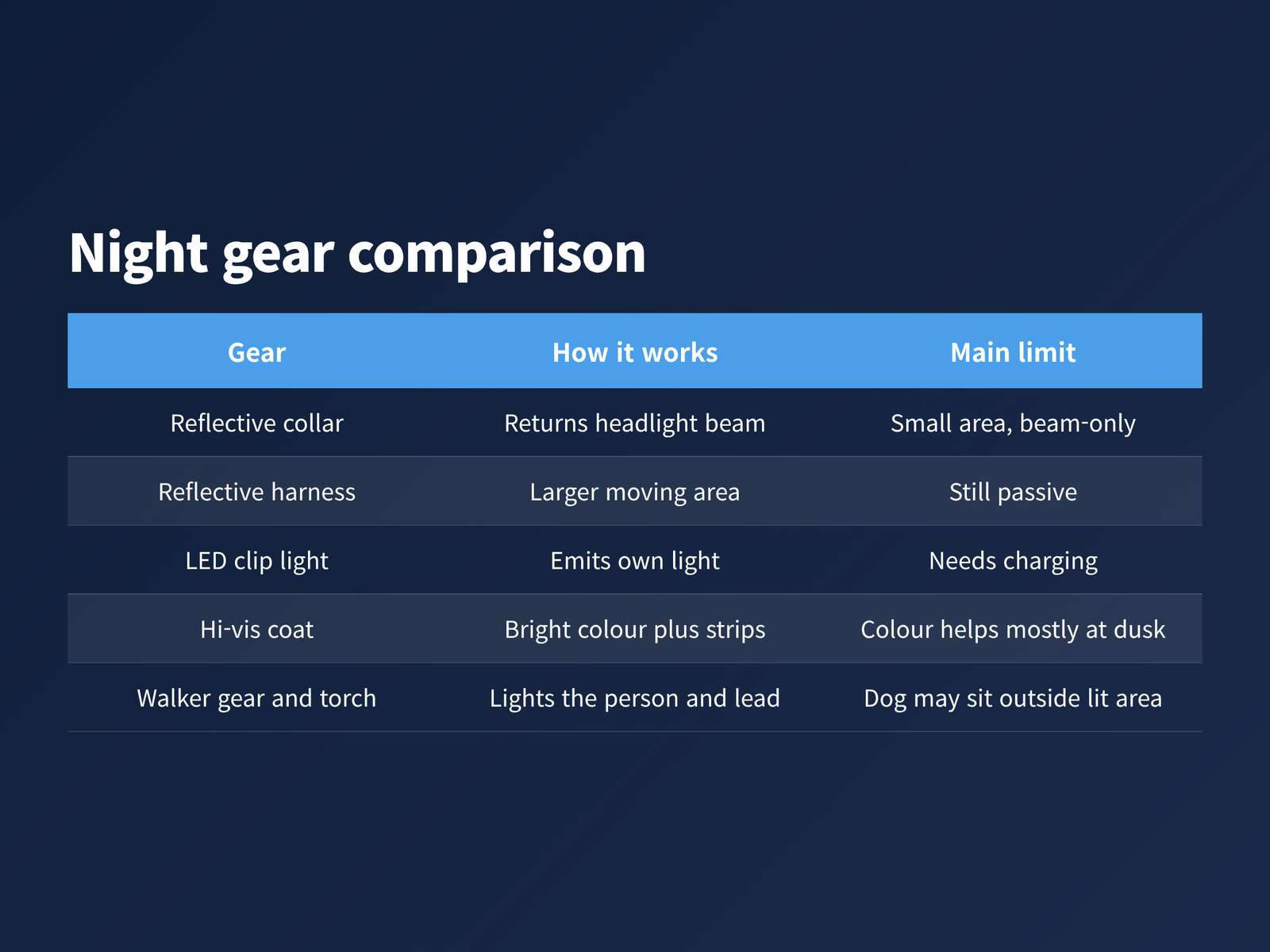
Each piece of night gear covers a different weakness, and none of them works alone. The table below compares the common options for a small dog, based on the Federal Highway Administration definition of retroreflection and Highway Code Rule 3.
| Gear | How it works | Main limit |
|---|---|---|
| Reflective collar | Returns headlight beam | Small area, beam-only |
| Reflective harness | Larger moving area | Still passive |
| LED clip light | Emits own light | Needs charging |
| Hi-vis coat | Bright colour plus strips | Colour helps mostly at dusk |
| Walker gear and torch | Lights the person and lead | Dog may sit outside lit area |
Highway Code Rule 3 notes that fluorescent colours help mainly in daylight and poor light, while reflective material is what works in the dark. Combining a light, reflective trim on a harness and a visible walker covers more situations than any single item.
Frequently asked questions
Are dog lights a legal requirement in the UK?
No. The UK Highway Code does not require lights or reflectors on a dog. Rule 56 covers keeping a dog on a short lead near roads, and Rule 58 advises anyone moving herded animals after dark to wear reflective clothing and carry lights, but no rule makes dog lights mandatory.
Do studies show how far drivers can see a dog at night?
No peer-reviewed study on driver detection of dogs was found. The detection distances quoted for reflective material, dark clothing and small objects all come from research on human pedestrians and road objects. Those figures are useful as a guide, but they should not be read as measurements of dogs.
Is a reflective collar useless for a small dog?
A reflective collar is not useless, since the Highway Code says reflective material can be seen up to three times as far away. The problem is relying on a reflective collar alone, because it only works inside a headlight beam.
Sources
- UK Government, The Highway Code – Rules about animals (47 to 58), Rules 51, 56 and 58, accessed 2026-10-15 – https://www.gov.uk/guidance/the-highway-code/rules-about-animals-47-to-58
- UK Government, The Highway Code – Rules for pedestrians (1 to 35), Rule 3, accessed 2026-10-15 – https://www.gov.uk/guidance/the-highway-code/rules-for-pedestrians-1-to-35
- UK Government, When do the clocks change, accessed 2026-10-15 – https://www.gov.uk/when-do-the-clocks-change
- National Institute of Standards and Technology, Daylight Saving Time Rules, updated 2026-02-09 – https://www.nist.gov/node/430171
- Federal Highway Administration, Enhanced Night Visibility Series Vol. III, FHWA-HRT-04-134, December 2005 – https://www.fhwa.dot.gov/publications/research/safety/humanfac/04134/508txt.cfm
- Federal Highway Administration, Methods for Maintaining Traffic Sign Retroreflectivity, Chapter 1 – https://highways.dot.gov/safety/other/visibility/methods-maintaining-traffic-sign-retroreflectivity/chapter-1-introduction
- Balk SA, Tyrrell RA, Brooks JO, Carpenter TL, “Highlighting human form and motion information enhances the conspicuity of pedestrians at night”, Perception 37(8):1276-1284, 2008 – https://journals.sagepub.com/doi/abs/10.1068/p6017
- Tyrrell RA, Wood JM, et al., “Seeing pedestrians at night: the benefits of biological motion are robust to clutter”, Journal of Vision 7(9):475, 2007 – https://portfolio.erau.edu/en/publications/seeing-pedestrians-at-night-the-benefits-of-biological-motion-are/
- Wood J, QMIHSC conference presentation summarising Wood et al. 2005 (Human Factors), 2015 – https://www.qmihsconference.org.au/wp-content/uploads/qmihsc-2015-concurrent-woodj.pdf
- Association for Psychological Science, “Why ‘Batman’ Met a Tragic Death on the Highway” (reporting Borzendowski et al., Journal of Safety Research) – https://psychologicalscience.org/?p=116122
- PDSA, Pets and daylight savings, accessed 2026-10-15 – https://www.pdsa.org.uk/pet-help-and-advice/looking-after-your-pet/all-pets/pets-and-daylight-savings
- Vet Nurse Online, PDSA road safety advice (Lynne James), 2021-11-15 – https://vnonline.co.uk/vn/news/20985/PDSA-asks-pet-owners-to-