A human hair dryer on a small dog is the wrong tool because a human hair dryer dries with heat, while a dog dryer dries with moving air. The American Kennel Club (AKC) says plainly that owners should not use a human blow dryer on a dog, and it warns that heat on the coat might burn the skin. This guide explains why small dogs need extra care at drying time, what distance AKC gives, and what went wrong in the heated cage dryer cases.
Is it safe to use a human hair dryer on a small dog?
No, AKC advises against using a human hair dryer on any dog, including small dogs. The AKC article “Dry Your Dog” states: “But it’s important not to use a human blow dryer on your dog.” The reason is the drying mechanism. According to AKC, “When you use a dog dryer, the airflow, not heat, is drying their fur.” A human hair dryer is built for human hair and pushes heat to do the work, and AKC adds: “Try to avoid using heat on your dog’s fur, since it might burn their skin.”
Heat, not air, is the problem. How much risk a human hair dryer adds for a particular small dog depends on coat length, skin condition and how close the nozzle gets. If a small dog shows redness, sore patches, eye squinting or other discomfort after drying, consult your veterinarian rather than guessing at the cause.
Why are small dogs more at risk during grooming and drying?
Small dogs feature heavily in grooming-related eye injury data, which matters because drying air often reaches the face. A study in the Journal of the American Animal Hospital Association (JAAHA) by Chmiel and colleagues reviewed 161 grooming-related eye injury episodes in 159 dogs. The authors reported: “Small-breed dogs (breeds with an average adult weight <10 kg) were involved in 71% of incidents.” The same study found that 94% of the injured dogs had long or wire-haired coats.
The JAAHA study covered grooming visits in general and did not report how many eye injuries came from dryers specifically. Still, the authors flagged drying air as one plausible factor: “Increased airflow across the corneal surface from warm air dryers can trigger desiccation and discomfort.” Corneal ulceration was the most common injury at 71%, followed by conjunctivitis at 11%, eyelid laceration at 7% and subconjunctival hemorrhage at 6%. In the JAAHA study, 14% of cases required surgery and 4 dogs lost an eye, which is why AKC’s advice to keep air away from the face matters for a long-coated small dog.
How far away should you hold a dryer from a small dog?
AKC says to hold the dryer at least a foot away, which is roughly 30 cm. The AKC article “The Soap and Water of Dog Ownership” puts it directly: “Hold the dryer at least a foot away from your dog so you don’t burn his skin.”
AKC adds a few more points for small dogs at home. Use a dryer made for dogs, choose a low setting, and start from a distance. Keep the airflow away from the face and ears. Keep the dog in a warm place until the coat is completely dry, since a small dog left damp after a bath is an avoidable problem. Whether a given dryer setting is comfortable depends on the dog, so watch the dog’s reaction rather than the clock.
Why does rubbing a towel make a small dog’s long coat tangle?
Rubbing a towel hard through a long coat twists wet hair together, which is how tangles and mats start. AKC’s “Dry Your Dog” article warns: “Rubbing the towel vigorously can cause tangles to develop and mats to form.” The better method is to press the towel into the coat and lift it away, soaking up water without dragging the hair in circles.
Towel pressing is especially relevant for small dogs with long or wire-haired coats, the coat types reported for 94% of the injured dogs in the JAAHA study. A thorough towel press also removes more water before any dryer comes out, which shortens the time a small dog spends under airflow. Afterward, AKC says to keep the dog warm until fully dry.

What went wrong in the heated cage dryer cases?
Heated cage dryers, also called cabinet dryers, were linked to dog deaths in cases cited by the New York City Bar Association. The New York City Bar report supported New York bills A.7502-B and S.5702-A, which proposed banning heated cage dryers. According to the report, the heating element in a cage dryer “can reach temperatures of 135 degrees.” The report described heated dryers as “inherently dangerous and, in many instances, has resulted in serious injury to and the death of such animals.”
The cases in the New York City Bar report included toy breeds, and one dog was left in a heated cage dryer for nearly an hour. Recorded body temperatures in two cited deaths were 108.7 F and 107 F, against a normal range of 100-102 F. The proposed civil penalty was $250 to $500 per occurrence. Whether the bill became law has not been verified, so the ban should be read as proposed, not enacted. AKC separately advises against crate dryers, noting that some dogs find being contained with a dryer stressful.
A UK study in the journal Animals by Hall, Carter and O’Neill adds context: 40 of 879 heat-related illness events with a recorded trigger, or 4.6%, happened while the dog was under the care of a vet clinic or groomer. That figure covers all causes in those settings, not dryers alone.
Dog dryer vs human hair dryer: what actually differs?
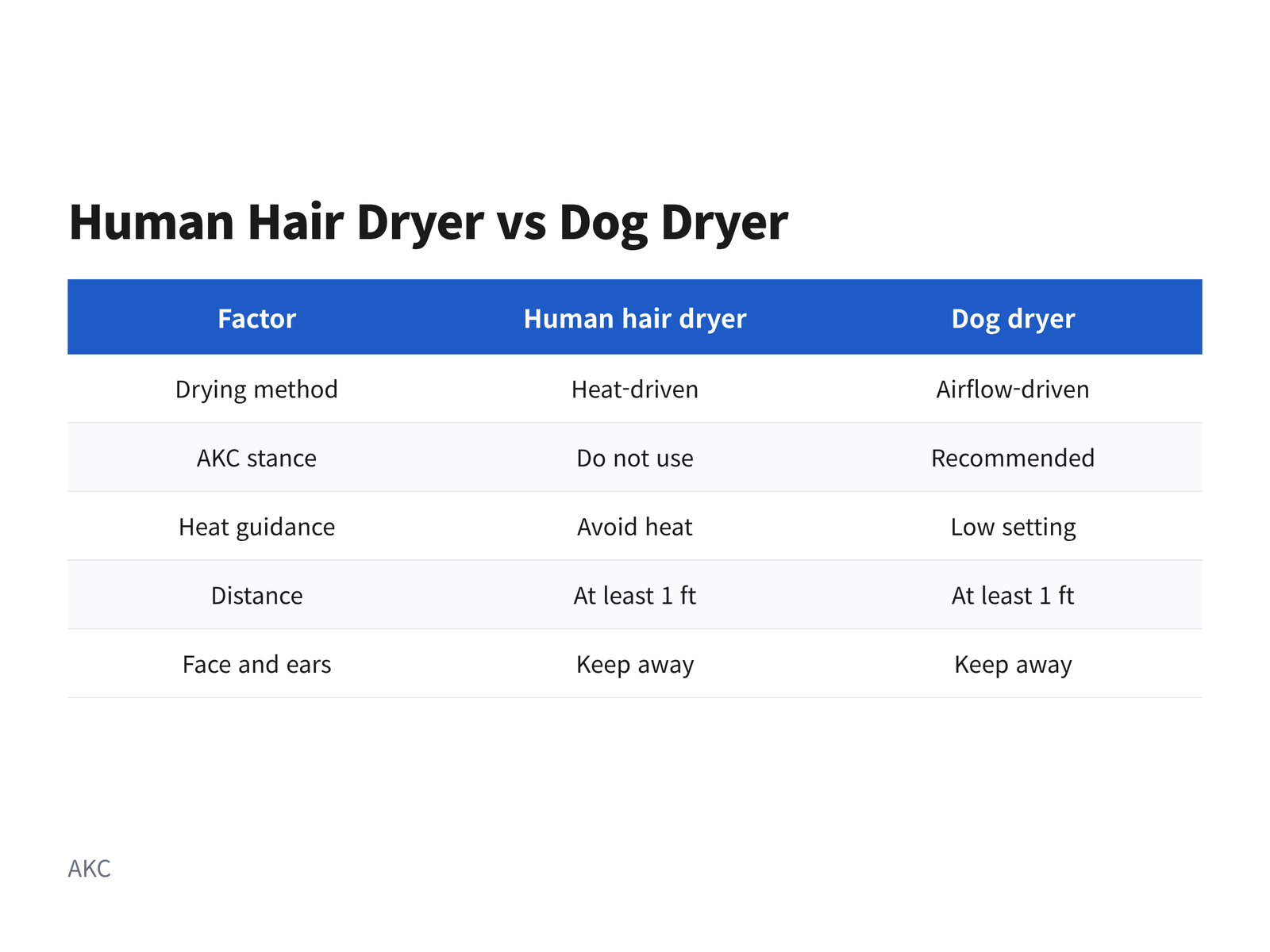
The main difference is that a dog dryer dries with airflow and a human hair dryer dries with heat. The table below sums up what AKC says about each tool for a small dog.
| Factor | Human hair dryer | Dog dryer |
|---|---|---|
| Drying method | Heat-driven | Airflow-driven |
| AKC stance | Do not use | Recommended |
| Heat guidance | Avoid heat | Low setting |
| Distance | At least 1 ft | At least 1 ft |
| Face and ears | Keep away | Keep away |
AKC describes a dog dryer as “specifically designed for a dog’s sensitive skin and coat.” The distance rule and the face-and-ears rule still apply to a dog dryer, so switching tools does not remove the need for care around a small dog’s eyes and ears.
What do professional grooming standards say about drying?
The UK National Occupational Standard for drying a dog’s coat requires groomers to match equipment, temperature and airflow to the individual dog. Lantra’s standard LANAnC25 tells groomers to dry the coat “using drying equipment and hand tools that are suitable for the dog, its coat type and condition.” The standard also requires groomers to “establish the correct drying temperature and velocity and monitor the condition of the dog’s coat and skin … to ensure it does not overheat.”
LANAnC25 goes further on warning signs. Groomers must “recognise when the temperature, velocity or drying technique appears to be causing distress to the dog,” and must know “what heat stress and brush burn are, their signs and causes and how to prevent them happening.” The standard lists cabinet, blaster and blow dryers as equipment types. For a small dog at home, the same principle applies: the right setting depends on the dog in front of you, not on what works for human hair.
Frequently asked questions
Can a human hair dryer on the cool setting be used on a small dog?
AKC’s guidance is to avoid a human blow dryer on dogs and to avoid heat on the coat, with airflow doing the drying. No source in this guide confirms that a cool setting makes a human hair dryer suitable, so a dryer made for dogs remains the option AKC describes.
How long should a small dog be dried?
AKC does not give a time limit. AKC says to keep the dog in a warm place until completely dry, to use a low setting, and to watch the face and ears.
Is towel drying alone enough for a small dog?
Towel pressing removes a lot of water, and AKC recommends pressing rather than rubbing. A long-coated small dog still needs to stay somewhere warm until the coat is fully dry. If the skin looks irritated afterward, consult your veterinarian.
Sources
- American Kennel Club, “Dry Your Dog” (Sassafras Patterdale, CPDT-KA, CTDI), updated 2026-04-15 – https://www.akc.org/expert-advice/health/dry-your-dog/
- American Kennel Club, “The Soap and Water of Dog Ownership,” updated 2018-01-22 – https://www.akc.org/expert-advice/health/the-soap-and-water-of-dog-ownership/
- Chmiel et al., “Ocular Injuries Related to Grooming Visits in Dogs: 161 Cases (2004-2020),” Journal of the American Animal Hospital Association 58(6):277, published 2022-10-31 – https://jaaha.kglmeridian.com/view/journals/aaha/58/6/article-p277.xml
- Hall EJ, Carter AJ, O’Neill DG, “Dogs Don’t Die Just in Hot Cars – Exertional Heat-Related Illness (Heatstroke) Is a Greater Threat to UK Dogs,” Animals 10:1324, 2020 – https://rvc-repository.worktribe.com/OutputFile/1376438
- Lantra, UK National Occupational Standard LANAnC25 “Dry a dog’s coat ready for styling and finishing,” v2, January 2014 – https://files.ukstandards.org.uk/pdfs/LANANC25.pdf
- New York City Bar Association, report on A.7502-B / S.5702-A banning heated cage dryers, March 2012 – https://www.nycbar.org/wp-content/uploads/2023/05/20072263-BanningHeatedGrooming.pdf