On many major airlines, a Japanese Chin cannot fly in the cargo hold or as checked baggage. American Airlines, Lufthansa and Singapore Airlines list the Japanese Chin as a brachycephalic, or snub-nosed, breed and keep the dog out of the hold, while some still allow the Japanese Chin in the cabin. The rules are not identical: airlines disagree on whether mixes are covered, and Air France does not list the breed at all.

Can a Japanese Chin fly in the cargo hold on major airlines?
On American Airlines, Lufthansa, Discover Airlines and Singapore Airlines, a Japanese Chin cannot travel in the hold. American Airlines states, “We don’t accept brachycephalic or snub-nosed dogs of any ‘mix’ as checked pets.” Lufthansa names “Japanese chins” and “Japanese spaniels” on its list and explains, “Lufthansa has therefore barred the transport of these breeds in the cargo hold since 1 January 2020.” Lufthansa still allows a Japanese Chin in the cabin as a carry-on, and Lufthansa Cargo freight remains a separate route.
Singapore Airlines prohibits the Japanese Chin both as cargo and as checked baggage. In the IATA Live Animals Regulations, 52nd Edition, Addendum I, Austrian bars the Japanese Chin from cargo holds apart from service animals, and Oman Air calls the listed breeds “not acceptable on Oman Air aircrafts,” with exceptions via its Special Cargo Desk. Turkish Cargo accepts a Japanese Chin only under conditions covered below.
Why do airlines treat the Japanese Chin as a high-risk snub-nosed breed?
Airlines restrict the Japanese Chin because the breed’s short face is linked to breathing problems that can worsen in a cargo hold. The AVMA explains, “Because of their anatomical abnormalities, short-nosed breeds seem to be more vulnerable to changes in air quality and temperature in the cargo hold of a plane.” The AVMA also cites U.S. Department of Transportation data released in July 2010: about half of 122 dog deaths on flights over a five-year period involved short-faced breeds.
A 2026 study in PLOS One measured the Japanese Chin specifically. Tomlinson and colleagues examined 898 dogs across 14 breeds and reported that the Pekingese and “Japanese Chin, had the highest rates of BOAS,” or brachycephalic obstructive airway syndrome. Only 17.4% of the 46 Japanese Chins assessed were graded free of BOAS signs, leaving about 82.6% graded 1 to 3. In April 2026, Dogs Australia placed the Japanese Chin in the high-risk group of its respiratory grading scheme.
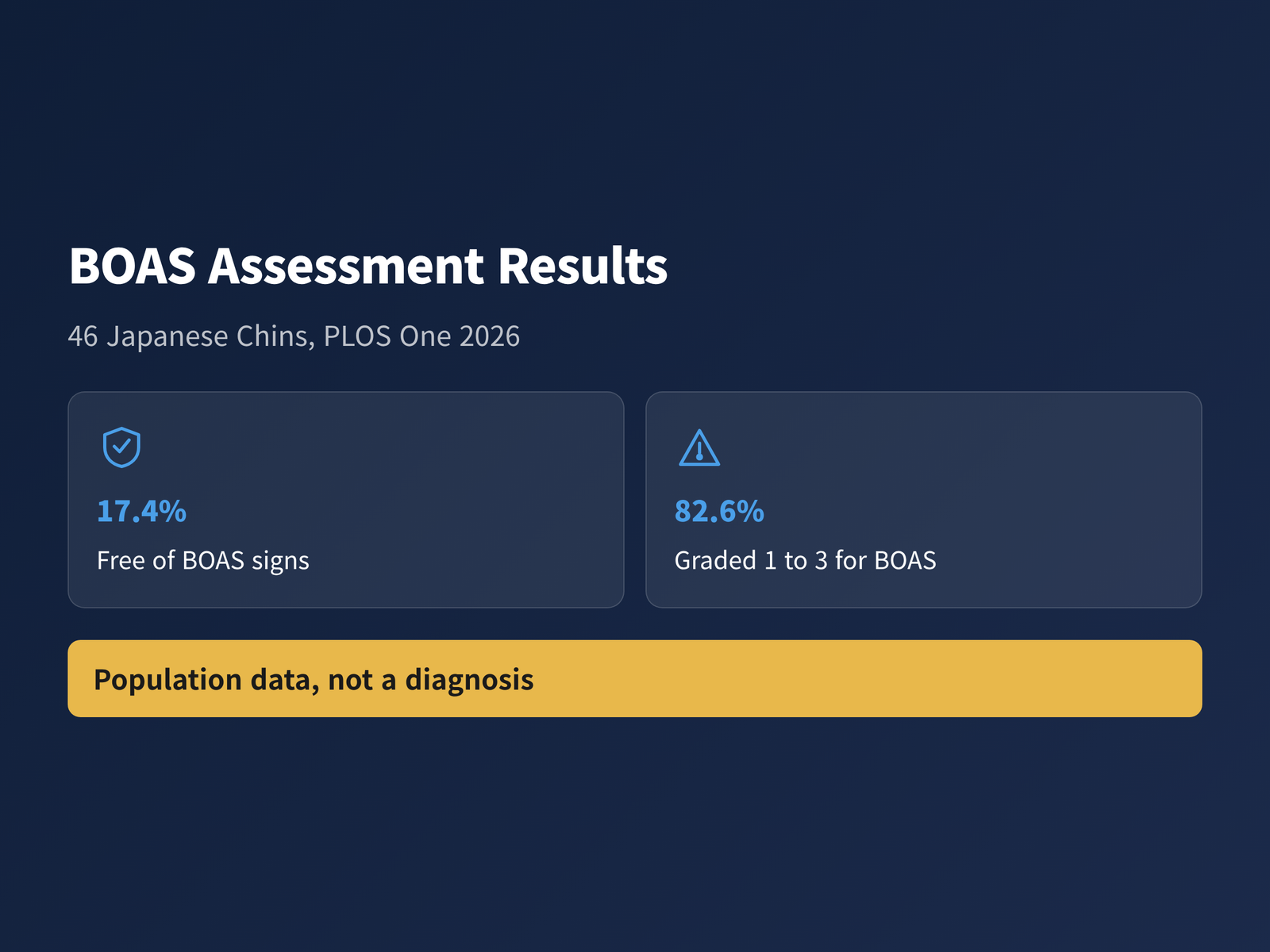
These are population statistics, not a verdict on any one Japanese Chin. The Kennel Club breed standard calls for “Nose large with open nostrils,” yet only 5.8% of the Japanese Chins in the study had open nostrils. The standard also asks for a “Muzzle short, wide, well cushioned,” the trait behind airline snub-nosed lists.
Does a Japanese Chin mix fall under the same airline ban?
Whether a Japanese Chin mix is banned depends entirely on the airline. American Airlines refuses snub-nosed dogs “of any ‘mix'” as checked pets. Lufthansa says its restrictions “also apply to cross-breeds,” Discover Airlines says they “also apply to mixes,” and Singapore Airlines covers the listed breeds “inclusive of crosses.” On these four carriers, a Japanese Chin mix faces the same hold restrictions as a purebred Japanese Chin.
Qantas Freight takes the opposite approach. Qantas lists the “Japanese Chin / Japanese Spaniel” on its brachycephalic page, but states that its breed list applies to “purebreds only,” and owners of listed breeds must book through an approved pet travel specialist. Air France goes further still: the AF-01 entry in the IATA regulations names only the American Bully, English and French Bulldogs, Boston Terriers and Pugs, plus crosses of those breeds. The Japanese Chin is not on the Air France list at all.
For a Japanese Chin mix, one airline’s answer cannot be carried over to another. Oman Air, Austrian and Turkish Cargo list the Japanese Chin, but their IATA entries do not state whether mixes are covered, so confirm the rule directly with the carrier.
Why is heat the biggest travel risk for a Japanese Chin?
Heat is the main travel risk for a Japanese Chin because flat-faced dogs face higher odds of heat-related illness than dogs with average-length muzzles. A 2020 study in Animals by Hall, Carter and O’Neill found that brachycephalic dogs had 3.07 times the odds of vehicle-related heat illness, 2.36 times the odds of environmental heat illness and 1.32 times the odds of exertional heat illness compared with mesocephalic dogs. The authors summarized, “Any dog can develop heatstroke if left in a hot car, but flat-faced breeds were particularly at risk.”
Airline rules reflect this heat risk. American Airlines does not allow pet travel when temperatures exceed 85°F at any point on the itinerary. Pets not flying in the cabin cannot travel to, through or from Phoenix, Tucson, Las Vegas or Palm Springs between May 1 and September 30. Turkish Cargo accepts snub-nosed breeds only when origin and destination temperatures are below 27°C, with a kennel one size larger, ventilation on four sides and an indemnity letter.
Even where a Japanese Chin is accepted in the hold, the AVMA notes that no one can monitor an animal during the flight, so a problem may only be found after landing. The AVMA advises avoiding flight times that expose a pet to midday heat or cold.
What should you ask a veterinarian before a Japanese Chin flies?
Before any flight, consult your veterinarian about whether your Japanese Chin’s breathing and overall health suit air travel. The AVMA recommends a veterinary visit within 10 days before any interstate trip. Only a veterinarian can judge an individual Japanese Chin, because BOAS figures describe groups of dogs.
Questions worth raising with the veterinarian include:
- Does this Japanese Chin show signs of breathing difficulty at rest or in warm weather?
- Is the dog fit for the length of this flight and the connections?
- Which paperwork does the chosen airline require?
- How should heat be managed at the airports on the route?
Do not plan sedation on your own. The AVMA states, “We strongly recommend that you avoid tranquilizing your pet for air travel.” Book cabin space early as well. The AVMA advises, “Do this when you make your reservation, not when you show up at the airport for your flight.”
How do airline rules for the Japanese Chin compare?
Airline rules for the Japanese Chin range from a hold ban covering mixes to no listing at all. The table summarizes five carriers from their policy pages and the IATA regulations.
| Airline | Japanese Chin in hold | Mixes covered |
|---|---|---|
| American Airlines | Not accepted (checked) | Yes, any mix |
| Lufthansa | Banned since 2020 | Yes |
| Singapore Airlines | Prohibited | Yes |
| Qantas Freight | Specialist booking only | No, purebreds only |
| Air France | Not on list | Not applicable |
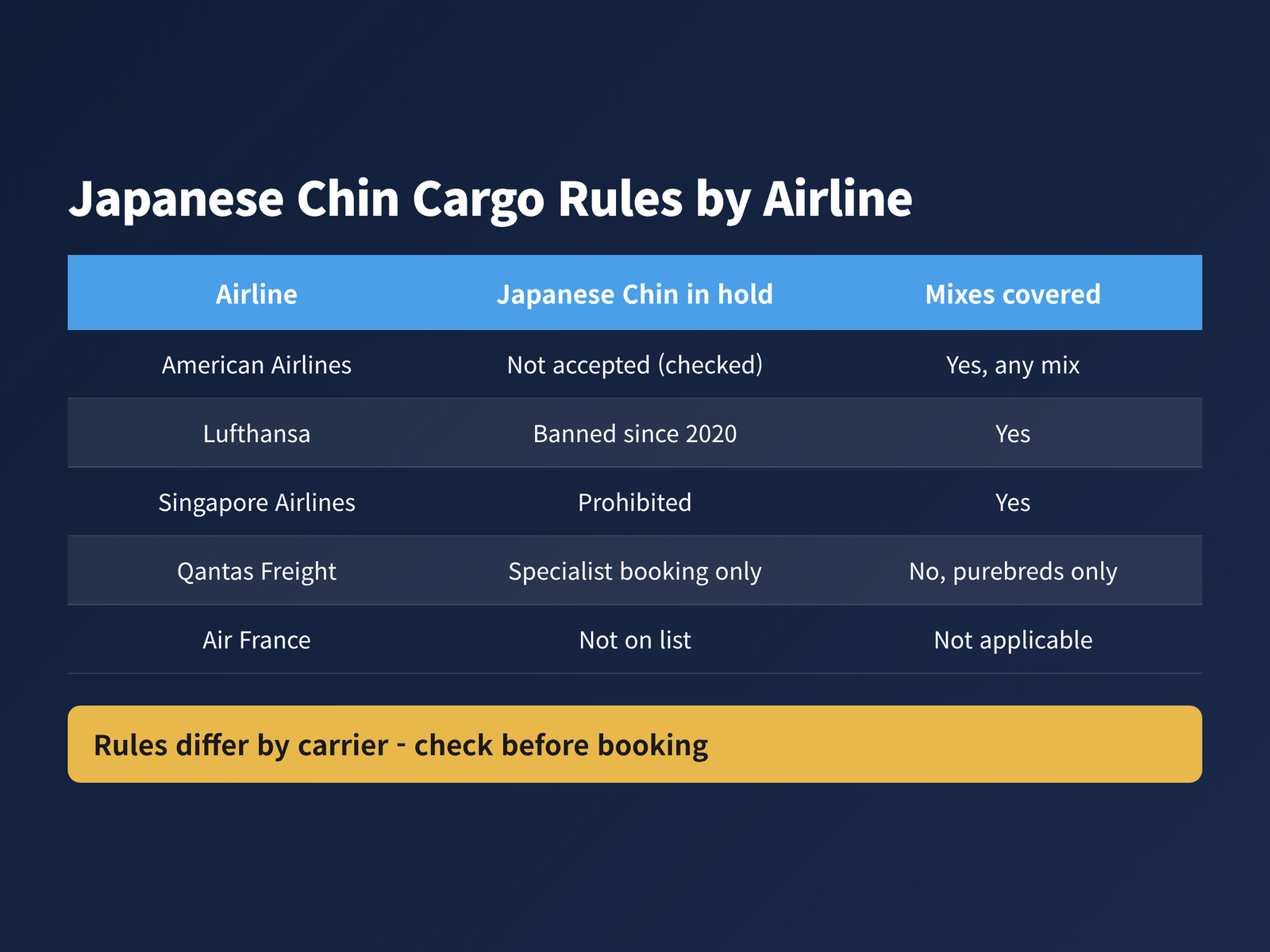
The American Kennel Club reports that United’s PetSafe program does not take reservations for brachycephalic dogs, but United’s own breed list could not be confirmed. Airline pet policies change without notice, so check the carrier’s current page before booking a Japanese Chin.
Frequently asked questions
Can a Japanese Chin fly in the cabin?
On many airlines, yes. Lufthansa and Discover Airlines allow the Japanese Chin in the cabin, and American Airlines states no breed restriction for carry-on pets. The Kennel Club standard gives an ideal weight of 1.8 to 3.2 kg (4 to 7 lb), but each airline sets its own cabin limits.
Is a Japanese Chin mix allowed in cargo on Qantas?
Qantas Freight states that its brachycephalic list applies to purebreds only, and listed breeds book through an approved pet travel specialist. Confirm a Japanese Chin mix’s status with Qantas Freight first.
Does Air France ban the Japanese Chin from the hold?
The Japanese Chin does not appear on the Air France snub-nosed list in the IATA Live Animals Regulations, which names the American Bully, English and French Bulldogs, Boston Terriers and Pugs. General Air France pet rules still apply.
Sources
- American Airlines, “Traveling with pets”, accessed 2026-10-14 — https://www.aa.com/i18n/travel-info/special-assistance/pets.jsp
- Lufthansa, “Information about travelling with fighting dog breeds and snub-nosed animals”, accessed 2026-10-14 — https://www.lufthansa.com/au/en/dangerous-dogs
- Discover Airlines, “Fighting dogs and snub-nosed animals”, accessed 2026-10-14 — https://www.discover-airlines.com/us/en/book/special-requests/pets/fighting-dog-breeds-snub-nosed-animals
- Qantas Freight, “Brachycephalic breeds”, accessed 2026-10-14 — https://freight.qantas.com/pets/brachycephalic-breeds.html
- Singapore Airlines, “Pets as Checked Baggage Checklist” (ref AOD/03/300724), 2024-07-30 — https://www.singaporeair.com/saar5/pdf/Customer-Version-Pets-as-Checked-Baggage-Checklist_30Jul24_V3.pdf
- IATA, “Live Animals Regulations 52nd Edition, Addendum I”, 2026-01-15 — https://www.iata.org/contentassets/80b3908be0ca4ebe8d359292c46cdac2/20260101-lar-addendum-i-v1.0-final_ext.pdf
- Tomlinson F, Liu N-C, Sargan DR, Ladlow JF, “A cross-sectional study into the prevalence and conformational risk factors of BOAS across fourteen brachycephalic dog breeds”, PLOS One, 2026-02-18 — https://pmc.ncbi.nlm.nih.gov/articles/PMC12915975
- Hall EJ, Carter AJ, O’Neill DG, “Dogs Don’t Die Just in Hot Cars: Exertional Heat-Related Illness (Heatstroke) Is a Greater Threat to UK Dogs”, Animals, 2020-07-31 — https://pmc.ncbi.nlm.nih.gov/articles/PMC7459873
- American Veterinary Medical Association, “Air travel and short-nosed dogs FAQ”, undated page citing DOT data released July 2010 — https://www.avma.org/public/PetCare/Pages/Short-nosed-Dogs-and-Air-Travel-FAQs.aspx
- The Kennel Club, “Japanese Chin breed standard”, undated page — https://thekennelclub.org.uk/breed-standards/toy/japanese-chin
- American Kennel Club, “Flying Pet? Check Airlines’ Policies”, modified 2024-08-14 — https://www.akc.org/clubs-delegates/government-relations/flying-pet-check-airlines-policies/
- Dogs NSW / Dogs Australia, “Updated list of breeds that can be assessed under the RFG scheme”, April 2026 — https://www.dogsnsw.org.au/about-us/news-updates/2026/april/from-dogs-australia-updated-list-of-breeds-that-can-be-assessed-under-the-rfg-scheme/