Why retractable leashes are bad for small dogs comes down to three facts: the cord is longer than a six-foot leash, the dog can build speed before the brake stops it, and the manufacturer’s own instructions warn of finger, hand and eye injuries. Even the smallest common model pays out 3 m of cord, about 9.8 ft. This guide sets those warnings beside the official six-foot rules.
Why is a retractable leash riskier for a small dog than a fixed six-foot leash?
A retractable leash is riskier because the extra cord lets a small dog run farther and faster before the handler can stop it. A retractable leash is a spring-loaded handle that lets a cord or tape pay out and rewind, with a brake button and a lock. The manufacturer’s instructions for flexi leashes say: “Because the flexi™ leash is longer than regular leashes, your dog can build up more speed and pull on it harder.” When you brake, the instructions add, you will be pulled.
The American Kennel Club names a training problem too: “Unfortunately, a retractable leash rewards pulling.” Each time a small dog leans forward, the cord gives more length, so the small dog learns that pulling works. The AKC recommends learning loose-leash walking on a standard six-foot leash first.
Does even the smallest retractable leash break a six-foot leash rule?
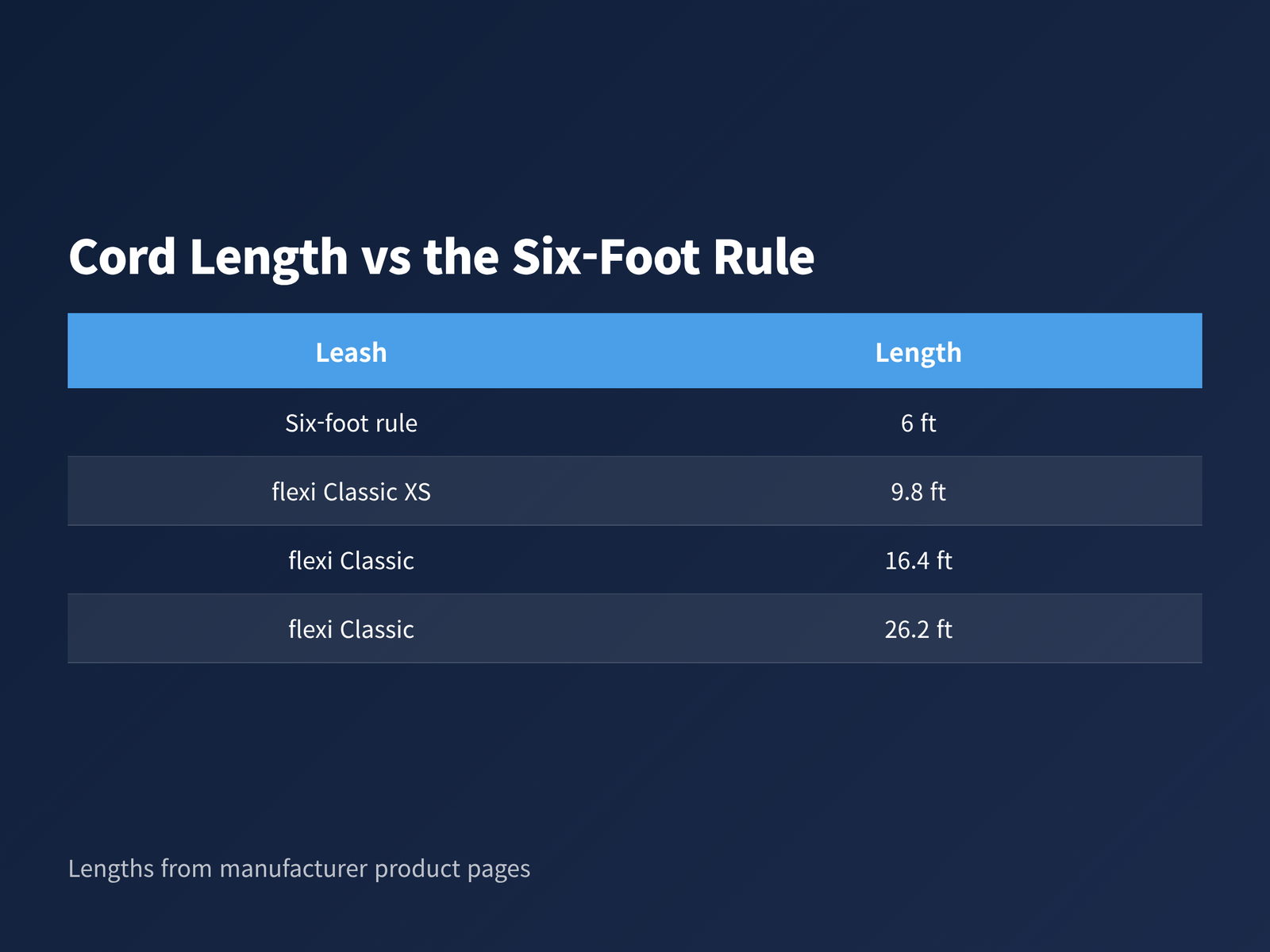
Fully extended, yes: the smallest flexi Classic model has a 3 m cord, about 9.8 ft, roughly 1.6 times a six-foot leash. The manufacturer lists the flexi Classic XS for “little dogs, cats and other small animals up to max. 8 kg.” Other flexi Classic lengths run to 5 m (about 16.4 ft) and 8 m (about 26.2 ft), and the AKC says “26 feet is likely too long for most dogs.”
In US national parks, 36 CFR 2.15 requires “a leash which shall not exceed six feet in length.” The federal rule caps leash length at six feet, and some parks say a retractable leash must be kept at six feet or less. National Park Service pages for two National Historic Sites state: “Retractable leashes should be kept at a maximum length of six feet.” Saratoga National Historical Park instead asks for “a physical leash no longer than 6 feet,” so check the specific park’s pets page.
What do retractable leash makers warn about in their own instructions?
The flexi instructions warn of amputated fingers, broken bones and serious eye damage from snap-back. The most direct line reads: “If the tape/belt wraps around fingers or catches on a ring, a hard pull on the leash can amputate fingers or break bones.” The instructions also state that “the tape/belt and hook can snap back with enough force to cause serious eye damage,” and the manufacturer supplies a separate safety collar for the case where the collar or hook breaks.
In 2008 the US Consumer Product Safety Commission announced a recall of about 223,000 SlyDog retractable leashes because the metal clasp could break, citing 5 injury reports, including facial cuts and a broken tooth. The flexi instructions tell owners to inspect the leash and collar before each use: “If any part of the leash or your dog’s collar are damaged, frayed or broken, do not use the leash.”
Why does hitting the end of the cord matter more for a small dog’s neck?
Hitting the end of the cord matters because the stop lands on the small dog’s neck when the leash clips to a collar. Stephanie Gibeault of the American Kennel Club writes: “When your dog hits the end of the leash, your dog can suffer injuries like a damaged trachea or spine.” A retractable leash gives the dog extra cord to gather speed before that stop.
The American College of Veterinary Surgeons lists small breeds, including Yorkshire terriers, Pomeranians, Poodles and Chihuahuas, as the main group affected by tracheal collapse. That list describes which breeds are most often affected, not any single dog. If your dog coughs after pulling on a collar, has a history of airway problems, or shows pain or behavior changes after a leash jolt, consult your veterinarian before choosing a leash setup.
Is a weight rating enough to choose a retractable leash for a small dog?
No: a weight rating only sets a weight ceiling, and the flexi instructions say to use the leash only with a dog under the listed limit. The flexi Classic XS rating is 8 kg, about 17.6 lb. The rating does not change the cord length, the braking distance or the load on the neck at the end of the cord.
Where does a retractable leash not fit – roads, shared paths and parks?
A retractable leash does not fit places that call for a short, steady lead: pavements, roads, shared paths and parks with a six-foot limit. In Great Britain, Highway Code Rule 56 says: “Keep it on a short lead when walking on the pavement, road or path shared with cyclists or horse riders.” On England’s coastal margin, GOV.UK guidance asks for “a short lead of no more than 2 metres” near livestock, about 6.6 ft.
The flexi instructions add their own limits: no use while on a bike, skateboard or roller blades, and avoid use near small children, including children in strollers. MSPCA-Angell also notes that a dropped handle can make a loud noise and frighten a dog into running away.
When can a retractable leash still work for a small dog?
A retractable leash can still work in open space away from traffic, locked short whenever people or other animals come near. The flexi instructions say: “When around other people or animals, shorten the leash and keep your dog at your side with the leash locked.” They also say “Do not allow slack to build up in the tape/belt,” since slack lets the small dog reach full speed before the cord tightens.
The AKC adds a rule for the handler: never grab the cord while the dog is moving. MSPCA-Angell goes further and “recommends that retractable leashes should not be used in most situations.” A middle path for a small dog is a fixed leash for streets and paths, and a retractable leash only on open, quiet ground once loose-leash walking is solid.
How does a retractable leash compare with a fixed six-foot leash?
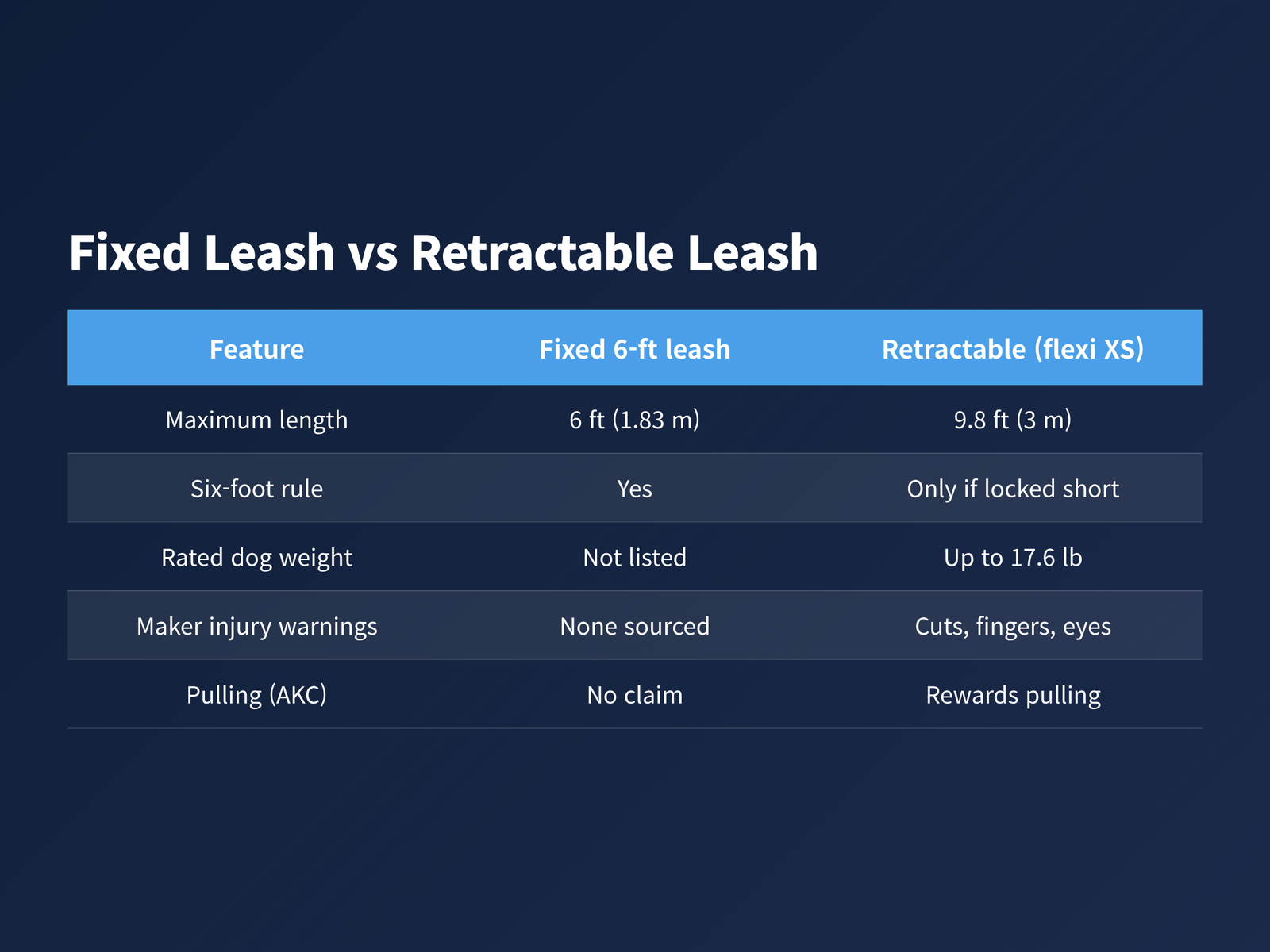
A fixed six-foot leash meets the six-foot rule by design, while the smallest retractable leash meets it only when locked at six feet or less. The table below lines up length, the six-foot rule, weight rating, maker warnings and the AKC view on pulling.
| Feature | Fixed 6-ft leash | Retractable (flexi XS) |
|---|---|---|
| Maximum length | 6 ft (1.83 m) | 9.8 ft (3 m) |
| Six-foot rule | Yes | Only if locked short |
| Rated dog weight | Not listed | Up to 17.6 lb |
| Maker injury warnings | None sourced | Cuts, fingers, eyes |
| Pulling (AKC) | No claim | Rewards pulling |
Injury studies cover all leash types, not retractable leashes alone. A 2020 study in the American Journal of Emergency Medicine estimated 356,746 leash-related emergency department injuries in the US from 2001 to 2018, with fracture the most common at 26.8%. A 2024 review in Hand of 443 leash-injury patients found 75.4% had a hand caught in the leash as it was pulled.
Frequently asked questions
Is a retractable leash allowed in US national parks?
The federal rule caps leash length at six feet. Some parks state that retractable leashes should be kept at six feet or less, while others ask for a physical leash, so check the park’s pets page.
Can you lock a retractable leash at six feet for a small dog?
Locking the cord at six feet or less keeps it within the length some parks accept, and the flexi instructions ask for a short, locked leash around people or animals.
Does a lighter small dog make a retractable leash safer?
No. A lighter small dog does not remove the cord length, speed or snap-back risks in the manufacturer’s instructions.
Sources
- US Code of Federal Regulations, 36 CFR 2.15 “Pets”, current text via Cornell Legal Information Institute, viewed 2026-10-16 – https://www.law.cornell.edu/cfr/text/36/2.15
- National Park Service, Home of Franklin D. Roosevelt NHS “Pets”, viewed 2026-10-16 – https://nps.gov/hofr/planyourvisit/pets.htm
- National Park Service, Vanderbilt Mansion NHS “Pets”, viewed 2026-10-16 – https://www.nps.gov/vama/planyourvisit/pets.htm
- National Park Service, Saratoga NHP “Pets”, viewed 2026-10-16 – https://www.nps.gov/sara/planyourvisit/pets.htm
- GOV.UK, “The Highway Code – Rules about animals (47 to 58)”, updated 2025-10-22 – https://www.gov.uk/guidance/the-highway-code/rules-about-animals-47-to-58
- GOV.UK, “Open access land: management, rights and responsibilities”, updated 2025-11-06 – https://www.gov.uk/guidance/open-access-land-management-rights-and-responsibilities
- American Kennel Club, Stephanie Gibeault, “Retractable Dog Leashes: When and How to Use Them Safely”, updated 2026-03-10 – https://www.akc.org/expert-advice/training/retractable-dog-leashes-use-safely/
- American College of Veterinary Surgeons, “Tracheal Collapse”, viewed 2026-10-16 – https://www.acvs.org/small-animal/tracheal-collapse/
- US Consumer Product Safety Commission, “Worldwise Inc. Recalls Retractable Dog Leashes; Metal Clasp Can Break and Cause Facial Injuries”, 2008-09-03 – https://www.cpsc.gov/Recalls/2008/worldwise-inc-recalls-retractable-dog-leashes-metal-clasp-can-break-and-cause-facial
- Forrester MB, “Dog leash-related injuries treated at emergency departments”, American Journal of Emergency Medicine, 2020 – https://ajemjournal.com/article/S0735-67572030446-0/fulltext
- Plusch K et al., “Hand and Wrist Dog-Leash Injuries in the Outpatient Setting: A Review of 443 Cases”, Hand (N Y), 2024-11-26 – https://pmc.ncbi.nlm.nih.gov/articles/PMC11600420/
- flexi North America, LLC, flexi retractable leash use and care instructions, manufacturer document (manufacturer document, retailer-hosted PDF; date not shown, viewed 2026-10-16)
- flexi, “New Classic XS” cord 3 m product page, viewed 2026-10-16 – https://flexi.de/en/?p=817
- MSPCA-Angell, “Retractable Leashes” position page, 2026-04-18 – https://www.mspca.org/who_we_are/retractable-leashes/